Broadening Assault on the Left, Trump Designates EU Anti-Fascist Groups as ‘Foreign Terrorist Organizations’

Spread the love

Original article by Stephen Prager republished from Common Dreams under a Creative Commons (CC BY-NC-ND 3.0).
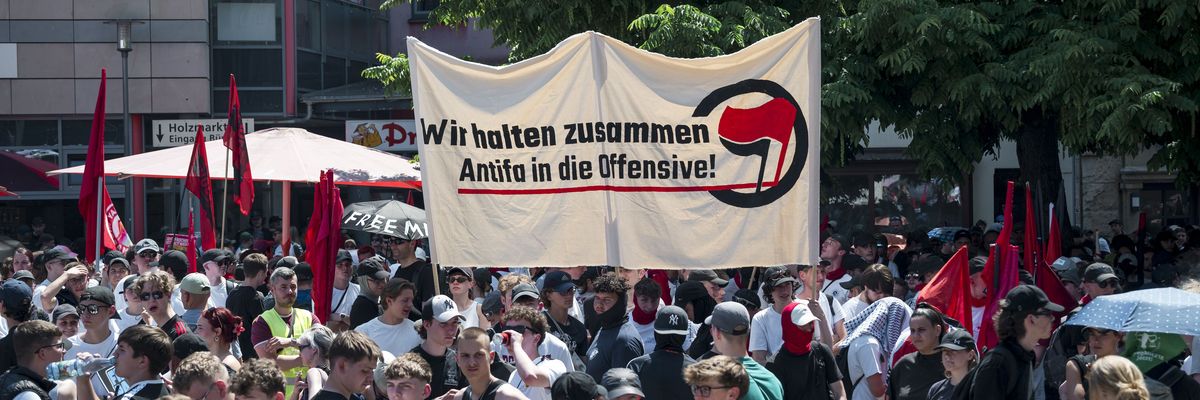
“We stick together – Antifa on the offensive!” reads a banner at a demonstration on June 14, 2025, in Jena, Thuringia, Germany, called by a broad alliance of anti-fascist groups under the slogan “Now more than ever! Anti-fascism is necessary!”.  (Photo by Daniel Vogl/Picture Alliance via Getty Images)

Investigative journalist Ken Klippenstein warns that the designation opens up US citizens to government surveillance, asset seizure, and material support charges.

President Donald Trump’s State Department on Thursday broadened his efforts to use “terrorism” to crush his enemies on the left, designating four European groups as “foreign terrorist organizations” based on their alleged connections to the vaguely defined network of leftist agitators known as “antifa,” short for “anti-fascist.”

Following the assassination of right-wing activist Charlie Kirk in September, Trump turned his attention toward waging a war on left-wing protest groups and liberal nonprofits, describing them as part of a vast, interconnected web that was fomenting “terrorism,” primarily through First Amendment-protected speech.

As part of that effort, Trump formally designated “antifa” as a “domestic terrorist organization,” even though it is not a formal group with any structure, but rather, a loose confederation of individuals all expressing an amorphous political belief. Civil rights advocates warned that the vague nature of the designation could be extended to bring terrorism charges against anyone who describes the Trump administration’s actions as fascist or authoritarian.

Shortly after, Trump also signed a little-reported national security order, known as National Security Presidential Memorandum 7 (NSPM-7), which mandated a “national strategy to investigate and disrupt networks, entities, and organizations that foment political violence so that law enforcement can intervene in criminal conspiracies before they result in violent political acts.”

Some of the indicators of potential violence, the memo said, were “anti-Americanism, anti-capitalism, and anti-Christianity,” “extremism on migration, race, and gender,” and “hostility towards those who hold traditional American views on family, religion, and morality.”

Referencing NSPM-7 explicitly, the State Department on Thursday spread that crusade against the left overseas, slapping four German, Greek, and Italian anarchist groups with the label of “foreign terrorist organization” (FTO). The same designation has been given to groups like al-Qaeda, ISIS, and al-Shabaab.

The groups targeted were Antifa Ost in Germany; the Informal Anarchist Federation/International Revolutionary Front (FAI/FRI) in Italy; Armed Proletarian Justice in Greece; and Revolutionary Class Self-Defense, also in Greece.

The State Department said:

The designation of Antifa Ost and other violent Antifa groups supports President Trump’s National Security Presidential Memorandum-7, an initiative to disrupt self-described ‘anti-fascism’ networks, entities, and organizations that use political violence and terroristic acts to undermine democratic institutions, constitutional rights, and fundamental liberties.

Groups affiliated with this movement ascribe to revolutionary anarchist or Marxist ideologies, including anti-Americanism, ‘anti-capitalism,’ and anti-Christianity, using these to incite and justify violent assaults domestically and overseas.

Each of the accused groups has had members charged with or convicted of violence, often against Neo-Nazis or adjacent far-right causes. But while they are more organized than America’s anti-fascist movement, they are still broad-based and diffuse.

Mirroring what studies have shown in the US, the far-right is responsible for the overwhelming bulk of political violence in the European Union. A 2024 study by Armed Conflict Location and Event Data (ACLED) found that across Europe, the far-right was responsible for 85% of the violent targeted incidents they tracked.

Though Greece was one exception, where far-left violence was more prevalent than far-right violence, Mary Bossis, an emeritus professor of international security at Piraeus University in Athens, told The Guardian that Greece’s anti-fascist movement has little to do with it.

“It is highly exaggerated to say that the antifa movement in Greece employs terror tactics,” she said. “They even run in elections and have never shown any sign of violence.”

While most social movements have some violent adherents, Bossis said, “that does not mean, as in the case of antifa, that the whole movement is either violent or supportive of terrorism. In fact, it is very much not the case… Standing against fascism does not make someone a terrorist.”

As Mark Bray, a Rutgers University professor who teaches a course on the history of antifascism, pointed out in The GuardianAntifa Ost is the only one of the four groups designated by Trump that self-identifies as anti-fascist.

“The others are revolutionary groups,” he said. “This shows how the Trump administration is trying to lump all revolutionary and radical groups together under the label ‘antifa’. By establishing the (alleged) existence of foreign antifa groups, the Trump administration seems to be setting the stage for declaring American antifa groups (and all that they deem to be ‘antifa’) to be affiliated with these supposed foreign terrorist groups.”

Ken Klippenstein, an independent investigative journalist who has warned about NSPM-7 since its release, noted that this marks the first time that an entity in any of these three European countries has ever been slapped with the label of an FTO.

“The move seems an attempt to make people accustomed to white Westerners being treated as terrorists,” he wrote Thursday. “That, after all, is the goal of Trump’s national security directive NSPM-7.”

While there is no law on the books to back Trump’s designation of antifa as a domestic terrorist organization, there is such a designation for foreign terrorist groups.

Being designated as a member of a foreign terrorist organization can subject one to significant sanctions, including having assets in American banks frozen, being unable to enter the country, or being prosecuted for “material support.”

The government has used accusations of terrorism to go much farther, including carrying out extrajudicial assassinations of targets. Over the past two months, the Trump administration has bombed over a dozen boats in the Caribbean using the unsubstantiated justification that their passengers are “narco-terrorists” shipping drugs for cartels, which the administration has also designated as FTOs. The attacks have killed at least 76 people.

Attorney General Pam Bondi suggested last month that the Trump administration planned to use the “same approach” to antifa as it has with cartels, leading many to fear that might include assassinations.

Mehdi Hasan, the founder of the media outlet Zeteo, said the designation of these groups as terrorist organizations was “super bad for US citizens, especially on the left of the spectrum,” because it “gives this authoritarian administration potentially the power to surveil and go after US citizens on spurious ‘funding of FTO’ grounds.”

The State Department noted in a fact sheet on the designations that it is also seeking to target those in the US accused of supporting these groups.

“US persons are generally prohibited from conducting business with sanctioned persons. It is also a crime to knowingly provide material support or resources to those designated, or to attempt or conspire to do so,” the memo said. “Persons that engage in certain transactions or activities with those designated today may expose themselves to sanctions risk. Notably, engaging in certain transactions with them entails risk of secondary sanctions pursuant to counterterrorism authorities.”

Klippenstein said that while Trump’s “domestic terrorist” designation was limited, “with an FTO designation, the gloves come off,” opening Americans up to “FISA surveillance, seizure of financial assets, [and] material support charges.”

Original article by Stephen Prager republished from Common Dreams under a Creative Commons (CC BY-NC-ND 3.0).

Donald Fuhrump says that Amerikkka doesn't bother with crimes or charges anymore, not being 100% Amerikkkan and opposing his real estate intentions is enough.
Donald Fuhrump says that Amerikkka doesn’t bother with crimes or charges anymore, not being 100% Amerikkkan and opposing his real estate intentions is enough.
Donald Trump warns against following the Onaquietday.org blog, says that he's heard that she's a witch with a black cat and a dangerous kitchen.
Donald Trump warns against following the Onaquietday.org blog, says that he’s heard that she’s a witch with a black cat and a dangerous kitchen.
Orcas discuss how Trump was re-elected and him being an obviously insane, xenophobic Fascist.


Continue ReadingBroadening Assault on the Left, Trump Designates EU Anti-Fascist Groups as ‘Foreign Terrorist Organizations’

Italian left party demands answers over police infiltration scandal

Spread the love

Original article by Ana Vračar republished from peoples dispatch under a Creative Commons Attribution-ShareAlike 4.0 (CC BY-SA) license.

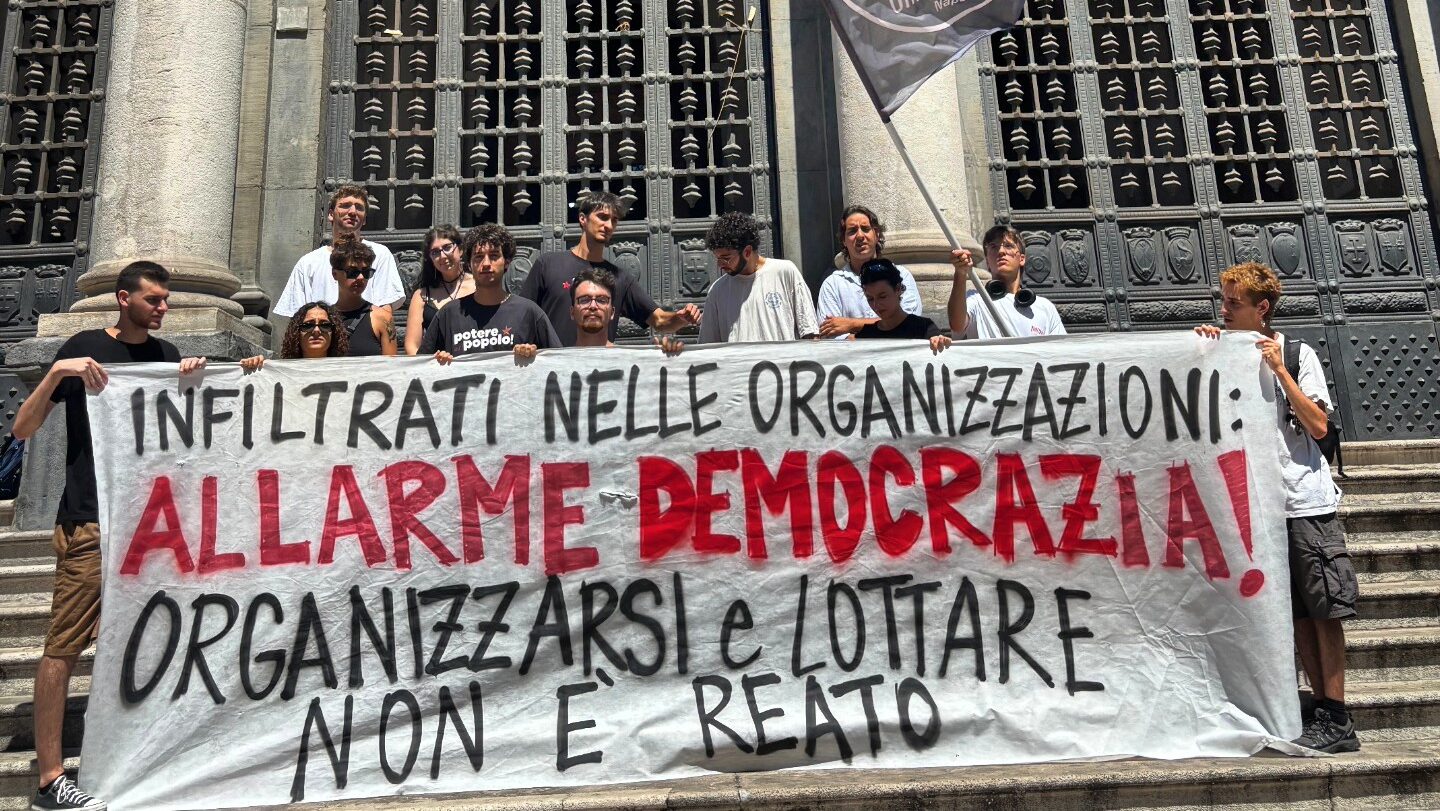
Activists protesting against police infiltrations in Italy. Source: Cambiare Rotta/Facebook

Potere al Popolo is pressing the Meloni government to explain five police infiltration attempts targeting the party’s youth organizations.

Italian left party Potere al Popolo! (Power to the People!) continues to demand full government transparency following revelations that multiple police agents infiltrated the party’s youth groups, Collettivo Autorganizzato Universitario (Self-Organized University Collectives, CAU) and Cambiare Rotta (Changing Course). For approximately eight months, undercover police officers infiltrated or attempted to infiltrate chapters in Naples, Milan, Bologna, and Rome, only to be uncovered through by the party’s internal investigation and independent media outlet Fanpage.

Speaking to Peoples Dispatch, Giuliano Granato, one of Potere al Popolo’s spokespeople, stated that the party is exploring all potential avenues for action, emphasizing that it will not wait passively in the meantime. A key priority is compelling the relevant institutions, including Prime Minister Giorgia Meloni and Interior Minister Matteo Piantedosi, to publicly explain what happened. “They owe the public some answers,” Granato says. “Who ordered this operation? Who planned it? And on what grounds?”

Read more: Italian left party uncovers more cases of police infiltration in their ranks

Meloni’s government and institutions, however, are not known for responding transparently to uncomfortable questions. This became evident again after the first case was exposed in May, when official statements ranged from evasive to outright absurd. One explanation offered, Granato recalls, was that the officer who infiltrated the youth group in Naples had done so not as part of an official assignment, but rather because he had “fallen in love with a Potere al Popolo activist.”

“Are we now supposed to believe five officers from the same training course all suddenly fell in love with five of our activists at the same time?”

Another line of defense claimed that while the infiltrations were official operations, they did not target Potere al Popolo as a political party, but only the specific youth collectives. Yet, even if one was to accept the dubious legitimacy of undercover operations in youth organizations on campuses, that explanation raises new questions. As Granato notes, there are many youth collectives across Italy active on similar issues, including Palestine solidarity and housing. “And yet, the only ones where infiltrators were discovered are the ones organically tied to Potere al Popolo.”

A state increasingly intolerant of dissent

Granato also stresses the importance of keeping public attention on the issue. Since the revelations in May, Potere al Popolo! has received solidarity from grassroots networks and trade unions, civil society organizations, and even a few opposition parties that submitted formal inquiries to the government. “In contrast to this, there has been no media uptake of the case,” Granato said. “Apart from Fanpage, only Il Fatto Quotidiano and il manifesto covered it. The rest of the mainstream media landscape? Radio silence. All the big self-declared progressive media ignored it.”

“This is a very grave thing,” he continues, “because these are the same center-left media that now and then raise concerns about Meloni’s authoritarian drift.” By choosing not to cover the infiltrations in Potere al Popolo, Granato suggests, they show that they will only raise issues when it benefits them, ignoring the public interest when it doesn’t.

The tendency is particularly worrying in the current context, Granato says, considering the infiltration of Potere al Popolo is not an isolated case but part of a broader trend. He points to connections to other recent cases, such as the surveillance of Fanpage journalists and of activists from Mediterranea Saving Humans, who have challenged the government’s deadly migration policies through their work. He also mentions the government’s so-called security decree and an ongoing campaign against the right to strike. “If we connect all these little dots, what emerges is a picture of a government and institutions that are less and less tolerant of dissent,” Granato explains.

Read more: “Disarmiamoli!” brings 30,000 to Rome against NATO and war

Yet it is not individual dissent they are afraid of. Instead, what state authorities and institutions fear is collective dissent that organizes people and gives them the tools to change the status quo, Granato says. This fear is one of the reasons why they would want to infiltrate Potere al Popolo, as they recognize it as a political force capable of posing a real threat to the structures they want to protect.

One way to resist this tendency, Granato concludes, is to remain persistent in showing solidarity, including to those who have been infiltrated by the police. “Publicly showing solidarity means publicly showing there’s still a democratic fabric that hasn’t been destroyed, both in Italy and beyond.”

Original article by Ana Vračar republished from peoples dispatch under a Creative Commons Attribution-ShareAlike 4.0 (CC BY-SA) license.

Continue ReadingItalian left party demands answers over police infiltration scandal

Italian Oil Giant Eni Knew About Climate Change More Than 50 Years Ago, Report Reveals

Spread the love

Original article by Stella Levantesi and Benjamin Franta republished from DeSmog.

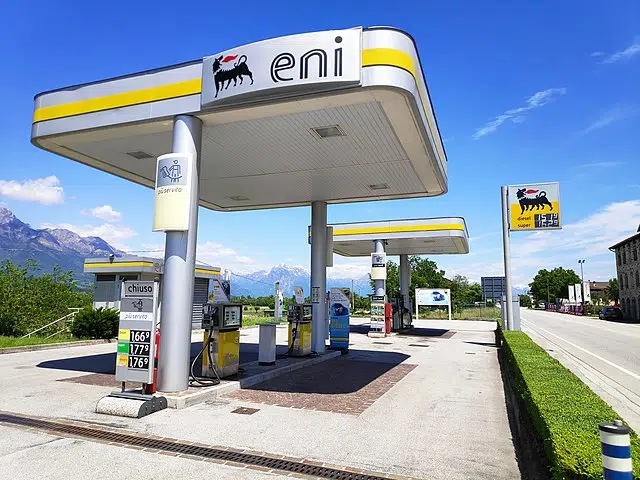
A 1970 report by Eni’s Isvet research centre warned of “catastrophic” climate risk from the build-up of CO2 caused by burning fossil fuels. Flickr via PRP Channel (CC BY-2.0)

Italian oil major Eni knew of the climate impacts of fossil fuel extraction since 1970, according to a report by Greenpeace Italy and advocacy group ReCommon shared with DeSmog. 

The report comes four months after the two organizations announced a lawsuit against the company alleging Eni used “lobbying and greenwashing” to push for more oil and gas production, despite having known about the risks fossil fuels posed over the past 53 years.

The two groups had previously unearthed a 1970 report by Eni’s Isvet research centre that warned of the “catastrophic” climate risk from the build-up of carbon dioxide (CO2) caused by burning fossil fuels. They also found a 1978 report produced by Eni’s Tecneco company that included a projection of how much atmospheric CO2 levels would rise by the turn of the 21st century.

But, until now, compared to other oil majors, relatively little evidence was uncovered that Eni had longstanding knowledge of the damage its fossil fuel products would cause. 

“Our investigation shows how Eni joins the long list of fossil fuel companies that, as emerged from numerous international investigations conducted in the recent years, were aware at least since the early 1970s of the destabilizing effect of coal, gas, and oil exploitation on global climate balances, due to greenhouse gas emissions,” said Felice Moramarco, a communications strategist with Greenpeace Italy, who coordinated the research for this report.

“If we find ourselves today in the midst of a climate crisis that threatens the lives of each and every one of us,” he added, “the responsibility falls mainly on companies like Eni, which have continued for decades to exploit fossil fuels, ignoring the alarming and growing warnings from the global scientific community.”

The report aims to build on evidence in Eni’s 1970 and 1978 report, and is the result of months of research within public and private archives in Italy, including the company’s own archive.

The findings add to the existing body of research that fossil fuel companies have been aware of the climate risks of burning fossil fuels since at least the 1970s and 80s, but still chose to expand oil and gas production and obstruct climate action. 

‘They’ve Been Playing Us All for Fools’

Last week, California filed what may be the most consequential climate lawsuit yet against a range of Carbon Majors, including Exxon, Shell, Chevron, and BP for covering up what they knew about emissions and misleading the public for decades about the climate crisis. Speaking about the fossil fuel defendants, California Governor Gavin Newsom charged, “They’ve been playing all of us for fools,” and noted that the legal action could “illuminate their deception and their lies over 50, 60, 70 years.”

The report in the Italian case shows that Eni also foresaw damages from its products going back more than 50 years. 

In 1971, Eni set up a new company in Rome to study pollution problems called Tecneco. In a 1973 report, Tecneco predicted that human activities could cause permanent changes to the atmosphere, including changes that could “gradually cause the disappearance of all life on earth.” Among the atmospheric changes listed was “climatic modifications.” Another section of the report stated that the increase of carbon dioxide “in the atmosphere is considered a potential cause of climate change.”

Another 1978 Tecneco report was even clearer, stating, “Carbon dioxide (CO2) is the ultimate oxidation product of fossil fuels … it exists in air in concentrations of about 300 ppm [parts per million] and only human activity increases this value by interfering with natural processes, so that above a certain threshold it becomes a pollutant.” 

The report warned that continued production and use of fossil fuels would “alter the heat balance of the atmosphere, leading to climatic change with serious consequences for the biosphere.” Another section predicted that “climatic changes may occur on a regional scale due to the continued, increasing consumption of fossil fuels, and this may become a major problem by the end of the century … the best available data indicate that the CO2 content of the atmosphere will reach 375–400 ppm in the year 2000; this would increase the temperature of the atmosphere by 0.5 °C.” Eni’s prediction was quite accurate: Global warming in the year 2000 was exactly 0.5 °C and CO2 concentrations were around 370 ppm.

Eni also understood the need to limit fossil fuel pollution decades ago, according to the report. A 1988 issue of the company’s corporate magazine Ecos – widely read by employees and executives – warned that continued use of “fossil sources” of energy would produce a “greenhouse effect that could lead to climate change with devastating effects on the entire earth’s ecosystem.” Another issue of the magazine from the same year stated that as research on global warming continued, “it is incumbent on us to work as of now, as far as possible, to contain the phenomenon of carbon dioxide emissions. … It is generally agreed that it is very important to ‘buy time’ so as to refine the complex prediction models and identify the most appropriate solutions. Buying time means limiting the increase in CO2 as far as possible.”

The same issue also includes an article detailing the link between “greenhouse effect” and fossil fuel “combustion processes,” and contains information on CO2 concentration: “From samples of air trapped in glaciers, data on the concentration of carbon dioxide in the air in past times can be obtained. It has been estimated by this route that the concentration of CO2 in the air has increased by about 25% in the last 200 years, from a level of 275 parts per million by volume to a current level of around 330-340 ppm (volume).”

In 1992, Eni claimed it needed more research before taking action on climate change. Credit: Petar Milošević Wikimedia Commons (CC BY-2.0)

Earlier this year, a DeSmog investigation also found that Eni has misleadingly promoted fossil gas since the 1980s as the “clean energy of the future,” despite its damaging effects on the climate. 

Eni also continued to be a member of IPIECA – the International Petroleum Industry Environmental Conservation Association. Starting in the late 1980s, the organization  coordinated Big Oil’s efforts to delay fossil fuel controls around the world (and weaken the foundational UN Framework Convention on Climate Change) by emphasizing scientific uncertainty and misleading the public about the industry’s own knowledge.

The report reveals that at a 1992 IPIECA symposium in Rome co-hosted by Eni, for example, the company’s manager of Safety, Quality and Environmental Protection department insisted that “before taking political decisions, such as adopting a carbon tax, which could lead to dire and unexpected economic consequences, it is necessary to obtain more data … on several controversial points such as the role of the oceans and clouds in climate change, as well as data on their behaviour in various countries and economic and geographic areas.” 

Experts say Big Tobacco and other polluters used the “we need more research” refrain as a delay tactic. The Eni manager at the 1992 symposium added that “Eni feels that its objectives are very similar to those of IPIECA and strongly supports this important international association founded by oil companies.”

“In due course [Eni] will make the respective pleadings and arguments public so that anyone can get a full, correct, accurate (and free from misleading ideologies) idea of the very significant issues and complexities associated, as well as the correctness of both the company’s behavior and its energy transition strategies,” said the company in a recent statement to Italian newspaper Domani. 

And added that “following the logic described by the NGOs, which is devoid of any foundation and knowledge of the industrial and technological history of energy systems, as well as the evolution of economic and industrial systems and the energy mix required for their operation, anyone who has been using fossil energy or fuel for the past 50 years would have ignored these ‘alarms’ and would be similarly responsible for the emissions generated through their use.”

On July 25, Greenpeace Italy and ReCommon received a “request for mediation” from Eni in response to their lawsuit. This is a mandatory prerequisite for filing a defamation lawsuit under Italian law. The company also stated it may seek at least 50,000 euros in damages from each group.

“We intend to resist this attempt at intimidation by Eni and call for the support of all people and public and private entities who care about the cause of climate justice, starting with those who live and work in the territories that are suffering the catastrophic consequences of the crisis themselves,” said Antonio Tricarico,  program director at ReCommon.

Original article by Stella Levantesi and Benjamin Franta republished from DeSmog.

Continue ReadingItalian Oil Giant Eni Knew About Climate Change More Than 50 Years Ago, Report Reveals