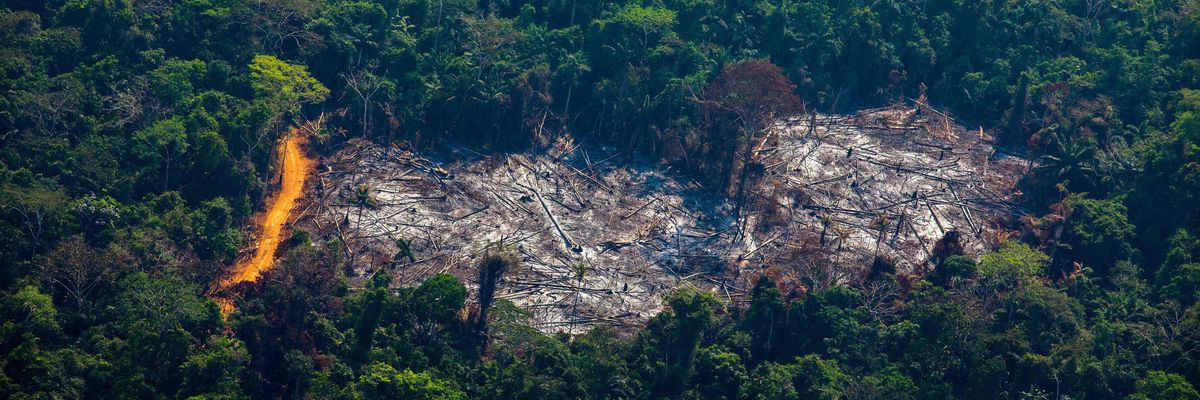
This aerial view shows Amazon forest degradation in the Menkragnoti Indigenous Territory in Altamira, Pará state, Brazil, on August 28, 2019. (Photo: Joao Laet/AFP/Getty Images)
The world’s largest rainforest showed “ominous indicators,” including wildfires and extreme drought, in 2024.
The Amazon, sometimes called the “lungs of the planet,” this year showed signs of further inching toward a much-feared tipping point, threatening the very existence of the world’s largest rainforest.
Rampant wildfires and extreme drought ravaged large parts of the Amazon in 2024. The fires and dry conditions were fueled by deforestation and the El Niño weather pattern, and also made worse by climate change, according to the World Economic Forum. “The number of fires reached its highest level in 14 years this September,” the group reported in October.
Drought has also impacted the Amazon River, causing one of the river’s main tributaries to drop to its lowest level ever recorded, according to October reporting from The Associated Press. The drop in the river has negatively impacted local economies and food supplies.
Andrew Miller, advocacy director at Amazon Watch, told the AP last week that the fires and droughts experienced across the Amazon in 2024 “could be ominous indicators that we are reaching the long-feared ecological tipping point.”
“Humanity’s window of opportunity to reverse this trend is shrinking, but still open,” he said.
The Amazon plays a vital role in keeping the planet healthy. 150-200 billion tons of carbon are stored in the Amazon, and it also carries 20% of the earth’s fresh water to sea.
According to the World Economic Forum, if the Amazon tipping point is reached, “it will release billions of tonnes of CO2 into the atmosphere through fires and plants dying off. This would further exacerbate climate change and make the 1.5°C goal impossible to achieve. It would also alter weather patterns, which would impact agricultural productivity and global food supplies.”
A paper published in the journal Nature in February indicates that up to half of the rainforest could hit a tipping point by the middle of the century. “We estimate that by 2050, 10% to 47% of Amazonian forests will be exposed to compounding disturbances that may trigger unexpected ecosystem transitions and potentially exacerbate regional climate change,” explained the researchers behind the paper.
However, it wasn’t all bad news out of the Amazon in 2024. According to the AP, the amount of deforestation in Brazil and Colombia declined in this year. In Brazil, which houses the largest chunk of the Amazon, forest loss dropped 30.6% compared to the year prior, bringing it to the lowest level of destruction in nearly a decade.
The improvement is an about-face from a couple of years ago, when the country registered 15-year high of deforestation during the leadership of former far-right President Jair Bolsonaro. Brazil is now led by the left-wing President Luiz Inácio Lula da Silva, who—despite presiding over this drop in deforestation—has also come under scrutiny, as AP noted, by environmentalist for backing projects that they argue could harm the environment.
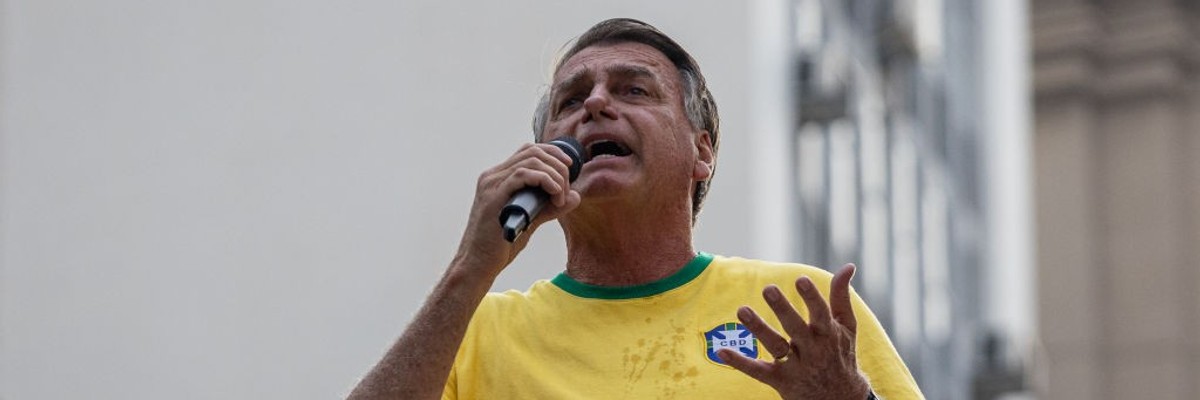
Former Brazilian President Jair Bolsonaro speaks during a rally on September 7, 2024 in São Paulo, Brazil. (Photo: Allison Sales/picture alliance via Getty Images)
“Well, look at this thing called ‘accountability,’” said one MSNBC host.
The Brazilian Federal Police on Thursday indicted former President Jair Bolsonaro and 36 others for allegedly plotting the “violent overthrow of the democratic state” after the country’s current leftist president, Luiz Inácio Lula da Silva, defeated the right-wing leader in 2022.
“The final report has been sent to the Supreme Court with the request that 37 individuals be indicted for the crimes of the violent overthrow of the democratic state, coup d’ etat, and criminal organization,” police said in a statement about the conclusion of the two-year investigation.
As The New York Times explained: “Although the police in Brazil can make recommendations about criminal prosecutions, they do not have the power to formally charge Mr. Bolsonaro. The country’s top federal prosecutor, Paulo Gonet, must now… decide whether to pursue charges against Mr. Bolsonaro and compel him to stand trial before the nation’s Supreme Court.”
The recommendations for charges came after the arrest of four members of the military and a federal police officer earlier this week over an alleged plot to kill Lula and Vice President Geraldo Alckmin before they were sworn in, as well as Supreme Court Justice Alexandre de Moraes. Police said that “a detailed operational plan called ‘Green and Yellow Dagger’ was identified, which would be executed on December 15, 2022, aimed at the murder of the elected candidates for president and vice president.”
According to CNN, “Police reportedly allege that Bolsonaro had ‘full knowledge’ of a plan to prevent Lula and his government from taking office after his election victory.”
Bolsonaro has repeatedly denied any wrongdoing, including with two other pending cases: In March he was indicted for allegedly falsifying his Covid-19 vaccination data and in July he was indicted for crimes including embezzlement related to alleged misappropriation of diamond jewelry and other state property. Those indictments came after Brazil’s highest election authority last year barred him from running for any public office for eight years over his lies about the 2022 contest.
In addition to Bolsonaro, the other three dozen people indicted on Thursday include “some of the most important members of his far-right administration,” The Guardian reported. As the newspaper detailed:
They included Bolsonaro’s former spy chief, the far-right Congressman Alexandre Ramagem; the former defense ministers, Gen. Walter Braga Netto and Gen. Paulo Sérgio Nogueira de Oliveira; the former minister of justice and public security, Anderson Torres; the former minister of institutional security, Gen. Augusto Heleno; the former navy commander Adm. Almir Garnier Santos; the president of Bolsonaro’s political party, Valdemar Costa Neto; and Filipe Martins, one of Bolsonaro’s top foreign policy advisers.
Also named is the right-wing blogger grandson of Gen. João Baptista Figueiredo, one of the military rulers who governed Brazil during its 1964-85 dictatorship.
The list contains one non-Brazilian name: that of Fernando Cerimedo, an Argentinian digital marketing guru who was in charge of communications for Argentina’s president, Javier Milei, during that country’s 2023 presidential campaign. Buenos Aires-based Cerimedo is close to Bolsonaro and his politician sons.
Given that Bolsonaro previously traveled to the United States when faced with legal trouble shortly after his loss two years ago, in this case, “precautionary measures have been issued, including a ban on international travel, which led to the confiscation of Bolsonaro’s passport months ago,” EL País noted Thursday.
vBolsonaro was among the right-wing leaders around the world who celebrated U.S. President-elect Donald Trump’s victory earlier this month. The Brazilian—who is sometimes called the “Trump of the Tropics” and like the American incited an insurrection after his last electoral loss—said that the impact of Trump’s win “will resonate across the globe… empowering the rise of the right and conservative movements in countless other nations.”
Trump’s return to office is expected to at least stall if not end his various legal issues, including for trying to overturn his 2020 loss.
Right-wing groups are peddling false claims that the heavy rainfall that led to the region’s disastrous flooding in May is not related to climate change.
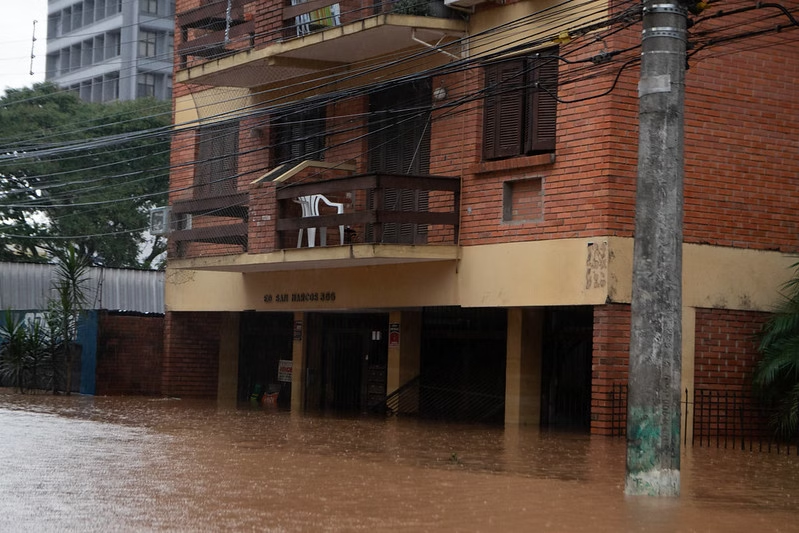
On May 9, volunteers and emergency workers were still rescuing people and animals who remained stranded on the sixth day of flooding on the streets of Rio Grande do Sul’s capital, Porto Alegre. Social media images of the rooftop rescue of a horse named Caramelo shocked the world.
A day before the dramatic rescue, Porto Alegre’s deputy mayor, Ricardo Gomes, appeared on a livestream wearing a cap with the Brasil Paralelo logo. Brasil Paralelo is a far-right media company with a streaming platform focusing on “journalism, entertainment, and education,” as its website states. The company was founded in Porto Alegre in 2016 and serves as a main channel of climate denialism among right-wing groups in Brazil. By wearing the Brasil Paralelo logo, Gomes associated himself with an institution that experts say is a purveyor of climate denialism, at the height of a climate-related disaster.
Some days later, Ricardo Felício, a professor of Brasil Paralelo’s education wing who has also appeared on many of the platform’s documentaries, wrote that climate change did not cause the extreme rainfall in South Brazil. He published his opinions in the Revista Oeste (West Magazine), a print and online publication that caters to far-right followers of former President Jair Bolsonaro, saying “CO2 has nothing to do with it!”
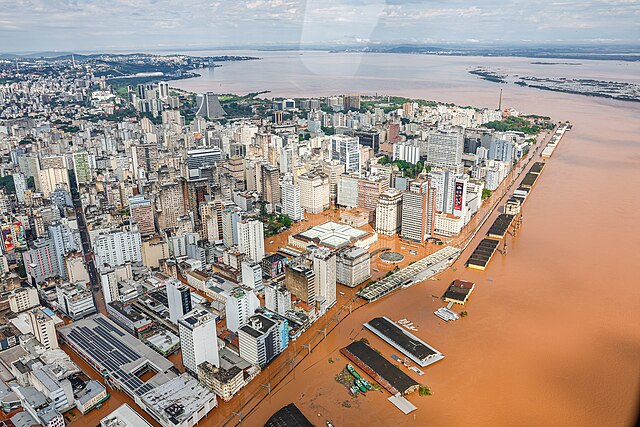
Southern Brazil was under water for the entire month of May, and two months later, it’s still facing the consequences of the worst flood in its history. Hundreds of thousands have been displaced – 180 have died, and 32 are still missing.
Flooded rivers swept away entire communities in a disaster on par with 2005’s Hurricane Katrina. The town of Estrela, located on the banks of Taquari River, was more than 70 percent submerged. In recent years, the region has experienced more and more extreme rainfall. Residents of towns on the Taquari River are still feeling the impacts of their third consecutive flood in a six-month period.
Porto Alegre, with 1.4 million inhabitants, was flooded for four weeks between May and June due to swelling water from the Guaiba River and failures of the city’s anti-flood system. The region’s main airport, Salgado Filho International Airport, is not expected to operate again until December.
Porto Alegre’s mayor, Sebastião Melo, and Deputy Mayor Gomes have led its city council since 2021. Both were elected in the wake of Bolsonarism and won decisive victories. And both have faced media criticism for failures in managing the city’s emergency responses to the flood and for failing to update its anti-flood system.
Gomes has participated in events run by Atlas Network, an extensive global collective of more than 500 think tanks, many known to have a history of working against climate action. He attended Atlas Network’s 2019 CEO Summit of the Americas, where leaders of right-wing think tanks gathered to exchange ideas. He appeared at the summit as president of RELIAL, a network of right-wing Latin American research organizations. He is a member of Atlas Network’s Global Council of CEOs team.
Gomes also participated in Atlas Network’s 2020 Latin America Liberty Forum online, again representing RELIAL. The politician is also a long-standing ally, teacher, and host of a political series on Brasil Paralelo’s YouTube channel. His political connections reveal an intricate network that links Brazilian far-right organizations that deny climate change with international think tanks.
Brasil Paralelo’s Roots
In the months after the center-left Brazilian president Dilma Rousseff was impeached in 2016, far-right proponents established Brasil Paralelo, which arose from the growth of far-right ideas that gained ground in the country at the time. Its five founders, who were students, claimed that mass media was overwhelmingly left-wing, and they wanted to challenge mainstream public opinion about the nation’s political crisis after Rouseff’s impeachment.
Three of the original founders, Lucas Ferrugem, Henrique Viana, and Filipe Valerim, now run the company. Experts interviewed for the platform’s first documentaries included names from Instituto Millenium, Instituto Liberal, and Instituto Mises, partner think tanks of Atlas Network in Brazil in 2016.
A panel titled “Entrepreneurship for Common Good” by Atlas Network partner Acton Institute used Brasil Paralelo’s founding and development as a case study in 2021. The panel explored how “entertainment can shape a society’s culture,” and Brasil Paralelo’s role within the “prevailing cultural winds to point Brazil towards pillars of freedom and virtue through a holistic approach to education and entrepreneurship,” as the video states.
Alejandro Chafuen, president of Atlas Network between 1991 and 2018 and a Mont Pelerin Society member, taught a Brasil Paralelo course about faith and free-market ideas in 2019. Chafuen also mentioned the media company in his Forbes magazine column in 2023, in which he compared the Brazilian organization to the U.S. nonprofit conservative media group PragerU. He made the same comparison to his YouTube subscribers (over 3.38 million) and Instagram followers (2.5 million), indicating that Brasil Paralelo surpassed PragerU’s audience levels with more than 300,000 subscribers on YouTube and around 400,000 on Instagram.
Chafuen compares the popularity of Brasil Paralelo to widespread support for Olavo de Carvalho, the deceased influential far-right philosopher who was also known for his strident scientific denialism, including climate denialism. Chafuen also wrote in Forbes that “Brasil Paralelo is planning to land in the United States and replicate its success with U.S.-focused topics, teams, and profiles.”
In August 2023, Brasil Paralelo ran an article raising doubts about the effects of climate change stemming from a speech by UN Secretary Antonio Guiterrez claiming that “the era of global boiling has arrived”. According to the article,”It is not a question of denying climate change, but of discussing whether or not humankind influences this process and to what degree the planet will warm up (or cool down).”
Chafuen’s article promoted a 2021 Brasil Paralelo documentary called “Cortina de Fumaça” (“Smoke Screen”). It stated that the documentary seeks to answer questions such as, “How does the environmental movement affect the economy in Brazil and other countries? What lies behind some of the main environmentalist misinformation?”
Patrick Moore, a known climate science denier, is presented in the documentary as a co-founder of Greenpeace. Years before, DeSmog had reported that this claim was false. Moore stated in the documentary that Greenpeace is “a conspiracy organization, spreading junk science around the world.”
One of the sections in “Smoke Screen,” which is available on YouTube, is titled “Environmental apocalyptic predictions that are false.” The journalist Augusto Nunes, one of the founders of Revista Oeste, said in the segment that the Amazon rainforest is not being destroyed, contradicting official data from 2021. Other sources in Brazil, including Aldo Rebelo, former minister of defense during Rousseff’s government, supported the same argument.
According to the documentary, environmental campaigners’ criticisms and so-called “lies” about the Amazon rainforest’s deforestation are attempts to protect the U.S. and European agricultural markets.
In another article in September 2023, Brasil Paralelo defended the idea that global warming legitimizes NGOs’ actions pushing international actions such as the Paris Agreement, which the platform claims keeps developing countries producing less while first-world countries maintain their production.
In an interview with The Intercept Brasil, researcher Renata Nagamine from the Brazilian Center of Analysis and Planning (Cebrap) said Brasil Paralelo’s “Smoke Screen” uses a “scientific repertoire on the margins of climate science.”
When contacted by DeSmog, representatives for Brasil Paralelo did not respond to requests for comment.
“CO2 Has Nothing to Do With It!”
Climate change boosted the rainfall volume in Rio Grande do Sul by 15 percent, according to a study by the website Clima Meter, which confirmed the influence of climate change on the recent flooding disaster in the region.
Clima Meter is “an experimental rapid framework for understanding extreme weather events in a changing climate based on looking at similar past weather situations.” From the analysis of the patterns of local precipitation and the ElNiño-Southern Oscillation, the researchers interpreted the “Brazil floods as an event whose local characteristics can mostly be ascribed to human driven climate change.”
Flooding in South Brazil on May 5. Credit: Ricardo Stuckert/Wikimedia Commons
Davide Faranda, a researcher of the Laboratory for Sciences of Climate and Environment at the Institute Pierre Simon Laplace and coauthor of Clima Meter’s study on Brazil’s flooding, said in an interview with the local newspaper, GaúchaZH, that floods have been intensified by the burning of fossil fuels and have a major impact on vulnerable communities, which bear the brunt of climate change.
However, Ricardo Felício, who teaches courses at Brasil Paralelo and is a professor of geography at the University of São Paulo (USP), offered a contradictory explanation for the disaster.
“It is confusing to relate the climate to a meteorological scenario of large dimensions, which is the case here,” wrote Felício in his May 12 weekly column in Revista Oeste. “CO2 has nothing to do with it!”
In addition to writing for Revista Oeste, Felício is a well-known climate denier in Brazilian politics. DeSmog uncovered an interview with Felício on a once-popular Brazilian TV show, where Felício stated in 2012, “There is no scientific proof of global warming.” Brazil’s ex-president Bolsonaro tweeted an interview between Nando Moura, a well-known right-wing influencer, and Felicio in 2017.
Between 2017 and 2021, Felício gave several lectures at universities and trade associations across the country denying climate change after the Aprosoja Mato Grosso (an association of soybean growers) sponsored his talks, according to a BBC investigation.
Journalists and media executives founded Revista Oeste in 2020. It is a self-proclaimed conservative outlet and claims the problems of capitalism should be solved with more capitalism.
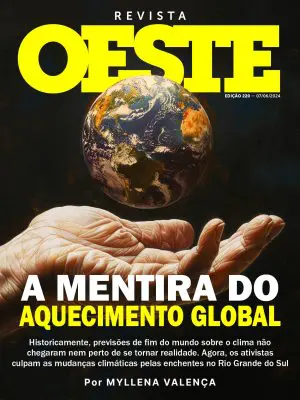
The magazine’s print cover in June 2024, a month after the tragedy in Rio Grande do Sul, showed the planet resting on a palm, followed by the headline “The global warming hoax.” The periodical also published other articles on the floods in Rio Grande do Sul, denying climate change had a part in the disaster.
“Historically, apocalyptic predictions about the climate have not come close to coming true. Now, activists are blaming climate change for the floods in Rio Grande do Sul,” wrote the journalist Myllena Valença. The piece claimed that “facts overturn the delirious prophecies of environmental activists, who for decades have been announcing disasters caused by global warming.” Felício is a leading source in the report.
The June print edition also featured an interview with the president of Environmental Progress, Michael Shellenberger, a well-known nuclear energy enthusiast and a Republican witness in climate hearings in the U.S. Congress. In the interview, he pointed out he is optimistic about the environment and pessimistic about civilization. “I’m worried about the hysteria around global warming,” Shellenberger said.
When contacted by DeSmog, representatives for Revista Oeste did not respond to requests for comment.
A Well-Connected Deputy Mayor
Donations poured into Rio Grande do Sul in the aftermath of the flooding disaster to help people who had lost everything. Brasil Paralelo asked for donations for an organization called Instituto Cultural Floresta (ICF).
Porto Alegre’s Deputy Mayor Gomes also requested donations to the same organization, even though his City Hall made its own donation channel available, an Agência Públicainvestigation revealed last month.
The ICF is a nonprofit organization based in Porto Alegre, and according to its website, it focuses on providing security forces with military equipment. Leaders and members of the organization are connected to the Instituto de Estudos Empresariais (IEE), an Atlas Network think tank partner in Brazil that promotes the right-wing annual meeting, Liberty Forum, which is sponsored directly by Atlas Network, and boosts right-wing political candidates.
Leonardo Fração is president of the ICF and a former IEE president. He spoke at the Liberty Forum in 2018 and in 2010.
Other ICF members are affiliated with IEE, including Bruno Zaffari, the owner of real estate and supermarket companies, and Wilson Ling, the director of the plastic packaging and forestry company Évora S.A.
Gomes held various positions, including president of the IEE from 2009 to 2012. But his relations with right-wing think tanks stretch much further. Between 2016 and 2020, he served as the president of RELIAL, and he also is a member of the Mont Pelerin Society. DeSmog research found that Mont Pelerin Society members are affiliated with over 100 organizations that also appear on the membership list of the Atlas Network.
Atlas Network also quoted Gomes in a report about the Latin America Liberty Forum in 2021.
RELIAL presents itself as a network of brain trusts that “disseminate and implement liberal principles as their flag.” Agustín Etchebarne, a member and a former director of RELIAL, is also the general director of the Fundación Libertad y Progreso, an Argentinian Atlas-affiliated think tank that supported the election of far-right Argentinian President Javier Gerardo Milei.
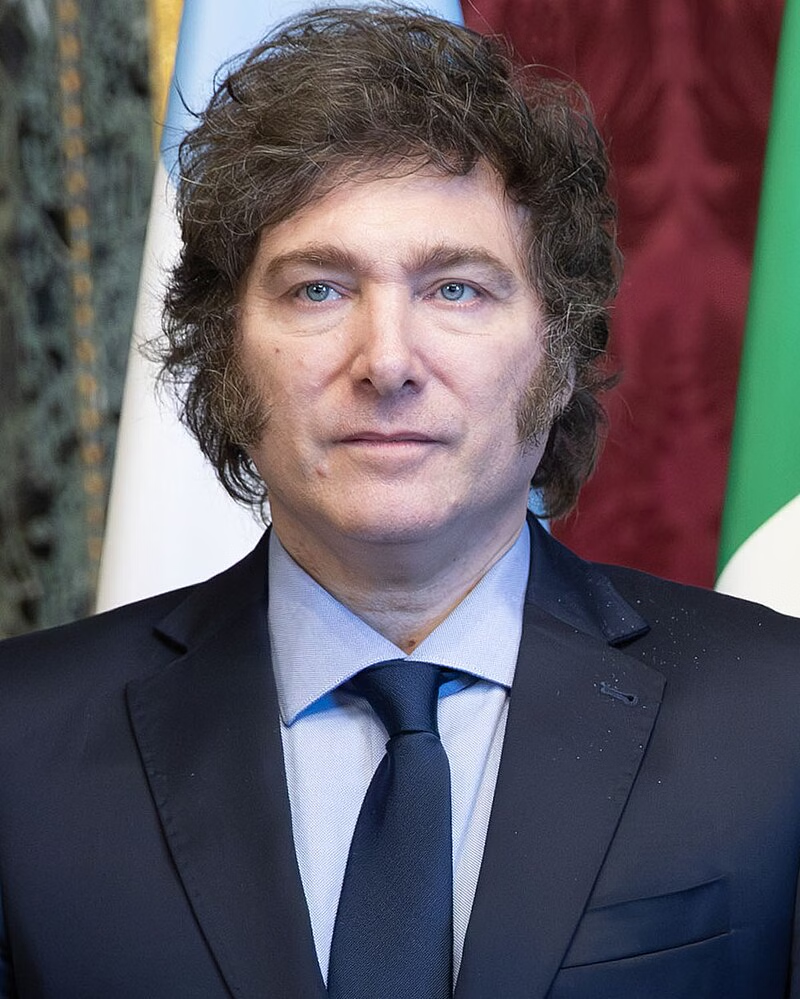
Atlas Network awarded Fundación Libertad y Progresoa a grant in 2024. The organization spent the money to promote an international summit in partnership with the Cato Institute for the six-month anniversary of the inauguration of Milei. The event took place June 11-12 in Buenos Aires, and Milei attended.
Fundación Libertad y Progresoa promoted an international summit in partnership with the Cato Institute for the six-month anniversary of the inauguration of Argentininan President Javier Milei. Credit: Wikipedia
When contacted for comment, Atlas Network said in a statement that the organization “has no grant programs related to climate change and makes no policy prescriptions to its partners on the subject of climate change.” It also stated that it “does not fund initiatives advocating against the existence of climate change.”
The organization stated that it “has no partnerships with candidates, parties, or government officials,” and that its “partners are independent, nonprofit organizations engaged in public policy issues.”
Atlas also asserted that “there are no ‘Atlas Network groups’ in Brazil,” but instead “independent partner organizations that apply to receive training, grants, and networking opportunities from Atlas Network.” The think tank network also stated that its partners are “each governed independently and are not managed by our organization.”
Political Negligence and Climate Denialism
The media has widely criticized Porto Alegre’s Mayor Melo for his crisis management issues and his administration’s low budget for flood prevention. To defend against the criticism, Melo claimed online that, “I’m not a denialist on anything, much less on the climate issue.”
Porto Alegre suffered two severe floods in 2023, including its biggest flood since 1941. However, since 2021, the city council reduced its investment in flood protection, and added no additional protection in 2023.
Experts also condemned the city’s failure to maintain its anti-flooding system, which was designed in the 1970s. The Municipal Department of Water and Sewage, which operates the system, has laid off more than half of its employees since 2013. In addition, Melo’s term in office has included environmental scandals and conflicts with environmentalists and indigenous people.
When contacted by DeSmog, Porto Alegre’s City Hall Press Office, which represents Melo and Gomes, did not respond to requests for comment.
When the flooding crisis deepened in Porto Alegre, Melo used a Bolsonarist style, applying the motto that every person looks out for his own, which summarizes his way of doing politics. “If you have a house on the beach and can afford to leave, I recommend that you leave and go to the beach,” he said, talking about wealthier families who have second homes at the beach. This comes from the mayor of a city where inequality is so entrenched that many people don’t have one home, let alone a second beach house.
Gomes has said he will not seek reelection with Melo this year, but that he will continue supporting Melo against “the radical left.” Everything suggests, however, that the Brasil Paralelo cap will officially be part of his uniform.
“We can’t go beyond the laws of a country,” Musk has said (Wall Street Journal, 4/8/24)—unless, of course, he doesn’t like the government making the laws.
Elon Musk, the right-wing anti-union billionaire owner of Twitter (recently rebranded as X), has cast his defiance of a Brazilian judicial ruling as a free speech crusade against censorship. Such framing is, of course, bullshit. It is instead a political campaign by a capitalist to use social media to reshape global politics in favor of the right. And it’s important that we all understand why that is.
As Reuters (4/7/24) reported, Brazilian Supreme Court Justice Alexandre de Moraes ordered “the blocking of certain accounts” on Twitter, prompting Musk to announce that Twitter would defy the judge’s orders “because they were unconstitutional.” He went on to call for Moraes’ resignation.
It isn’t clear which accounts are being targeted, but the judge is investigating “‘digital militias’ that have been accused of spreading fake news and hate messages during the government of former far-right President Jair Bolsonaro.” He’s also probing “an alleged coup attempt by Bolsonaro.”
The AP (4/8/24) then reported that the judge opened up an inquest into Musk directly, saying the media mogul “began waging a public ‘disinformation campaign’ regarding the top court’s actions.”
Musk claimed that he’s doing this in the name of free speech at the expense of profit, saying “we will probably lose all revenue in Brazil and have to shut down our office there” (Wall Street Journal, 4/8/24). He added that “principles matter more than profit.”
Michael Shellenberger (Public, 4/8/24), an enthusiastic pro-Musk pundit, was less restrained, saying the judge “has taken Brazil one step closer to being a dictatorship.” To Shellenberger, it’s “clear that Elon Musk is the only thing standing in the way of global totalitarianism.”
‘Par for the course’
Verge (1/25/23): “The documentary’s ban isn’t an example of Musk violating a vocal ‘free speech absolutist’ ethos. It’s a reminder that Musk has always been fine with government censorship.”
Anyone with a memory better than Shellenberger’s will recall that Musk’s Twitter has been all too eager to censor content at the request of the Indian government, including a BBC documentary that was critical of Prime Minister Narendra Modi (Verge, 1/25/23). India under Modi, who heads the right-wing Hindu nationalist BJP party, has seen a steep decline in press freedom, worrying journalists and free speech advocates (New York Times, 3/8/23; NPR, 4/3/23; Bloomberg, 2/25/24). At the same time Musk was pretending to defend free speech in Brazil, he was bragging about traveling to India to meet with Modi (Twitter, 4/10/24).
Musk suppressed Twitter content in the Turkish election in response to a request from Turkish President Recep Erdoğan, saying the “choice is have Twitter throttled in its entirety or limit access to some tweets. Which one do you want?” This move, he insisted, was “par for the course for all Internet companies” (Vanity Fair, 5/14/23). Turkey, with its laws against insulting the Turkish identity (Guardian, 11/16/21), is a country that is almost synonymous with the suppression of free speech—it ranks 165 out of 180 on Reporters Without Borders’ press freedom index. Yet Musk didn’t seem to feel the need to intervene to save democracy through his social media network.
The impact of Musk’s decision to censor Twitter when it comes to Turkey and India isn’t just that it exposes his duplicity when it comes to free speech, but it robs the global public of vital points of view when it comes to these geopolitically important countries. In essence, the crime is not so much that Musk is hypocritical, but that his administration of the social media site has kept readers in the dark rather than expanding their worldview.
Grappling with balance
AP (10/25/22) reported that Brazilian social media posts claimed that Lula “plan[ned] to close down churches if elected” and that Bolsonaro “confess[ed] to cannibalism and pedophilia.”
The context in Brazil is that in the last presidential election, in 2022, the leftist challenger Lula da Silva ousted the incumbent, Bolsonaro (NPR, 10/30/22), who has since been implicated in a failed coup attempt that closely resembled the January 6, 2021, riot at the US Capitol (Reuters, 3/15/24). Ever since, tech companies have bristled at Brazil’s attempt to curb the influence of fake news, such as a bill that would put “the onus on the internet companies, search engines and social messaging services to find and report illegal material” (Guardian, 5/3/23).
Brazil experienced a flurry of disinformation about the candidates in the run-up to the election, inspiring the country’s top electoral court to ban “false or seriously decontextualized” content that “affects the integrity of the electoral process” (AP, 10/25/22).
The Washington Post (1/9/23) reported that social media were “flooded with disinformation, along with calls in Portuguese to ‘Stop the Steal,’” and demands for “a military coup” in response to a possible Lula victory. And while these problems existed in various online media, a source told the Post that this occurred after Musk fired people in Brazil “who moderated content on the platform to catch posts that broke its rules against incitement to violence and misinformation.”
While Turkey and India are brazenly attempting to suppress opinions the government doesn’t like, a democratic Brazil is grappling with how to balance maintaining a free internet while protecting elections from malicious interference (openDemocracy, 1/3/23).
Despotic future
Brazilian Report (4/9/24): “Billionaire Elon Musk joined this week a campaign led by the Brazilian far-right to characterize Brazil as a dictatorship.”
Lula’s victory, in addition to being a source of hope for Brazil’s poor and working class (Bloomberg, 4/25/23), was seen as a blow to the kind of right-wing despotism espoused by people like Bolsonaro, who represents a past of US-aligned terror-states that use military force to protect US interests and suppress egalitarian movements in the Western Hemisphere (Human Rights Watch, 3/27/19). As Brazilian Report (4/9/24) put it, Musk has joined a “campaign led by the Brazilian far right.”
Indeed, the Wall Street Journal (4/10/24) noted that Musk’s tussle in the Brazilian judiciary was an extension of his alignment with the Brazilian right:
Supporters of former right-wing President Jair Bolsonaro, who gave Musk a medal during his visit in 2022 to announce plans to install satellites over the Amazon rainforest, have reveled in Musk’s defiance, declaring him a “hero,” as the dividing lines in Brazil’s culture wars deepen.
Erdoğan and Modi represent more successful iterations of neo-fascist ideology over liberal democracy. The dystopian societies they oversee make up the political model that the MAGA movement would like to impose in the United States, where a caudillo is unchecked by independent courts, the press and other civil institutions, while rights for workers and marginalized groups are eviscerated.
Musk isn’t simply displaying hypocrisy when he pretends to fight for free speech in Brazil while Twitter censors speech when it comes to India and Turkey. If anything, he is being consistent in his quest to use his corporate wealth to alter the political landscape against liberal democracy and toward a dark, despotic future.
Advisors to former President Jair Bolsonaro were arrested this Thursday morning (8) – Douglas Magno/AFP
On Thursday (8), Brazil’s Federal Police (PF) carried out an operation to investigate the involvement of former President Jair Bolsonaro, some of his former ministers and advisers in a criminal organization that allegedly planned a coup d’état in 2023. Two of Bolsonaro’s former advisers were arrested, and multiple search and seizure warrants were executed.
The country’s Federal Police carried out 33 search and seizure warrants, four preventive arrest warrants and 48 additional precautionary measures. These measures included restrictions on contact with other individuals under investigation, travel bans (with an order to surrender Bolsonaro’s passport within 24 hours) and suspension of public functions. Notably, during the 2022 presidential campaign, organized groups allegedly spread misinformation about election fraud, intending to make it easier for military intervention.
The investigation focuses on two main aspects:
Dissemination of falsehoods: The first axis targets the spreading of lies about electronic voting machines, whose supposed “hacking” and “fraud” occurred during the 2022 elections, which Bolsonaro lost.
Acts to undermine democracy: The second axis involves planning actions to overthrow democracy, including the invasion of the National Congress on January 8, 2023, with military support.
The alleged offenses under investigation include criminal organization, the violent undermining of the democratic state and an attempted coup.