The angry tide of the Latin American far right

Spread the love

This article by Vijay Prashad republished from peoples dispatch under a Creative Commons Attribution-ShareAlike 4.0 (CC BY-SA) license.
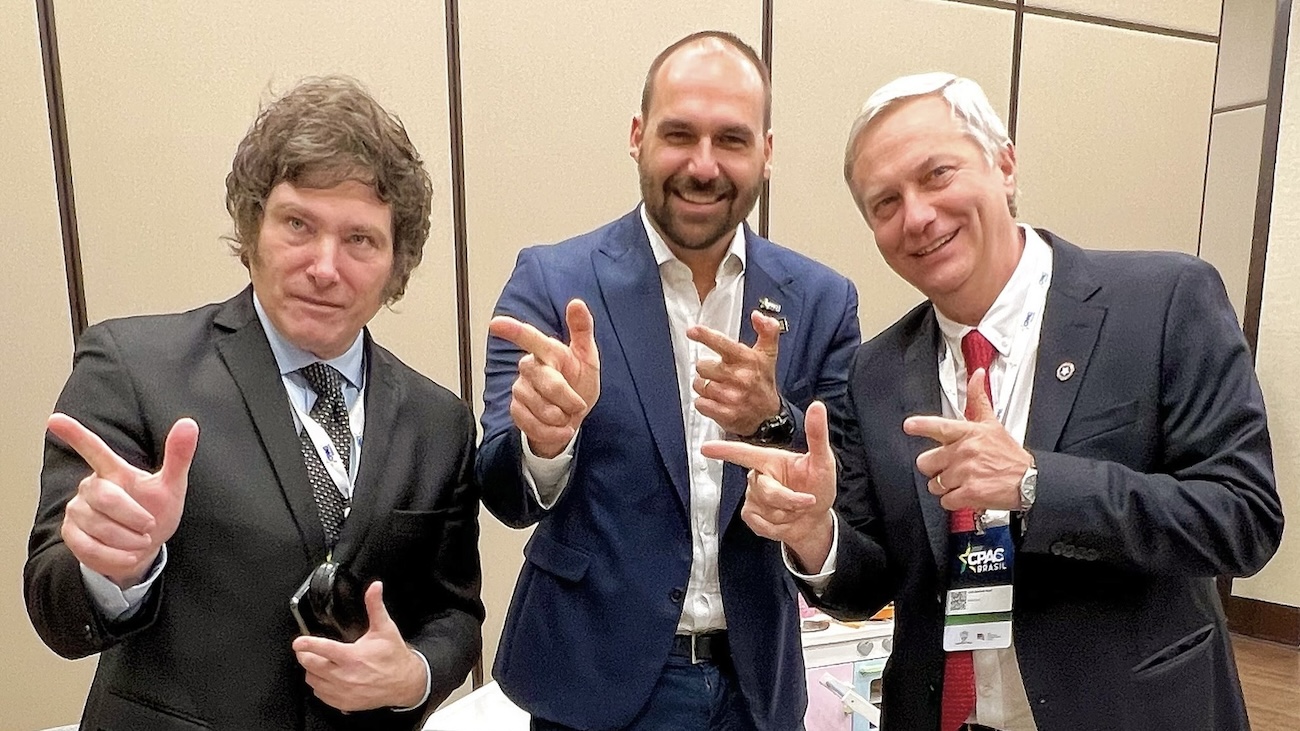
Argentine President Javier Milei, Brazilian legislator Eduardo Bolsonaro, and Chilean far-right presidential candidate José Antonio Kast at CPAC Conference in 2022. Photo: Eduardo Bolsonaro / X

The far right in Latin America is angry. Brazil’s Jair Bolsonaro and Argentina’s Javier Milei always look furious, and they always speak loudly and aggressively. Testosterone leaks from their pores, a toxic sweat that has spread across the region. It would be easy to say that this is the impact of Donald Trump’s own brand of neo-fascism, but this is not true. The far right has much deeper pedigrees, linked to the defense of the oligarchical families that have roots in the colonial era across the virreinatos (viceroyalties) from New Spain to Rio de la Plata. Certainly, these far right men and women are inspired by Trump’s aggressiveness and by the entry of Marco Rubio, a furious defender of the far right in Latin America, to the position of US Secretary of State. This inspiration and support are important but not the reason for the return of the far right, an angry tide that has been growing across Latin America.

On the surface, it looks as if the far right has suffered some defeats. Jair Bolsonaro is in prison for a very long time because of his role in the failed coup d’état on January 8, 2023 (inspired by Trump’s own failed coup attempt on January 6, 2021). In the first round of the presidential election in Chile, the candidate of the Communist Party, Jeannette Jara won the most votes and will lead the center-left bloc into the second round (December 14). Despite every attempt to overthrow the government of Venezuela, President Nicolás Maduro remains in charge and has mobilized large sections of the population to defend the Bolivarian Revolution against any threats. And, in late October 2025, most of the world’s countries voted for a UN General Assembly resolution that demands an end to the blockade on Cuba. These indicators – from Bolsonaro’s imprisonment to the vote on Cuba – suggest that the far right has not been able to move its agenda in every place and through every channel.

However, beneath the surface, there are indications that Latin America is not seeing the resurgence of what had been called the Pink Tide (after the election of Hugo Chávez in Venezuela in 1998) but is experiencing the emergence of an angry tide that slowly has begun to sweep the region from Central America down to the Southern Cone.

Elections in South America

The first round of the Chilean presidential election produced a worrying result. While Jara of the Communist Party won 26.85% of an 85.26% turnout, the far right’s José Antonio Kast came in second with 23.92%. Evelyn Matthei of the traditional Right won 12.5%, while the extreme right candidate who was once with Kast and now to his right, Johannes Kaiser, won 14%. It is likely that Jara will pick up some of the votes of the center, but not enough to overcome the advantage of the far right which looks to have at least more than 50% of the voters on its side. The so-called social liberal, Franco Parisi, who came in third, endorsed Kast in 2021 and will likely endorse him again. That means that in Chile, the presidency will be in the hands of a man of the far right whose ancestry is rooted in German Nazism (Kast’s father was a member of the Nazi Party who escaped justice through the intercession of the Vatican) and who believes that the dictatorship in Chile from 1973 to 1990 was on balance a good idea.

North of Chile, in Bolivia, the new president Rodrigo Paz Pereria, son of a former president, beat the far right’s Jorge Tuto Quiroga (a former president) in the second round of the election. This round had no candidate of the left, after the Movement for Socialism governed Bolivia continuously from 2006 to 2025. Paz’s own party has a minority position in the legislature and he will therefore have to align himself with the Quiroga’s Libre coalition and he will likely adopt a pro-US foreign policy and a libertarian economic policy. Peru will have its own election in April, where the former mayor of Lima – Rafael López Aliaga – is expected to win. He rejects the label far right but adopts all the generic policies of the far right (ultra-conservative Catholic, advocate for harsh security measures, and favors a libertarian economic agenda). Iván Cepeda of Colombia is the left’s likely candidate in their presidential election in May 2026, since Colombia does not permit second terms (so President Gustavo Petro cannot run again). Cepeda will face strong opposition from Colombia’s oligarchy which will want to return the country to their rule. It is too early to say who Cepeda will face, but it might be journalist Vicky Dávila, whose far right opposition to Petro is finding traction in unexpected parts of Colombian society. It is likely that by the middle of 2026, most of the states along the western edge of South America (from Chile to Colombia) will be governed by the far right.

Even as Bolsonaro is in prison, his party, the PL (or Liberal Party), is the largest bloc in Brazil’s National Congress. It is likely that Lula will be re-elected to the presidency next year due to his immense personal connection with the electorate. The far right’s candidate – who could be possibly Tarcísio de Freitas, the governor of São Paulo state, or one of the Bolsonaro’s (wife Michelle or son Flavio) – will struggle against him. But the PL will make inroads into the Senate. Their control over the legislature has already tightened the reins on the government (at COP30, Lula’s representative made no proposals to confront the climate catastrophe), and a Senate win will further their control over the country.

Common agenda of the angry tide

The Angry Tide politicians who are making waves have many things in common. Most of them are now in their fifties – Kast (born 1966), Paz (born 1967), Venezuelan politician María Corina Machado (born 1967), and Milei (born 1970). They came of age in the post-dictatorship period in Latin America (the last dictatorship to end was in Chile in 1990). The decade of the 1990s continued the economic stagnation that characterized the 1980s: the Lost Decade (La Década Perdida) that convulsed these countries with low growth rates and with poorly developed comparative advantages forced into globalization. It was in this context that these politicians of the Angry Tide developed their common agenda:

Anti-Communism. The far right in Latin America is shaped by an anti-left agenda that it inherits from the Cold War, which means that its political formations typically endorse the era of US-backed military dictatorships. The ideas of the left, whether from the Cuban Revolution (1959) or from the era of the Pink Tide (after 1998), are anathema to these political forces; these ideas include agrarian reform, state-led finance for industrialization, state sovereignty, and the importance of trade unions for all workers and peasants. The anti-communism of this Angry Tide is rudimentary, mother’s milk to the politicians and used cleverly to turn sections of society against others.

Libertarian Economic policies. The economic ideas of the Angry Tide are shaped by the Chilean “Chicago Boys” (including Kast’s brother Miguel who was the head of General Augusto Pinochet’s Planning Commission, his Minister of Labor, and his head of the Central Bank). They directly take their tradition from the libertarian Austrian School (Friedrich Hayek, Ludwig von Mises, and Murray Rothbard as well as Milton Friedman). The ideas were cultivated in well-funded think tanks, such as the Centro de Estudios Macroeconómicos de Argentina (founded in 1978) and the Chilean Centro de Estudios Públicos (founded in 1980). They believe the State should be a force to discipline the workers and citizens, and that the economy must be in the hands of private interests. Milei’s famous antics with a chainsaw illuminate this politics not only of cutting social welfare (the work of neoliberalism) but of destroying the capacity of the State itself.

Culture Wars. Drawing on the wave of anti-gender ideology and anti-migration rhetoric, the Angry Tide has been able to appeal to conservative evangelical Christians and to large sections of the working class that has been disoriented by changes seen to come from above. The far right argues that the violence in working class neighborhoods created by the drug industry is fostered by “liberalism” and that only tough violence (as demonstrated by El Salvador’s president Nayib Bukele) can be the solution; for this reason, they want to strengthen the military and police and set aside constitutional limitations on use of force (on October 28, the government of Bolsonaro ally Cláudio Castro in Rio de Janeiro sent in the police who killed at least 121 people in Operation Containment). It helps the far right that it adopted various conspiracy theories about how the “elites” have spread “globalized” ideas to damage and destroy the “culture” of their nations. This is a ludicrous idea coming from far right and traditional right political forces that champion full-scale entry of US corporations into their society and culture, and that have no respect for the histories of struggle of the working class and peasantry to build their own national and regional cultural worlds. But the Angry Tide has been able to construct the idea that they are cultural warriors out to defend their heritage against the malignancies of “globalization”. Part of this culture war is the promotion of the individual entrepreneur as the subject of history and the denigration of the necessity of social reproduction.

It is these three elements (anti-communism, libertarian economic policies, and the culture wars) that brings together the far right across Latin America. It provides them with a robust ideological framework to galvanize sections of the population to believe that they are the saviours of the hemisphere. This Latin American far right is backed by Trump and the international network of the Spanish far right (the Foro Madrid, created in 2020 by Fundación Disenso, the think tank of the far right Vox party). It is heavily funded by the old elite social classes, who have slowly abandoned the traditional Right for these new, aggressive far right parties.

Crisis of the Left

The Left is yet to develop a proper assessment of the emergence of these parties and has not been able to drive an agenda that sparkles with vitality. A deep ideological crisis grips the Left, which cannot properly decide whether to build a united front with the traditional right and with liberals to contest elections or to build a popular front across the working class and peasantry to build social power as a prelude to a proper electoral push. The example of the former strategy (the electoral alliance) comes from Chile, where first the Concertación de Partidos por la Democracia (Concertación) formed in 1988 to keep out the parties of the dictatorship from power and second the Apruebo Dignidad formed in 2021 that brought Gabriel Boric of the centrist Broad Front to the presidency. But outside Chile, there is little evidence that this strategy works. The latter has become harder as unionization rates have collapsed, and as uberization individualizes the working class to erode working class culture.

It is telling that Bolivia’s former socialist Vice President Álvaro García Linera looked northwards to New York City for inspiration. When Zohran Mamdani won the mayor’s race, García Linera said, “Mamdani’s victory shows that the left must commit to boldness and a new future.” It is hard to disagree with this statement; although, Mamdani’s own proposed agenda is mostly to salvage a worn-out New York infrastructure rather than to advance the city to socialism. García Linera did not mention his own time in Bolivia, when he tried with former president Evo Morales to build a socialist alternative. The left will have to be bold, and it will have to articulate a new future, but it will have to be one that emerges from its own histories of building struggles and building socialism.

Vijay Prashad is an Indian historian, editor, and journalist. He is a writing fellow and chief correspondent at Globetrotter. He is an editor of LeftWord Books and the director of Tricontinental: Institute for Social Research. He has written more than 20 books, including The Darker Nations and The Poorer Nations. His latest books are On Cuba: Reflections on 70 Years of Revolution and Struggle (with Noam Chomsky), Struggle Makes Us Human: Learning from Movements for Socialism, and (also with Noam Chomsky) The Withdrawal: Iraq, Libya, Afghanistan, and the Fragility of US Power.

(*) First published in People’s Democracy

This article by Vijay Prashad republished from peoples dispatch under a Creative Commons Attribution-ShareAlike 4.0 (CC BY-SA) license.

Donald Fuhrump says that Amerikkka doesn't bother with crimes or charges anymore, not being 100% Amerikkkan and opposing his real estate intentions is enough.
Donald Fuhrump says that Amerikkka doesn’t bother with crimes or charges anymore, not being 100% Amerikkkan and opposing his real estate intentions is enough.
Continue ReadingThe angry tide of the Latin American far right

Could Bolsonaro go to jail this week?

Spread the love

Original article by Brasil de Fato republished from peoples dispatch under a Creative Commons Attribution-ShareAlike 4.0 (CC BY-SA) license.
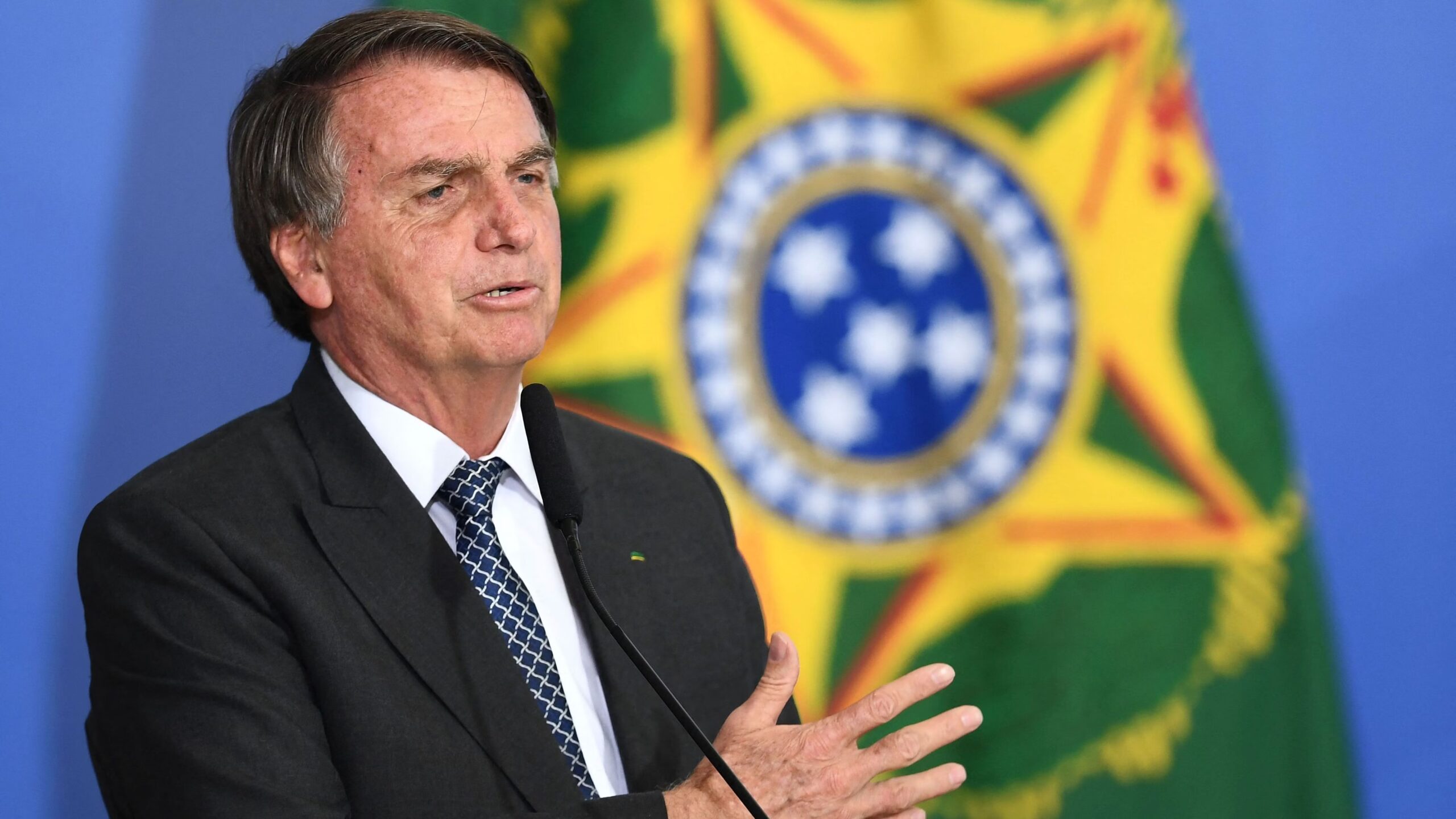
Jair Bolsonaro in front of flag

Former Brazilian President Jair Bolsonaro. Photo: Huete

He is already under house arrest, but if convicted, he would be taken to a cell only after the sentence becomes final.

The answer to the question is yes. In fact, former Brazilian President Jair Bolsonaro is already under house arrest after failing to comply with precautionary measures imposed by the reporting judge in the criminal case investigating the attempted coup in Brazil, Alexandre de Moraes, such as the prohibition on using social media.

Lawyer Ney Strozake states that preventive detention could be imposed if there is a risk of flight. “If he [Bolsonaro] flees or takes actions that clearly demonstrate that he is going to flee, what could happen is that the Attorney General’s Office could request preventive detention and Alexandre Moraes could order preventive detention. But [only] because he is preparing to flee or because he has fled, which is the case with [Carla] Zambelli. She is already abroad and has announced that she has fled. Then her preventive detention was ordered. In Bolsonaro’s case, this could also happen,” explained the lawyer.

However, these are preventive measures, which are primarily aimed at ensuring the smooth running of the proceedings and are unlikely to be taken on the eve of a sentence. The final arrest, in compliance with a possible sentence established by the First Panel of the Supreme Federal Court (STF), will still take a little more time, and this depends on how the five ministers will vote.

Possibilities for appeals

If there are at least two disagreements among the justices regarding the merits of the case, that is, regarding the conviction or acquittal of the defendants, the defense may file appeals to bring the case to the full court, known as infringements. The deadline for the defense to file these appeals is ten days, and there is no deadline for the court to decide whether to accept them.

If there is not this minimum number of disagreements on the merits, the defense will be limited to only one possibility of appeal: the so-called motions for clarification. In this case, there is no possibility of changing the majority decision, but lawyers may contest or even request clarification regarding any measure imposed in the sentence, or request, for example, immediate progression to house arrest for health reasons. For this type of appeal, the deadline for filing defenses is five days after the sentence, and the judge in the case has the same amount of time to rule on them.

Jail only after the final judgment

According to the understanding established by the STF, those convicted will only begin serving their sentences after the so-called final judgment, that is, when there are no more possibilities for appeals.

Former President Jair Bolsonaro and seven other defendants are identified by the Attorney General’s Office (PGR) as the “crucial nucleus” of the coup plot. They are accused of the crimes of armed criminal organization, attempted violent abolition of the Democratic Rule of Law, coup d’état, damage qualified by violence and serious threat, and deterioration of listed heritage.

Together, the penalties related to the crimes identified by the Attorney General’s Office could total 43 years in prison, considering the maximum penalties for each crime and the possibility of aggravating circumstances.

In addition to the former president, seven other men, all close allies during his administration, are being tried this week. They are: Alexandre Ramagem (former head of the Brazilian Intelligence Agency, Abin, and now a federal deputy for the Liberal Party in Rio de Janeiro); Almir Garnier Santos (former Navy commander); Anderson Torres (former Minister of Justice); Augusto Heleno (Army general and former Minister of Institutional Security); Mauro Cid (Bolsonaro’s former aide-de-camp); Paulo Sérgio Nogueira (who, like Braga Netto, was also Minister of Defense); and Walter Braga Netto (Army general and former Minister of Defense and Chief of Staff).

Among the eight defendants, Ramagem is the only one charged with three crimes, rather than five, as the charges of aggravated damage and deterioration of listed property (relating to January 8) were suspended, since he was already a certified congressman at the time and therefore had parliamentary immunity.

With the exception of whistleblower Mauro Cid, who has confessed to the charges, the others claim innocence.

This article was first published in Brasil de Fato in Portuguese.

Original article by Brasil de Fato republished from peoples dispatch under a Creative Commons Attribution-ShareAlike 4.0 (CC BY-SA) license.
Continue ReadingCould Bolsonaro go to jail this week?

Lula to Trump: If you charge us 50%, we’ll charge you 50%. Brazil must be respected!

Spread the love

Original article by Pablo Meriguet republished from peoples dispatch under a Creative Commons Attribution-ShareAlike 4.0 (CC BY-SA) license.
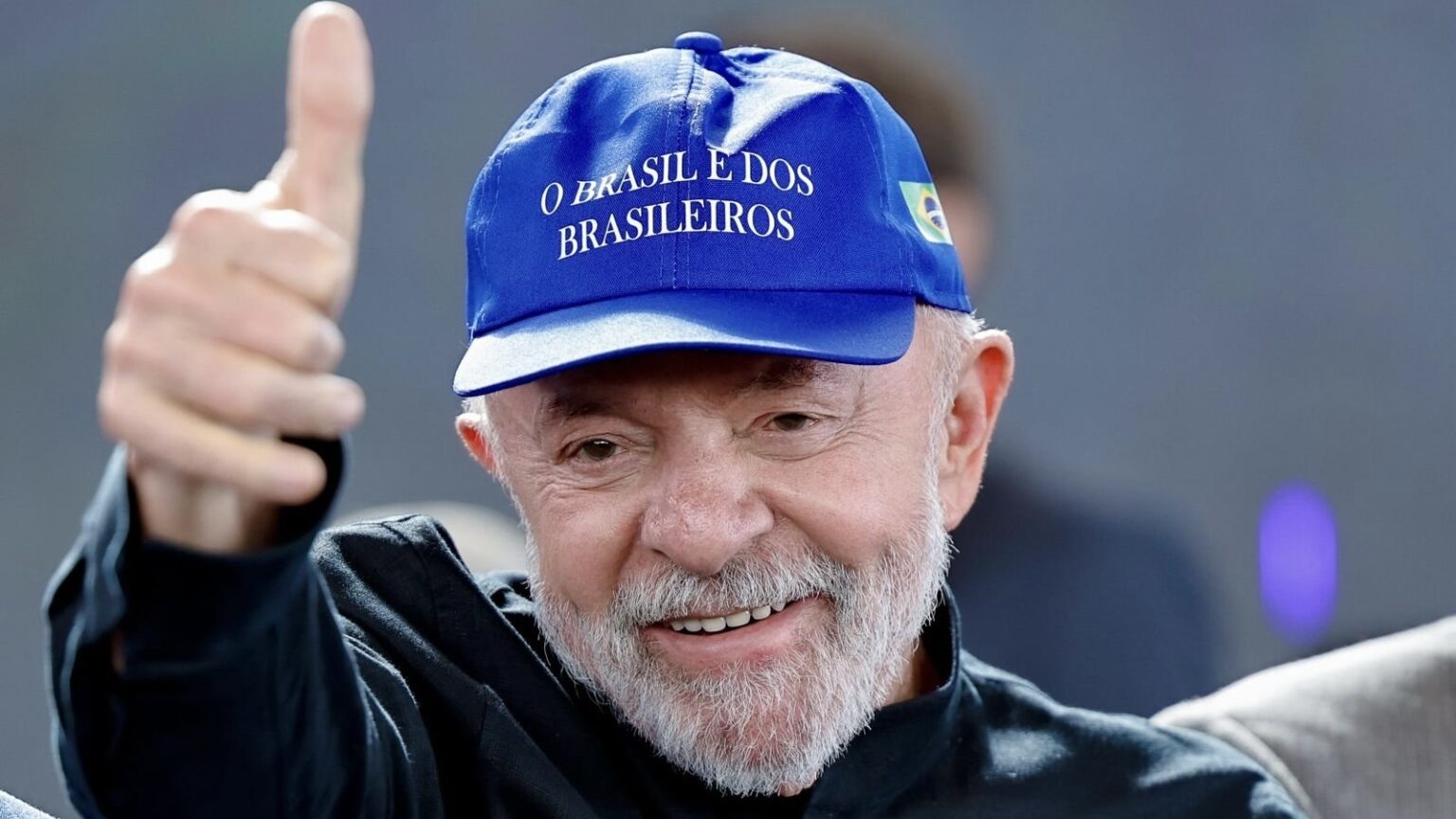
Brazilian President Lula da Silva wearing hat “Brazil is for the Brazilians”. Photo: Lula / X

The diplomatic row devolved into a potential trade crisis when Trump threatened Brazil with higher tariffs on Brazilian products if it did not cease the alleged persecution of the ultra-right former president Jair Bolsonaro.

Tensions between Washington and Brasília persist. On July 7, Trump sent a letter to the Brazilian government urging an end to the alleged persecution of former Brazilian president Jair Bolsonaro and threatening a 50% tariff on Brazilian goods.

Lula responds

Brazilian President Lula da Silva swiftly responded to Bolsonaro’s close friend and ally, asserting that Brazil’s decisions and its judiciary are sovereign and that they reject any interference whatsoever. He announced reciprocity in the measures taken by Trump: “If he charges us 50%, we will charge him 50% … Brazil is respected!”

In a post on X, Lula wrote: “Brazil is a sovereign country with independent institutions that will not accept being tutored by anyone. The judicial process against those who planned the coup d’état is the sole responsibility of the Brazilian justice system and is therefore not subject to any interference or threat that would harm the independence of national institutions.”

Lula stated that the information about the “alleged US deficit is false”, pointing out the fact that the US is not currently the main country to which Brazilian products are sold. In other words, the United States sells more to Brazil than it buys from it, meaning the US may stand to lose more from a trade war.

The Brazilian president noted: “The US government’s statistics show a surplus in trade in goods and services with Brazil of around 410 billion dollars over the last 15 years. In this sense, any measure to raise tariffs unilaterally will be responded to in light of the Brazilian Law of Economic Reciprocity. Sovereignty, respect, and the uncompromising defense of the interests of the Brazilian people are the values that guide our relationship with the world.”

However, it is important to emphasize that Lula is not closed to talks with the Trump administration: “We have several options. We can go to the WTO [World Trade Organization], initiate international investigations, and demand explanations [from the White House]. But the main thing is to show that Brazil is respected.”

The crisis has also involved other institutions of both countries. On July 9, the US Embassy released a public statement defending Bolsonaro: “Jair Bolsonaro and his family have been strong partners of the United States … The political persecution against him, his family, and his supporters is shameful and disrespectful of Brazil’s democratic traditions.”

In response, the Brazilian Secretariat of State, which called the statement “undue meddling” in Brazil’s internal affairs, summoned the US chargé d’affaires, Gabriel Escobar, in an expression of diplomatic displeasure.

Lula’s progressive government has now taken further concrete measures to respond to Trump’s threats. On Monday, July 14, Lula signed a decree regulating the country’s Reciprocity Law. According to the announcement by the President’s office, the decree, “establishes criteria for suspending trade concessions, investments, and obligations related to intellectual property rights in response to unilateral measures adopted by countries or economic blocs that negatively impact Brazil’s international competitiveness.”

The decree also calls for the creation of a committee which will be responsible for “deciding on the application of provisional countermeasures and monitoring negotiations to overcome the unilaterally imposed measures.”

Read more: Beijing denounces Trump’s use of “coercive tariffs” to pressure Global South to isolate China

Bolsonaro’s case

Bolsonaro, together with several generals and civilians aligned with his ultra-right program, is accused of participating in a plot to overturn the election that he lost to Lula at the end of 2022. According to the prosecutor’s office, part of this plot was the coup attempt on January 8 in Brasília, when thousands of Bolsonaro supporters stormed the Three Powers Square and other Brazilian government buildings, and vandalized and destroyed them.

Read more: Jair Bolsonaro will stand trial for coup attempt

The episode on January 8, 2023 somewhat resembled January 6, 2021, when hundreds of Trump supporters stormed the US Capitol building to protest the allegedly “stolen elections” in November 2020. Though hundreds were prosecuted for their participation in the January 6 riots, Trump pardoned 1,500 of those convicted, in one of his first actions in office.

People’s movements in Brazil and left groups have demanded that the Lula government hold those responsible for the January 8 coup attempt responsible to ensure it does not happen again  .

Mobilizations in Brazil

Social and trade union movements in Brazil organized a mass mobilization on July 10 in São Paulo against a veto by the Brazilian congress that aimed to thwart Lula’s project to increase taxes on the richest and most powerful companies.

The protest soon incorporated the tension between Washington and Brasília, with demonstrators rejecting Trump’s threats: “The demonstration had been born as a response to the Congress veto against Lula’s government projects that sought to charge more taxes on large companies and banking transactions, but given the situation it became a march to repudiate the tariffs imposed by Trump against Brazil,” said journalist Nacho Lemus on X.

In this way, it is entirely possible that Washington’s measures could backfire: not only could they deepen the unity around a sovereigntist sentiment and behind Lula as a defender of the nation’s interests, but many businessmen may even distance themselves from a crisis that carries risks for them as well.

Geopolitical implications

Brazil is South America’s leading economy and is currently part of the BRICS. Its main trading partner is China, far ahead of the United States. Some analysts have seen in Trump’s statements more than a simple gesture of generosity to Jair Bolsonaro, but rather a tactic to enter negotiations from a stronger position with one of the largest economies in the Global South and one of the fundamental nations involved in building a multipolar world not subordinated to US financial hegemony.

It is a surprise to no one that Lula, for the moment, has not approached the second Trump administration for negotiations, so there has been a kind of tense calm for the last six months between the countries. The calm, however, was abruptly ended with the back and forth messages from the top officials in the public and on social media.

For now, it seems that Brasilia has extended its hand to negotiate a “ceasefire” on social media. Fernando Hadad, secretary of finance, has reiterated his government’s willingness to engage in dialogue with the US government. For now, it is unclear if Washington has responded to this gesture, although it is likely that the economic advisors of the White House would caution the president against ignoring the clear geo-economic reality.

Original article by Pablo Meriguet republished from peoples dispatch under a Creative Commons Attribution-ShareAlike 4.0 (CC BY-SA) license.

Continue ReadingLula to Trump: If you charge us 50%, we’ll charge you 50%. Brazil must be respected!

Lula demands respect for Brazil’s sovereignty after Trump’s statements

Spread the love

Original article by Pablo Meriguet republished from peoples dispatch under a Creative Commons Attribution-ShareAlike 4.0 (CC BY-SA) license.

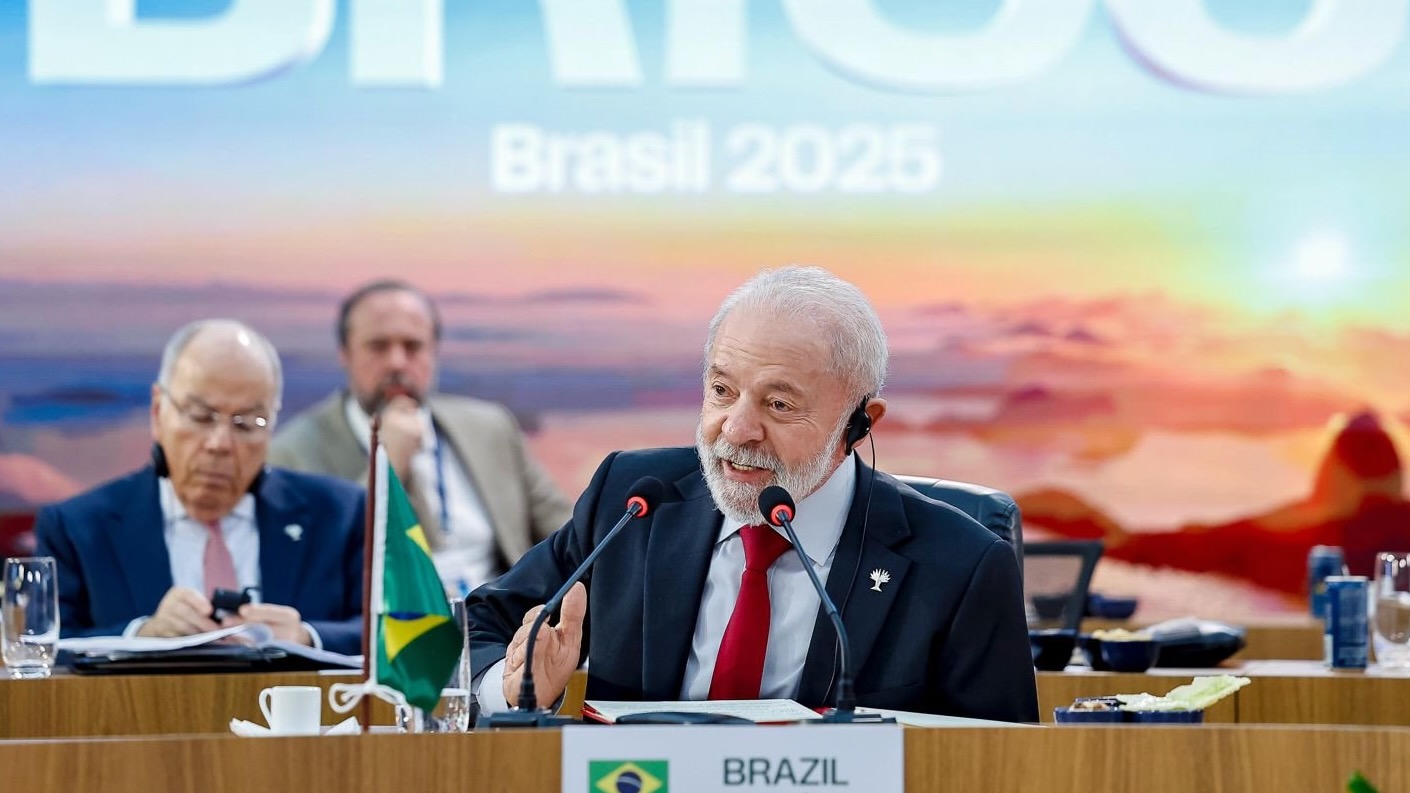
Brazilian President Lula da Silva leads the 17th BRICS Summit in Rio de Janeiro, Brazil, July 6, 2025. Photo: X

New tensions have arisen between the United States and Brazil after Trump claims that former Brazilian President Jair Bolsonaro, an ultra-right-wing leader, is innocent

On July 7, the president of the United States, Donald Trump, published a message on Truth Social defending former Brazilian President Jair Bolsonaro and claiming he has been mistreated and is innocent. Bolsonaro was los reelection in the 2022 elections and later the Supreme Court declared that he was ineligible to serve in public office due to his numerous violations.

Trump wrote: “Brazil is doing a terrible thing on their treatment of former President Jair Bolsonaro. I have watched, as has the World, as they have done nothing but come after him, day after day, night after night, month after month, year after year! He is not guilty of anything, except having fought for THE PEOPLE… This is nothing more, or less, than an attack on a Political Opponent — Something I know much about! It happened to me, times 10, and now our Country is the “HOTTEST” in the World! The Great People of Brazil will not stand for what they are doing to their former President.”

He also claimed that the alleged persecution of Bolsonaro is a “witch hunt”: “I’ll be watching the WITCH HUNT of Jair Bolsonaro, his family, and thousands of his supporters, very closely. The only Trial that should be happening is a Trial by the Voters of Brazil — It’s called an Election. LEAVE BOLSONARO ALONE!”

In response to these statements, Brazilian President Luiz Inácio Lula da Silva asserted that the US president’s declaration is interference and that Brazilian sovereignty must be respected. “The defense of democracy in Brazil is a matter for Brazilians. We are a sovereign country,” Lula reminded Trump. “We do not accept interference or tutelage from anyone. We have solid and independent institutions. No one is above the law. Especially those who attack freedom and the rule of law.”

For her part, Brazil’s secretary of state, Gleisi Hoffmann, was more confrontational: 

“Donald Trump is very mistaken if he thinks he can interfere in the Brazilian judicial process. The period when Brazil was subservient to the US was during Bolsonaro’s presidency, when he saluted his flag and failed to defend national interests. Today, he is answering for the crimes he committed against democracy and the electoral process in Brazil. You can’t talk about persecution when a sovereign country complies with due process in the democratic rule of law, which Bolsonaro and his coup plotters have tried to destroy. The US president should take care of his problems, of which there are many, and respect the sovereignty of Brazil and our judiciary.”

Trump’s comments were made while Lula leads the 17th BRICS Summit in Rio de Janeiro, where the economic bloc denounced “unilateral, punitive, and discriminatory protectionist measures” and called for the strengthening of multilateralism to create a more equitable global order.

What is Bolsonaro accused of?

Former President Jair Bolsonaro (2019-2023), a longtime friend of Donald Trump, thanked the US president for his support: “I was delighted to receive the note from President Donald Trump. This lawsuit to which I am responding is a legal aberration (Lawfare), clear political persecution, already perceived by everyone with common sense … I thank the illustrious President and friend. You went through something similar … Your struggle for peace, justice, and freedom echoes across the planet. Thank you for existing and for giving us an example of faith and resilience.”

According to the Brazilian justice system, Bolsonaro led, together with several high-ranking military officers and other far-right politicians, an attempt to delegitimize and reverse the electoral results that marked his defeat in October 2022 by the current President Lula da Silva, who obtained 50.9% of the valid votes, to the far-right’s 49.1%. On January 8, 2023, hundreds of Bolsonaro supporters stormed the headquarters of the legislative and judicial branches in Brasilia.

The protesters entered the Three Powers Square a week after Lula assumed his mandate as president of the country. Following the declaration of a state of emergency, security forces took several hours to expel Bolsonaro’s supporters, while most governments around the world condemned the incursion.

Read more: Jair Bolsonaro will stand trial for coup attempt

For his part, Bolsonaro has denied his participation in the events, in which, according to the Brazilian justice system, generals Augusto Heleno and Walter Braga (former Secretary of Defense), as well as former Secretaries, Anderson Torres, Augusto Heleno, and the 2022 electoral campaign aide, Mauro Cid, are also involved.

The charges are attempted coup d’état, participation in an armed criminal organization, attempted abolition of the democratic rule of law, aggravated damages, and deterioration of historical heritage. The final decision of justice will be known in the coming months and will surely affect the political future of the Amazonian nation.

Original article by Pablo Meriguet republished from peoples dispatch under a Creative Commons Attribution-ShareAlike 4.0 (CC BY-SA) license.

Continue ReadingLula demands respect for Brazil’s sovereignty after Trump’s statements

Bolsonaro’s indictment over alleged coup plot signals shift in Brazil’s approach to political accountability

Spread the love
Brazil’s top prosecutor has filed federal charges against Jair Bolsonaro, alleging that the former president attempted a coup in 2023. Focus Pix / Shutterstock

Felipe Tirado, King’s College London

The Brazilian attorney-general has charged the country’s former president, Jair Bolsonaro, with participating in a plot to cling to power through a coup d’etat in 2023 milo. If Bolsonaro is convicted, he could spend between 38 and 43 years in prison.

Bolsonaro, who governed Brazil between 2019 and 2022 but lost his attempt at re-election to current president Luiz Inácio “Lula” da Silva, is one of 34 people to be formally charged for offences related to the alleged coup. These include high-ranking serving and retired members of the military, as well as former ministers and politicians.

The charges levelled against them are involvement in an attempted coup d’etat, violent abolition of the democratic rule of law, and criminal organisation.

According to the attorney-general’s 272-page indictment, Bolsonaro became increasingly inclined to pursue anti-democratic measures in the months before the election. He allegedly considered taking steps to retain power even before the first round of voting.

Then, after his defeat by an extremely narrow margin, the indictment claims that Bolsonaro and his alleged accomplices decided to implement the plan before Lula took office in January 2023.

An investigation by Brazil’s federal police in November found that the insurrection in the country’s capital Brasília on January 8 2023, where rioters invaded the presidential palace, congress and supreme court, was part of this plan. The same investigation suggested the plan also included a plot to assassinate Lula and his vice-president Geraldo Alckmin, as well as supreme court judge Alexandre de Moraes.

Bolsonaro denies any wrongdoing and – at least in public – is bullish about his fate. Speaking to journalists hours before the charges were filed, he said: “I have no concerns about the accusations, zero.”

The case will now be considered by the Supreme Court, whose judges will decide whether to initiate criminal proceedings against Bolsonaro and the other defendants. This is expected to happen over the coming weeks. If the judges accept the charges and proceedings are established, the defendants will be called to answer them.

This is the first time in Brazilian history that high-ranking members of the armed forces have been indicted and charged with crimes associated with a coup d’etat. According to the indictment, the intention was for the armed forces to be called upon to act as a “moderating power”, with the aim of overturning the election result.

Army generals Augusto Heleno, Walter Braga Netto and Paulo Sérgio Nogueira de Oliveira are among those who have been charged. These men served as ministers in the Bolsonaro government, with Braga Netto also running as the vice-president on Bolsonaro’s ticket in 2022.

Another high-ranking member of the armed forces charged by the attorney-general is Almir Garnier Santos, the commander of the Brazilian navy. These four men were allegedly part of the inner nuclei that planned and prepared the attempted coup.

Several other servicemen, including generals, colonels and other officers, were charged with crimes related to the planning and execution of the initial phases of the coup. The sentences for all of these men could amount to up to 30 years in prison.

Like Bolsonaro, Braga Netto denies any guilt. In a statement released on February 18, his lawyers called the charges a “fantasy”. Lawyers for Garnier Santos and Heleno have chosen not to comment until having fully reviewed the charges.

Unlike those in the military, some of the political figures charged by the attorney general had criminal antecedents. One of the politicians named in the indictment is Filipe Martins, Bolsonaro’s former international affairs adviser and a “disciple” of the deceased far-right polemicist, Olavo de Carvalho. Martins’ lawyers released a statement on February 18 calling the accusations “unfounded”.

In December 2024, Martins was convicted of making a gesture alluding to white supremacy during a virtual session of the senate. He initially received a sentence of two years and four months in prison for inciting racial prejudice, which was replaced by 850 hours of community service.

Far-right commentator Paulo Figueiredo Filho, the grandson of Brazil’s last military dictator, João Figueiredo, was also charged. He appeared on a podcast on February 19 to criticise the charge. Figueiredo lives in the US, where he was arrested in 2019 because of problems with his immigration status.

Lessons from and to Brazil

Brazil has already offered some lessons to other countries facing similar authoritarian challenges. Its response to the insurrection in Brasília was swift and robust. Within days, hundreds of rioters had been arrested and the state governor of the federal district was suspended for his sluggish response.

Then, in 2023, Bolsonaro was banned from running for office for eight years over false claims that the electronic ballots used in the previous year’s election were vulnerable to hacking and fraud. Those involved with the attempted military coup have also been investigated and some subsequently arrested.

But the coup plot case can also serve as a lesson to the country. Brazil has a history both of successful and unsuccessful military coups. The last successful military coup led to a dictatorship that lasted from 1964 until 1985.

Brazil also has a history of amnesties, whereby crimes committed during these coups and authoritarian regimes have been pardoned. There have been 48 amnesties in Brazil since 1889, with the most recent one, in 1979, allowing the dictatorship to self-amnesty its crimes.

For over 45 years, it has hindered criminal accountability for the perpetrators of the crimes of the dictatorship. This included the murder of politician Rubens Paiva, whose disappearance was the focus of the 2024 Oscar-nominated film, I’m Still Here.

Bolsonaro and other individuals charged, as well as their supporters and aligned politicians, have been demanding a “humanitarian amnesty” for those who allegedly participated in the coup plot.

Given Bolsonaro’s history, this seems paradoxical. Throughout his decades-long public career, Bolsonaro has consistently celebrated the crimes of the military dictatorship and supported violations of human rights. At the same time, he has also opposed individuals and organisations that advocate for victims of the dictatorship.

If Bolsonaro and his alleged accomplices are found guilty, it could be an unparalleled lesson for Brazil. Punishing anyone convicted would be an opportunity to step away from the country’s tradition of impunity and move towards addressing systemic injustices.

Felipe Tirado, PhD Candidate in Law, King’s College London

This article is republished from The Conversation under a Creative Commons license. Read the original article.

Continue ReadingBolsonaro’s indictment over alleged coup plot signals shift in Brazil’s approach to political accountability