Capitalism’s Free Speech Trap: Bezos Shows How Billionaires Set the Boundaries of Debate

Spread the love

Original article by Peter Bloom republished from Common Dreams under Creative Commons (CC BY-NC-ND 3.0). 
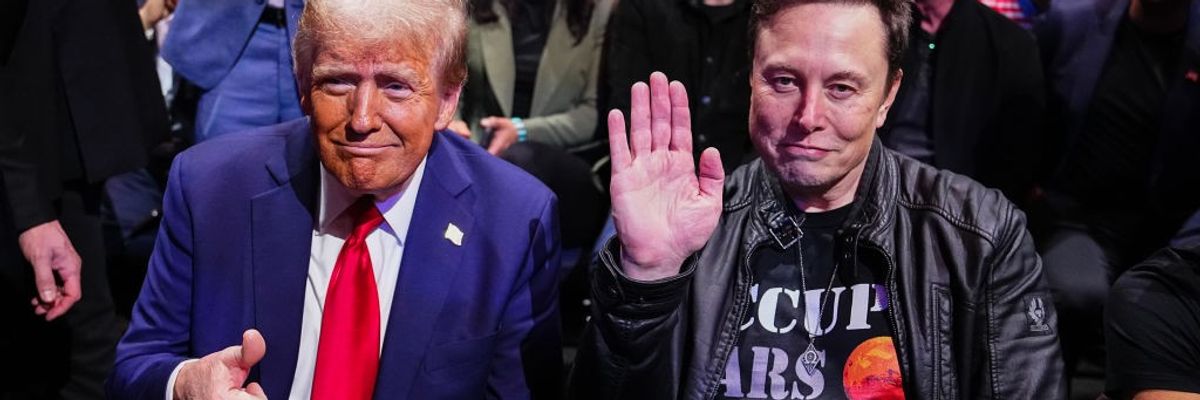
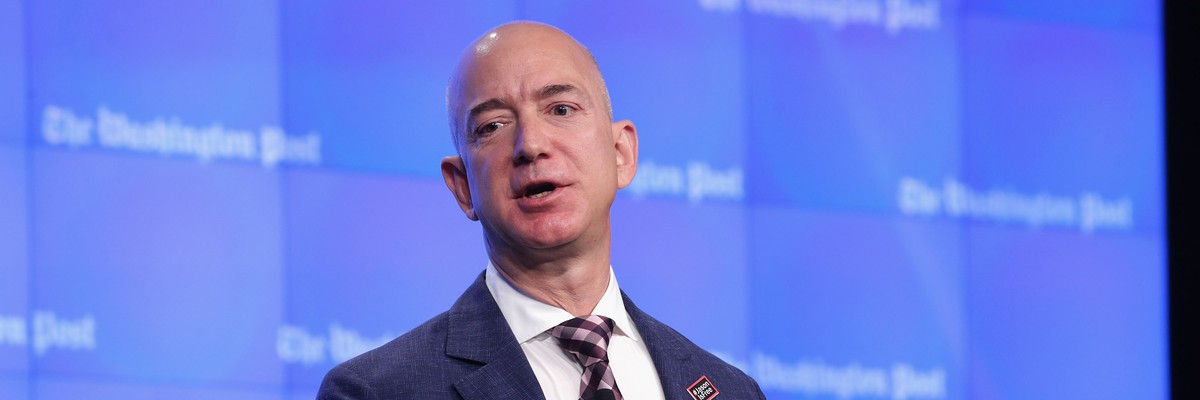
Amazon founder and Washington Post owner Jeff Bezos delivers remarks during the opening ceremony of the media company’s new location January 28, 2016 in Washington, D.C. (Photo: Chip Somodevilla/Getty Images)

The Washington Post’s shift toward free-market advocacy is not simply an editorial decision; it is a strategic move to reinforce the dominant ideological framework that benefits the billionaire class.

The recent directive by Jeff Bezos that The Washington Post editorial section should promote “personal liberties and free markets” is a stark reminder of how freedom under capitalism often boils down to the freedom of economic elites to dictate the parameters of public discourse. While Bezos has suggested that social media provides alternative perspectives, thus absolving his newspaper of the responsibility to represent diverse viewpoints, his decision is part of a broader trend of billionaire media ownership shaping acceptable discourse.

This phenomenon is visible across digital platforms as well. Elon Musk’s control over X (formerly Twitter) has demonstrated how ownership can shape public debate—both through direct interventions, such as the alleged suppression of progressive perspectives, and through more subtle changes to platform algorithms. Similarly, Mark Zuckerberg’s Meta has faced repeated allegations of privileging certain political narratives while suppressing others, including ending its “fact checking” policy that could challenge far-right viewpoints.

Perhaps the most glaring contradiction in Bezos’ advocacy for free markets is the extent to which he, and other billionaires like him, have benefited from state intervention as part of an intentional strategy of “corporate welfare.”

In each case, the rhetoric of “free speech” is selectively applied. While these platforms and newspapers claim to support open debate, their policies ultimately reflect the ideological preferences of their owners. This demonstrates a fundamental truth: In capitalist societies, freedom of expression is often contingent on the interests of those who control the means of communication. The Washington Post’s shift toward free-market advocacy is not simply an editorial decision; it is a strategic move to reinforce the dominant ideological framework that benefits the billionaire class.

The Myth of Meritocracy and the Far-Right’s War on DEI

Bezos’ framing of free markets as inherently linked to personal liberties exposes a deeper ideological assumption—namely, that economic success is the result of individual talent and merit rather than systemic privilege. This assumption is not unique to Bezos but is foundational to the way many economic elites understand their own wealth and influence.

The logic behind Bezos’ editorial direction is similar to the arguments used by the contemporary far-right to attack Diversity, Equity, and Inclusion (DEI) initiatives. The opposition to DEI is rooted in a desire to preserve the myth that success is determined purely by hard work and ability, rather than by racial, gender, or class privilege. By rejecting policies that acknowledge structural inequalities, The far-right seeks to uphold a narrative that justifies existing economic and social hierarchies.

This worldview is deeply intertwined with the ideology of neoliberalism, which insists that markets are neutral mechanisms that reward the most capable individuals. However, history shows that markets are anything but neutral. The barriers faced by marginalized groups are not simply the result of individual shortcomings; they are the product of centuries of systemic exclusion. The far-right’s attack on DEI serves to obscure these realities, just as Bezos’ insistence on free markets seeks to erase the role of privilege and power in determining economic outcomes.

By positioning The Washington Post as a champion of free markets, Bezos is promoting the idea that capitalism functions as a pure meritocracy. This serves not only to legitimize his own position but also to delegitimize calls for policies that challenge structural inequality, whether in the form of DEI programs, labor protections, or wealth redistribution measures.

The Illusion of the Free Market and Its Political Implications

Perhaps the most glaring contradiction in Bezos’ advocacy for free markets is the extent to which he, and other billionaires like him, have benefited from state intervention as part of an intentional strategy of “corporate welfare.” The notion of a truly free market, where economic actors compete on equal footing without government interference, is a fantasy. In reality, corporations like Amazon have thrived not because of unregulated competition, but because of significant government support.

From tax incentives to government contracts, Amazon has received billions in subsidies that have allowed it to dominate the retail and logistics industries. Moreover, the U.S. government plays a critical role in enforcing corporate-friendly trade policies, suppressing labor movements, and protecting the interests of multinational corporations abroad. These interventions are rarely acknowledged in discussions of free markets, yet they are crucial to understanding the power dynamics of contemporary capitalism.

If freedom under capitalism ultimately means the freedom of the wealthy to dictate the terms of discourse, then the very concept of free speech is in jeopardy.

Politically, Bezos’ editorial directive at The Washington Post serves to strengthen a broader ideological alignment between neoliberal economics and far-right nationalism. By framing free-market capitalism as an essential component of personal liberty, Bezos is laying the groundwork for a political agenda that fuses economic libertarianism with nationalist conservatism. This is significant because it provides an ideological foundation for challenging emerging economic policies that deviate from neoliberal orthodoxy—such as the rise of protectionism in response to globalization.

This alignment between free-market ideology and far-right nationalism is not new. Historically, neoliberalism has often coexisted with reactionary politics, as seen in the economic policies of figures like former U.S. President Ronald Reagan and former U.K. Prime Minister Margaret Thatcher. Today, this synthesis is being revived as right-wing populists seek to defend corporate interests while simultaneously appealing to nationalist sentiments. Bezos’ intervention in The Washington Post should be understood within this broader context: It is not just about shaping editorial policy but about consolidating an ideological framework that benefits economic elites while limiting the scope of acceptable political debate.

The Dangers of Billionaire-Controlled Media

Bezos’ decision to impose a free-market ideology on The Washington Post is not an isolated event; it is part of a larger trend in which media ownership is used to shape public discourse in ways that serve elite interests. This phenomenon extends beyond traditional journalism to social media platforms, where billionaires like Musk and Zuckerberg wield immense power over the flow of information.

At its core, this issue is about more than just media bias—it is about the fundamental tension between democracy and concentrated economic power. A truly free and open society requires a diversity of perspectives, yet the dominance of billionaire-controlled media threatens to constrain the range of acceptable debate. If freedom under capitalism ultimately means the freedom of the wealthy to dictate the terms of discourse, then the very concept of free speech is in jeopardy.

The consolidation of media power in the hands of a few ultra-wealthy individuals raises urgent questions about the future of democratic debate. If we are to challenge the ideological hegemony of economic elites, we must first recognize the mechanisms through which they shape public discourse. Bezos’ editorial mandate is not just about The Washington Post—it is a reflection of the broader struggle over who gets to define the boundaries of political and economic debate in the 21st century.

Original article by Peter Bloom republished from Common Dreams under Creative Commons (CC BY-NC-ND 3.0). 

Continue ReadingCapitalism’s Free Speech Trap: Bezos Shows How Billionaires Set the Boundaries of Debate

WaPo Provides Cover for Musk’s Government Takeover

Spread the love

Original article by Pete Tucker republished from FAIR under a Creative Commons Attribution-NonCommercial-NoDerivs 3.0 Unported License.

Adam Johnson (Column2/3/25): “The New York TimesWashington Post and CNN ran with the framing that ‘DOGE’ was some good-faith, post-ideological effort to ‘cut costs,’ ‘find savings’ and ‘increase efficiencies.’”

Having spent nearly $300 million to purchase the US presidency for Donald Trump, Elon Musk now feels entitled to do with it as he pleases. Just how radically Musk plans to remake the country was conveyed to the American people only after the election, when Musk stood behind the presidential seal on Inauguration Day and gave a Nazi salute. Then did it again. Maybe that sort of thing was OK to do in apartheid South Africa, where Musk grew up, but it’s jarring to see here in the United States.

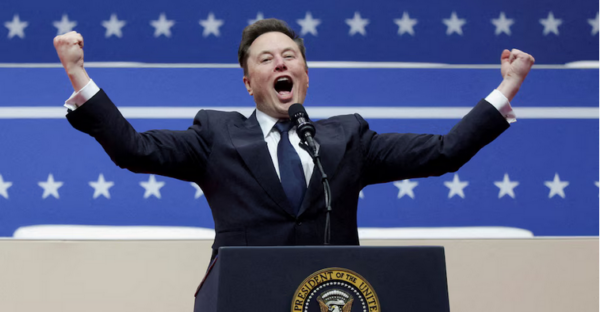
Reporters initially struggled to meet the moment (FAIR.org2/4/25), downplaying Musk’s salute (the Washington Post described a “high-energy speech“), as well as his broader agenda, which Musk now openly declares a “revolution,” and consists of an unelected billionaire wresting control of nearly the entire executive branch of government. Early media reports went along with Musk’s “efficiency” mantra (Column2/3/25), but more recently reporters have started to find their footing, and the dangers of Musk’s project are being conveyed. Sort of.

“Reporters on the battlefield are doing what they can” to expose the radical nature of Trump’s second term, writes media columnist Oliver Darcy (Status2/5/25). “The news generals back in the command center, however, are largely abdicating their duties.”

‘Musk’s audacious goal’

Nowhere is this discrepancy more apparent than at the Washington Post, a newspaper famed for opposing a prior Republican president with an expansive view of executive power. These days, however, even as Post reporters like Jeff Stein are busy breaking stories (e.g., 1/28/252/8/25) about the Trump power grab, the paper’s higher-ups are careful not to offend the president or Musk. The Post is even, incredibly, calling on the Constitution-defying billionaire duo to push further.

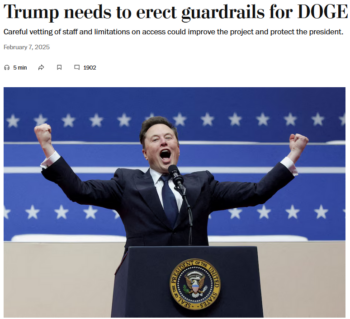
As Elon Musk seizes extraconstitutional control of the federal budget, Washington Post editors (2/7/25) urge him to use that power to go after Social Security and Medicare.

“To have any chance of achieving Musk’s audacious goal of $2 trillion in cuts,” the Post editorial board (2/7/25) wrote, “Trump will need to work with elected representatives in Congress to reform entitlement programs such as Social Security and Medicare before they become insolvent.”

While claiming it wants Trump to “erect guardrails” for Musk, the Post urges the president to abandon one of the only guardrails he established—the cutting of Social Security and Medicare, which Trump repeatedly said he wouldn’t do, but recently started waffling on.

To be clear, the Post has long called for cutting so-called entitlements (FAIR.org11/1/116/15/23). But to do so at this moment—by encouraging a coup attempt to push further—is quite extraordinary.

The Post’s move comes as its billionaire owner, Amazon founder Jeff Bezos, is lavishing praise and millions of dollars on Trump and his family, while coaching his paper to take a less critical approach in its coverage (FAIR.org1/22/25). Bezos’s ingratiation toward Trump started prior to the election, when Bezos personally spiked the Post’s endorsement of Kamala Harris (FAIR.org10/30/24).

Good news for X from Amazon

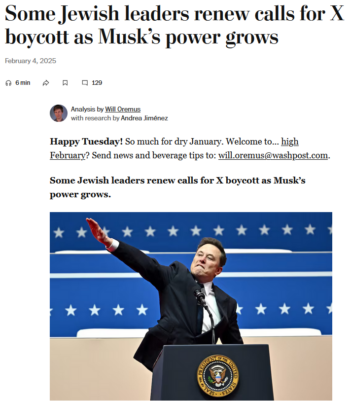
The Washington Post (2/4/25) reports on “divergent views among Jewish leaders in how to respond to Musk”: Some object to his ” Nazi-esque salute and Holocaust jokes,” others appreciate his censorship of criticism of Israel.

Bezos has also been busy making nice with Musk, his longtime rival for most powerful man on Earth and in space. On both fronts, Musk now has a decided edge, aided by his control over much of the US government, which both men’s sprawling empires rely on for billions of dollars in contracts.

With Musk’s hand on the public-money spigot, Bezos apparently did him a favor. After Musk openly heiled Hitler, Jewish leaders renewed calls to boycott Musk’s social media platform, (Washington Post2/4/25). “To advertisers—including GoogleAmazon and the ADL: Pull your ads now,” the Jewish leaders wrote. “The pressure is working. X’s financial difficulties prove it.”

But the boycott’s pressure was countered by Bezos’s company. “[X] got good news last week, with Amazon reportedly planning to hike its advertising on the site,” the Post (2/4/25) reported, without mentioning Bezos.

While X’s finances “were once so bad that Musk floated the idea of filing for bankruptcy,” things are suddenly looking up, the Financial Times (2/12/25) reported:

Musk famously admitted to overpaying for Twitter after he bought the social media platform known now as X for $44 billion in 2022. But the billionaire’s foray into government has coincided with a turnaround in X’s fortunes, as advertisers, including Amazon, flock back to the platform.

‘Lemmings leaping in unison’

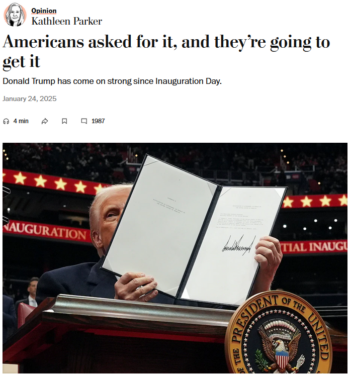
Kathleen Parker (Washington Post1/24/25) likened those who condemned Musk’s Nazi gesture to “lemmings leaping in unison from a cliff”—because it’s suicidal to notice fascism in high places?

It wasn’t just Bezos’s company that threw Musk a lifeline, but also his newspaper. An initial Post headline (1/20/25), which omitted mention of Musk’s Nazi salute, read “Elon Musk Gives Exuberant Speech at Inauguration.” The following day, Post columnist Megan McArdle, echoing the ADL, downgraded Musk’s salute to an “awkward gesture,” the same phrase Post columnist Kathleen Parker used to dismiss those who saw something more sinister as “lemmings leaping in unison from a cliff” (Washington Post1/24/25).

Interestingly, one of the most vociferous “lemmings” was Post columnist Catherine Rampell, who brilliantly called out Musk’s Nazi salute, but on CNN, and noticeably not in the Post, except once in passing (1/30/25).

Musk responded to Rampell’s CNN appearance by threatening to sue her in a post (1/27/25) to his over 200 million X followers.

I noted at the top that Musk spent nearly $300 million to elect Trump, but that’s only part of the story. Musk also provided inestimable support by transforming X into a pro-Trump bullhorn. Personally, when I logged onto X during the campaign, I routinely saw Musk’s pro-Trump tweets at the top of my feed, even though I didn’t follow Musk at the time.

Since the election, Musk ’s gifts to Trump have continued. X recently agreed to pay Trump $10 million to settle Trump’s 2021 lawsuit against the company, even though the case was dismissed in 2022. Trump was still appealing the ruling two-and-a-half years later when a deal was cut. “The settlement talks with X began after the election and were more informal, with both Trump and Musk personally involved in hammering out the $10 million number,” the Wall Street Journal (2/13/25) reported.

‘Cheering for change’

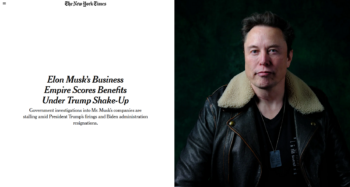
New York Times (2/11/25): Many of the federal agencies targeted by Musk “were leading investigations, enforcement matters or lawsuits pending against Mr. Musk’s companies.”

It’s quite something for Elon Musk—the world’s richest human and one of the largest government contractors—to gleefully slash public spending benefiting others. Especially when, by one measure, “virtually all of his net worth can be pinned to government help,” CNN (11/20/24) reported.

While Musk claims to wield a populist’s pitchfork as he attacks “the bureaucracy,” a closer look reveals the work of an oligarch’s scalpel. Musk’s coup team—called DOGE, and consisting mostly of twentysomething male engineers, several of whom appear to share Musk’s racist ideology (New York Times2/7/25)—is targeting the federal agencies investigating Musk’s companies, which in addition to X, include Tesla and SpaceX.

“President Trump has been in office less than a month, and Elon Musk’s vast business empire is already benefiting—or is now in a decidedly better position to benefit,” read the opening lines of a New York Times story (2/11/25):

At least 11 federal agencies that have been affected by [Trump’s] moves have more than 32 continuing investigations, pending complaints or enforcement actions into Mr. Musk’s six companies.

While Trump claims Musk is “not gaining anything” from the arrangement, and Musk says the same, Wall Street sees things differently. Even as Musk says he’s turning his “efficiency” revolution to the Pentagon—the only federal agency never to pass an audit, and where any honest attempt to rein in government spending would begin—stocks for armsmaking companies associated with Musk are surging, while those without ties to him languish. “Palantir, as well as Musk’s SpaceX, OpenAI and robotics and AI specialist Anduril Industries, are cheering for change,” the Wall Street Journal (2/10/25) reported.

In other words, having seized control of the levers of government, an oligarch will now be directing funding to himself and his cronies. That’s Wall Street’s view, anyhow.

It seems to be Bezos’s as well. With Amazon and Blue Origin, Bezos’s space company, competing for billions in government contracts, it makes perfect business sense for Bezos to cozy up to Musk and Trump. From a journalistic perspective, however, it’s nothing short of a disaster, one that’s playing out daily in the pages of the Washington Post.


You can send a message to the Washington Post at letters@washpost.com (or via Bluesky@washingtonpost.com).

Please remember that respectful communication is the most effective. Feel free to leave a copy of your message in the comments thread on FAIR.org.

FAIR’s work is sustained by our generous contributors, who allow us to remain independent. Donate today to be a part of this important mission.

Original article by Pete Tucker republished from FAIR under a Creative Commons Attribution-NonCommercial-NoDerivs 3.0 Unported License.

Elon Musk urges you to be a Fascist like him, says that you can ignore facts and reality then.
Climate Science Denier Donald Trump says Burn, Baby, Burn.

Continue ReadingWaPo Provides Cover for Musk’s Government Takeover

‘Extremely Dangerous Time’: Sanders Warns of Oligarchs’ War on Working Class

Spread the love

Original article by Jessica Corbett republished from Common Dreams under Creative Commons (CC BY-NC-ND 3.0).

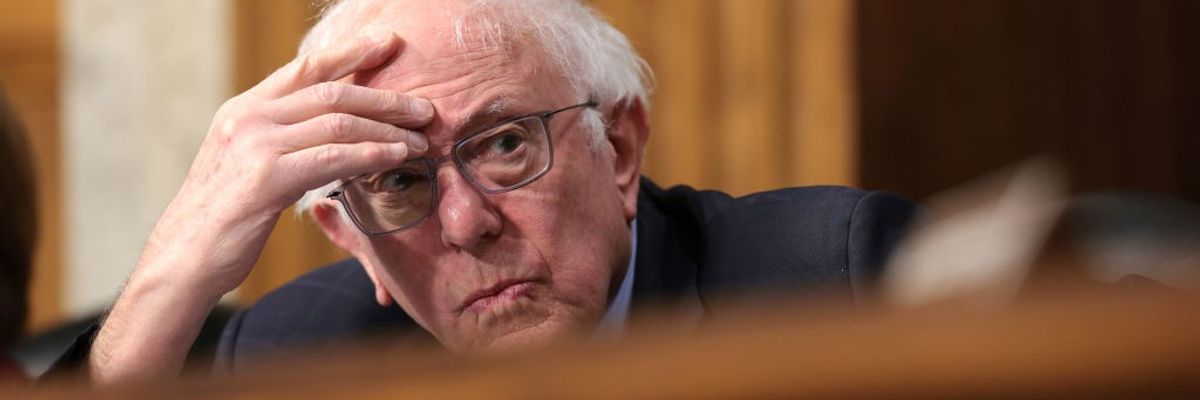
U.S. Sen. Bernie Sanders (I-Vt.) attends a Senate hearing on January 29, 2025 in Washington, D.C. (Photo: Win McNamee/Getty Images)

“Does anyone really think that the oligarchs give a damn about ordinary Americans?” the senator asked. “Trust me, they don’t.”

As U.S. President Donald Trump and billionaire Elon Musk on Tuesday continued their effort to gut the federal government, Sen. Bernie Sanders warned that “the oligarchs, with their unlimited amounts of money, are waging a war on the working class of our country, and it is a war that they are intent on winning.”

A week after delivering a speech that sounded the alarm about “America’s dangerous movement toward oligarchy, authoritarianism, and kleptocracy,” Sanders (I-Vt.) took the Senate floor again to target the world’s three richest people—Musk, Jeff Bezos, and Mark Zuckerberg—and the politicians who serve them.

“We are living in an extremely dangerous time,” the seantor said Tuesday. “Future generations will look back at this moment—what we do right now—and remember whether we had the courage to defend our democracy against the growing threats of oligarchy and authoritarianism.”

As chair of Trump’s so-called Department of Government Efficiency (DOGE), Musk’s targets have included the U.S. Agency for International DevelopmentConsumer Financial Protection BureauDepartment of EducationNational Oceanic and Atmospheric Administration, and a critical U.S. Treasury Department payment system. Reporting—and remarks from the billionaire—suggest that the agencies responsible for Medicaid, Medicare, and Social Security are next.

“As we speak, right now, Elon Musk, the wealthiest man on the planet, is attempting to dismantle major agencies of the federal government which are designed to protect the needs of working families and the disadvantaged,” said Sanders. “These agencies were created by the U.S. Congress and it is Congress’ responsibility to maintain them, to reform them, or to end them. It is not Mr. Musk’s responsibility. What Mr. Musk is doing is patently illegal and unconstitutional—and must be ended.”

Sanders also detailed Trump and his allies’ attacks on the federal judiciary, which has delivered a series of blows to the Republican president’s agenda since he took office last month.

“Mr. Trump and his friends are not just trying to undermine two of the three pillars of our constitutional government—Congress and the courts—they are also going after the media, in a way that we have never seen in the modern history of this country,” the senator said. While recognizing that the media “makes mistakes every day,” he added that “I do hope that every member of Congress understands that you cannot have a functioning democracy, you cannot have a free flow of information, you cannot have the pursuit of truth, without an independent press.”

The senator also how the top three billionaires impact what information reaches people by buying news outlets and social media platforms—as Musk did with Twitter, which he rebranded X, and Bezos did with The Washington Post and Twitch. Zuckerberg, meanwhile, has made his money through Meta, the parent company of Facebook and Instagram.

“They will use the enormous media operations they own to deflect attention away from the impact of their policies while they ‘entertain us to death,'” Sanders warns. “They and their fellow oligarchs will continue within our corrupt campaign finance system to spend huge amounts of money to buy politicians in both major political parties.”

“Does anyone really think that the oligarchs give a damn about ordinary Americans?” he asked. “Trust me, they don’t.”

Sanders warned that “if we do not stop them, they will soon be going after the healthcare, nutrition, housing, and educational programs that protect the most vulnerable people in our country—all so that they can raise they money they need to provide huge tax breaks for themselves and for others billionaires. As modern-day kings who believe they have the absolute right to rule, they will sacrifice, without hesitation, the well-being of working people in order to protect their power and their privileges.”

However, he also stressed that “the worst fear of the ruling class of our country is that the American people—whether they are Black or white or Latino, whether they are urban or rural, whether they are young or old, gay or straight, whatever—the fear of the ruling class is that the American people come together to demand a government that represents all of us, not just the people on top.”

“The oligarch’s nightmare is that we will not allow ourselves to be divided up by race, religion, sexual orientation, or country of origin and will come together and have the courage to take them on,” he declared. “If we stand together, we’re gonna win this fight, and not only will we save American democracy, we’re gonna create the kind of nation that I think most of us know we should become.”

Original article by Jessica Corbett republished from Common Dreams under Creative Commons (CC BY-NC-ND 3.0).

Elon Musk urges you to be a Fascist like him, says that you can ignore facts and reality then.
Climate Science Denier Donald Trump says Burn, Baby, Burn.
Continue Reading‘Extremely Dangerous Time’: Sanders Warns of Oligarchs’ War on Working Class

Trump 2.0: the rise of an ‘anti-elite’ elite in US politics

Spread the love
Elon Musk urges you to be a Fascist like him, says that you can ignore facts and reality then.

William Genieys, Sciences Po and Mohammad-Saïd Darviche, Université de Montpellier

US president Donald Trump is surrounded by a new cohort of politicians and officials. While one of his campaign promises was to overthrow the “corrupt elites” he accuses of flooding the American political arena, his second term in office has elevated elites chosen, above all, for their political loyalty to him.

The media’s focus on Trump’s comments on making Canada the 51st US state and annexing Greenland and billionaire Elon Musk’s support for some far-right parties in Europe has obscured the ambitious programme to transform the federal government that the new political elite intends to implement.

In the wake of Trump’s inauguration on January 20, the Republican elites most loyal to the MAGA (“Make America Great Again”) leader, who staunchly oppose Democratic elites and their policies, are operating amid their party’s control over the executive and legislative branches (at least until the midterm elections in 2026), a conservative-dominated Supreme Court that includes three Trump-appointed justices, and a federal judiciary that shifted right during his first term.

However, the political project of the Trumpist camp consists less of challenging elitism in general than attacking a specific elite: one particular to liberal democracies.

Castigating democratic elitism

Typical anti-elite political propaganda, along the lines of “I speak for you, the people, against the elites who betray and deceive you,” claims that a populist leader would be able to exercise power for and on behalf of the people without the mediation of an elite disconnected from their needs.

Political theorist John Higley sees behind this form of anti-elite discourse an association between so-called “forceful leaders” and “leonine elites” (who take advantage of the former and their political success): a phenomenon that threatens the future of Western democracies.

Since the Second World War, there has been a consensus in US politics on the idea of democratic elitism. According to this principle, elitist mediation is inevitable in mass democracies and must be based on two criteria: respect for the results of elections (which must be free and competitive); and the relative autonomy of political institutions.

The challenge to this consensus has been growing since the 1990s with the increased polarization of American politics. It gained new momentum during and after the 2016 presidential campaign, which was marked by anti-elite rhetoric from both Republicans and Democrats (such as senators Bernie Sanders and Elizabeth Warren). At the heart of some of their diatribes was an aversion to “the Establishment” on the east and west coasts of the United States, where many prestigious financial, political and academic institutions are based, and the conspiracy notion of the “deep state”.

The re-election of Trump, who has never admitted defeat in the 2020 presidential vote, growing political hostility and the direct involvement of tech tycoons in political communication –especially on the Republican side– further reinforce the denial of democratic elitism.

Trump’s populism from above: a revolt of the elites

The idea that democracy could be betrayed by “the revolt of the elites”, put forward by the US historian Christopher Lasch (1932-1994), is not new. For the anthropologist Arjun Appadurai, it is a particular feature of contemporary populism, which comes “from above.” Indeed, if the 20th century was the era of the “revolt of the masses”, the 21st century, according to Appadurai, “is characterized by the ‘revolt of the elites’.” This would explain the rise of populist autocracies (such as those currently led by Viktor Orban in Hungary, Recep Tayyip Erdogan in Turkey and Narendra Modi in India, and formerly led by Jair Bolsonaro in Brazil), but also the election successes of populist leaders in consolidated democracies (including those of Trump in the US, Giorgia Meloni in Italy, and Geert Wilders in the Netherlands, for example).

As Appadurai explains, the success of Trumpian populism, which represents a revolt by ordinary Americans against the elites, casts a veil over the fact that, following Trump’s victory in November, “it is a new elite that has ousted from power the despised Democratic elite that had occupied the White House for nearly four years.”

The aim of this “alter elite” is to replace the “regular” Democrat elites, but also the moderate Republicans, by deeply discrediting their values (such as liberalism and so-called “wokeism”) and their supposedly corrupt political practices. As a result, this populism “from above” carried out by the President’s supporters constitutes an alternative elite configuration, the effects of which on American democratic life could be more significant than those observed during Trump’s first term.

Beyond the idea of a ‘Muskoligarchy’

The idea that we are witnessing the formation of a “Muskoligarchy” –in other words, an economic elite (including tech barons such as Jeff Bezos, Mark Zuckerberg and Marc Andreessen) rallying around the figurehead of Elon Musk, whom Trump asked to lead what the president has called a “Department of Government Efficiency” (DOGE) –is seductive. It perfectly combines the vision of an alliance between a “conspiratorial, coherent, conscious” ruling class and an oligarchy made up of the “ultra-rich”. For the Financial Times columnist Martin Wolf, it is even a sign of the development of “pluto-populism”. (It is also worth noting that former president Joe Biden, in his farewell speech, referred to “an oligarchy… of extreme wealth” and “the potential rise of a tech-industrial complex.”)

However, some observers are cautious about the advent of a “Muskoligarchy.” They point to the sociological eclecticism of the new Trumpian elite, whose facade of unity is held together above all by a political loyalty, for the time being unfailing, to the MAGA leader. The fact remains, however, that the various factions of this new “anti-elite” elite are converging around a common agenda: to rid the federal government of the supposed stranglehold of Democratic “insiders.”

An ‘anti-elite’ elite against the ‘deep state’

In his presidential inauguration speech in 1981, Ronald Reagan said: “Government is not the solution to our problem; government is the problem.” The anti-elitism of the Trump elite is inspired by this diagnosis, and defends a simple political programme: rid democracy of the “deep state.”

Although the idea that the US is “beleaguered” by an “unelected and unaccountable elite” and “insiders” who subvert the general interest has been shown to be unfounded, it is nonetheless predominant in the new Trump Administration.

This conspiracy theory has been taken to the extreme by Kash Patel, the candidate being considered to head the FBI. In his book, Government Gangsters, a veritable manifesto against the federal administration, the former lawyer writes about the need to resort to “purges” in order to bring elite Democrats to justice. He lists around 60 people, including Biden, ex-secretary of state Hillary Clinton and ex-vice president Kamala Harris.

Government Gangsters, Kash Patel’s controversial book. Google Books

The appointment of Russell Vought as head of the Office of Management and Budget at the White House, a person who is known for having sought to obstruct the transition to the Biden Administration in 2021, also highlights the hard turn that the Trump administration is likely to take.

Reshaping the state around political loyalty

To “deconstruct the administrative state”, the “anti-elite” elites are relying on Project 2025, a 900-plus page programme report that the conservative think-tank The Heritage Foundation, which published it, says was produced by “more than 400 scholars and policy experts.” According to former Project 2025 director Paul Dans, “never before has the entire movement… banded together to construct a comprehensive plan” for this purpose. On this basis, the “anti-elite” elite want to impose loyalty to Project 2025 on federal civil servants.

But this idea is not new. At the end of his first term, Trump issued an executive order facilitating the dismissal of statutory federal civil servants occupying “policy-related positions” and considered to be “disloyal”. The decree was rescinded by president Biden, but Trump on his first day back in office signed an executive order that seeks to void Biden’s rescindment. As President, Trump is also able to allocate senior positions within the federal administration to his supporters.

The “anti-elite” elite not only want to reduce the size of the state, as was the case under Reagan’s “neoliberalism”, but to deconstruct and rebuild it in their own image. Their real aim is a more lasting victory: the transformation of democratic elitism into populist elitism.

William Genieys, Directeur de recherche CNRS au CEE, Sciences Po and Mohammad-Saïd Darviche, Maître de conférences, Université de Montpellier

This article is republished from The Conversation under a Creative Commons license. Read the original article.

Continue ReadingTrump 2.0: the rise of an ‘anti-elite’ elite in US politics

Trump returns: nine things to expect for the climate

Spread the love

Below the Sky/Shutterstock

Jack Marley, The Conversation

Climate scientists are probably among those most aggrieved by Donald Trump’s return as US president.

Trump has scoffed at the increasingly dire warnings of these scientists and declared his enthusiasm for digging up and burning the coal, oil and gas that is overheating Earth. His empowerment of the far right dims prospects for collective solutions to collective problems, but what is he likely to change about US climate policy?


This roundup of The Conversation’s climate coverage comes from our award-winning weekly climate action newsletter. Every Wednesday, The Conversation’s environment editor writes Imagine, a short email that goes a little deeper into just one climate issue. Join the 40,000+ readers who’ve subscribed.


Trump has not published a climate agenda. To discern his impact on domestic and international policy, we have to sift through statements, appointments to political positions and the record of his first term.

Here, our academics glean grim portents for the years ahead – and some continuities with supposedly pro-climate presidents of the past.

1. It’s still ‘drill, baby, drill’

Trump’s three-word campaign slogan, “drill, baby, drill”, is intended to sum up his plans for the US oil and gas industry. It’s also an apt summary of existing US energy policy.

Since 2008, when Democrat Barack Obama was elected, oil production has soared from a 50-year low of 6.8 billion barrels a day to 19.4 billion in 2023.

A dry landscape littered with oil derricks.
Not starved of investment: an oil field in California. Alizada Studios/Shutterstock

“The United States is already producing more crude oil than any country ever,” says Gautam Jain, an energy and finance expert at Columbia University.

“Oil and gas companies are buying back stocks and paying dividends to shareholders at a record pace, which they wouldn’t do if they saw better investment opportunities.”

2. We won’t always have Paris (or even Rio)

Trump withdrew the US from the 2015 Paris agreement on the first day of his second term (it took him six months to do it last time).

Jain frets that he may go further and exit international negotiations entirely, by rescinding his country’s membership of the UN Framework Convention on Climate Change, which was adopted in Rio de Janeiro in 1992.

Rejoining would be “nearly impossible”, Jain says, as a future president would need the consent of two-thirds of the Senate.

The US risks dropping the mantle of climate leadership on China, he adds. A recent analysis by Oxford economists Matthew Carl Ives and Natalie Sum Yue Chung suggests that that ship may have sailed years ago.

“China already processes most of the clean energy supply materials and has an advanced manufacturing base that is more capable of scaling up production to meet the rising demand,” they say.

3. The bucks stop here?

A US retreat from international climate diplomacy would afflict people who are particularly vulnerable to the mounting crisis in Earth’s atmosphere. Jain highlights how Trump’s predecessor Joe Biden donated several billions of dollars more towards renewable energy and adaptation in the developing world, compared with Trump in his first term.

However, a 2023 study that estimated each country’s “fair share” of this climate finance pot according to income, population size and historical emissions, issued this withering assessment while Biden was president:

“Based on these metrics, we found that the US is overwhelmingly responsible for the climate finance shortfall,” says environmental economist Sarah Colenbrander (University of Oxford).

“The world’s largest economy should be providing US$43.5 billion of climate finance a year. In 2021, it gave just US$9.3 billion – a meagre 21% of its fair share.”

4. Biden’s green tax credits may endure…

Trump could keep some Biden-era investments in clean energy (tax breaks for investors in renewables, for example) as the benefits are accruing in Republican states, Jain says.

He may still cut tax credits for people buying electric vehicles, though. This would slow the transition from combustion-engine transport by making it harder for people to afford an EV. (Biden’s 100% tariff on Chinese-made EVs hasn’t help either).

5. … but his methane tax probably won’t

Jain predicts that the greatest damage inflicted by Trump will be to the regulation of fossil fuels and emissions. In his crosshairs is a federal charge for the release of methane from oil and gas wells and pipelines.

Biden identified cutting methane emissions as a potential brake on the accelerating pace of global heating. That’s because methane is a greenhouse gas that lingers in our atmosphere for decades instead of centuries like CO₂ and is far more potent in trapping heat during that time.

Reducing methane emissions could reduce climate change quickly – a climate action lifeline we will be sorry to see thrown away.

6. The nuclear option

Trump seems to have a soft spot for one low-carbon energy source: nuclear power. Perhaps because civil nuclear maintains the skills and supply chains needed for its military applications?

7. Up is down, left is right

Democrats may regret making “trust the science” their dividing line against Trump.

Eric Nast, an environmental governance expert at the University of Guelph, tracked how the first Trump administration altered language on US government websites.

He expects Trump to disguise his regulation bonfire as “strengthening transparency” (blocking air pollution standards that rely on private health data) and championing “citizen science” (dismissing academics from advisory boards for private citizens rich in time and money, who might benefit from scrapping rules and limiting scrutiny).

8. Fighting fire with money

Tesla’s Elon Musk, Amazon’s Jeff Bezos and Meta’s Mark Zuckerberg attended Trump’s second inauguration. Their presence – plus a pointed farewell speech by Biden – has provoked murmurs of “oligarchy”: rule by people whose immense wealth and influence has utterly captured ostensibly democratic societies.

At the still-raging LA fires, an oligarch-friendly response to climate change has presented itself: firefighters-for-hire.

“As public firefighters struggle to cope, affluent residents and businesses have turned to private firefighting services to protect their properties,” says Doug Specht, a University of Westminster geographer.

9. Arctic relations

What explains Trump’s sudden interest in the Arctic? Oil, gas and critical minerals newly liberated by thawing ice in a region warming four times faster than the global average says engineer Tricia Stadnyk at the University of Calgary.

“The second Trump administration is aware of both the new opportunities and risks as global temperatures shatter new records and thresholds, and an ice-free Arctic becomes a possibility,” she says.

Jack Marley, Environment + Energy Editor, The Conversation

This article is republished from The Conversation under a Creative Commons license. Read the original article.

Orcas comment on killer apes destroying the planet by continuing to burn fossil fuels.
Continue ReadingTrump returns: nine things to expect for the climate