Analysis Reveals Wall Street Titans Behind Big Oil Profiteering Push in Venezuela

Spread the love

Original article by Stephen Prager republished from Common Dreams under Creative Commons (CC BY-NC-ND 3.0).
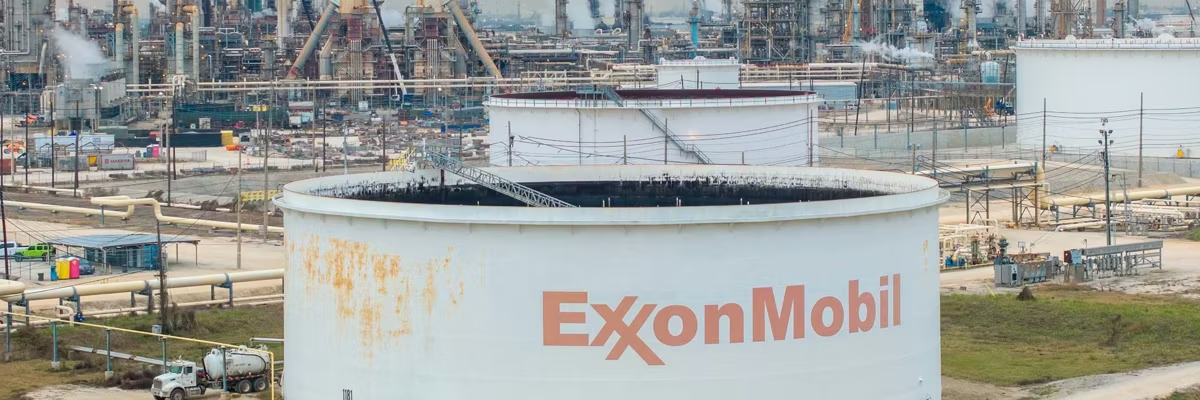
In an aerial view, the ExxonMobil Baytown Refinery is seen on January 13, 2026, in Baytown, Texas. (Photo by Brandon Bell/Getty Images)

Since 2021, top Wall Street banks have committed more than $124 billion in investments to the nine companies set to profit most from the toppling of Venezuela’s government.

As oil industry giants are being set up to profit from President Donald Trump’s invasion of Venezuela, a new analysis shows the ample backing those companies have received from Wall Street’s top financial institutions.

Last week, Bloomberg reported that stock traders and tycoons were “pouncing” after Trump’s kidnapping of President Nicolás Maduro earlier this month, after having pressured the Trump administration to “create a more favorable business environment in Venezuela.”

RECOMMENDED…

VENEZUELA-US-CONFLICT-CRISIS-OIL

Democrats Launch Probe to Learn What Trump Told Oil Giants About Venezuela Attack—and When
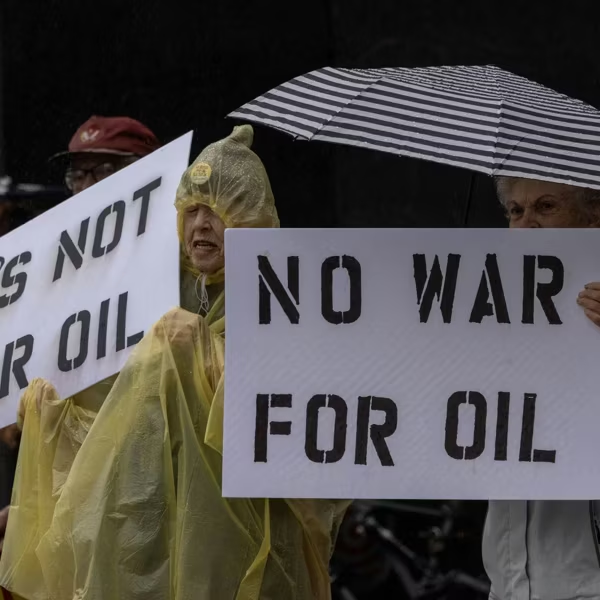
People participate in a “No War on Venezuela” protest

Trump Meeting With Big Oil Underscores Venezuela Agenda: Enriching ‘Himself and His Fossil Fuel Donors’

dataset compiled by the international environmental advocacy group Stand.earth shows the extent to which these interests are intertwined.

Stand.earth found that since 2021, banks—including JPMorgan Chase, HSBC, TD, RBC, CitigroupWells Fargo, and Bank of America—have committed more than $124 billion in investments to the nine companies set to profit most from the toppling of Venezuela’s government.

More than a third of that financing, $42 billion, came in 2025 alone, when Trump launched his aggressive campaign against Venezuela.
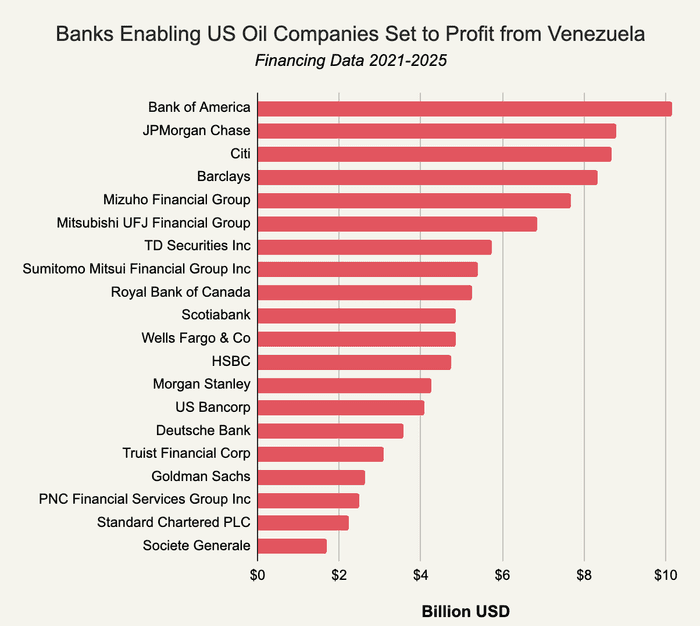
(Graphic from Stand.earth)

Among the companies expected to profit most immediately are refiners like Valero, PBF Energy, Citgo, and Phillips 66, which have large operations on the Gulf Coast that can process the heavy crude Venezuela is known to produce. These four companies have received $41 billion from major banks over the past five years.

Chevron, which also operates many heavy-crude facilities, benefits from being the only US company that operated in Venezuela under the Maduro regime, where it exported more than 140,000 barrels of oil per day last quarter.

At a White House gathering with top oil executives on Friday, the company’s vice chair, Mark Nelson, told Trump the company could double its exports “effective immediately.”

According to Jason Gabelman, an analyst at TD Cowen, the company could increase its annual cash flow by $400 million to $700 million as a result of Trump’s takeover of Venezuelan oil resources.

Chevron was also by far the number-one recipient of investments in 2025, with more than $11 billion in total coming from the banks listed in the report—including $1.78 billion from Barclays, another $1.78 billion from Bank of America, and $1.32 billion from Citigroup.

According to Bloomberg, just weeks before Maduro’s removal, analysts at Citigroup predicted 60% gains on the nation’s more than $60 billion in bonds if he were replaced.

Even ExxonMobil, whose CEO Darren Woods dumped cold water on Trump’s calls to set up operations in Venezuela on Friday, calling the nation “uninvestable,” potentially has something major to gain from Maduro’s overthrow.

Exxon and ConocoPhillips each have outstanding arbitration cases against Venezuela over the government’s 2007 nationalization of oil assets, which could award them $20 billion and $12 billion, respectively.

The report found that in 2025, ExxonMobil and ConocoPhillips received a combined total of more than $12.8 billion in investment from major financial institutions, which vastly exceeded that from previous years.

Data on these staggering investments comes as oil companies face increased scrutiny surrounding possible foreknowledge of Trump’s attack on Venezuela.

Last week, US Senate Democrats launched a formal investigation into “communications between major US oil and oilfield services companies and the Trump administration surrounding last week’s military action in Venezuela and efforts to exploit Venezuelan oil resources.”

Richard Brooks, Stand.earth’s climate finance director, said the role of the financial institutions underwriting those oil companies should not be overlooked either.

“Without financial support from big banks and investors, the likes of Chevron, Exxon, ConocoPhillips, and Valero would not have the power that they do to start wars, overthrow governments, or slow the pace of climate action,” he said. “Banks and investors need to choose if they are on the side of peace, or of warmongering oil companies.”

Original article by Stephen Prager republished from Common Dreams under Creative Commons (CC BY-NC-ND 3.0).

Elon Musk urges you to be a Fascist like him, says that you can ignore facts and reality then.
Donald Fuhrump says that Amerikkka doesn't bother with crimes or charges anymore, not being 100% Amerikkkan and opposing his real estate intentions is enough.
Donald Fuhrump says that Amerikkka doesn’t bother with crimes or charges anymore, not being 100% Amerikkkan and opposing his real estate intentions is enough.
Orcas discuss how Trump was re-elected and him being an obviously insane, xenophobic Fascist.

Continue ReadingAnalysis Reveals Wall Street Titans Behind Big Oil Profiteering Push in Venezuela

Report Reveals $2 Billion of New Financing by Big Banks for Oil and Gas in the Amazon

Spread the love

Original article by Julia Conley republished from Common Dreams under Creative Commons (CC BY-NC-ND 3.0). 

The Pastaza River and the Heart island are seen in the southern Ecuadorian Amazon Rainforest on April 12, 2023. 
Photo by Misha Vallejo Prut for The Washington Post via Getty Images)

“These investments are complicit in genocide: They are killing our culture, our history, and destroying the biodiversity of the Amazon.”

A day after the Brazilian state-run oil firm Petrobras announced it would begin drilling for oil near the mouth of the Amazon River “immediately” after obtaining a license despite concerns over the impact on wildlife, an analysis on Tuesday revealed that banks have added $2 billion in direct financing for oil and gas in the biodiverse Amazon Rainforest since 2024.

The report from Stand.earth—and Petrobras’ license—come weeks before officials in Belém, Brazil prepare to host the 2025 United Nations Climate Change Conference (COP30), where advocates are calling for an investment of $1.3 trillion per year for developing countries to mitigate and adapt to the climate emergency.

Examining 843 deals involving 330 banks, Stand.earth found that US banks JPMorgan ChaseBank of America, and Citi are among the worst-performing institutions, pouring between $283 million and $326 million into oil and gas in the Amazon.

The biggest spender on oil and gas in the past year has been Itaú Unibanco, the Brazilian bank, which has sent $378 million in financing to oil and gas firms for extractive activities in the Amazon.

“Oil and gas expansion in the Amazon endangers one of the world’s most vital ecosystems and Indigenous peoples who have protected it for millennia,” said Stand.earth. “In addition to fossil fuels leading global greenhouse gas emissions, in the Amazon their extraction also accelerates deforestation, and pollutes rivers and communities.”

The group’s research found that banks have directly financed more than $15 billion to oil and gas companies in the Amazon region since the Paris Agreement, the legally binding climate accord, was adopted in 2016. Nearly 75% of the investment has come from just 10 firms, including Itaú, JPMorgan Chase, Citi, and Bank of America.

The analysis comes weeks after the UN-backed Net-Zero Banking Alliance said it was suspending its operations, following decisions by several large banks to leave the alliance that was established in 2021 to limit banks’ environmental footprint, achieve net-zero emissions in the sector by 2050, and set five-year goals for reducing the institutions’ financing of emissions.

“Around 1,700 Indigenous people live here, and our survival depends on the forest. We ask that banks such as Itaú, Santander, and Banco do Nordeste stop financing companies that exploit fossil fuels in Indigenous territories.”

Devyani Singh, lead researcher for Stand.earth’s new bank scorecard on fossil fuel financing, noted that European banks like BNP Paribas and HSBC have “applied more robust policies to protect the sensitive Amazon rainforest than their peers” and have “significantly dropped in financing ranks.”

But, said Singh, “no bank has yet brought its financing to zero. Every one of these banks must close the existing loopholes and fully exit Amazon oil and gas without delay.”

More than 80% of the banks’ Amazon fossil fuel financing since 2024 has gone to just six oil and gas companies: Petrobras, Canada’s Gran Tierra, Brazil’s Eneva, oil trader Gunvor, and two Peruvian companies: Hunt Oil Peru and Pluspetrol Camisea.

The companies have been associated with human rights violations and have long been resisted by Indigenous people in the Amazon region, who have suffered from health impacts of projects like the Camisea gas project, a decline in fish and game stocks, and a lack of clean water.

“It’s outrageous that Bank of America, Scotiabank, Credicorp, and Itaú are increasing their financing of oil and gas in the Amazon at a time when the forest itself is under grave threat,” said Olivia Bisa, president of the Autonomous Territorial Government of the Chapra Nation in Peru. “For decades, Indigenous Peoples have suffered the heaviest impacts of this destruction. We are calling on banks to change course now: by ending support for extractive industries in the Amazon, they can help protect the forest that sustains our lives and the future of the planet.”

Stand.earth’s report warned that both the Amazon Rainforest—which provides a habitat for 10% of Earth’s biodiversity, including many endangered species—and the people who live there are facing “escalating threats” from oil and gas companies and the firms that finance them, with centuries of exploitation driving the forest “toward an ecological tipping point with irreversible impacts that have global consequences.”

Oil and gas exploration is opening roads into intact parts of the Amazon and other forests, while perpetuating the new fossil fuel emissions that scientists and energy experts have warned have no place on a pathway to limiting planetary heating.

“With warming temperatures, the delicate ecological balance of the Amazon could be upset, flipping it from being a carbon-absorbing rainforest into a carbon-emitting savannah,” reads the group’s report.

Jonas Mura, chief of the Gavião Real Indigenous Territory in Brazil, said “the noise, the constant truck traffic, and the explosions” from Eneva’s projects “have driven away the animals and affected our hunting.”

“Even worse: they are entering without our consent,” said Mura. “Our territory feels threatened, and our families are being directly harmed. Around 1,700 Indigenous people live here, and our survival depends on the forest. We ask that banks such as Itaú, Santander, and Banco do Nordeste stop financing companies that exploit fossil fuels in Indigenous territories.”

“These companies have no commitment to the environment, to Indigenous and traditional peoples, or to the future of the planet,” he added. “These investments are complicit in genocide: They are killing our culture, our history, and destroying the biodiversity of the Amazon.”

Original article by Julia Conley republished from Common Dreams under Creative Commons (CC BY-NC-ND 3.0). 

Orcas comment on killer apes destroying the planet by continuing to burn fossil fuels.
Donald Trump urges you to be a Climate Science denier like him. He says that he makes millions and millions for destroying the planet, Burn, Baby, Burn and Flood, Baby, Flood.
Nigel Farage urges you to ignore facts and reality and be a climate science denier like him and his Deputy Richard Tice. He says that Reform UK has received £Millions and £Millions from the fossil fuel industry to promote climate denial and destroy the planet.

Continue ReadingReport Reveals $2 Billion of New Financing by Big Banks for Oil and Gas in the Amazon

The World’s Largest Funder of Fossil Fuel Expansion

Spread the love

Original article by ALEC CONNON republished from Common Dreams under Creative Commons (CC BY-NC-ND 3.0). 

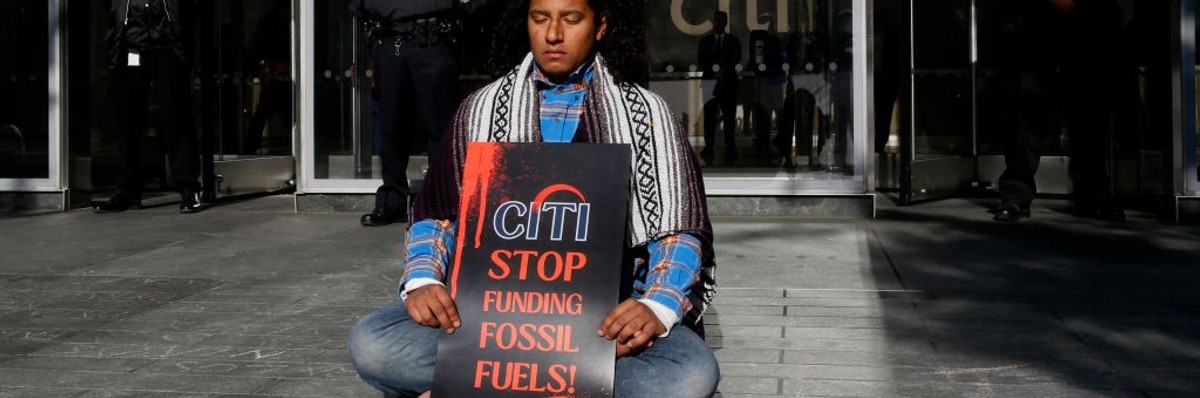
Environmental activist protest outside CitiBank Headquarters in New York City on April 25, 2023, calling for an end to fossil fuel financing.
 (Photo by Leonardo Munoz / AFP via Getty Images)

Here’s why we will be using our bodies to shut down Citibank’s global headquarters over and over again, this summer.

This summer, along with dozens of others, I’ll be helping to run the Summer of Heat on Wall Street, a campaign of sustained nonviolent civil disobedience against the banks, investors, and insurance companies financing fossil fuel expansion.

As we have written about here already, our plan is simple: using our bodies, we will continually blockade the New York headquarters of the Wall Street giants bankrolling coal, oil, and gas expansion; week after week, we will disrupt the companies disrupting our climate and our planet.

We’re targeting several companies―including the insurance company, Chubb, and the private equity group, KKR―but our number one target will be Citigroup. Here’s why.

Since the adoption of the Paris Agreement in 2015, Citi has provided $204.46 billion in financing to the company’s most rapidly developing new coal, oil, and gas fields. Remarkably, Citi has provided more money to those oil and gas companies than even JPMorgan Chase―the bank that climate activists like to call the “Doomsday Bank.”

To be clear, I’m talking here only about the financing Citi has provided for companies developing new oil and gas reserves, not merely investing in infrastructure to keep the oil pumping from existing reserves. When we take into account financing to all fossil fuel companies, Citi has provided a little shy of $400 billion to coal, oil, and gas companies since 2015. But focusing on expansion is important.

Numerous climate experts, from the International Energy Agency to the Intergovernmental Panel on Climate Change, have made it clear that to stave off the worst of climate catastrophe, there must be no investment in new fossil fuel expansion. But last year alone, Citibank provided $14.6 billion to the companies most rapidly expanding their coal, oil, and gas operations.

Citibank’s financing of fossil fuel expansion not only drives climate chaos, it also results in environmental racism. To give just one example, 70% of the air pollution generated by ExxonMobil is dumped on communities of color, contributing to the higher levels of heart disease, strokes, cancer, and other illnesses that are widely associated with living near oil and gas infrastructure.

Citibank’s top fossil fuel client is ExxonMobil. Yet when asked by Congress if she knew what environmental racism was, Citi CEO Jane Fraser replied: “Only vaguely.”

Not content with merely financing fossil fuels, Citi also works to block climate action both from its own investors and the U.S. government.

CEO Jane Fraser is chair of a group called the Financial Services Forum and a board member of the Bank Policy Institute, groups that have fought tooth and nail to weaken climate-financial regulation advanced by the Biden Administration. Citi also donates to several high-profile politicians who work against action on climate, including Congressman Andy Barr who has led the charge in a series of fossil fuel-backed, right-wing attacks designed to prevent the financial industry from taking action on climate.

For the past three years, Citi has faced a shareholder resolution from investors calling for a report on how the bank ensures that the oil, gas, and mining companies it finances respect Indigenous rights and sovereignty. Yet, in spite of Ms. Fraser’s previous claims in 2020 that Citi was committed to being ”an anti-racist institution,” Citi has fought the resolution each year, urging investors to vote against it, even as they remain one of the world’s largest funders of oil and gas in the Amazon rainforest.

Besides its role in the climate crisis and environmental racism, there are plenty other reasons to be angry at Citibank, too. In the early 20th century, Citi actively lobbied the US government to invade and occupy Haiti, which it promptly did, resulting in decades of bloodshed and misery for Haitians. A century later, Citi did as much as any bank to cause the financial crisis of 2008, which led to nearly 3.8 million Americans losing their homes; no bank received a larger bailout from the government than Citi.

And then there’s the fact that Citi is the foreign bank with the largest presence in Israel and a major financier of weapons manufacturers that are currently providing Israel with fighter jets and missiles being used to massacre Palestinians.

All of this is why Citibank is our number one target this summer.

To kick off the campaign, we will disrupt and shut down Citibank’s headquarters in Manhattan every day, all week long. We start on Monday, June 10th. We hope that you join us.

Original article by ALEC CONNON republished from Common Dreams under Creative Commons (CC BY-NC-ND 3.0). 

‘Just The Beginning’: 50+ Arrested For Blockading Citigroup Bank Over Climate Crimes ›

Continue ReadingThe World’s Largest Funder of Fossil Fuel Expansion

‘Criminal’: Major Banks Funneled $1.8 Trillion to Carbon Bombs Between 2016 and 2022

Spread the love

Original article by OLIVIA ROSANE republished from Common Dreams under Creative Commons (CC BY-NC-ND 3.0). 

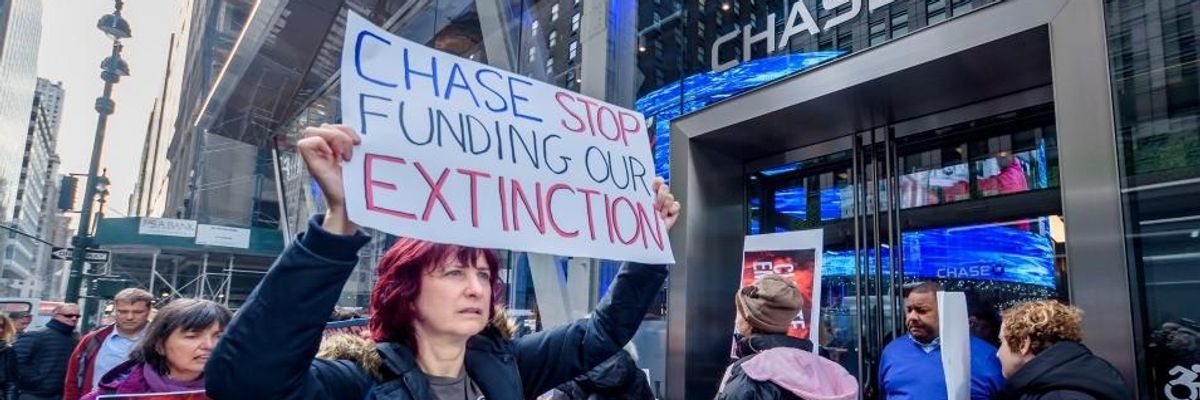
Protesters picket outside a Chase Bank branch in November 2019. (Photo: Erik McGregor/LightRocket via Getty Images)

JPMorgan Chase led the pack with more than $141 billion invested between 2016 and 2022, followed by Citi with $119 billion, and Bank of America with $92 billion.

Major banks funneled more than $150 billion in 2022 toward “carbon bomb” fossil fuel projects that would blow through the world’s chances of limiting global heating to 1.5°C above pre-industrial levels.

The data, published by The Guardian Tuesday, shows that major banks in the U.S., Europe, and China funded the companies behind these projects with a total of $1.8 trillion between 2016 and 2022, with U.S. banks contributing more than half a trillion of that total.

“Criminal,” Nuclear Consulting Group chair Paul Dorfman tweeted in response to the news.

“We need to rapidly decline our production of fossil fuels and support for fossil fuels, whether that’s regulatory or financial.”

The “carbon bombs” are 425 fossil fuel extraction projects identified by The Guardian and other nonprofit and media organizations and compiled in an online database in 2022. Each bomb has the potential to release more than a gigaton of carbon dioxide over its lifetime. At first, it was calculated that igniting all 425 bombs would release emissions more than double the remaining carbon budget that scientists say humans can spend and still have a 50% chance of limiting warming to 1.5°C. However, research published Monday calculated that the remaining carbon budget is actually around 250 gigatons of carbon dioxide, not the 500 previously believed. The carbon bombs would release a combined total of more than 1,000 gigatons, or four times the revised number.

“The budget is so small, and the urgency of meaningful action for limiting warming is so high, [that] the message from [the carbon budget] is dire,” study co-author Joeri Rogelj of Imperial College London told The Guardian Monday.

That narrowing window makes it all the more urgent that banks stop financing fossil fuels, yet that is not what they are doing, according to the analysis of the carbon bomb data completed by French nonprofits Data for Good and Éclaircies, along with European media partners.

The data includes a list of the top ten financial backers of companies operating carbon bombs.

JPMorgan Chase led the pack with more than $141 billion invested between 2016 and 2022, followed by Citi with $119 billion, Bank of America with $92 billion, the Chinese ICBC with $92.2 billion, and BNP Paribas with $71.9 billion. Last year alone, the banks directly or indirectly funded the projects with around $161 billion. This comes despite greenwashing rhetoric from financial institutions pledging to act on climate.

For example, JPMorgan has promised to set goals to reduce the emission intensity of its portfolios for key sectors, including oil and gas, electricity, and auto making.

“We provide financing all across the energy sector: supporting energy security, helping clients accelerate their low-carbon transitions, and increasing clean energy financing with a target of $1 trillion for green initiatives by 2030,” a JPMorgan Chase spokesperson told The Guardian. “We are taking pragmatic steps to meet our 2030 emission intensity reduction targets in the six sectors that account for the majority of global emissions, while helping the world meet its energy needs securely and affordably.”

The data suggests these institutions need to do more and faster.

“We need to rapidly decline our production of fossil fuels and support for fossil fuels, whether that’s regulatory or financial,” Shruti Shukla, a National Resources Defense Council energy campaigner who was not involved with the research, told The Guardian.

In a worse-case scenario, nothing will be done to limit emissions, these carbon bombs will be exploited and burned, and weather will turn ever more extreme. However, if world leaders do succeed in rapidly phasing out fossil fuels, these projects could become stranded assets for the companies and banks that invested in them, and if this happens all at once, it could trigger a financial crash, University of Witten-Herdecke sustainable finance research fellow Jan Fichtner told The Guardian.

To avoid this, the world must work to make fossil fuels less profitable, Fichtner said.

“In a capitalist system, profitability is the most important current,” Fichtner told The Guardian. “You can try to swim against the current, it’s possible, but it’s very, very difficult.”

Original article by OLIVIA ROSANE republished from Common Dreams under Creative Commons (CC BY-NC-ND 3.0). 
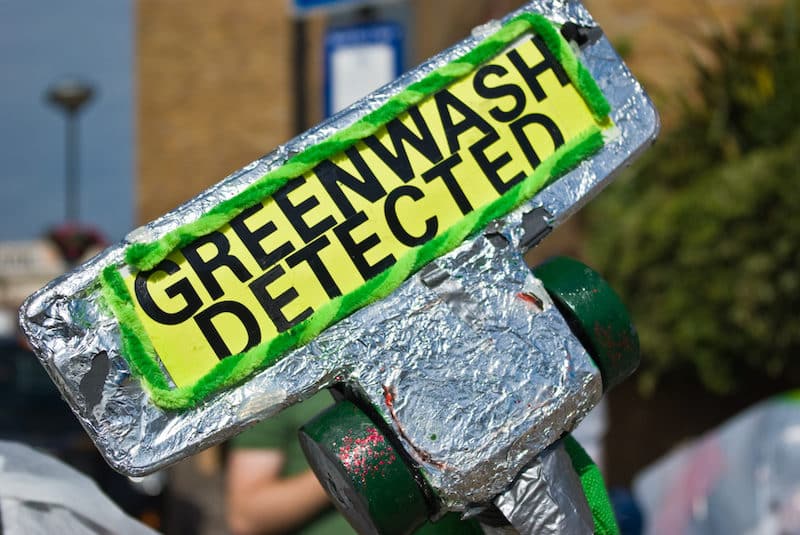
Greenwash detected.

Continue Reading‘Criminal’: Major Banks Funneled $1.8 Trillion to Carbon Bombs Between 2016 and 2022

Reports Expose US Billionaires and Corporate Profiteers Enabling Israel’s War on Gaza

Spread the love

Original article by JESSICA CORBETT republished from Common Dreams under Creative Commons (CC BY-NC-ND 3.0).
Zionist president Joe Biden. 27 July 2021 image by Official White House Photo by Adam Schultz. Original public domain image from Flickr

“As the Biden administration attempts to deny the death toll of Israel’s campaign of mass murder in Gaza and sell genocide as a stimulus for the U.S. economy, these are the death merchants profiting from the war machine.”

With more than 7,300 Palestinians killed so far in Israel’s three-week bombardment of Gaza, a series of reports this week have exposed how U.S. weapon-makers and billionaire donors are enabling what legal scholars say could amount to genocide.

After Israel declared war in response to Hamas killing over 1,400 Israelis and taking around 200 hostages, the stocks of major American and European war profiteers soared. A Thursday report from Eyes on the Ties—the news site of LittleSis and Public Accountability Initiative—targets five U.S. firms with a record of providing weaponry to Israel.

The outlet stressed that while announcing a supplemental funding request that includes $14.3 billion for Israel, U.S. President Joe Biden last week “invoked ‘patriotic American workers’ who are ‘building the arsenal of democracy and serving the cause of freedom,’ but it’s the defense company CEOs who rake in tens of millions a year, and Wall Street shareholders, who are the real beneficiaries of warmongering.”

The five targeted industry giants collectively recorded $196.5 billion in military-related revenue last year, Eyes on the Ties reported. They are Boeing ($30.8 billion), General Dynamics ($30.4 billion), Lockheed Martin ($63.3 billion), Northrop Grumman ($32.4 billion), and RTX, formerly Raytheon ($39.6 billion).

“The top shareholders in these five defense companies largely consist of big asset managers, or big banks with asset management wings, that include BlackRock, Vanguard, State Street, Fidelity, Capital Group, Wellington, JPMorgan ChaseMorgan Stanley, Newport Trust Company, Longview Asset Management, Massachusetts Financial Services Company, Geode Capital, and Bank of America,” the news outlet noted.

Eyes on the Ties also highlighted how chief executives are handsomely compensated—and the CEOs’ ties to Big Pharma, the fossil fuel industry, Wall Street, and foreign policy think tanks such as the Council on Foreign Relations and Center for Strategic and International Studies.

According to the report:

  • Boeing CEO David Calhoun took in over $64 million in total compensation from 2020-22 and as of February held 193,247 shares;
  • General Dynamics CEO Phebe N. Novakovic took in over $64 million in total compensation from 202-22 and as of March held 1,616,279 shares;
  • Lockheed Martin CEO Jim Taiclet took in over $66 million in total compensation from 2020-22 and as of February held 56,054 shares;
  • Northrop Grumman CEO Kathy J. Warden took in over $61 million in total compensation from 2020-22 and as of March held 161,231 shares; and
  • RTX CEO Gregory J. Hayes took in over $63 million in total compensation from 2020-22 and as of February held 801,339 shares.

Other reporting this week has taken aim at those CEOs for their suggestions that Israel’s assault on Gaza is good for business.

During Lockheed Martin’s latest earnings call, Taiclet correctly predicted Biden’s request last week, saying that “there continues to be the option… for supplemental requests related to support Ukraine, Israel, and potentially Taiwan.”

In addition to the request for Israel—which already gets nearly $4 billion in annual U.S. military aid—Biden asked for $4 billion to counter Chinese influence in the Indo-Pacific region and $61.4 billion more for Ukraine, which is battling a Russian invasion.

“We are all witnessing significant geopolitical tensions across the globe, including the ongoing war in Ukraine and the horrific attacks in Israel,” Warden said during Northrop Grumman’s Thursday earnings call, according toVICE. “As we saw last week, the [Biden] administration continues to make supplemental requests for urgent needs, including those in Ukraine and Israel, to include investments in weapons systems and defense industrial base readiness.”

As The Lever reported:

“The Israel situation obviously is a terrible one, frankly, and one that’s just evolving as we speak,” said Jason Aiken, chief financial officer and executive vice president at General Dynamics, on Wednesday. “But I think if you look at the incremental demand potential coming out of that, the biggest one to highlight and that really sticks out is probably on the artillery side.”

He continued: “Obviously that’s been a big pressure point up to now with Ukraine, one that we’ve been doing everything we can to support our Army customer. We’ve gone from 14,000 rounds per month to 20,000 very quickly. We’re working ahead of schedule to accelerate that production capacity up to 85,000, even as high as 100,000 rounds per month, and I think the Israel situation is only going to put upward pressure on that demand.”

Last week, roughly 100 activists gathered outside of General Dynamics’ weapons plant in Pittsfield, Massachusetts, to protest the Israeli war, holding signs with slogans like, “Genocide: Brought To You By General Dynamics.”

Both The Lever and VICE also pointed out that during RTX’s Tuesday call, Hayes started by “acknowledging the tragic situation playing out in Israel” before turning to “an update on our end markets.”

If Congress approves Biden’s request for Israel, VICE explained, “some of the money would be used to restock Israel’s Iron Dome rocket defense system, which RTX manufactured.” Hayes said: “I think really across the entire Raytheon portfolio, you’re going to see a benefit of this restocking. On top of what we think is going to be an increase in [U.S. Department of Defense] top line.”

It’s not just defense executives enabling Israel’s mass slaughter of civilians in Gaza. As Eyes on the Ties reported, “Lobbying groups including the American Israel Public Affairs Committee (AIPAC) and Democratic Majority for Israel have been active in Washington, calling on lawmakers to send money and weapons to Israel.”

The report names some billionaire donors to the lobbying groups, including New England Patriots and the Kraft Group CEO Robert Kraft, private equity investor Marc Rowan, venture capitalist Gary Lauder, hedge fund managers Daniel Loeb and Paul Singer, and Home Depot co-founder Bernard Marcus, who is also the founding president of the Israel Democracy Institute.

U.S. Rep. Summer Lee (D-Pa.) said Wednesday that Americans “know that funneling billions more dollars into arms dealers’ pockets won’t keep our children safe from weapons of war at home or across the world. It won’t keep our loved ones safe from toxins in our air and drinking water. They know that lining the pockets of weapons manufacturers won’t help families struggling to afford housing, medicine, or grocery costs. They know defense contractors won’t safeguard Medicare and Social Security or shield our communities against the climate crisis.”

Unlike the CEOs of firms like Lockheed Martin and RTX, “moms who can’t afford childcare, young folks who can’t pay off their debt, veterans who can’t keep up with housing costs, and children who go to school hungry don’t have million-dollar lobbying budgets,” added Lee, one of the few members of Congress pushing for a cease-fire in Gaza. “So it’s up to us to stand up for their needs.”

Original article by JESSICA CORBETT republished from Common Dreams under Creative Commons (CC BY-NC-ND 3.0).
Continue ReadingReports Expose US Billionaires and Corporate Profiteers Enabling Israel’s War on Gaza