This workby Middle East Monitor is licensed under a Creative Commons Attribution-NonCommercial-ShareAlike 4.0 International License.
Displaced Palestinians in the Jabalia al-Nazla area in northern Gaza are trying to survive in makeshift tents set up among the rubble of destroyed homes on February 09, 2026. [Saeed M. M. T. Jaras – Anadolu Agency]
Four Palestinians, including a child, were killed and another wounded Friday by Israeli gunfire and shelling that targeted areas in Gaza City and the northern Gaza Strip, in a new violation of a ceasefire in force since Oct. 10, Anadolu reports.
Ismail Aql, 12, was killed after Israeli forces opened fire near the Khalifa School in northern Gaza, which shelters displaced civilians.
Another Palestinian, Ayman Ahmed al-Nabih, 54, was killed in Israeli shelling that targeted the Tuffah neighborhood in eastern Gaza City. His body was transferred to the Al-Ahli Baptist Hospital in the city center.
Witnesses told Anadolu that Israeli artillery shelled the area where al-Nabih was present, which lies outside the Israeli army’s deployment zone under the ceasefire agreement.
In the Tuffah neighborhood, 22-year-old Rizq Iyad al-Sharafa was wounded when an Israeli drone targeted a gathering of civilians near the al-Sharafa roundabout, east of al-Mahatta Park, according to a medical source.
Earlier, Abdelwahab Asaad Qanbour, 32, was killed in Israeli shelling that targeted the Shujaiya neighborhood, east of Gaza City. His body was also transferred to Al-Ahli Baptist Hospital.
Witnesses said an Israeli drone struck Qanbour while he was near Salah al-Din Street in Shujaiya, in an area outside Israeli troop deployment zones.
Since the Gaza ceasefire took effect, Israeli violations involving shelling and gunfire have killed 636 Palestinians and wounded 1,704 others as of Thursday, according to Palestinian sources.
The deal was reached after two years of a genocidal war launched by Israel on Oct. 8, 2023. The war left more than 72,000 Palestinians dead and 172,000 wounded, while destroying roughly 90% of Gaza’s civilian infrastructure, with reconstruction costs estimated by the United Nations at about $70 billion.
This workby Middle East Monitor is licensed under a Creative Commons Attribution-NonCommercial-ShareAlike 4.0 International License.
Elon Musk urges you to be a Fascist like him, says that you can ignore facts and reality then.Donald Trump warns against following the https://onaquietday.org blog, says that it’s easy atm, she only needs to report war crimes supporting Israel’s genocidal expansion.Orcas discuss rotting brain. Front Orca says “Wish someone would lock him up”.
This work by Middle East Monitor is licensed under a Creative Commons Attribution-NonCommercial-ShareAlike 4.0 International License
Body of a Palestinian fisherman are brought to Nasser Hospital in Khan Yunis, in the southern Gaza Strip, after an Israeli army attack targeted a small fishing boat off the coast on January 4, 2026. [Abed Rahim Khatib – Anadolu Agency]
The Israeli army killed three Palestinians on Sunday and carried out a series of airstrikes across various parts of the Gaza Strip, Anadolu reports.
One Palestinian was killed after an Israeli drone opened fire in an area from which the army had withdrawn under the ceasefire agreement northwest of the city of Rafah in southern Gaza, a medical source told Anadolu.
The Israeli army also killed a fisherman, another medical source said.
According to local sources, Israeli naval forces fired gunshots off the coasts of Khan Younis and Rafah in southern Gaza earlier Sunday.
On the northwestern outskirts of Rafah, a medical source said another Palestinian was shot in the head by Israeli forces, describing his condition as “critical.”
Local sources said that the area where the Palestinian was injured is among those from which the Israeli army withdrew under the ceasefire agreement.
A 15-year-old boy was killed by Israeli gunfire in the Joura Al-Lout area, south of the city of Khan Younis in southern Gaza, from which the army had withdrawn under the agreement, a medical source told Anadolu.
Another Palestinian sustained a gunshot wound to the thigh after the Israeli naval opened fire off the coast of Deir al-Balah in central Gaza, medical sources and eyewitnesses told Anadolu.
Israeli warplanes also carried out a series of airstrikes on various areas north and west of Rafah.
Meanwhile, the Israeli army carried out demolitions of residential buildings in eastern Khan Younis, accompanied by artillery shelling of areas that are under its control under the agreement.
Separately, Israeli warplanes launched a series of airstrikes on different areas in northern Gaza and east of Gaza City.
In central Gaza, Israeli military vehicles opened indiscriminate fire toward the eastern areas of the Bureij refugee camp.
Since the ceasefire agreement came into effect on Oct. 10, the Israeli army has committed hundreds of violations, killing 420 Palestinians and wounding 1,184 others, according to the Health Ministry.
The ceasefire halted Israel’s two-year war that killed nearly 71,400 Palestinians, most of them women and children, injured more than 171,200 others, and left the enclave in ruins. But despite the ceasefire, Israel’s deadly attacks on Gaza continue.
This work by Middle East Monitor is licensed under a Creative Commons Attribution-NonCommercial-ShareAlike 4.0 International License
Keir Starmer objects to criticism of the IDF. He asks how could anyone object to them starving people to death, forced marches like the Nazis did, bombing Gaza’s hospitals and universities, mass-murdering journalists, healthworkers and starving people queuing for food, killing and raping prisoners and murdering children. He calls for people to stop obstructing his genocide for Israel.Orcas discuss Genocide-supporting and complicit Zionists. Donald Trump, Keith Starmer, David Lammy, Rachel Reeves, Angela Rayner and Wes Streeting are acknowledged as evil genocide-complicit and supporting cnuts.Vote Labour for Genocide.
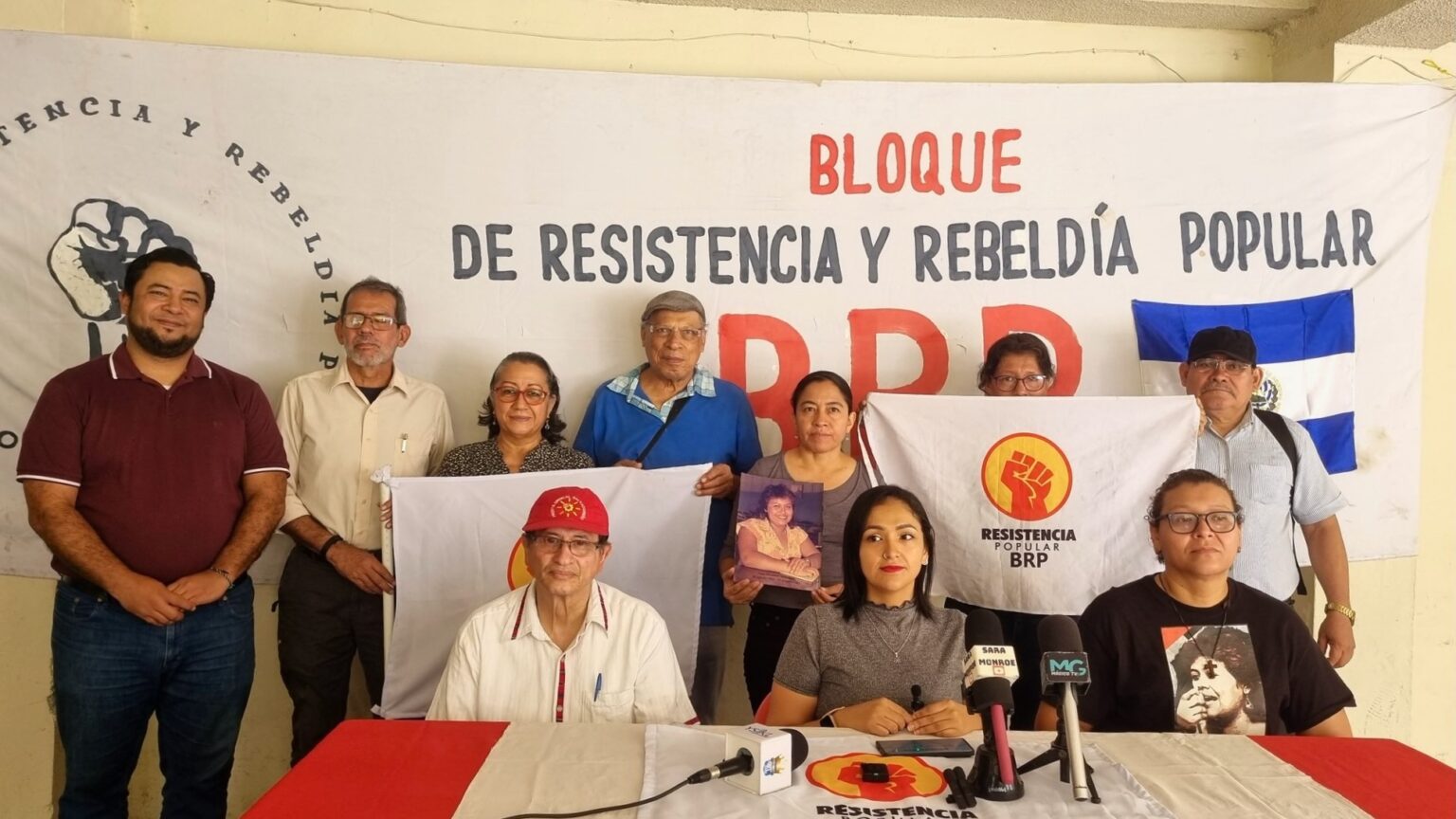
Organizers hold flags and a photo of labor martyr Febe Elizabeth Velasquéz during a press conference on the commemoration of the Day of the Salvadoran Trade Unionist. Photo: BRRP/X
The October 31 commemoration links past revolutionary struggles with today’s fight for labor rights and democracy
October 31 in El Salvador is recognized as the Day of the Salvadoran Trade Unionist.
This year’s commemoration event brought together veteran organizers and a new generation of grassroots leaders, bridging past and present struggles for workers’ rights and social change.
“This date brings us back to the origin of labor organizing in our country,” asserted Marisela Ramírez, a leader of the Popular Resistance and Rebellion Bloc, at the rally at Cuscatlán Park in San Salvador, organized by the group.
“We remember with dignity, the history of struggle, resistance, and sacrifice, of the labor movement in El Salvador.”
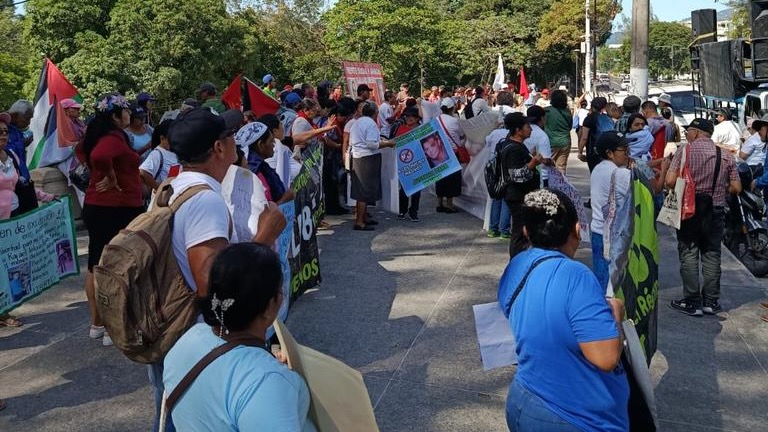
A few hundred people gathered with placards, flags, and banners representing various organizations, like the Salvadoran Social and Labor Front (FSS), the Permanent Roundtable for Labor Justice, the Movement of Victims of the Regime (MOVIR), and others.
Ramírez outlined the legacy that the day is tied to: the historic strikes of the 40s and 50s, the struggles for the 8-hour workday, for fair wages, and for the right to unionize. The event also paid tribute to “the thousands of women and men who, during the repression of the 70s and 80s, sacrificed their lives to defend justice and the dignity of the working class” against the US-backed Salvadoran government.
The Day of the Salvadoran Trade Unionist was established by Legislative Decree 589 (1990). It specifically honors the leaders of the National Union Federation of Salvadoran Workers (FENASTRAS) that were bombed by government forces on October 31, 1989.
Friday’s commemoration paid homage to prominent labor figure Febe Elizabeth Velasquéz and the nine other leaders martyred in the attack on the country’s principal organized labor front at the time.
A legacy of revolutionary struggle
The country’s trade groups have a long history of tying labor organizing to social change. These connections can be traced back to the formation of the Communist Party in 1930. Similarly, many of the 1989 FENASTRAS martyrs were affiliated with the National Unity of Salvadoran Workers (UNTS), the main federation tied to the popular movement aligned with the left guerilla force, the Farabundo Martí National Liberation Front (FMLN).
Legislative Decree 589 (1990) came two years before the 1992 Peace Accords, which officially ended the 12-year war between the FMLN (Farabundo Martí National Liberation Front) and the US-backed Salvadoran state.
By 1990, faced with continued armed opposition and a popular movement (made up of unions, student groups, and peasant associations) that had endured heavy repression, the Salvadoran government was under tremendous pressure to negotiate and recognize the legitimacy of the country’s social movements.
The deadly attack on FENASTRAS’ headquarters was a major factor in this outcome. Less than two weeks after the massacre, the FMLN would launch their historic final offensive, named in honor of the martyred union leader: “To the Limit, Period. Febe Elizabeth Lives”.
The Salvadoran military responded with intense fighting and indiscriminate aerial bombardment of residential neighborhoods, allegedly to dislodge the guerilla fighters. One US-trained Atlacatl Battalion unit stormed the Central American University (UCA) campus and murdered six Jesuit priests. The priests were known to advocate for a negotiated settlement to the conflict and spoke out against the military’s human rights abuses. The government and military claimed they were the “brain of the guerilla”.
International condemnation of the Salvadoran government grew louder than ever.
The FMLN was ultimately forced to retreat from the cities, but not before making it clear that a decisive military victory for the government was impossible. Negotiations became inevitable.
Decree 589 (1990) represented one of the first concessions by the state. It opened democratic space and acknowledged the sacrifices of trade unionists persecuted, imprisoned, or killed over the previous decade for their association with the revolutionary left. The FENASTRAS bombing and the martyrdom of Febe Elizabeth Velásquez was etched in history as the Day of the Salvadoran Trade Unionist.
Following these events, the power of the revolutionary movement and organized labor in El Salvador would completely restructure politics in the country through key democratic reforms signed into law in the 1992 Peace Accords.
Historical continuity and labor setbacks under Bukele
At the rally at Cuscatlán Park, the Bloc emphasized that this day is not only about remembrance, but also historical continuity: “the defense of labor rights today is part of the same battle for social justice that those martyrs defended with their lives,” Marisela Ramírez proclaimed.
The event’s organizers asserted that today, the Salvadoran trade unionist faces a new wave of “persecution and criminalization” by the “authoritarian regime of Nayib Bukele”.
“This regime has imposed a neoliberal and anti-union model that intends to eliminate all forms of independent organizing that defends labor rights,” says the Bloc leader.
The group has consistently denounced a systematic weakening of union structures by the Bukele regime. They claim that recently, dozens of union members have suffered arbitrary arrests, threats, and terminations without justification. Over 200 unions have been denied credentials.
Despite the increasing attacks, Ramírez tells Peoples Dispatch that the historic spirit of resistance in the Salvadoran labor movement is still alive.
“Just as before, today we see unionism as a collective and solidarity-based struggle, not only for economic improvements, but also for social transformation and justice,” she says.
Several Palestine flags were visible throughout the crowd, as well as placards that read “Respect our rights!” and “Freedom for political prisoners!” Some had photos of young men imprisoned or disappeared, asserting their innocence. Several placards displayed the image of Febe Elizabeth Velasquéz. Others, the image of Óscar Romero, the Archbishop of San Salvador, assassinated by government forces in 1980 after calling on the soldiers to disobey their orders amid escalating violence and massacres of civilians.
Commemoration event for the Day of the Salvadoran Trade Unionist. Photo: BRRP
“The impunity of yesterday is the impunity of today,” she declared.
“The only way to resist the impunity, the social injustice that we’re living under is through social struggle. We have to continue taking the streets and raising our voices.”
Rebuilding the labor movement in Bukele’s El Salvador
Ramírez says that what is lacking in the Salvadoran left is a political instrument that can “capture the discontent of the popular sectors and channel their demands towards a strategic commitment to social transformation.”
Amid Bukele’s “state of exception”, the challenge the new generation faces, she argues, is that of rebuilding and revitalizing Salvadoran trade unionism. Not just the infrastructure itself but the values and culture of historic movements. The new generation must promote “the active participation of women and young people in a process of organizational and ethical renewal that can re-articulate the labor struggles with broader social causes,” Ramírez says.
The Popular Resistance and Rebellion Bloc recently held a mass march on September 15, El Salvador’s Independence Day. It mobilized its various affiliated organizations, trade unions, civil society groups, and the general public against the human rights violations of the Bukele government.
September 15 mass march in El Salvador. Photo: BRRP
A new generation may be doing just that: revitalizing the historic struggles of the Central American country.
As resistance grows once again, organizers across generations maintain that commemorations like the Day of the Salvadoran Trade Unionist are crucial in giving shape, identity, and historical memory to the social movements of today.
The labor leaders targeted in the October 31, 1989 FRENASTRAS bombing are the following:
Febe Elizabeth Velásquez – General Secretary of FENASTRAS and member of the National Unity of Workers (UNTS); killed.
Ricardo Humberto Cestoni – Recording Secretary of the ANDA Workers’ Company Union (SETA); killed.
Rosa Hilda Saravia de Elías – Member of the Union of Workers of the Cotton, Synthetic, Textile Finishing and Related Industries (STITAS); killed.
Julia Tatiana Mendoza Aguirre – Member of the Gastronomic Union (STITGASC); killed.
Vicente Melgar – Secretary of Social Assistance of SETA; killed.
José Daniel López Meléndez – Member of SETA and Secretary of Conflicts of FENASTRAS; killed.
Luis Gerardo Vásquez – Member of the General Union of Bank Employees (SIGEBAN); killed.
María Magdalena Sánchez – FENASTRAS member; killed.
Carmen Hernández – FENASTRAS member; killed
Unidentified male worker – Died later from injuries sustained in the explosion
This work by Middle East Monitor is licensed under a Creative Commons Attribution-NonCommercial-ShareAlike 4.0 International License.
Israel continues to deploy soldiers, tanks, military aircraft and armoured vehicles near the Gaza Border as Israeli attacks continue on Gaza on May 1, 2024 [Mostafa Alkharouf – Anadolu Agency]
Israeli media reported that 4 soldiers were missing, and others were killed and wounded in Gaza, as part of a large ambush to capture Israeli soldiers carried out by the Qassam Brigades in the Zeitoun neighbourhood east of Gaza City.
Sources reported that the operation began with a large ambush in the Zeitoun neighbourhood, which resulted in the deaths of several Israeli soldiers, while other reports confirmed injuries described as critical.
Hebrew media added that the Israeli army deployed 6 additional helicopters to evacuate the dead and wounded from the ambush site, while firing flares intensively into the skies over central Gaza in an attempt to secure its forces.
Reports also indicated that the Israeli army activated the Hannibal Protocol, an emergency military measure used in such situations to prevent its soldiers from being captured.
Sources confirmed that forces from the (162) Division and the (401) Armoured Brigade were the ones who fell into the ambush, and that these forces were under heavy field pressure due to fighting in the Zeitoun neighbourhood with the arrival of more Palestinian fighters to support the operation.
Israeli media reported that Qassam fighters attempted to capture soldiers during the ambush in the Zeitoun neighbourhood, while the Israeli army continues extensive searches for the missing soldiers.
Reports also indicated that the first operation took place in the Zeitoun neighbourhood when a force from the Nahal Brigade fell into a well-planned ambush, killing one soldier and wounding others. Other forces were then subjected to a second ambush in the Sabra neighbourhood, prompting Israeli helicopters to intervene and bomb the site.
Abu Obeida, spokesman for the Qassam Brigades, the military wing of the Islamic Resistance Movement (Hamas), confirmed that the Palestinian resistance is on high alert to confront Israel’s plans to occupy Gaza City, which he said would be devastating for the occupation’s political and military leadership. He noted that the Israeli prisoners would be with the resistance fighters in the fighting areas.
In a series of posts on Telegram on Friday evening, Abu Obeida said that the plans to occupy Gaza “will be paid for by the enemy army in the blood of its soldiers, and will increase the chances of capturing new soldiers, God willing.”
Keir Starmer objects to criticism of the IDF. He asks how could anyone object to them starving people to death, forced marches like the Nazis did, bombing Gaza’s hospitals and universities,mass-murdering journalists, healthworkers and starving people queuing for food, killing and raping prisoners and murdering children. He calls for people to stop obstructing his genocide for Israel.UK Labour Party government ministers Keir Starmer, Angela Rayner and Rachel Reeves explain that they are partners complicit in Israel’s Gaza genocide. The UK has provided Israel with arms, military and air force support. They explain that they don’t do gas chambers but do do forced marches, starvation, destroy hospitals, mass-murders of journalists and healthcare workers.Genocide denier and Current UK Prime Minister Keir Starmer is quoted that he supports Zionism without qualification. He also confirms that UK air force support has been essential in Israel’s mass-murdering genocide. Includes URLs https://www.declassifieduk.org/keir-starmers-100-spy-flights-over-gaza-in-support-of-israel/ and https://youtu.be/O74hZCKKdpA
Demonstrators kick back teargas canisters shot by police during a protest in the central business district of Nairobi, Kenya, 25 June 2025. Photograph: Daniel Irungu/EPA
Police clashed with people marching in Nairobi and other areas to honour those killed in protests last year
At least 16 people have been killed and 400 injured in Kenya as a nationwide demonstration to honour those killed during last year’s anti-government protests turned chaotic, with police clashing with protesters in different parts of the country.
Amnesty Kenya’s executive director, Irũngũ Houghton, said the death toll had been verified by the government-funded Kenya national commission on human rights. “Most were killed by police,” he said.
A joint statement from groups supporting the protests said 83 people were seriously injured and at least eight people were being treated for gunshot wounds.
“We pray for our nation, dialogue and a way forward from the political impasse facing Kenya,” said the statement from the Law Society of Kenya (LSK), the Police Reforms Working Group and the Kenya Medical Association.
Thousands of Kenyans took to the streets early on Wednesday to pay tribute to more than 60 people who died last year when police opened fire on a crowd that tried to storm parliament while MPs inside passed legislation to raise taxes.