Spending review: Rachel Reeves is about to make a £600 billion gamble on growth

Spread the love

Steve Schifferes, City St George’s, University of London

UK chancellor Rachel Reeves faces her biggest test with the government’s departmental spending plans for the three years from next April until the general election. With nearly £600 billion a year to spend, her decisions will impact on every aspect of public life and shape the political weather for years to come.

She believes the key to reviving Labour’s fortunes as its poll ratings tumble lies in boosting economic growth.

So the government has promised that its policies will increase the UK’s anaemic growth rate and enhance productivity. Reeves is looking to capital spending on big projects that will boost the economy, such as the £14.2 billion government investment in a new nuclear power plant at Sizewell in Suffolk.

Last year she revised the government’s fiscal rules to give herself the space to borrow an extra £113 billion over three years to transform Britain’s ageing infrastructure. She has already made it clear that she wants to boost transport investment outside of London, as well as invest in research and development, including green energy.

But there are challenges ahead. In the first place, the effect of infrastructure investment takes a long time to feed through. This is partly because of the lag between planning the projects and when they come on-stream.

It will take time before the full effect will be felt on productivity, which has been growing more slowly than expected. The Office for Budget Responsibility (OBR) suggested in March that the latest government plans for planning reform might increase productivity by just 0.2% in the longer term.

There are also some real trade-offs as to where the increased capital investment will go – and which sectors will benefit most. The chancellor has emphasised her commitment to putting more money into projects outside London and south-east England that have had less public investment in the past.

But London and the south-east is where productivity is highest and where further investment might have a bigger effect on economic growth.

It appears that there may be less funding for social housing, which may threaten the government’s ambitious target of building 1.5 million homes over the parliament. There may also be less available to repair schools and hospitals.

And the plans to boost defence spending on expensive military equipment – such as frigates and fighter planes – will also count as capital spending. As such, it could further reduce the amount available for infrastructure investment.

The departmental trade-offs

Despite the relative abundance of cash for infrastructure, the tighter fiscal rules on day-to-day spending mean that many departments are facing a squeeze on their budgets. The government plans to allow total day-to-day departmental spending on average to rise by just 1.2% per year in real terms during the next three years. This probably spells a real-terms cut for some “unprotected” departments.

This is because the money will not be distributed equally. The Department of Health and Social Care gets 40% of all departmental spending and is likely to be the big winner.

It has already received a big increase in the last spending round, with an 11% increase in capital spending is likely to get even more to realise an ambitious ten-year plan for improving services in the NHS in England.

If health spending were to go up by 2.5% (well under its historic average), this could mean very little increase for many other government departments. And if it is increased by 3.5% this will imply real-terms cuts for other areas.

The situation is made more difficult by the government’s decision to prioritise two other areas: defence and schools. For defence, it is committed to raising spending to 2.5% by 2027 and to 3% in the next parliament.

And for education, Reeves has pledged an extra £4.5 billion per year for more teachers, childcare places and free school meals. The decisions have a strong political dimension, as health and education tend to be the most popular spending priorities among the public.

two primary-aged schoolgirls sitting at their desks.
Boosting the education spend tends to play well with the UK public. Monkey Business Images/Shutterstock

The spending review, however, only covers half of total government spending. The more unpredictable part is annually managed expenditure, mainly on benefits and interest payments on government debt.

The Treasury sets an overall target (known as the spending envelope) on how much will be spent in these areas. But it now faces a crunch point over the unpopular decisions to cut disability benefits and keep the two-child benefit cap.

Reeves’ partial U-turn on the winter fuel payment, which will now be paid to 9 million pensioners, will cost an additional £1.25 billion a year but may have been a political necessity.

But a full U-turn on the two other issues will be much more expensive. Taken together, such a change might breach the fiscal rules, which give only £10 billion of “headroom” in a total government budget of more than £1.2 trillion. So while there will be some rowing back, the finances suggest any more major U-turns are unlikely.

To make matters worse, these spending plans are based on an economic forecast made by the OBR in March. This did not include the effect of US president Donald Trump’s tariff plans. Since then, both the IMF and the OECD downgraded their UK growth forecasts for both 2025 and 2026, and despite a recent small upgrade by the IMF, growth is still significantly lower than previously expected.

Even though Britain seems to have secured a deal with the US, the effect of tariffs on global growth will still damage the UK’s prospects as a trading nation.

This will make it harder for the government to meet its fiscal targets in the autumn budget while sticking to the departmental spending plans. The chancellor will then have three options. She can look for more cuts in benefits spending.

She could try to find other sources of tax revenue, for example by tweaking the rules on taxing pensions or extending the freeze on upgrading tax bands. Or, more radically, she could modify the fiscal rules to give herself more flexibility – for example by having only one economic forecast a year, as the IMF has suggested.

Ultimately Labour’s electoral prospects will depend on whether it has succeeded in boosting living standards. While the productivity drive could work, the UK economy remains at the mercy of wider global economic forces.

Steve Schifferes, Honorary Research Fellow, City Political Economy Research Centre, City St George’s, University of London

This article is republished from The Conversation under a Creative Commons license. Read the original article.
Continue ReadingSpending review: Rachel Reeves is about to make a £600 billion gamble on growth

Cuts to welfare and aid go hand-in-hand with the war drive

Spread the love

https://morningstaronline.co.uk/article/f/cuts-welfare-and-aid-go-hand-hand-war-drive

DIANE ABBOTT MP points out the false premises used by Rachel Reeves in the Spring Statement

THERE is a liberal cliche that the first casualty of war is the truth. In reality it is usually the working class, the poor, disabled people and ethnic minorities.

Typically, they face more pressure and exploitation, longer hours, higher prices or charges, they get less state support and face greater discrimination all as part of the war effort. Or, more accurately, the war effort is used as the excuse to implement long-desired changes which increase exploitation and discrimination of all kinds.

That is what it is happening now.

To give just one example, both the Chancellor and the Secretary for Work and Pensions separately have said many years ago that we should be tougher on welfare than the Tories.

But it is only now, against the backdrop of the Ukraine war and the rhetoric of rearmament that that they are finally able to realise their ambitions.

Tory commentators are amazed and admiring about the depth of the cuts to welfare. One called Rachel Reeves the new George Osborne

This is true across the board. So it seems strange that many on the left are currently unwilling to link the war drive with the attacks on welfare and the cuts to international aid.

Article continues at https://morningstaronline.co.uk/article/f/cuts-welfare-and-aid-go-hand-hand-war-drive

Continue ReadingCuts to welfare and aid go hand-in-hand with the war drive

Jeremy Corbyn: The facts about a planet facing climate disaster are clear. Why won’t this Labour government face them?

Spread the love

https://www.theguardian.com/commentisfree/2024/dec/20/planet-climate-disaster-labour-government

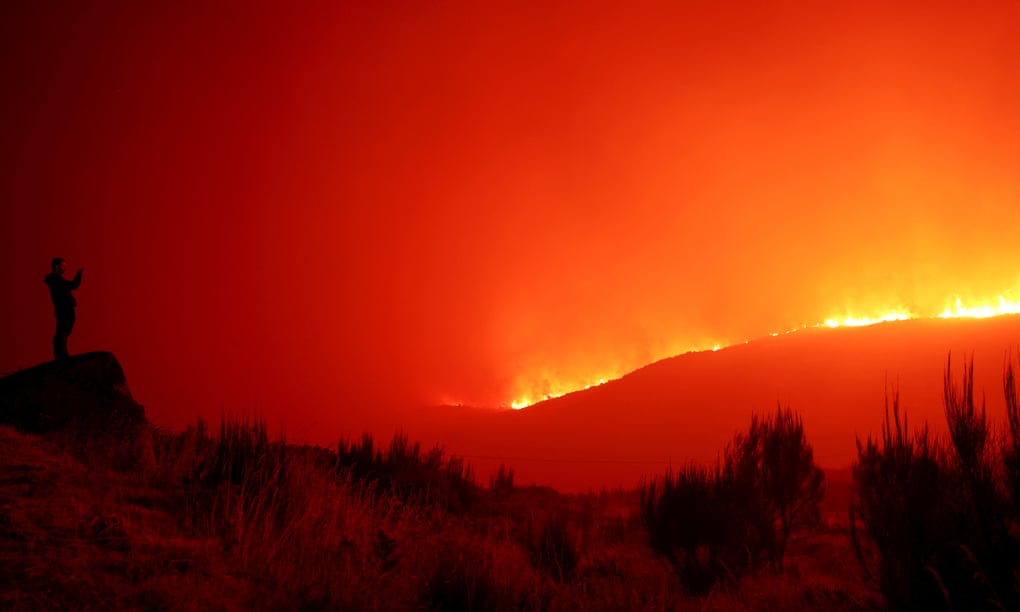
A wildfire near Povoa de Montemuro, Portugal, 18 September 2024. Photograph: Susana Vera/Reuters

Labour seems gripped by a form of denialism. The danger is real and incremental change won’t avert it

If our political leaders acted out of humanity, the plight of others would be enough to motivate them into action. In the absence of empathy, perhaps we need to be more direct: the climate crisis is coming for you, because it is coming for us all.

Without urgent action, “once-in-a-generation” events – the flooding of New York subways, the typhoon-like winds sucking people out of their apartments in China, the forest fires – will become the new routine of daily life. Politicians abandoned the goal to stop climate breakdown many years ago. We have a much more basic demand: to stop climate breakdown entering a new phase of existential disaster.

That means avoiding certain “tipping points” that would put humanity on an irreversible path to catastrophe. The collapse of the Atlantic meridional overturning circulation, for example, would disrupt the rains that billions of people depend on for food in India, South America and west Africa. Permafrost thaw would generate an irreversible release of carbon dioxide. And the loss of the Greenland ice sheet would result in disastrous runaway melting.

Few politicians deny that human-made global heating is real. Instead, our government peddles a different – more insidious – kind of denialism. One that moves away from a disbelief in the climate crisis, and toward a belief that incremental change can fix it.

This government is not just failing to stand up to fossil fuel giants. It is failing to confront the economic system that empowers them. The richest 1% are responsible for more carbon emissions than the poorest 66%, yet our government still refuses to bring in wealth taxes to reduce inequality. Unless the government has the courage to rewrite the rules of our ecocidal economy, its climate targets will soon become yet another broken promise.

A planet cannot be cooled by warm words; we need fundamental change, now. A Green New Deal would invest in publicly owned renewable energy and water. It would create millions of green jobs. It would promote sustainable farming based on the principles of agroecology. And it would kickstart an economy based on human need, not corporate greed.

The whole article is at https://www.theguardian.com/commentisfree/2024/dec/20/planet-climate-disaster-labour-government. I’ve been registered for some time, unsure what’s needed to get access. Perhaps the Guardian can provide easier access?

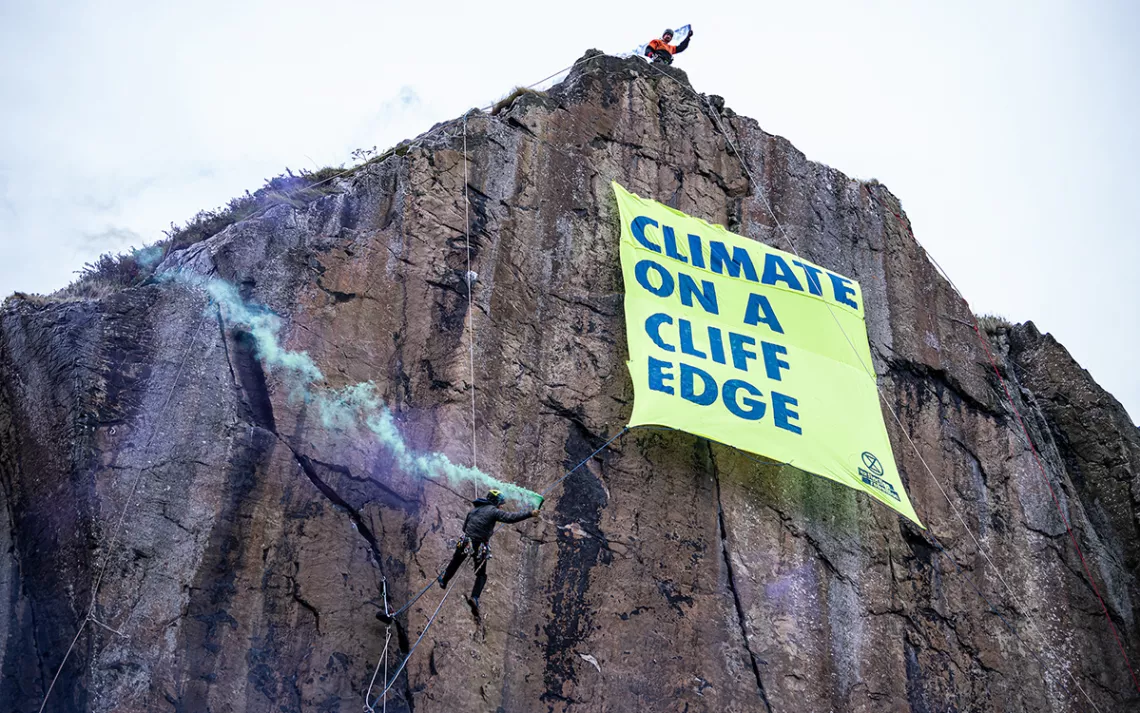
Experienced climbers scale a rock face near the historic Dumbarton castle in Glasgow, releasing a banner that reads “Climate on a Cliff Edge.” One activist, dressed as a globe, symbolically looms near the edge, while another plays the bagpipes on the shores below. | Photo courtesy of Extinction Rebellion and Mark Richards
Continue ReadingJeremy Corbyn: The facts about a planet facing climate disaster are clear. Why won’t this Labour government face them?

Australian PM First Western Leader Referred to ICC as ‘Accessory to Genocide in Gaza’

Spread the love

Original article by JULIA CONLEY republished from Common Dreams under Creative Commons (CC BY-NC-ND 3.0). 

Australian Prime Minister Anthony Albanese speaks during a press conference on February 20, 2024 in Perth, Australia. (Photo: Matt Jelonek/Getty Images)

More than 100 lawyers endorsed the referral, which points to the military, intelligence, and rhetorical support Prime Minister Anthony Albanese has provided to the Israeli government.

Australian Prime Minister Anthony Albanese is one of several Western leaders who have provided political and material support of the Israeli government and military over the past five months as their bombardment of Gaza has killed more than 30,000 people, but on Monday he became the first to be referred to the International Criminal Court for being an “accessory to genocide.”

More than 100 lawyers supported the referral under Article 15 of the Rome Statute, arguing that Albanese, a member of the Labor Party, as well as members of his Cabinet and of Parliament, have provided Israel with “rhetorical support in their public statements, their press conferences, their speeches” as well as material assistance, as attorney Sheryn Omeri told ABC‘s “News Breakfast.”

Omeri said the aid Australia has “most particularly” provided since Israel began attacking Gaza has been the export of F-35 fighter jet parts as well as military intelligence through the government’s surveillance work at Joint Defense Facility Pine Gap in Australia’s Northern Territory.

While Albanese has recently called on Israel to respect international law, said Omeri, “it’s been months since the 7th of October, 2023, and between then and now there has been very little in the way of urging restraint on Israel and discouraging what the International Court of Justice found on the 26th of January was a plausible case of genocide.”

The 92-page document compiled by the legal team lays out a number of specific ways Albanese and other Australian officials have acted as an accessory to genocide, including:

  • Freezing $6 million in funding to the United Nations Relief and Works Agency for Palestine Refugees in the Near East amid a humanitarian crisis based on unsubstantiated claims by Israel;
  • Providing military aid and approving defence exports to Israel, which could be used by the Israel Defense Forces (IDF) in the course of the prima facie commission of genocide and crimes against humanity;
  • Ambiguously deploying an Australian military contingent to the region, where its location and exact role have not been disclosed; and
  • Permitting Australians, either explicitly or implicitly, to travel to Israel to join the IDF and take part in its attacks on Gaza.

“The Rome Statute provides four modes of individual criminal responsibility, two of which are accessorial,” Omeri explained in a statement.

Along with Albanese, U.S. President Joe Biden, British Prime Minister Rishi Sunak, and German Chancellor Olaf Scholz are among the Western leaders who have repeatedly defended Israel’s actions in Gaza—despite the genocidal intent expressed in numerous public statements by Israeli leaders.

Biden was sued in federal court in January for alleged “complicity in the Israeli government’s unfolding genocide.” That case is still making its way through the U.S. appeals process.

Original article by JULIA CONLEY republished from Common Dreams under Creative Commons (CC BY-NC-ND 3.0). 

Zionist Keir Starmer supports Israel's Gaza genocide.
Zionist Keir Starmer supports Israel’s Gaza genocide.

Continue ReadingAustralian PM First Western Leader Referred to ICC as ‘Accessory to Genocide in Gaza’

Adam Bandt urges Australians to ‘embrace’ civil disobedience and join climate protests

Spread the love

Adam Bandt, leader of the Australian Greens on the right to protest. Video is 3 months old.

https://www.theguardian.com/environment/2023/aug/30/adam-bandt-urges-australians-to-embrace-civil-disobedience-and-join-climate-protests

Greens leader says Albanese government is ‘hellbent on opening more coal and gas mines’ and people must ‘fight back’

The Australian Greens leader, Adam Bandt, has called on people to join disruptive climate protests to pressure the Albanese government to stop opening new fossil fuel mines, saying he plans to help blockade the country’s largest coal port.

He has also written to the leaders of 16 Pacific Island nations suggesting they should make any support for an Australia bid to host a UN climate summit conditional on the government “taking stronger climate action”.

Speaking to climate activists in Melbourne on Wednesday night, Bandt said Labor was “hellbent on opening more coal and gas mines”.

He said more people needed to “get in behind” groups that engaged in nonviolent civil disobedience, naming Disrupt Burrup Hub, Rising Tide and Extinction Rebellion.

“The Liberals and Nationals were kicked out of office for thumbing their nose at the climate crisis … but with Labor it’s somehow more disappointing because you know they know what they’re doing is wrong,” he said, according to speech extracts shared in advance.

“Some Labor MPs might not get into politics to help out [oil and gas company] Woodside, but sure enough they end up there.

“Now we need to embrace the importance of protest and civil disobedience. We must come together and fight back.”

Bandt said the “law is often complex, but the morality is simple”.

“We might not all want to climb a coal bridge or sit in the foyer of Woodside, but we need to back the right of people to do so, and celebrate and feel joy from their action,” he said.

https://www.theguardian.com/environment/2023/aug/30/adam-bandt-urges-australians-to-embrace-civil-disobedience-and-join-climate-protests

Continue ReadingAdam Bandt urges Australians to ‘embrace’ civil disobedience and join climate protests