‘Jamaica Will Be Unrecognizable After This’: Hurricane Melissa Erupts Into Category 5 ‘Monster’

Spread the love

Original article by Jon Queally republished from Common Dreams under Creative Commons (CC BY-NC-ND 3.0).
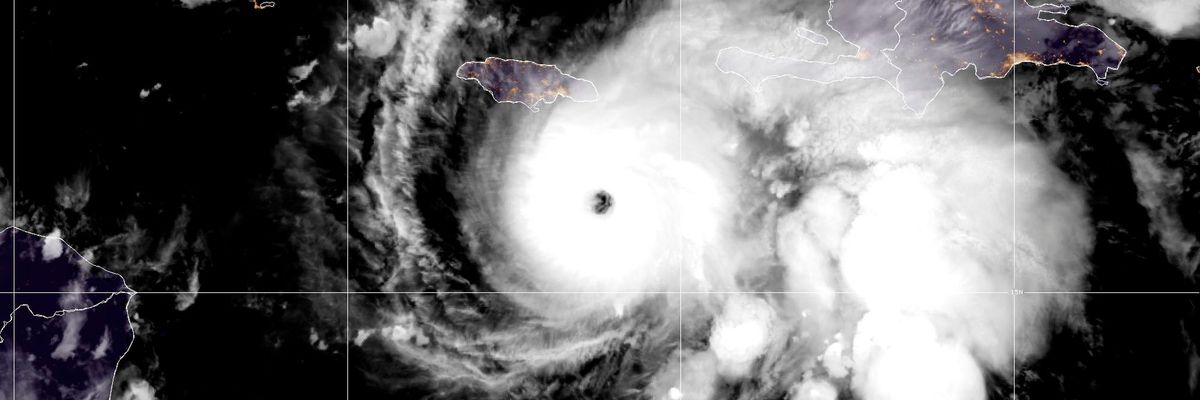
In this handout satellite image provided by the National Oceanic and Atmospheric Administration (NOAA) , Hurricane Melissa strengthens into a Category 4 storm as it churns northwest through the Caribbean Sea captured at 7:40Z on October 26, 2025. Later, Melissa intensified into a Category 5 hurricane as it approached Jamaica. (Photo by NOAA via Getty Images)

One hurricane historian said the world is “witnessing history on satellite right now” as the people of Jamaica came under evacuation orders and braced for impact of a storm that threatens severe flooding, landslides, and winds of over 200 mph.

The people of Jamaica are making emergency preparations on Monday as Hurricane Melissa intensified overnight, with meteorologists in awe of the scale and shape of the “monster” storm now bearing down on the island nation, already saturated from previous rains and bracing for what could be a major climate-related catastrophe.

In a 5:00 am EDT advisory on Monday, the US National Hurricane Center said Melissa is “now a Category 5 Hurricane” and warned of “destructive winds and storm surge and catastrophic flooding” that would worsen across Jamaica throughout the day and into the night. Landfall is expected Tuesday morning, with devastating consequences across the island nation.

The storm, reports the Weather Channel, “will be one of the most intense, devastating hurricanes on record in Jamaica, with widespread flooding, landslides, and destructive winds.”

According to NBC News:

Some areas of eastern Jamaica could be inundated with up to 40 inches of rain, more than some areas of the country typically get in a year.

Wind speeds in mountainous areas could be 30% higher that the main storm, meaning potential winds of more than 200 mph.

With Cuba, Turks and Caicos, the Bahamas, and Haiti also within reach of the storm’s impacts, governments across the region are ordering evacuations of the most vulnerable areas and preparing infrastructure for the rescue and recovery operations from the life-threatening destruction almost certain to be unleashed.

“Hurricane Melissa could be one of the most intense and devastating hurricanes on record for Jamaica,” said Katharine Hayhoe, a professor of climate science, “and it’s rapidly becoming a textbook example of how climate change is making hurricanes more dangerous: explosive intensification, slow movement, and massive rainfall.”

In a Monday morning address to the nation, Prime Minister Andrew Holness urged “every Jamaican to prepare, stay indoors during the storm, and comply with evacuation orders. Check on your neighbours, especially the elderly and vulnerable, and continue to pray for our nation’s safety.”

Melissa is now the third storm of the 2025 hurricane season to reach Category 5 status, the first time that has happened in the Atlantic since 2005, the year a devastating Hurricane Katrina struck communities along the US Gulf Coast.

Weather experts expressed alarm about the storm’s size, power, and trajectory overnight.

Jordan Smith, a meteorologist with WJHG-TV in Panama City, Florida, said he was “absolutely speechless” after seeing the latest satellite images of the storm.

“This satellite image of Hurricane Melissa needs to be put in meteorology textbooks,” exclaimed Smith. “Please, everyone, send all your prayers and thoughts to the island of Jamaica. Catastrophic impacts are expected on so many levels. Jamaica will be unrecognizable after this.

Michael Ferragamo, a hurricane historian, said the world is “witnessing history on satellite right now,” just before Melissa officially hit Category 5 status.

In remarks to reporters on Sunday night, Desmond Mackenzie, Jamaica’s minister of local government and community development, warned that many Jamaican communities “will not survive” the flooding predicted for the island. McKenzie said all citizens, residents, and visitors to the island should follow the instructions of the government and emergency officials.

“This is not the time for people to become complacent. I believe that we have been giving Jamaicans adequate notice,” he said. “I can only urge Jamaicans to heed the warnings.”

Original article by Jon Queally republished from Common Dreams under Creative Commons (CC BY-NC-ND 3.0).

Orcas comment on killer apes destroying the planet by continuing to burn fossil fuels.
Donald Trump urges you to be a Climate Science denier like him. He says that he makes millions and millions for destroying the planet, Burn, Baby, Burn and Flood, Baby, Flood.
Nigel Farage urges you to ignore facts and reality and be a climate science denier like him and his Deputy Richard Tice. He says that Reform UK has received £Millions and £Millions from the fossil fuel industry to promote climate denial and destroy the planet.

Continue Reading‘Jamaica Will Be Unrecognizable After This’: Hurricane Melissa Erupts Into Category 5 ‘Monster’

Unprecedented rains cause floods and landslides in Nepal, killing nearly 200 people

Spread the love

Original article by Abdul Rahman republished from peoples dispatch under a Creative Commons Attribution-ShareAlike 4.0 (CC BY-SA) license.

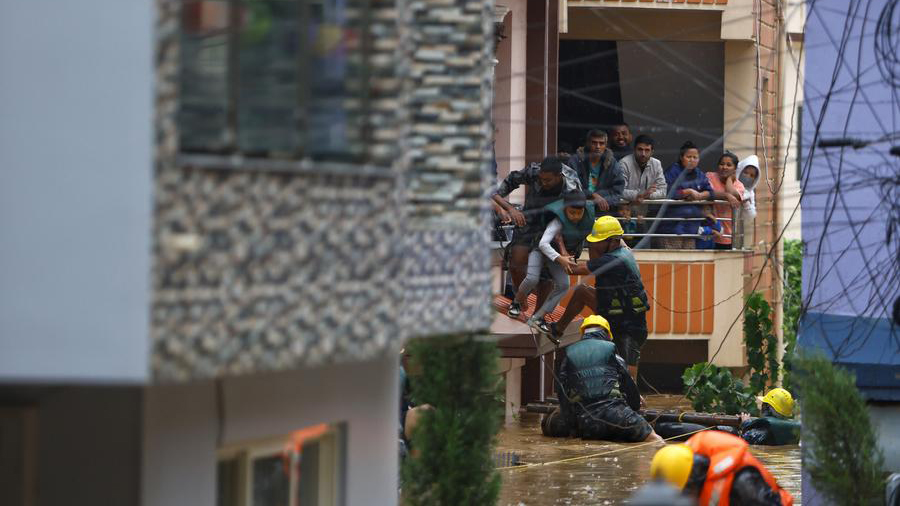
Rescuers evacuate flood victims in Lalitpur, Nepal ((Photo: Sulav Shrestha/Xinhua)

Meteorologists in the Himalayan nation have observed a pattern of change in the local climate in the last few years, with monsoon season lasting longer than usual and erratic rains affecting millions

Over 200 people have been killed or missing in the floods and landslides caused by unprecedented rains lashing Nepal for the last five days. Thousands have been displaced in different parts of the mountainous country.

On Monday, authorities announced the shutting down of all educational institutions. Several school and university buildings have also been damaged after facing the brunt of the torrential rains.

The capital Kathmandu has been one of the most affected regions in the country with a large number of neighborhoods flooded or covered with the mud due to rain water, which has also caused the water levels in the Bagmati river to rise. The flood and landslides have destroyed numerous homes, bridges, roads, and vehicles, leaving a large number of people stranded.

Many flooded areas are localities where poor and working class people live. Their houses have been inundated with water and mud, which may take longer to clear, raising the risk of the breakout of epidemics after the water recedes.

According to Nepal’s Ministry of Transport, 47 out of 80 highways in the country have been affected by the rains and landslides, greatly impacting transportation. Over one hundred flights were canceled due to heavy rains, and the Kathmandu airport stopped operating on Friday and Saturday for several-hour-long periods. It re-started operations again on Sunday morning.

Several power plants have also been damaged due to the flooding and landslides, disrupting the power supply to different parts of the country.

The Communist Party of Nepal (UML) issued a statement earlier asking the government to increase its efforts to relief and rescue work. The party also asked cadres to participate in flood relief efforts.

The heavy rains in Nepal could also have a significant impact in India. In Indian states like Bihar, the flooding was already worsening in the last couple of weeks. Thousands of people have been displaced in several bordering regions in Bihar in the last couple of days, with most of the rivers in the region flowing far above the danger mark.

According to official data, at least 1.6 million people on the Indian side of the border are already severely affected due to the floods. Several schools and other public services have been affected. Local power grids are also shutting down due to flooding, leaving thousands without electricity.

Effects of climate change

Heavy rains during the monsoon season in South Asia are normal. However, in the last few years, local meteorological officials have claimed the severity of rains has increased and the monsoon has been significantly prolonged. The monsoon has shifted its usual duration. Its withdrawal, stretching until the month of October, is quite unusual, resulting in larger repercussions on the region’s agriculture.

From Thursday to Saturday, Kathmandu received 322 mm rainfall against an annual average of around 2,700 mm, causing a sudden rise in the water levels in the region’s rivers. On Saturday alone, some parts of the city received 240 mm rainfall within 24 hours, a record in over two decades.

Several studies indicate that Nepal has emerged as one of the most vulnerable countries in the context of climate change. The rise in the country’s average temperature is much higher than that of the global average (0.056 degrees Celsius against the global average of 0.03 degree Celsius), for example. The rise in temperature has caused the melting of several glaciers in the country, again endangering the local climate as well as the livelihoods of millions of people.

Despite the seriousness of the climate situation in Nepal, most of the developed world has largely been indifferent to its concerns in the climate negotiations so far. Raising the issue, Prime Minister KP Sharma Oli, while speaking during the ongoing UN General Assembly’s 79th session on Thursday said that the world needs to pay attention to the possible effects of climate change in a country such as Nepal which is a “natural climate stabilizer” vital for maintaining balance in the global environment.

Given its significance for global climate concerns, “it is essential that the mountain agenda receive due attention in climate negotiations,” Oli said.

Original article by Abdul Rahman republished from peoples dispatch under a Creative Commons Attribution-ShareAlike 4.0 (CC BY-SA) license.

Continue ReadingUnprecedented rains cause floods and landslides in Nepal, killing nearly 200 people