Italy marks 80 years since liberation with calls against genocide and militarism

Spread the love

Original article by Ana Vračar republished from peoples dispatch under a Creative Commons Attribution-ShareAlike 4.0 (CC BY-SA) license.
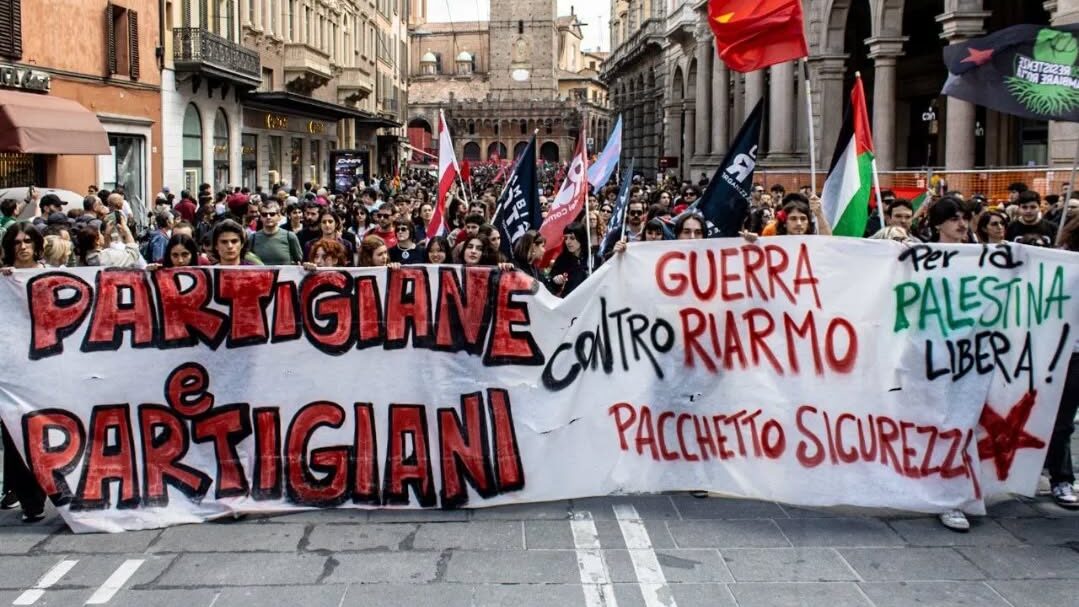
Source: Potere al Popolo Bologna e provincia/Facebook

On the 80th anniversary of liberation from Nazi-fascism, left forces in Italy mobilize against genocide, armament, and the Meloni government

In the coming weeks, many European countries will mark the 80th anniversary of liberation from Nazi-fascist occupation. Italy is among the first, with dozens of events organized for April 25 – Liberation Day – despite ongoing attempts by the Meloni government and right-wing forces to rewrite or erase the memory of the Resistance. For most grassroots groups, this year’s events aim to locate the values that inspired partisan fighters in the 1940s into today’s context, marked by an aggressive rearmament agenda, support for Israel’s genocide in Gaza, and domestic repression of civil rights.

“Eighty years ago, our grandparents freed us from the grip of fascism. But remembering the past is not enough, especially not in the stale, institutional way the Democratic Party and center-left do,” Giuliano Granato of Potere al Popolo said during the demonstration in Naples. Along similar lines, the Unione Sindacale di Base (USB) stated that April 25 should not be reduced to a mere ritual or commemoration. “It should actualize the values and ideals of the partisan Resistance, which freed, perhaps not once and for all, this country from the barbarity of war and Nazi-fascism and provided an inescapable push toward better democratic, working, and living conditions for the people of this country,” the trade union declared in its call to action.

Against Israeli genocide

These values, according to USB, Potere al Popolo, and other left groups, must necessarily include opposition to genocide. In many cities, protesters have insisted that Italy’s ongoing ties with the Israeli occupation are unacceptable. These ties, they argue, are evidence that the political establishment has failed to grasp the true meaning and importance of the Resistance. Ahead of Liberation Day, the Genoa chapter of Potere al Popolo organized an action addressing President Sergio Mattarella, criticizing him for formally honoring the Resistance while remaining silent on the genocidal war against Palestinians and on the breakdown of democratic rights under the current government.
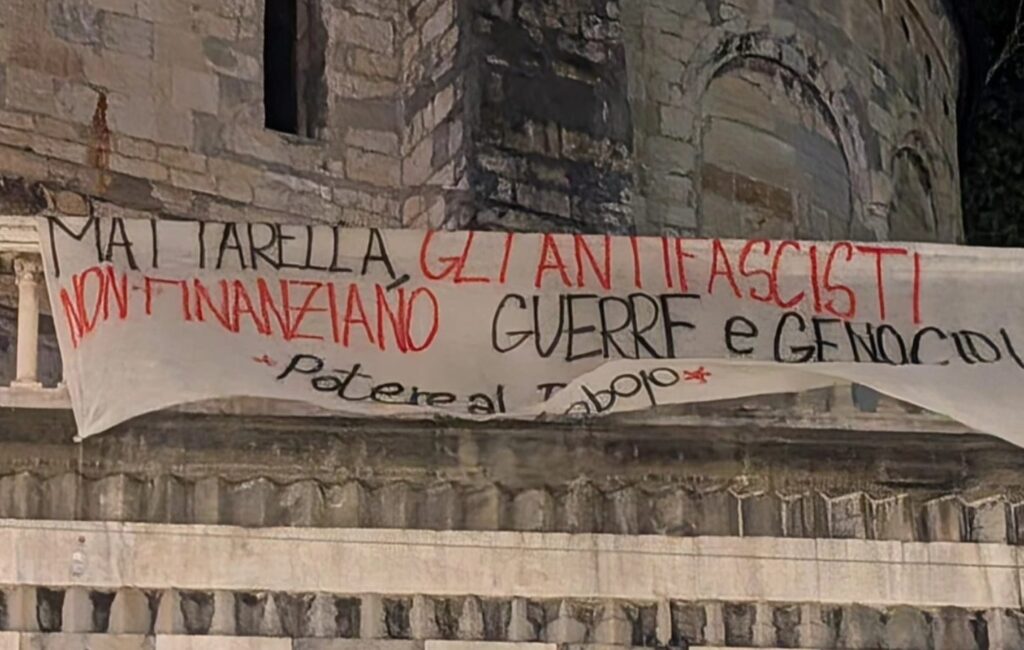
Potere al Popolo Genoa with banner reading: “Mattarella, antifascists don’t finance wars and genocide.” Source: Potere al Popolo Genoa/Facebook

“To do so [speak of the Resistance] after cozying up to the president of the criminal state of Israel, effectively supporting the ongoing genocide of the Palestinians, is an insult to those who, since the days of the partisan struggle, have fought against all genocide,” Potere al Popolo Genoa stated. “To honor the Resistance while equating the Soviet communists who liberated much of Europe from Nazism with the Third Reich is an insult to history and memory.”

Against armament

Equally prominent as the call to stop the genocide and sever ties with Israel is the demand to reject Europe’s new armament agenda, which will come at the cost of public services, education, healthcare, and climate justice. Giorgia Meloni’s administration and mainstream opposition parties alike have supported this agenda in different ways, endorsing increased spending on so-called defense and entertaining proposals for a joint European army. These priorities stand in stark contrast with the interests of Italy’s working class and the vision of a more just society that accompanied the antifascist Resistance.

Read more: Movement against increased military spending grows in Italy

“The rearmament plan launched by the EU represents the latest folly of a continental political class disinterested in building a present and future of peace and prosperity for the peoples of Europe,” warned USB. Similarly, Potere al Popolo called on people to rally around an alternative set of priorities: “We don’t need more money to enrich the arms industry. We need money for wages, for health care and services, for envisioning an ecological revolution and addressing the real challenge of our time, which is the climate crisis.”

Against new iterations of fascism

Meanwhile, Giorgia Meloni and her ministers are pursuing a different kind of battle, one aimed at minimizing the role of the antifascist struggle, led largely by communists, in shaping modern Italy. While the mainstream opposition tends to fixate on this behavior by the right wing, Granato warns that doing so risks missing important pieces of the puzzle.

“For us, Giorgia Meloni is simply following the path she’s always been on, one clearly tied to the rise of neo-fascism. After the defeat of Nazism, the slogan of the Italian Social Movement [neo-fascist party] was ‘neither renounce nor restore’ – and that’s exactly what Meloni is doing today. She doesn’t outright deny their fascist roots, but she also doesn’t walk around openly glorifying Benito Mussolini,” Granato told Peoples Dispatch.

The most recent attempt of the right to undermine the legacy of the Resistance came in the wake of the death of Pope Francis, when the government declared a record five days of mourning and called for “sobriety” at all public events. Many understood this to be an attempt to minimize April 25 events. Liberal and right-wing local administrations seized the opportunity to scale down and cancel rallies, while far-right media ran headlines such as April 25: Day of mourning. “Sure, they can claim they were referring to the death of the pope, but the truth is, they’ve been waiting 80 years for an excuse to print something like that, because for them, April 25 has always been a defeat,” says Granato.

Progressive forces, however, resisted, criticizing the government for using the death of a pope who – unlike the administration, called for peace and solidarity – to advance its agenda. They also refused to limit the day’s activities to commemorations, echoing the partisans’ revolutionary vision of a radically different society. “We don’t stop at the official ceremonies, not just because they’re cold and formulaic, but because we believe the fight for liberation and resistance isn’t over,” Granato explains. “Just like many partisans understood back then that toppling fascism wasn’t enough, we believe that defeating the Meloni government wouldn’t be enough either.”
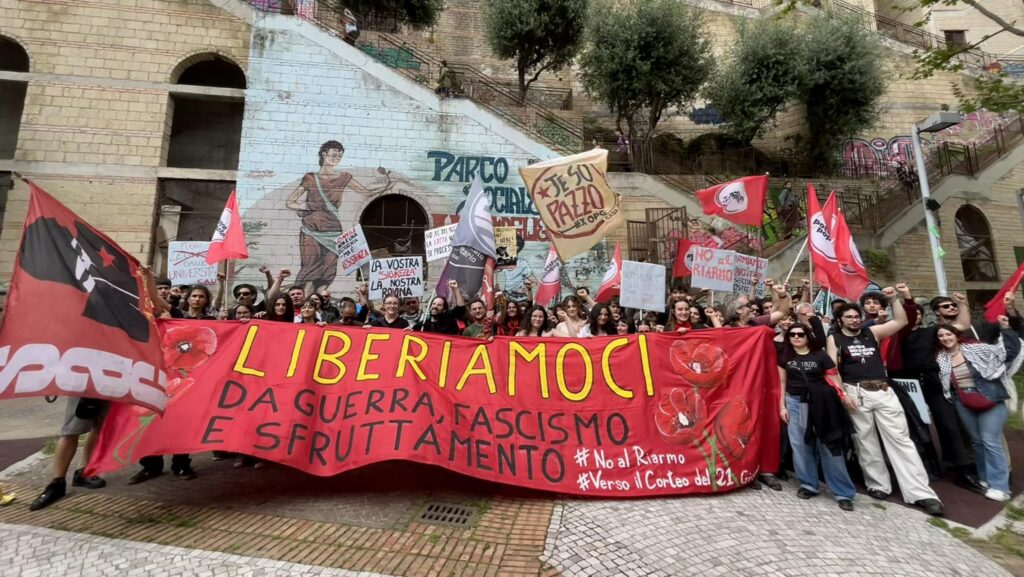
A group of protesters after the central demonstration in Naples, April 25, 2025. Source: Ex-OPG Je so’ pazzo/Facebook

Instead, Granato calls on the people to work together to free themselves from contemporary forms of danger and oppression: first and foremost genocide and militarization. “We worked to make today a day of liberation from militarism and genocide and to link it to the mobilization we are building, including a national assembly in Rome on May 24, and a mass demonstration on June 21, just days before the NATO summit in The Hague,” he adds.

“We believe militarism has always been a tool of fascism. The militarization of Europe today goes hand-in-hand with growing authoritarianism at home and worsens conditions for the working class across the continent.”

Original article by Ana Vračar republished from peoples dispatch under a Creative Commons Attribution-ShareAlike 4.0 (CC BY-SA) license.
Continue ReadingItaly marks 80 years since liberation with calls against genocide and militarism

European Leaders Condemn Musk’s ‘Ominous’ Push for Germany to ‘Forget’ Holocaust

Spread the love

Original article by Julia Conley republished from Common Dreams under Creative Commons (CC BY-NC-ND 3.0). 

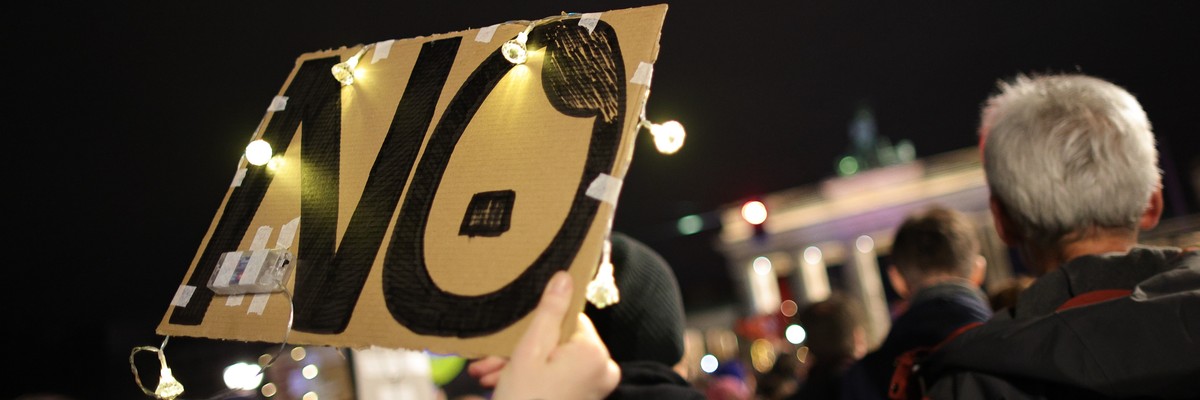
Protesters hold up a banner reading “NO” with the O shaped like an Adolf Hitler caricature during a demonstration against right-wing extremism, U.S. President Donald Trump, and right-wing billionaire Elon Musk on January 25, 2025 in Berlin, Germany. (Photo: Omer Messinger/Getty Images)

“We must not forget the tragic lesson of our past,” said Polish Prime Minister Donald Tusk. “Evil, violence and contempt cannot triumph anew.”

Billionaire enterpreneur Elon Musk insisted at a far-right rally in Germany over the weekend that the European country must move “beyond the past” and leave behind the memory of one of the deadliest genocides in history—but as leaders on the continent marked the 80th anniversary of the Auschwitz concentration camp liberation on Monday, several made clear that Musk’s advice was not welcome.

Musk’s comments on “‘the need to forget German guilt for Nazi crimes’ sounded all too familiar and ominous,” said Polish Prime Minister Donald Tusk on Sunday. “Especially only hours before the anniversary of the liberation of Auschwitz.”

German Chancellor Olaf Scholz said on the social media platform X, “I couldn’t agree more.”

The country’s ambassador to Israel said that while Musk claimed German children are treated as “guilty of the sins” of the Nazis during World War II, the government simply wants “them to grow up informed and responsible and to apply the lessons of Germany’s past.”

As Common Dreams reported, the Tesla CEO and key adviser to U.S. President Donald Trump made the remarks at a rally for Alternative for Germany (AfD) on Saturday, five weeks before Germans are set to vote in federal elections.

AfD is currently polling at 19%, trailing the center-right Christian Democratic Union (CDU), which is in first place at 28%. But leaders across Europe, including Spanish Prime Minister Pedro Sánchez, French President Emmanuel Macron, and Scholz have warned that Musk appears to be angling for the spread of far-right ideologies—including neo-Nazism—in European countries.

The AfD has been designated a “suspected extremist” group by Germany’s domestic intelligence agency, and one of its candidates for public office last year said that “not all” Nazis who worked for Adolf Hitler’s government were criminals.

The party has been ostracized in Germany, with other political groups including the CDU ruling out the formation of a coalition government with the AfD, but last week CDU leader Friedrich Merz said he would push for tougher anti-immigration proposals even if they were submitted by the AfD.

Scholz, who represents the Social Democrats, toldStuttgarter Zeitung in response to Merz’s comments that “the firewall to the AfD must not crumble.”

As Tusk oversaw the liberation of Auschwitz anniversary on Monday, International Holocaust Remembrance Day, he alluded to Musk’s comments at the AfD rally.

https://twitter.com/donaldtusk/status/1883818460054163902?ref_src=twsrc%5Etfw%7Ctwcamp%5Etweetembed%7Ctwterm%5E1883818460054163902%7Ctwgr%5Ecf2d7f515151e94748916bbf163a93631d35079a%7Ctwcon%5Es1_c10&ref_url=https%3A%2F%2Fwww.commondreams.org%2Fnews%2Felon-musk-europe

Sorry, this content could not be embedded.

X

“We must not forget the tragic lesson of our past,” he said on X, which is owned by Musk. “Evil, violence, and contempt cannot triumph anew.”

Musk’s comments came days after he appeared to flash a Nazi salute twice at an event for Trump’s inauguration.

In the U.S. on Sunday, Illinois Gov. JB Pritzker addressed Musk’s remarks at the AfD rally on CNN, asking why Trump hadn’t spoken out against them.

“President Trump ought to be calling that out,” said the Democratic governor. “If he doesn’t agree with Elon Musk, if he doesn’t agree with two Sieg Heils at his own rally, and backing a party that backs Nazis, then he ought to say so. Why isn’t Donald Trump speaking out?”

Original article by Julia Conley republished from Common Dreams under Creative Commons (CC BY-NC-ND 3.0). 

Elon Musk urges you to be a Fascist like him, says that you can ignore facts and reality then.
Continue ReadingEuropean Leaders Condemn Musk’s ‘Ominous’ Push for Germany to ‘Forget’ Holocaust

Solidarity protests erupt across Tamil Nadu as Samsung workers’ strike enters fourth week

Spread the love

Original article republished from peoples dispatch under a Creative Commons Attribution-ShareAlike 4.0 (CC BY-SA) license.
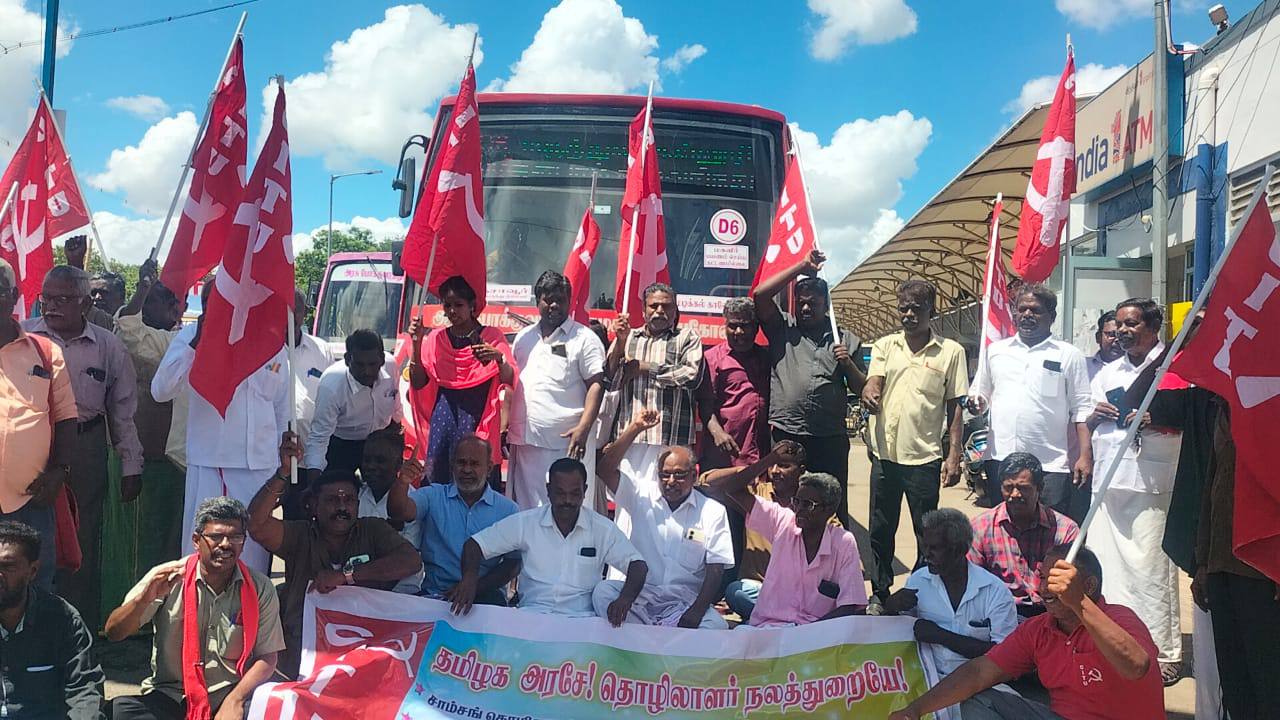
Across Tamil Nadu, workers and cadre of CITU and CPI (M) staged road blockades in support of the Samsung workers’ strike and the demand for recognition of their union. Photo: CPI(M) TN

Major left parties have called for a joint protest against the state government’s failure to recognize the SIWU and management’s anti-workers attitude on October 5.

Hundreds of workers at the Samsung electronics factory in India’s Tamil Nadu state staged roadblocks and a sit-in on Monday, September 30 as their strike entered its fourth week. Thousands of cadres of the Communist Party of India (Marxist) from across Tamil Nadu also joined the call of the Samsung workers and risked arrest and police repression.

According to the news reports, over 900 striking workers were detained by the police in the Kanchipuram district. The police also detained the state president of the Centre of Indian Trade Union (CITU), A Soundararajan. They were released later that evening.

Over 1,300 workers of Samsung electronics factory in Sriperumbudur, part of the Kanchipuram district near Chennai have been on strike since September 9 under the leadership of newly formed Samsung India Workers’ Union (SIWU) demanding recognition of their union, a salary increase, an end of discrimination, and better working conditions at the factory.

Samsung has only two factories in India. Its Chennai factory has been operating since 2007 without any union. The SIWU was formed in July 2023. According to its president E Muthukumar, over 90% of workers at the Chennai factory have already joined the union.

The call for roadblocks was given following the failure of five rounds of talks between the management and the SIWU under the mediation of the Tamil Nadu Ministry of Labor. The last talks on September 24 were held by the state government after it faced strong reactions from the unions and left parties following the police action on the striking workers earlier.

The state government intervened after the management refused to have direct talks with the SIWU calling it illegitimate. The management has maintained that it does not recognize the newly formed union and instead constituted a “workers committee” and arbitrarily appointed workers to it. The management has even lodged objections to SIWU’s registration claiming its use of the company’s name is illegal.

Monday’s sit-ins and roadblocks also targeted the state government’s delaying the registration of the union in violation of legal procedures and using its security forces to unleash repression on striking workers.

SIWU is affiliated to CITU, one of India’s largest trade unions, affiliated to the left party CPI(M). As per labor law, the registration application must be processed within 45 days of filling of such an application. The SIWU claims it has been more than three months since it filed for registration.

When SIWU tried to call a rally in support of its demands on September 16 the police attacked the workers and arrested its leadership even trying to dismantle the protest site erected almost a kilometer away from the factory.

State units of all left parties in Tamilnadu, including the Communist Party of India (CPI), CPI (M) and Communist Party of India (Marxist-Leninist) Liberation on Wednesday launched the call for a statewide protest on Saturday, October 5 in support of the SIWU workers. They issued a joint statement asking the state government to immediately recognize SIWU. They blamed that the strike is continuing because of the “anti-worker attitude” of the management of Samsung electronics.

Kannan, a state committee member of CITU, told Peoples Dispatch that the management is adamant but the workers are ready to fight till their demands are met.

Kannan also informed that workers are observing a day of hunger strike on October 2 on the occasion of the birth anniversary of Mahatma Gandhi to press the point that they will continue to protest peacefully in support of their demands.

Original article republished from peoples dispatch under a Creative Commons Attribution-ShareAlike 4.0 (CC BY-SA) license.
Continue ReadingSolidarity protests erupt across Tamil Nadu as Samsung workers’ strike enters fourth week

Morning Star: Fight the far right to commemorate the D-Day heroes

Spread the love

Republished from https://morningstaronline.co.uk/article/editorial-fight-far-right-commemorate-d-day-heroes

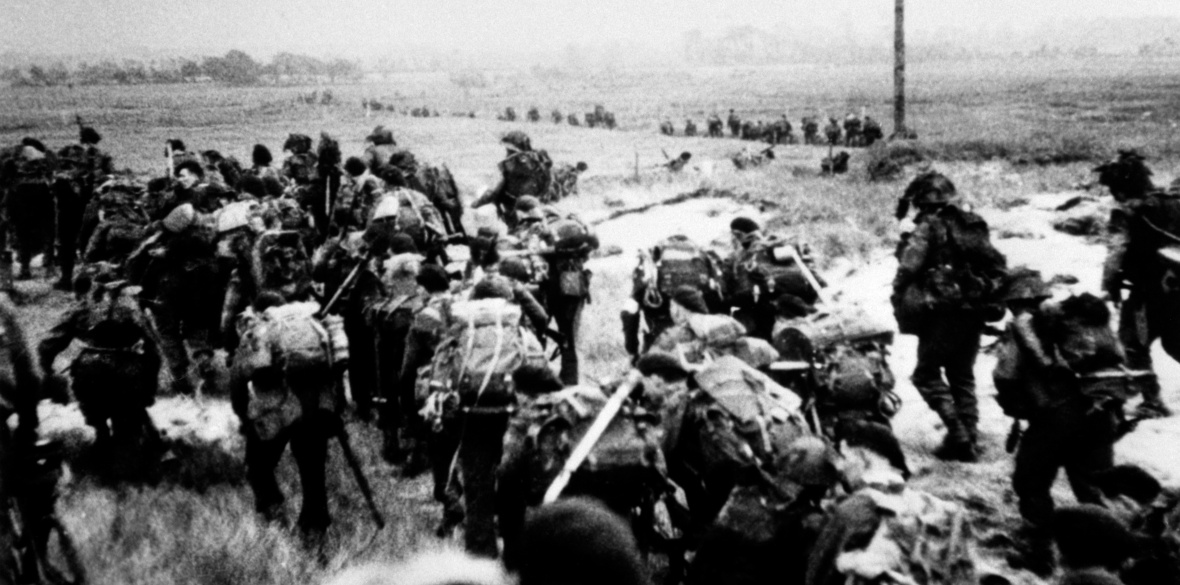
Royal Marine commandos moving off the Normandy Beaches during the advance inland from “Sword” beach, June 6, 1944

WITH the Tories and Labour exchanging blame over Channel crossings, we mark 80 years since a Channel crossing of a different kind.

On June 6 1944 British, US and allied troops crossed the Channel to open a second front against the Nazis in Europe, something the Soviet Union, which had borne the brunt of the war against fascism for the previous three years, had long urged.

Veterans are arriving in Normandy for commemorations of this heroic chapter in Europe’s liberation. Modern hostilities overshadow celebration of the anti-Nazi alliance of the 1940s, with the US and Britain criticising France for inviting Russia because of its invasion of Ukraine, though they themselves have never been excluded from World War II memorials while laying waste to countries from Vietnam in the cold war to Afghanistan, Iraq and Libya more recently.

These diplomatic divisions raise a question we should be asking our own politicians. Have you any right to claim the inheritance of anti-fascist victory if you are dismantling its achievements?

The world war against fascism was the crucible of international institutions as we know them today. The United Nations was established in a joint declaration by Britain, the United States, the Soviet Union and China on January 1 1942: it formalised the alliance against the Axis powers Germany, Italy and Japan, and a condition of membership was to declare war against Nazi Germany and its allies.

The foundation of the UN and new treaties like the Geneva Conventions of 1949 (on the conduct of war) and 1951 (on the treatment of refugees) expressed hope that a more civilised world order would stop any future descent into Nazi barbarism.

These agreements are not perfect, and powerful countries have often ignored them. But their existence is a legacy of the sacrifice made by those who gave their lives to smash fascism on D-Day, or at the battles of Stalingrad or Berlin, or among the heroic resistance movements that sprang up across Nazi-occupied Europe.

Politicians talk now as if the rules are outdated: the refugee conventions were drawn up by people who couldn’t conceive of the scale of “irregular” migration today. It isn’t true: World War II and its aftermath saw huge population displacement, the uprooting of millions of people. The Refugee Convention of 1951 set out universal obligations to refugees because of these horrific experiences.

Those obligations are ones governments across Europe, including ours, are trying to erase. The end of EU search-and-rescue operations, the active persecution of civil rescue crews by states like Italy, have fatally undermined the binding responsibility to aid anyone in distress at sea. The odious Nigel Farage clearly approves, having insulted brave volunteer lifeboat crews by calling the Royal National Lifeboat Institution a “migrant taxi service” for presuming to save people from drowning.

Farage has never yet been elected, but his ability to call the tune at Westminster is as great as ever if the first leaders’ debate is anything to go by: with Labour’s Keir Starmer calling Rishi Sunak, the PM of the Rwanda deportations scheme and the Bibby Stockholm prison barge, “the most liberal prime minister we have ever had on immigration.”

This is gutter politics, and a betrayal of what the D-Day heroes fought for. But so, at home, is the systematic destruction of the NHS and welfare state built after defeating fascism, fruits of a victorious people’s war and a recognition that fascism had emerged from a Europe wracked by poverty and unemployment.

It is no coincidence that today, with living standards falling, public services failing and the brazen theft of our wealth by an ever smaller corporate elite, the far-right politics of grievance and hate are on the march across the continent.

The real commemoration of D-Day must be to mobilise against them. For peace and socialism, against fascism and war.

Republished from https://morningstaronline.co.uk/article/editorial-fight-far-right-commemorate-d-day-heroes

Continue ReadingMorning Star: Fight the far right to commemorate the D-Day heroes

Commentary and analysis of recent political events

Spread the love

There’s a special edition of BBC Question Time tonight from Johannesburg, South Africa. I hope that somebody will discuss the real legacy of Nelson Mandela and the African National Congress: that South Africa is still an Apartheid state. The clearest indicator of this is the massacre of 34 striking miners at Marikana

Nelson Mandela: The Reluctant Revolutionary is an article about the South African campaign for liberation. It discusses the Apartheid regime and the history of Nelson Mandela, the ANC and anti-apartheid campaigning. It recognises that the ANC leadership was repeatedly a moderating force opposed to radical campaigning while simultaneously claiming that it had organised that same radical campaigning. Recommended.

spiked appears on the Want to make a worthwhile donation this Solstice? page

Firefighters launch fresh strikes over pension changes

Firefighters in England and Wales are to launch a fresh wave of strikes in their long-running row with the government over pensions.

Members of the Fire Brigades Union (FBU) will walk out for four hours from 6pm on Friday, and again from the same time on Saturday, with the threat of further action in the new year.

One brigade urged Christmas partygoers to buy takeaway food during the strike rather than try to cook at home if drunk.

FBU members have gone on strike four times in recent months in protest against changes to pensions and their retirement age. The union argues that older firefighters face losing their jobs if they fail fitness tests as part of changes to the pension age from 55 to 60.

The general secretary, Matt Wrack, said: “It’s now been almost two months since the government has been willing to meet us for negotiations despite several invitations from us.

“Until they do, and until they start to actually resolve the dispute, we’ll keep up the pressure for the sake of public safety and our members’ pensions.

‘UK’s stale energy market makes it easy for Big Six to hike prices,’ says new study

Image of an electricity pylon tree

Six years ago Britain had the healthiest record among all major developed economies for people shopping around for the cheapest prices, but the country has badly slipped down international league tables. While 21 per cent were changing companies in 2006, just 11.5 per cent have changed this year (including estimates for December). This is partly because the Big Six stopped door-step selling in the second half of 2011 after a series of fines for misleading customers.

The figures will fuel suspicions the Big Six firms, which have all hiked their prices significantly above inflation in recent weeks while announcing huge profits, are taking advantage of the problems people experience in changing provider.

Prime Minister David Cameron has urged customers to switch to better deals – but many find the process difficult and time-consuming.

EU migrants face 100 new questions to make it harder to obtain benefits

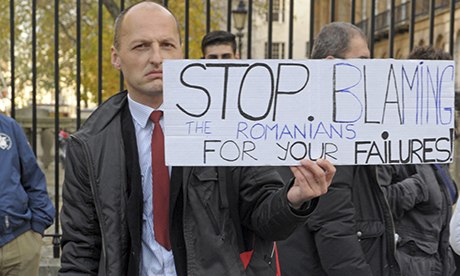
Image of protest. Placard reads 'Stop blaming the Romanians for your failures!"

Income-related benefits such as housing benefit, income support and council tax benefit are to be harder for EU migrants to obtain from Friday as they face a string of 100 questions, including the reasons they were unable to find a job in their home country. They will also be asked about their ability to speak English.

The new 100 questions in the fresh habitual residence test is being rushed out ahead of the transitional controls on Romanians and Bulgarians being lifted on 1 January.

The European Union insists on the free movement of workers within the EU, but the government believes it is legally entitled to ask tougher questions of migrants before they are entitled to make benefit claims.

Revised UK welfare sanctions mean more punishment for the poor

Job Seekers Allowance (JSA) and Employment and Support Allowance (ESA) sanctions are set to put many Britons in “dire financial conditions,” according to the Citizens Advice Bureau (CAB).

The report [https://skydrive.live.com/view.aspx?resid=CB5ED957FE0B849F!350&app=WordPdf&wdo=2&authkey=!AJTbB-gzwsSCayQ], published in October 2013 by the Manchester CAB on behalf of the Greater Manchester Citizens Advice Bureaux Cluster Group, is an in-depth evaluation of the impact of the sanctions. It describes benefit sanctions as “financial penalties” that are driving people already in devastating financial crisis even further into dire conditions. They raise concerns about the increase in the number of clients they had seen in relation to these sanctions.

Although the majority of the respondents were sanctioned for four weeks, one third had been given 10 week sanctions, with the average duration working out at eight weeks.

Two thirds had been left with no income. Twenty-three percent who had sanctions imposed had children, and 10 percent were lone parents.

Eighty percent of respondents borrowed money from family and friends, 8 percent borrowed from banks and 9 percent from pay day loan companies, which charge astronomical annual percentage rates.

The sanctions described in the CAB report are part of £21.8 billion in welfare cuts being imposed by the Conservative/Liberal government. Last month Prime Minister David Cameron declared that austerity cuts would be made permanent, meaning that escalating numbers of people will join the many already struggling to put food on the table, to find shelter and afford necessities like heating and lighting.

US drone strike in Yemen kills 15

At least 15 people were killed yesterday in central Yemen, when missiles fired from an unmanned US drone slammed into a wedding convoy. Yemeni security officials said the attack took place near the city of Radda, the capital of Bayda province, leaving behind charred bodies and burnt out vehicles.

No names and few details have been released. The CIA and US military, which are responsible for the criminal program of targeted assassinations in Yemen, Pakistan and other countries, have made no statement.

Yemeni security officials have provided conflicting accounts of the attack. “An air strike missed its target and hit a wedding car convoy,” one official told Reuters. “Ten people were killed immediately and another five who were injured died after being admitted to the hospital.” Another five people were injured. No attempt was made to explain what the real target was, or why “a mistake” was made.

Continue ReadingCommentary and analysis of recent political events