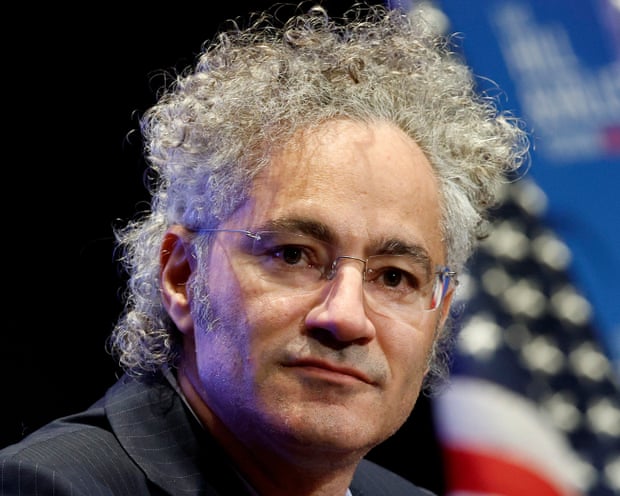
Alarm caused by posts of Alex Karp, tech firm’s CEO, championing US military dominance and of AI weapons
The US spy tech company Palantir published a manifesto extolling the benefits of American power and implying some cultures are inferior to others – in what MPs have called “a parody of a RoboCop film” and “the ramblings of a supervillain”.
“Some cultures have produced vital advances; others remain dysfunctional and regressive,” wrote Palantir in a 22-point post on X over the weekend, which also called for an end to the “postwar neutering” of Germany and Japan.
The post exhorted the US to reinstate a military draft, saying that “free and democratic societies” need “hard power” in order to prevail.
It also predicted a future dominated by autonomous weapons: “The question is not whether A.I. weapons will be built; it is who will build them and for what purpose. Our adversaries will not pause to indulge in theatrical debates about the merits of developing technologies with critical military and national security applications. They will proceed.”
…
It led to criticism from several MPs, who said that it raised yet more questions about the UK’s portfolio of contracts with the company. Palantir has built up more than £500m in contracts in Britain, including a £330m contract with the NHS, as well as deals with the police and Ministry of Defence. These deals have come in for increasing criticism.
“Palantir’s manifesto, which embraces AI state surveillance of citizens along with national service in the USA, is either a parody of a RoboCop film, or a disturbing narcissistic rant from an arrogant organisation,” said Martin Wrigley, a Liberal Democrat MP who is a member of the commons science and technology select committee.
“Either way it shows that the company’s ethos is entirely unsuited to working on UK government projects involving citizens’ most sensitive private data.”
Suspected shooter Luigi Mangione is led into the Blair County Courthouse for an extradition hearing on December 10, 2024 in Hollidaysburg, Pennsylvania. (Photo: Jeff Swensen/Getty Images)
“A reminder: the U.S. has the #1 most expensive healthcare system in the world, yet we rank roughly #42 in life expectancy,” the 26-year-old accused of assassinating a health insurance CEO reportedly wrote.
This is a breaking story… Please check back for possible updates…
A day after Luigi Mangione was arrested and charged as the alleged killer of UnitedHealthcare CEO Brian Thompson, independent journalist Ken Klippenstein on Tuesday published what he said was the 26-year-old’s highly reported on manifesto.
The existence of the handwritten document found on Mangione when he was taken into custody in Pennsylvania on Monday was confirmed by the New York Police Department, and major media outlets have quoted from it, but none had released it in full.
“My queries to The New York Times, CNN, and ABC to explain their rationale for withholding the manifesto, while gladly quoting from it selectively, have not been answered,” Klippenstein said on his Substack.
According to Klippenstein—who previously published dossiers on Vice President-elect JD Vance and Sen. Marco Rubio (R-Fla.), the nominee for U.S. secretary of state—Mangione’s manifesto reads:
To the Feds, I’ll keep this short, because I do respect what you do for our country. To save you a lengthy investigation, I state plainly that I wasn’t working with anyone. This was fairly trivial: some elementary social engineering, basic CAD, a lot of patience. The spiral notebook, if present, has some straggling notes and To Do lists that illuminate the gist of it. My tech is pretty locked down because I work in engineering so probably not much info there. I do apologize for any strife of traumas but it had to be done. Frankly, these parasites simply had it coming. A reminder: the US has the #1 most expensive healthcare system in the world, yet we rank roughly #42 in life expectancy. United is the [indecipherable] largest company in the US by market cap, behind only Apple, Google, Walmart. It has grown and grown, but as our life expectancy? No the reality is, these [indecipherable] have simply gotten too powerful, and they continue to abuse our country for immense profit because the American public has allwed them to get away with it. Obviously the problem is more complex, but I do not have space, and frankly I do not pretend to be the most qualified person to lay out the full argument. But many have illuminated the corruption and greed (e.g.: Rosenthal, Moore), decades ago and the problems simply remain. It is not an issue of awareness at this point, but clearly power games at play. Evidently I am the first to face it with such brutal honesty.
Common Dreams has not independently verified its authenticity.
Klippenstein said on social media that the manifesto he published is “the real one, not the fake one circulating online.”
NBC News deputy technology editor Ben Goggin noted that language shared by Klippenstein “matches what NBC has reported here as real.”
Earlier on Tuesday, Klippenstein published leaked talking points that UnitedHealthcare reportedly circulated to its employees as the insurance company faces widespread public criticism.
Rishi Sunak on stopping Rosebank says that any chancellor can stop his huge 91% subsidy to build Rosebank, that Keir Starmer is as bad as him for sucking up to Murdoch and other plutocrats and that we (the plebs) need to get organised to elect MPs that will stop Rosebank.
“We will not issue new licences to explore new fields because they will not take a penny off bills, cannot make us energy secure, and will only accelerate the worsening climate crisis. In addition, we will not grant new coal licences and will ban fracking for good.”
UK Government Denies Claims Ed Miliband Has Banned New North Sea Oil Licences
The Department for Energy Security and Net Zero has denied reports that Ed Miliband has banned the North Sea oil regulator from issuing any outstanding drilling and exploration licences, calling them “a complete fabrication”.
Earlier today, The Telegraph claimed that the new energy security and net zero minister had overruled his officials to stop the North Sea Transition Authority (NSTA) from issuing new licences, even those that were in the final round of approval with the regulator.
But Miliband’s department hit back at the claims, telling City A.M.: “This piece is a complete fabrication – it invents meetings and decisions that have not taken place.
…
Were Miliband to have withdrawn the licences, it could have left some North Sea oil firms millions of pounds out of pocket having prepared bids before the general election was called that were in the final throes of being approved.
…
It would appear that they are incompatible positions: The manifesto says “We will not issue new licences to explore new fields … ” but yet it’s a complete fabication that Ed Miliband has banned the North Sea oil regulator from issuing any outstanding drilling and exploration licences and licences yet to be approved are going to be granted? So, which is it?
Zionist Keir Starmes is quoted “I support Zionism without qualification.” He’s asked whether that means that he supports Zionism under all circumstances, whatever Zionists do.
“Stability is Change!” This seemingly paradoxical, almost Orwellian statement is the principal slogan of the Labour Party’s current parliamentary election campaign. Labour leader Keir Starmer used the slogan at the party’s manifesto launch, and it provides a key prism for understanding the manifesto and its weaknesses.
There is little doubt that the UK electorate is in the mood for change. The widespread, off-stated consensus in the country is that nothing works. The National Health Service is so chronically underfunded that doctor’s appointments are difficult to get and long waiting lists proliferate. The trains are shockingly expensive but utterly unreliable.
The list could go on and on, but the image most frequently used to sum up the situation comes from the failure of the privatized water services. A lack of investment in infrastructure accompanied by the looting of those companies for huge shareholder dividend payouts has led to the near constant release of untreated sewage into the UK’s river system. It flows from there onto our beaches. The British are quite literally swimming in shit!
These problems are identified quite clearly in the Labour Party manifesto, but the diagnosis of their causes and therefore their solutions proves much less convincing. Labour may have a plan to win in July, but how it will govern in the interests of its voters is anybody’s guess.
…
The totality of Labour’s spending pledges amounts to just 0.2 percent of GDP, smaller even than the Conservative pledges of 0.8 percent and dwarfed by the previous two Labour manifestos, which promised 2.1 percent and 3.2 percent respectively. Even the pro-market Institute for Fiscal Studies called Labour’s plans “tiny, going on trivial”.
These policies do not point to stability, not least because they do not address the 18 billion pounds of government spending cuts that the Conservatives have already baked into the government budget going forward. The effects of implementing such cuts on government services — which have already suffered so badly under 14 years of severe austerity — makes it hard to imagine that Labour will stick to this commitment. It seems likely that money will be found to prevent the worst of these cuts through technical changes in accounting between the government and the notionally independent Bank of England.
Beyond this paddling, however, the need for investment in the UK is huge. Both public and private investment in the country has collapsed since 2008. It hasthe lowest business investment in the G7 and ranks just twenty-eighthout of the 31 OECD countries. In the face of this, Labour, hamstrung by self-imposed fiscal rules on bringing down government debt and pledges not to raise the main forms of taxation, are promising so little investment that their plans seem unbelievable.
…
Until last February, Labour was promising to immediately strengthen workers’ rights through a New Deal for Workers, and to spend 28 billion pounds per year to decarbonize the economy through its Green Prosperity Plan. The Labour Party’s current openness to corporate funding and lobbying, including the imposition of over30 parliamentary candidates with corporate lobbying backgrounds, has led to a dramatic watering down of these pledges. The Green Prosperity Plan has been reduced to just 3.5 billion pounds, but the form that spending will take reveals another logic or worldview which may come to the fore as crises mount.
The word “securonomics”, an ugly portmanteau favoured by shadow chancellor Rachel Reeves, makes an appearance in the manifesto, introducing the idea that public investment should support and de-risk private investment in strategically key sectors. The chief vehicle for this will be a National Wealth Fund “capitalised with £7.3 billion over the course of the next parliament”. What precisely this will look like has yet to be determined, but The National Wealth Fund “will have a target of attracting three pounds of private investment for every one pound of public investment”. This is an explicit return to and acceleration of the kind of public-private partnerships that lost legitimacy in the UK during the fallout from the disastrous Public Finance Initiative under New Labour.
Image of InBedWithBigOil by Not Here To Be Liked + Hex Prints from Just Stop Oil’s You May Find Yourself… art auction. Featuring Rishi Sunak, Fossil Fuels and Rupert Murdoch.
… UK political parties’ plans for climate and the environment have been jointly assessed by Greenpeace and Friends of the Earth in a new election scorecard published today, which ranks Labour far ahead of the Conservatives across all key green policy categories.
Published just 10 days before voters head to the polls on July 4th, the scorecard assesses the Labour, Conservative, Liberal Democrat and Green Party manifestos released in the past fortnight against 40 policy recommendations set out by the two environmental campaign groups.
Overall, the Green Party topped the league table with a near-perfect 39 score out of a possible 40 recommended policies, ahead of the Liberal Democrats in second place with 31.5.
Labour, meanwhile, scored 20.5 against the 40 green policy recommendations, over four times higher than the Conservatives’ which scored only five points.
Rishi Sunak on stopping Rosebank says that any chancellor can stop his huge 91% subsidy to build Rosebank, that Keir Starmer is as bad as him for sucking up to Murdoch and other plutocrats and that we (the plebs) need to get organised to elect MPs that will stop Rosebank.