US healthcare corporations reap profit from human misery

Spread the love

Original article by Natalia Marques republished from peoples dispatch under a Creative Commons Attribution-ShareAlike 4.0 (CC BY-SA) license.

Slain health CEO Brian Thompson’s tenure was marked by skyrocketing prior authorization denials, leading to increased profits
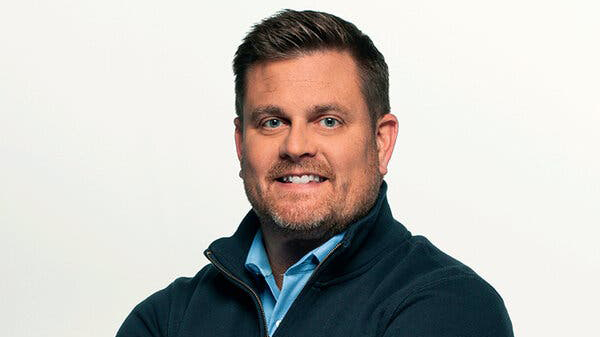
Brian Thompson, slain CEO of UnitedHealthcare, was responsible for skyrocketing prior authorization denials (Photo: UnitedHealthcare)

The assassination of UnitedHealthcare CEO Brian Thompson on December 4 has sparked a reaction that few may have suspected. The perpetrator has received an outpouring of popular support, and a profound debate on the brutality of the US for-profit healthcare system has been sparked, with many accusing healthcare corporations of reaping their profits directly from human misery.

Thompson was shot and killed while heading to an investors meeting in Midtown Manhattan on December 4. Police have arrested 26-year-old Luigi Mangione in connection with the crime, who quickly has become a working class hero in the eyes of many in the US public, especially after his alleged manifesto revealed that he was motivated by outrage towards healthcare corporations. “A reminder: the US has the #1 most expensive healthcare system in the world, yet we rank roughly #42 in life expectancy,” reads the alleged manifesto, which law enforcement claim to have found in his backpack. “It is not an issue of awareness at this point, but clearly power games at play. Evidently I am the first to face it with such brutal honesty.”

The reactions to Thompson’s death show that this outrage is echoed by the US public. UnitedHealthcare had to remove a Facebook post mourning Thompson after it received over 42,000 laughing reactions. Comments on social media regarding Thompson’s death made insurance-related quips including “unfortunately my condolences are out-of-network,” and “thoughts and deductibles to the family.”

Health beyond the for-profit system

People in the US are increasingly demanding alternatives to the present for-profit healthcare system. A Gallup poll taken shortly before Thompson’s assassination shows that the highest percentage of US adults in over a decade believe it is the government’s responsibility to ensure that people have healthcare coverage—62%, as opposed to 36% who insist it is not the government’s responsibility. Gallup data also indicates that most in the US have a negative view of the healthcare industry. 

Data for Progress polling indicates that people across the political spectrum support policies that make healthcare more equitable, with 75% of both Democrat, Republican, and independent voters opposing allowing insurers to deny coverage or charge more based on pre-existing conditions. Also across party lines, 70% of voters oppose stopping Medicare (US public insurance) from being able to negotiate lower costs for drug prices.

The unpopularity of the healthcare insurance industry becomes obvious when one examines how exactly insurance companies wield their power over the healthcare system to extract profits from working people. 

Cost cutting through denial of service

Shortly before Thompson’s killing, another insurance corporation, Anthem Blue Cross Blue Shield, announced that it would not pay for the complete duration of anesthesia for surgical procedures. This move was denounced by the American Society of Anesthesiologists (ASA). “This is just the latest in a long line of appalling behavior by commercial health insurers looking to drive their profits up at the expense of patients and physicians providing essential care,” said Dr. Donald E. Arnold of ASA. “It’s a cynical money grab by Anthem, designed to take advantage of the commitment anesthesiologists make thousands of times each day to provide their patients with expert, complete and safe anesthesia care. This egregious policy breaks the trust between Anthem and its policyholders who expect their health insurer to pay physicians for the entirety of the care they need.” 

Following Thompson’s assassination and the subsequent outrage over the state of the healthcare industry, Anthem walked back this decision, with a company spokesperson stating that “there has been significant widespread misinformation about an update to our anesthesia policy. As a result, we have decided to not proceed with this policy change.” 

Regardless of Anthem’s flip-flopping, the corporation was willing to cut anesthesia for patients mid-surgery simply to cut costs. This is only one example of how health insurance companies are able to reap their enormous profits from policies which maximize human misery. 

Under the current privatized healthcare system in the US, working people and their employers pay hundreds of billions of dollars to private insurance companies in the hopes of receiving adequate coverage when most needed. Insurance companies, which under a capitalist system exist only to make a profit, not to actually provide coverage, do whatever they can do to deny coverage to patients in their hour of need—enabling them to pocket the billions they receive from people in the US and increase their revenue. 

Companies such as UHC, which is the nation’s largest health insurer with over 15% of the market share, cut costs by denying coverage to patients, including through a process called prior authorization, a process which insurance companies utilize to determine if they will cover a prescribed procedure, service, or medication. Prior to  Thompson’s tenure as UHC CEO, which began in 2021, the rate of prior authorization denials was 8%. By 2022, the rate of denial had skyrocketed to 22.7%. According to personal finance platform ValuePenguin, UHC denies Medicare and non-Medicare insurance claims at a rate that is double the rate of the national average. 

UHC’s prior authorization denials increased so sharply that they prompted an investigation by media outlet ProPublica as well as the US Senate. ProPublica found that UHC had culled therapy expenses by using an algorithm to restrict mental healthcare coverage. A report by the Senate Permanent Subcommittee on Investigations found that UHC used artificial intelligence to deny claims at an increasing rate. In November of 2023, UHC was hit by a class action lawsuit filed by the families of two former UHC beneficiaries, which alleged that the company had illegally denied “elderly patients care owed to them under Medicare Advantage Plans” by utilizing an AI algorithm with a 90% error rate.

“The elderly are prematurely kicked out of care facilities nationwide or forced to deplete family savings to continue receiving necessary medical care, all because [UHC’s] AI model ‘disagrees’ with their real live doctors’ determinations,” said the complaint.

These sharp increases in claim denials served a particular purpose: under Thompson’s leadership, UHC profits increased from USD 12 billion in 2021 to USD 16 billion in 2023. UnitedHealthcare Group, of which UHC is a part, is now the largest health insurance company is the US, with an annual revenue of over USD 189 billion.

Hey @UHC. Completed a hysterectomy yesterday afternoon, discharged her home in the evening (saving @UHC and everyone some money). Discharge medications included 12 Vicodin. (retail cost $30). Vicodin DENIED pending prior authorization. Patient in pain all night. Way to go.

— DrByronHapner (@DrByronHapner) December 10, 2024

As health insurance companies extract their enormous profits from those left without coverage, some are seeking to propose and organize alternatives to the for-profit healthcare system. Progressive demands for Medicare for All, a single-payer healthcare program in which the costs of essential healthcare for all US residents are covered under a public health plan that would replace almost all other existing public and private health plans, have reignited following Thompson’s assassination. Organizations such as Physicians for a National Health Program have advocated for such a policy. As PNHP outlines, under a single-payer program, “over $500 billion in administrative savings would be realized by replacing today’s inefficient, profit-oriented, multiple insurance payers with a single streamlined, nonprofit, public payer.”

“There is no justification for violence,” said California Representative Ro Khanna, who supports the policy. “But the outpouring afterwards has not surprised me.

Original article by Natalia Marques republished from peoples dispatch under a Creative Commons Attribution-ShareAlike 4.0 (CC BY-SA) license.

Continue ReadingUS healthcare corporations reap profit from human misery

For-Profit US Healthcare System—Once Again—Ranks Dead Last Among Its Peers

Spread the love

Original article by Jake Johnson republished from Common Dreams under Creative Commons (CC BY-NC-ND 3.0).

Medical staffers tend to patients at a hospital in Houston, Texas on August 18, 2021. (Photo: Brandon Bell/Getty Images)

“Our private, profit-driven system means that we are paying more for less,” said one progressive activist.

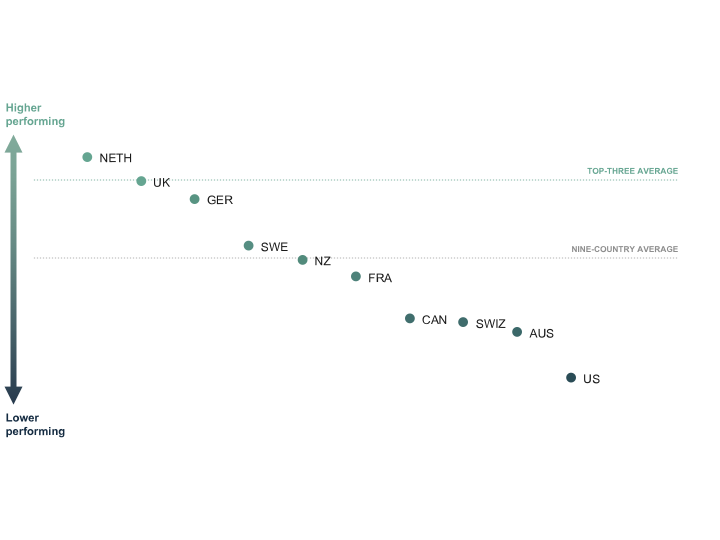
A report out Thursday shows that the United States’ for-profit healthcare system still ranks dead last among peer nations on key metrics, including access to care and health outcomes such as life expectancy at birth.

The new analysis from the Commonwealth Fund is the latest indictment of a corporate-dominated system that leaves tens of millions of people uninsured or underinsured and unable to afford life-saving medications without rationing doses or going into debt.

“Despite spending a lot on healthcare, the United States is not meeting one of the principal obligations of a nation: to protect the health and welfare of its residents,” the report states. “Most of the countries we compared are providing this protection, even though each can learn a good deal from its peers. The U.S., in failing this ultimate test of a successful nation, remains an outlier.”

People in the U.S., which spends roughly twice as much per capita on healthcare as other rich nations, “live the shortest lives and have the most avoidable deaths,” Commonwealth noted, pointing to frequent “denials of services by insurance companies” and other systematic defects of the American system, including massive administrative costs.

Meanwhile, insurance giants and pharmaceutical companies are raking in huge profits, benefiting in particular from the growing privatization of Medicare. More than half of the Medicare-eligible population in the U.S. is currently on a privately run Medicare Advantage plan.

“Our private, profit-driven system means that we are paying more for less,” progressive activist Jonathan Cohn wrote in response to the Commonwealth report.

Americans live the shortest lives and have the most avoidable deaths.

Note: To normalize performance scores across countries, each score is the calculated standard deviation from a nine-country average that excludes the US. See “How We Conducted This Study” for more detail.

Data: Commonwealth Fund analysis.

Source: David Blumenthal et al., Mirror, Mirror 2024: A Portrait of the Failing U.S. Health System — Comparing Performance in 10 Nations (Commonwealth Fund, Sept. 2024). https://doi.org/10.26099/ta0g-zp66

The Commonwealth Fund’s findings bolster progressives’ case for transitioning to a Medicare for All system that would provide comprehensive coverage to everyone in the country for free at the point of service. Studies have repeatedly shown that such a program would cost less than the immensely wasteful for-profit system—which is set to drive national healthcare spending to $7.7 trillion per year by 2032—while saving lives.

Commonwealth observed Thursday that while affordability “is a pervasive problem” in the U.S., Australia “offers free care in all public hospitals, and the nation’s universal Medicare system provides all Australians with coverage for all or part of the cost of [general practitioners] and specialist consultations and diagnostic tests, with additional subsidies available for private hospital care.”

“The U.S. continues to be in a class by itself in the underperformance of its healthcare sector,” the report continues. “While the other nine countries differ in the details of their systems and in their performance on domains, unlike the U.S., they all have found a way to meet their residents’ most basic health care needs, including universal coverage.”

Americans face the most barriers to accessing and affording health care.

Note: To normalize performance scores across countries, each score is the calculated standard deviation from a nine-country average that excludes the US. See “How We Conducted This Study” for more detail.

Data: Commonwealth Fund analysis.

Source: David Blumenthal et al., Mirror, Mirror 2024: A Portrait of the Failing U.S. Health System — Comparing Performance in 10 Nations (Commonwealth Fund, Sept. 2024). https://doi.org/10.26099/ta0g-zp66

With the U.S. presidential election less than two months away, neither 2024 candidate for the two major parties has outlined a detailed healthcare proposal thus far.

Former President Donald Trump, the Republican nominee, said during last week’s debate in Philadelphia that he merely has “the concepts of a plan,” while Harris—who once co-sponsored Medicare for All legislation in the Senate—said she “absolutely” supports “private healthcare options” and wants to “maintain and grow the Affordable Care Act.”

Just days after the debate, Sen. JD Vance (R-Ohio)—Trump’s running mate—said the Republican nominee prefers a system in which “a young American” and a “65-year-old American with a chronic condition” are not placed in “the same risk pools,” suggesting a rollback of the ACA’s protections for people with preexisting conditions.

“You can’t really say people with preexisting conditions are protected if they are in a separate insurance risk pool and can be charged exorbitant premiums,” Larry Levitt, executive vice president for health policy at the research group KFF, wrote in response to Vance’s comments.

Original article by Jake Johnson republished from Common Dreams under Creative Commons (CC BY-NC-ND 3.0).

Continue ReadingFor-Profit US Healthcare System—Once Again—Ranks Dead Last Among Its Peers

Young Voters Tell Kamala Harris to ‘Fight for Our Future’

Spread the love

Original article by JESSICA CORBETT republished from Common Dreams under Creative Commons (CC BY-NC-ND 3.0). 

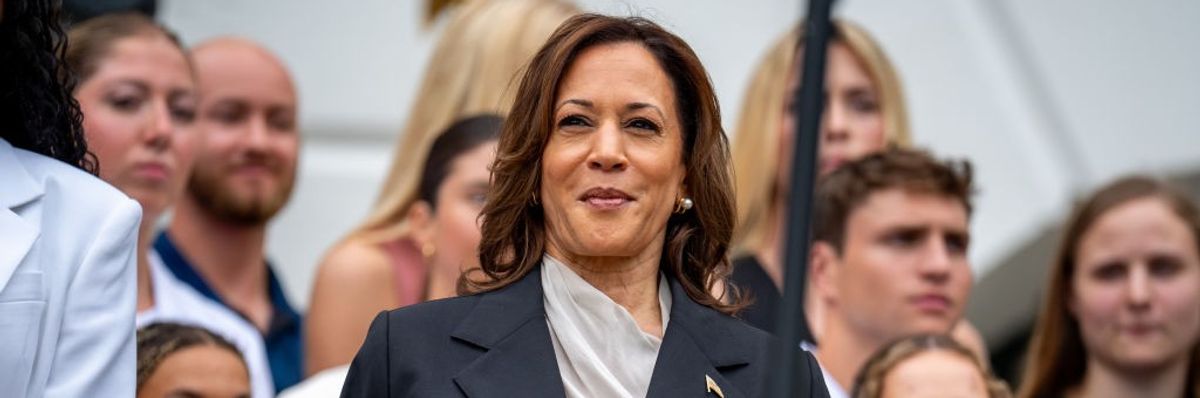
Vice President Kamala Harris arrives for an NCAA championship celebration on the South Lawn of the White House on July 22, 2024 in Washington, D.C.
 (Photo: Andrew Harnik/Getty Images)

“This is your chance to energize young people and our communities to vote, mount one of the greatest political comebacks in decades, and deliver a resounding defeat to the far-right agenda of Trump and Vance.”

Four youth-led groups on Thursday urged Vice President Kamala Harris, the presumptive Democratic presidential nominee, to “fight for our future” by pursuing a policy agenda the coalition unveiled in a March letter to U.S. President Joe Biden.

It’s been less than a week since Biden left the race and endorsed Harris, who is expected to face former Republican Donald Trump and his running mate, U.S. Sen. JD Vance (R-Ohio), in the November election. Since then, she’s racked up endorsements from Democratic members of Congress and progressive groups focused on issues including climatelabor, and reproductive rights.

March for Our Lives, which was launched after the 2018 mass shooting at Marjory Stoneman Douglas High School in Parkland, Florida, honored Harris with the group’s first-ever endorsement on Wednesday, calling her “the right person to stand up for us and fight for the country we deserve.”

“To defeat Trump, you must rebuild support and enthusiasm among young voters.”

The gun violence prevention organization is part of the youth-led coalition behind the new letter, which also includes the climate-focused Sunrise Movement; Gen-Z for Change, which advocates on a range of issues; and the national immigrant network United We Dream Action.

“You have an urgent and important task. To defeat Trump, you must rebuild support and enthusiasm among young voters,” the coalition told Harris on Thursday, noting that she sought the Democratic nomination during the last cycle. “You should build on your 2020 campaign platform where you put forward a strong vision to make the economy work for everyday people and ensure a livable future for us all.”

The groups urged Harris to support the Green New Deal, Medicare for All, and the Reverse Mass Incarceration Act. They pushed her to expand pathways to citizenship, keep families together, end fossil fuel subsidies, and create good, union jobs. They also called on her to prioritize gun violence prevention and investments in public health solutions and green, affordable housing.

“Democrats are at a critical crossroads with young people,” the coalition wrote to Harris on Thursday. “Polls showed Biden and Trump neck-and-neck among young voters.”

ANew York Times/Siena College poll conducted July 22-24 shows Trump leading Harris 48% to 47% among likely voters and 48% to 46% among registered voters—differences that fall within the margin of error.

Forbes noted Thursday that “Democrats are far more enthusiastic about Harris than they were Biden, the Times/Siena survey found, with nearly 80% of voters who lean Democrat saying they would like Harris to be the nominee, compared to 48% of Democrats who said the same about Biden three weeks ago.”

The outlet also pointed to two other polls conducted by Morning Consult and Reuters/Ipsos since Biden dropped out, which both show Harris with a narrow lead over Trump.

“You have an opportunity to win the youth vote by turning the page and differentiating yourself from Biden policies that are deeply unpopular with us, such as approving new oil and gas projects, denying people their right to seek refuge and asylum, and funding the Israeli government’s killing of civilians in Gaza,” the youth coalition highlighted Thursday. “You must speak to the economic pain young people are facing from crushing student debt and skyrocketing housing and food prices.”

Looking beyond November, the groups told Harris—who could be the first Black woman and person of Asian descent elected to the country’s highest office—that “you could be a historic president. Not just because of who you are, but what you can accomplish.”

“Young people are energized and ready to organize against fascism and for the future we deserve,” they concluded. “This is your chance to energize young people and our communities to vote, mount one of the greatest political comebacks in decades, and deliver a resounding defeat to the far-right agenda of Trump and Vance.”

Original article by JESSICA CORBETT republished from Common Dreams under Creative Commons (CC BY-NC-ND 3.0). 

Continue ReadingYoung Voters Tell Kamala Harris to ‘Fight for Our Future’