Donald Trump’s Fossil Fuel Executive UK Ambassador Donated $4 Million to President’s Inauguration Fund

Spread the love

Original article by Adam Barnett and Sam Bright republished from DeSmog.
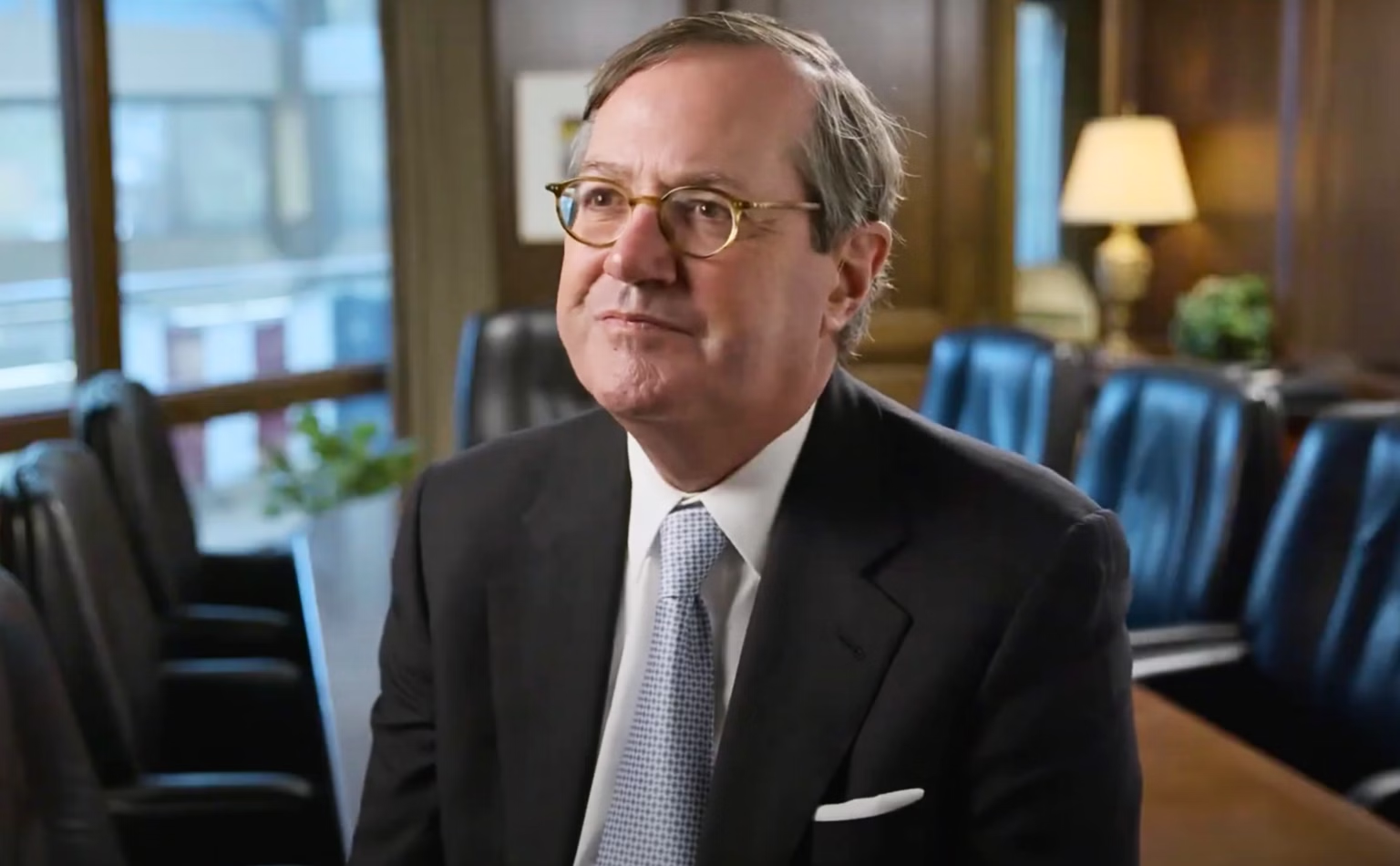
U.S. ambassador to the UK Warren Stephens. Credit: Arkansas Inc / YouTube

Warren Stephens made the donation alongside big tech firms and oil giants.

Donald Trump’s ambassador to the UK donated $4 million to the new U.S. president’s inauguration on the same day he was nominated for the diplomatic position, DeSmog can report.

Billionaire Warren Stephens gave $4 million (just under £3 million today) to the Trump Vance Inaugural Committee on 2 December, according to the official record of donations. The committee is appointed by the president-elect to arrange the inauguration ceremony, when a U.S. president is formally sworn into office.

“It’s not so surprising that a transactional president hands out favours to people who give him money, but that doesn’t make it any less outrageous,” said Agustina Oliveri, head of campaigns and communications at the Good Law Project.

There is no direct evidence that Warren secured the position due to this donation. However, U.S. presidents have a long history of handing out diplomatic roles to major donors, while the Trump administration has bestowed his patrons with a number of senior positions. Of the 37 people who gave $1 million or more to the inauguration committee, six have either been given a role in the administration or have been nominated for a role.

Tom Brake, a former Liberal Democrat MP and the director of the transparency campaign group Unlock Democracy, urged the UK government not to follow Trump’s lead.

“Whatever approach the U.S. administration adopts towards the appointment of its ambassadors, the UK government should make it clear that when it comes to appointing UK ambassadors or high commissioners, donating substantial sums of money directly or indirectly to the party of government will block an appointment not facilitate it,” he said. “There must never be a question mark over whether UK appointments are made on merit, or driven by a donor’s deep pockets.”

As DeSmog revealed on 5 December, Warren Stephens holds significant oil and gas interests. Prior to his appointment as Trump’s UK ambassador, he ran Stephens Inc. – one of the largest privately-owned investment banks in the United States. Stephens has since stood down as CEO, but remains its chairman.

The firm’s portfolio includes a number of companies that make their money from oil and gas exploration and production — including one, Stephens Natural Resources, which “has a rich history of drilling and producing both oil and natural gas”, according to its website.

The UK’s ambassador to the U.S. Peter Mandelson also co-founded a public affairs agency with major fossil fuel clients.

Trump’s inauguration committee – which raised almost $240 million – received donations from fossil fuel giants Chevron ($2 million), ExxonMobil ($1 million), the U.S. branches of BP and Shell ($500,000 each), and Valero ($250,000).

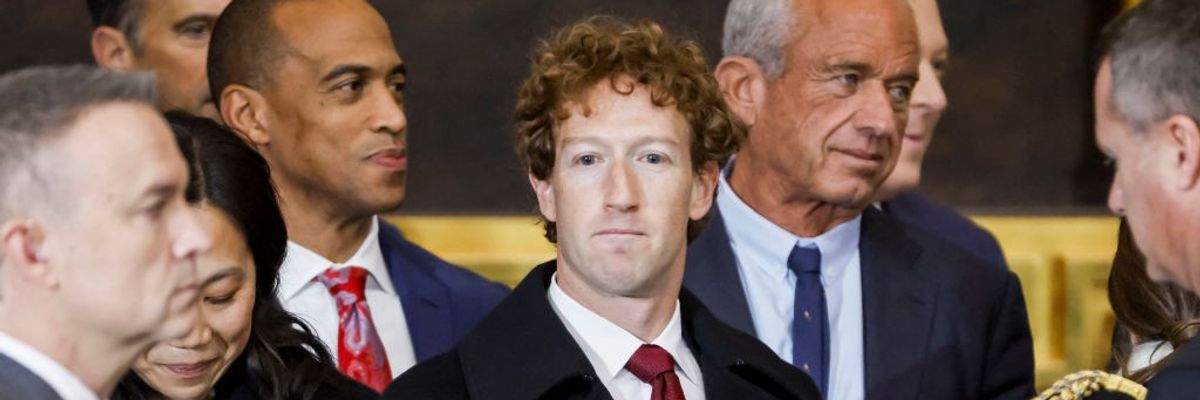
It also accepted donations from major tech platforms including Amazon and Meta, whose founders Jeff Bezos and Mark Zuckerberg received a front row seat to the event.
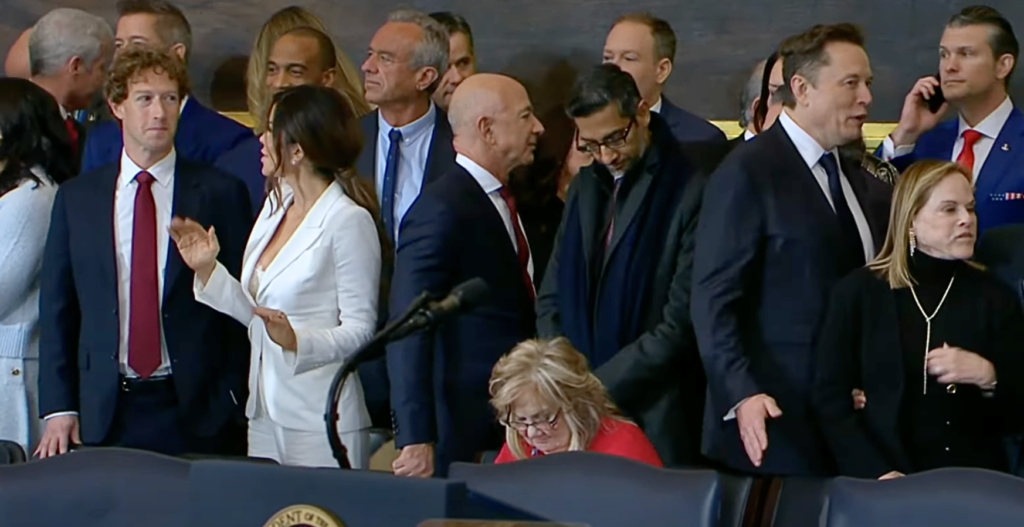
Mark Zuckerberg, Jeff Bezos, Elon Musk and others at Donald Trump’s 2025 inauguration. Credit: WSJ / YouTube

The inauguration committee received a further $1 million from the Heritage Foundation, a hard-right U.S. research and lobby group which drafted the “autocratic” Project 2025 blueprint for Trump’s second term.

Trump denied knowledge of Project 2025 during the election campaign but has subsequently appointed Russell Vought, one of its advisory board members and co-authors, as director of the Office for Management and Budget (OMB), a key department within the president’s office that helps to oversee and co-ordinate policy.

Project 2025 urged Trump to “dismantle the administrative state”, slash restrictions on fossil fuel extraction, scrap state investment in renewable energy, and gut the Environmental Protection Agency.

Since his inauguration on 20 January, Trump has announced a series of policies that have mirrored these demands.

The new president, who received more than $75 million from oil and gas interests for his re-election campaign, has pledged to once again withdraw the U.S. from the flagship 2015 Paris Agreement, which set an international target for limiting global warming. He has also declared a “national energy emergency” to allow the U.S. to “drill, baby, drill” for new fossil fuels.

“When we look at the dumpster fire of U.S. government policy – from trashing the planet to attacking basic human rights – there’s no point in asking ‘What are they up to?’. The question we need to focus on is ‘Who paid for that?,’” said Oliveri.

The U.S. embassy in London referred DeSmog’s enquiry to the U.S. State Department. The Heritage Foundation was approached for comment.

Original article by Adam Barnett and Sam Bright republished from DeSmog.

Neo-Fascist Climate Science Denier Donald Trump says Burn, Baby, Burn.
Elon Musk urges you to be a Fascist like him, says that you can ignore facts and reality then.
Orcas discuss how Trump was re-elected and him being an insane, xenophobic Fascist.
Continue ReadingDonald Trump’s Fossil Fuel Executive UK Ambassador Donated $4 Million to President’s Inauguration Fund

Capitalism’s Free Speech Trap: Bezos Shows How Billionaires Set the Boundaries of Debate

Spread the love

Original article by Peter Bloom republished from Common Dreams under Creative Commons (CC BY-NC-ND 3.0). 

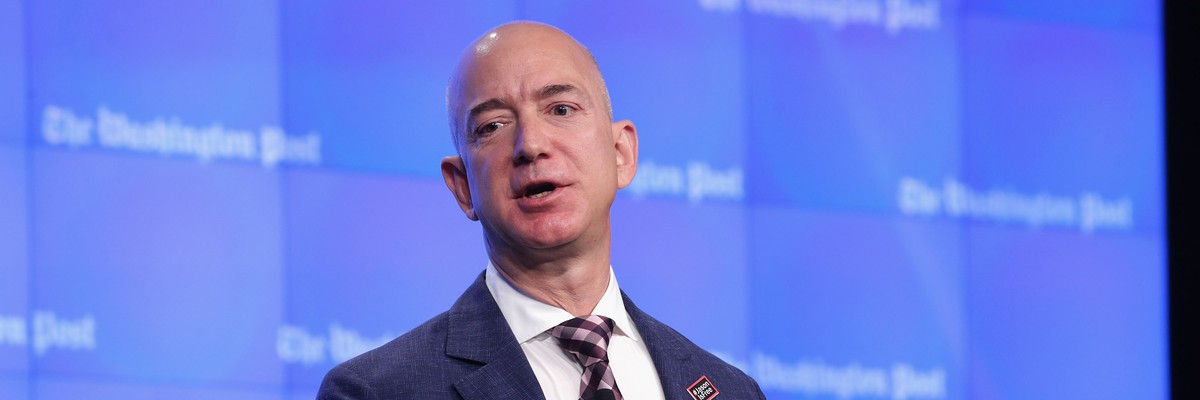
Amazon founder and Washington Post owner Jeff Bezos delivers remarks during the opening ceremony of the media company’s new location January 28, 2016 in Washington, D.C. (Photo: Chip Somodevilla/Getty Images)

The Washington Post’s shift toward free-market advocacy is not simply an editorial decision; it is a strategic move to reinforce the dominant ideological framework that benefits the billionaire class.

The recent directive by Jeff Bezos that The Washington Post editorial section should promote “personal liberties and free markets” is a stark reminder of how freedom under capitalism often boils down to the freedom of economic elites to dictate the parameters of public discourse. While Bezos has suggested that social media provides alternative perspectives, thus absolving his newspaper of the responsibility to represent diverse viewpoints, his decision is part of a broader trend of billionaire media ownership shaping acceptable discourse.

This phenomenon is visible across digital platforms as well. Elon Musk’s control over X (formerly Twitter) has demonstrated how ownership can shape public debate—both through direct interventions, such as the alleged suppression of progressive perspectives, and through more subtle changes to platform algorithms. Similarly, Mark Zuckerberg’s Meta has faced repeated allegations of privileging certain political narratives while suppressing others, including ending its “fact checking” policy that could challenge far-right viewpoints.

Perhaps the most glaring contradiction in Bezos’ advocacy for free markets is the extent to which he, and other billionaires like him, have benefited from state intervention as part of an intentional strategy of “corporate welfare.”

In each case, the rhetoric of “free speech” is selectively applied. While these platforms and newspapers claim to support open debate, their policies ultimately reflect the ideological preferences of their owners. This demonstrates a fundamental truth: In capitalist societies, freedom of expression is often contingent on the interests of those who control the means of communication. The Washington Post’s shift toward free-market advocacy is not simply an editorial decision; it is a strategic move to reinforce the dominant ideological framework that benefits the billionaire class.

The Myth of Meritocracy and the Far-Right’s War on DEI

Bezos’ framing of free markets as inherently linked to personal liberties exposes a deeper ideological assumption—namely, that economic success is the result of individual talent and merit rather than systemic privilege. This assumption is not unique to Bezos but is foundational to the way many economic elites understand their own wealth and influence.

The logic behind Bezos’ editorial direction is similar to the arguments used by the contemporary far-right to attack Diversity, Equity, and Inclusion (DEI) initiatives. The opposition to DEI is rooted in a desire to preserve the myth that success is determined purely by hard work and ability, rather than by racial, gender, or class privilege. By rejecting policies that acknowledge structural inequalities, The far-right seeks to uphold a narrative that justifies existing economic and social hierarchies.

This worldview is deeply intertwined with the ideology of neoliberalism, which insists that markets are neutral mechanisms that reward the most capable individuals. However, history shows that markets are anything but neutral. The barriers faced by marginalized groups are not simply the result of individual shortcomings; they are the product of centuries of systemic exclusion. The far-right’s attack on DEI serves to obscure these realities, just as Bezos’ insistence on free markets seeks to erase the role of privilege and power in determining economic outcomes.

By positioning The Washington Post as a champion of free markets, Bezos is promoting the idea that capitalism functions as a pure meritocracy. This serves not only to legitimize his own position but also to delegitimize calls for policies that challenge structural inequality, whether in the form of DEI programs, labor protections, or wealth redistribution measures.

The Illusion of the Free Market and Its Political Implications

Perhaps the most glaring contradiction in Bezos’ advocacy for free markets is the extent to which he, and other billionaires like him, have benefited from state intervention as part of an intentional strategy of “corporate welfare.” The notion of a truly free market, where economic actors compete on equal footing without government interference, is a fantasy. In reality, corporations like Amazon have thrived not because of unregulated competition, but because of significant government support.

From tax incentives to government contracts, Amazon has received billions in subsidies that have allowed it to dominate the retail and logistics industries. Moreover, the U.S. government plays a critical role in enforcing corporate-friendly trade policies, suppressing labor movements, and protecting the interests of multinational corporations abroad. These interventions are rarely acknowledged in discussions of free markets, yet they are crucial to understanding the power dynamics of contemporary capitalism.

If freedom under capitalism ultimately means the freedom of the wealthy to dictate the terms of discourse, then the very concept of free speech is in jeopardy.

Politically, Bezos’ editorial directive at The Washington Post serves to strengthen a broader ideological alignment between neoliberal economics and far-right nationalism. By framing free-market capitalism as an essential component of personal liberty, Bezos is laying the groundwork for a political agenda that fuses economic libertarianism with nationalist conservatism. This is significant because it provides an ideological foundation for challenging emerging economic policies that deviate from neoliberal orthodoxy—such as the rise of protectionism in response to globalization.

This alignment between free-market ideology and far-right nationalism is not new. Historically, neoliberalism has often coexisted with reactionary politics, as seen in the economic policies of figures like former U.S. President Ronald Reagan and former U.K. Prime Minister Margaret Thatcher. Today, this synthesis is being revived as right-wing populists seek to defend corporate interests while simultaneously appealing to nationalist sentiments. Bezos’ intervention in The Washington Post should be understood within this broader context: It is not just about shaping editorial policy but about consolidating an ideological framework that benefits economic elites while limiting the scope of acceptable political debate.

The Dangers of Billionaire-Controlled Media

Bezos’ decision to impose a free-market ideology on The Washington Post is not an isolated event; it is part of a larger trend in which media ownership is used to shape public discourse in ways that serve elite interests. This phenomenon extends beyond traditional journalism to social media platforms, where billionaires like Musk and Zuckerberg wield immense power over the flow of information.

At its core, this issue is about more than just media bias—it is about the fundamental tension between democracy and concentrated economic power. A truly free and open society requires a diversity of perspectives, yet the dominance of billionaire-controlled media threatens to constrain the range of acceptable debate. If freedom under capitalism ultimately means the freedom of the wealthy to dictate the terms of discourse, then the very concept of free speech is in jeopardy.

The consolidation of media power in the hands of a few ultra-wealthy individuals raises urgent questions about the future of democratic debate. If we are to challenge the ideological hegemony of economic elites, we must first recognize the mechanisms through which they shape public discourse. Bezos’ editorial mandate is not just about The Washington Post—it is a reflection of the broader struggle over who gets to define the boundaries of political and economic debate in the 21st century.

Original article by Peter Bloom republished from Common Dreams under Creative Commons (CC BY-NC-ND 3.0). 

Continue ReadingCapitalism’s Free Speech Trap: Bezos Shows How Billionaires Set the Boundaries of Debate

Human Rights Experts: Meta’s Trump-Friendly Policies Could Be ‘Conduit’ for ‘Genocide’

Spread the love

Original article by Olivia Rosane republished from Common Dreams under Creative Commons (CC BY-NC-ND 3.0).

Mark Zuckerberg (C), CEO of Meta, attends the inauguration ceremony where Donald Trump was sworn in as the 47th U.S. President in the U.S. Capitol Rotunda in Washington, D.C., on January 20, 2025. 
(Photo: Shawn Thew / POOL / AFP)

“Rather than learning from its reckless contributions to mass violence in countries including Myanmar and Ethiopia, Meta is instead stripping away important protections that were aimed at preventing any recurrence of such harms.”

An expert on technology and human rights and a survivor of the Rohingya genocide warned Monday that new policies adopted by social-media giant Meta, which owns Facebook and Instagram, could incite genocidal violence in the future.

On January 7, Meta CEO Mark Zuckerberg announced changes to Meta policies that were widely interpreted as a bid to gain approval from the incoming Trump administration. These included the replacement of fact-checkers with a community notes system, relocating content moderators from California to Texas, and lifting bans on the criticisms of certain groups such as immigrants, women, and transgender individuals.

Zuckerberg touted the changes as an anti-censorship campaign, saying the company was trying to “get back to our roots around free expression” and arguing that “the recent elections also feel like a cultural tipping point toward, once again, prioritizing speech.”

“With Zuckerberg and other tech CEOs lining up (literally, in the case of the recent inauguration) behind the new administration’s wide-ranging attacks on human rights, Meta shareholders need to step up and hold the company’s leadership to account to prevent Meta from yet again becoming a conduit for mass violence, or even genocide.”

However, Pat de Brún, head of Big Tech Accountability at Amnesty International, and Maung Sawyeddollah, the founder and executive director of the Rohingya Students’ Network who himself fled violence from the Myanmar military in 2017, said the change in policies would make it even more likely that Facebook or Instagram posts would inflame violence against marginalized communities around the world. While Zuckerberg’s announcement initially only applied to the U.S., the company has suggested it could make similar changes internationally as well.

“Rather than learning from its reckless contributions to mass violence in countries including Myanmar and Ethiopia, Meta is instead stripping away important protections that were aimed at preventing any recurrence of such harms,” de Brún and Sawyeddollah wrote on the Amnesty International website. “In enacting these changes, Meta has effectively declared an open season for hate and harassment targeting its most vulnerable and at-risk people, including trans people, migrants, and refugees.”

Past research has shown that Facebook’s algorithms can promote hateful, false, or racially provocative content in an attempt to increase the amount of time users spend on the site and therefore the company’s profits, sometimes with devastating consequences.

One example is what happened to the Rohingya, as de Brún and Sawyeddollah explained:

We have seen the horrific consequences of Meta’s recklessness before. In 2017, Myanmar security forces undertook a brutal campaign of ethnic cleansing against Rohingya Muslims. A United Nations Independent Fact-Finding Commission concluded in 2018 that Myanmar had committed genocide. In the years leading up to these attacks, Facebook had become an echo chamber of virulent anti-Rohingya hatred. The mass dissemination of dehumanizing anti-Rohingya content poured fuel on the fire of long-standing discrimination and helped to create an enabling environment for mass violence. In the absence of appropriate safeguards, Facebook’s toxic algorithms intensified a storm of hatred against the Rohingya, which contributed to these atrocities. According to a report by the United Nations, Facebook was instrumental in the radicalization of local populations and the incitement of violence against the Rohingya.

In late January, Sawyeddollah—with the support of Amnesty International, the Open Society Justice Initiative, and Victim Advocates International—filed a whistleblower’s complaint against Meta with the Securities and Exchange Commission (SEC) concerning Facebook’s role in the Rohingya genocide.

The complaint argued that the company, then registered as Facebook, had known or at least “recklessly disregarded” since 2013 that its algorithm was encouraging the spread of anti-Rohingya hate speech and that its content moderation policies were not sufficient to address the issue. Despite this, it misrepresented the situation to both the SEC and investors in multiple filings.

Now, Sawyeddollah and de Brún are concerned that history could repeat itself unless shareholders and lawmakers take action to counter the power of the tech companies.

“With Zuckerberg and other tech CEOs lining up (literally, in the case of the recent inauguration) behind the new administration’s wide-ranging attacks on human rights, Meta shareholders need to step up and hold the company’s leadership to account to prevent Meta from yet again becoming a conduit for mass violence, or even genocide,” they wrote. “Similarly, legislators and lawmakers in the U.S. must ensure that the SEC retains its neutrality, properly investigate legitimate complaints—such as the one we recently filed, and ensure those who abuse human rights face justice.”

The human rights experts aren’t the only ones concerned about Meta’s new direction. Even employees are sounding the alarm.

“I really think this is a precursor for genocide,” one former employee told Platformer when the new policies were first announced. “We’ve seen it happen. Real people’s lives are actually going to be endangered. I’m just devastated.”

Original article by Olivia Rosane republished from Common Dreams under Creative Commons (CC BY-NC-ND 3.0).

Climate Science Denier Donald Trump says Burn, Baby, Burn.
Elon Musk urges you to be a Fascist like him, says that you can ignore facts and reality then.
Continue ReadingHuman Rights Experts: Meta’s Trump-Friendly Policies Could Be ‘Conduit’ for ‘Genocide’

Trump’s Second Inauguration Took Influence Peddling to a Whole New Level

Spread the love

https://www.commondreams.org/opinion/trump-inauguration-donations

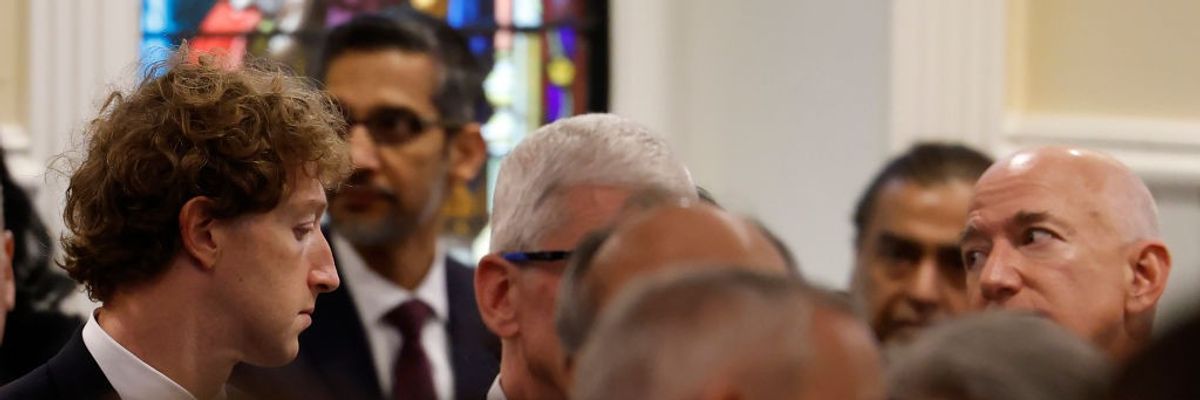
Meta and Facebook CEO Mark Zuckerberg (L), CEO of Apple Tim Cook, and Founder of Amazon and Blue Origin Jeff Bezos attend services as part of Inauguration ceremonies at St. John’s Church on January 20, 2025 in Washington, D.C. (Photo: Anna Moneymaker/Getty Images)

The very ripeness for scandal this time around calls for reasonable restrictions on the sources and amounts of inaugural donations.

U.S. President Donald Trump sounded a lot of populist notes on the campaign trail. But as he took the oath of office for the second time, he was joined onstage by billionaires and CEOs who’d spent millions to be there—leaving supporters who’d traveled across the country to attend literally out in the cold.

Presidential inaugurations have always been an opportunity for wealthy special interests to curry favor with the incoming administration with generous inaugural donations. But the nation has never seen influence peddling like we just witnessed at Trump’s second inauguration.

Shattering all records, the Trump Vance Inaugural Committee, Inc. raised and spent over $200 million in special interest money celebrating the 2024 election victory. (The all-time previous record was $107 million for Trump’s first inauguration in 2017. By contrast, former President Joe Biden’s 2021 inauguration raised and spent nearly $62 million.)

The sheer volume of today’s inaugural donations suggests that wealthy special interests believe it is worth the investment.

All the self-reporting donors—including Big Tech firms like Google, Microsoft, Meta, Amazon, and OpenAI—pledged $1 million or more. The cryptocurrency firm Ripple pledged $5 million. In fact, the cryptocurrency industry even hosted its own inaugural ball.

And of course, Wall Street is cozying up with major donations from Goldman SachsBank of America, and billionaire hedge fund manager Ken Griffin.

“EVERYBODY WANTS TO BE MY FRIEND!!!” Trump marvels on his Truth Social account.

https://www.commondreams.org/opinion/trump-inauguration-donations

Elon Musk urges you to be a Fascist like him, says that you can ignore facts and reality then.
Continue ReadingTrump’s Second Inauguration Took Influence Peddling to a Whole New Level

Zuckerberg and Musk have shown that Big Tech doesn’t care about facts

Spread the love

Original article by Jasper Jackson republished from TBIJ under This work is licensed under a Creative Commons Attribution-NonCommercial-NoDerivs 3.0 Unported License.

With tech titans openly disregarding the truth ahead of Trump’s second term, 2025 is likely to herald a new era of disinformation

The online information ecosystem has been in critical condition for some years now, but the prognosis for 2025 is looking more dire than ever.

Already this year two of the world’s richest men, who between them control a huge chunk of our communications infrastructure, have made it clear that they are not interested in our access to the truth.

On Tuesday, Mark Zuckerberg announced that his company Meta – which owns Facebook, Instagram and WhatsApp – would be scrapping its fact checking programme. The only exception to this for now will be in the EU, where strong regulations require it to police its platform.

The core purpose of this programme was to check content that had been flagged as containing potentially harmful misinformation, such as false claims about vaccines or military conflicts. These checks were carried out by third-party organisations, which had to follow rules around process and transparency – and which received significant funding from Meta.

In their place, Meta will now adopt a “community notes-style” system, which enables users themselves to weigh in on content that might be false. A similar set-up has already been adopted by X, where it has proven open to manipulation and failed abysmally to curb misinformation on the platform.

Recommended Articles

To be clear, Meta’s fact checking programme was not without its problems. For a start, there was no way it could catch every falsehood on the platforms. Meta’s financial arrangements with these organisations also raised questions. And ultimately, there is no definitive proof that showing people fact checks has any real impact on whether they believe the false claims.

But the programme did provide vital financial support to newsrooms that did hugely valuable work, from uncovering Russian propaganda campaigns to exposing online scam artists. And while it was only ever a partial solution at best, Meta’s programme was a sign that the company at least wanted to be seen to care about the accuracy of the information spreading across its platforms.

Zuckerberg’s about-turn came after a week in which another tech tycoon, Elon Musk, had been weighing in on UK politics, most notably with twisted falsehoods about the handling of child grooming cases and messages of support for Tommy Robinson, the far-right figure currently in prison for contempt of court after targeting a Syrian refugee with lies. On Monday, Musk suggested in a poll posted on X that “America should liberate the people of Britain from their tyrannical government”.

Click to sign up to TBIJ newsletter now

The recent behaviour of Zuckerberg and Musk can only be seen in light of the impending second term of Donald Trump, whose propensity for lying is legendary. Musk was already all in on Trump’s presidency. But since the election, much of the rest of the tech world has sought to curry favour with the incoming president, with many prominent figures making big donations to his inauguration.

Like the Trump presidency itself, Musk and Zuckerberg’s dismantling of systems that help protect the truth are logical consequences of the digital structures we have built. An online economy that rewards attention above all else has given new power to false claims. Outlandish lies spread quicker than boring truths. Telling people what they want to hear is more engaging than telling them what they need to hear.

And all the signs suggest that the problem will only be worsened by the tech world’s latest obsession: generative AI. Systems such as ChatGPT, which can come up with content that seems human and accurate but is often simply a convincing lie, are rapidly being incorporated into all our major channels of information and communication. Apple is putting inaccurate headlines on curated news articles. Meta is planning to flood its social networks with AI bots mimicking humans. Google is pushing AI-driven search that regularly throws up false results.

A huge amount of money has been poured into generative AI, and much of the tech industry is banking on it to deliver another lucrative boom. But it has turned out to be even worse than humans at telling fact from fiction – and even more willing to make things up. Dealing with this problem is vital for democracy, but it also threatens the industry’s next big payout. As Zuckerberg proved this week, it’s a lot easier to simply give up on accurate information altogether.

Big Tech is no longer even keeping up the pretence that it is committed to the truth. Keeping our information ecosystem healthy is going to be up to the rest of us.

Reporter: Jasper Jackson
Deputy editor: Katie Mark
Editor: Franz Wild

Production editor: Alex Hess
Fact checker: Frankie Goodway

TBIJ has a number of funders, a full list of which can be found here. None of our funders have any influence over editorial decisions or output.

Original article by Jasper Jackson republished from TBIJ under This work is licensed under a Creative Commons Attribution-NonCommercial-NoDerivs 3.0 Unported License.

This image added 11/1/25

Elon Musk urges you to be a Fascist like him, says that you can ignore facts and reality then.
Continue ReadingZuckerberg and Musk have shown that Big Tech doesn’t care about facts