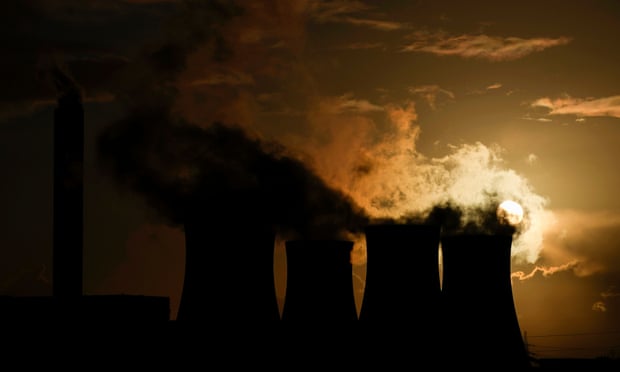
The Drax power station in Selby, England. The site was one of the UK’s worst methane hotposts. Photograph: Christopher Furlong/Getty Images
Greenpeace urges Labour to ‘fulfil international obligations’ as critics question accuracy of official data
…
The Guardian and Watershed Investigations analysed official methane emissions data from the National Atmospheric Emissions Inventory (NAEI) along with information on the Watershed pollution map to identify Britain’s methane hotspots.
Top of the list was a site near Glynneath in Wales, home to the Aberpergwm colliery, the UK’s last coalmine. Next was Selby, the location of industry including Drax power station, as well as a number of old landfills and farmland. The top 10 also includes power stations, oilwells and Slough trading estate, home to a wide range of industry.
…
Greenpeace’s chief scientist and policy director, Dr Doug Parr, said: “These alarming findings highlight that, despite the UK joining a global pledge to reduce methane emissions by nearly a third by 2030, a proper British action plan has yet to materialise.
“Given its potency, and the fact that it is in fact a short-lived greenhouse gas, reducing methane emissions could help rapidly slow the warming that is creating the climate crisis.
“The new government must fulfil the UK’s international promises, and has the opportunity to come up with an exemplary, internationally leading plan for tackling methane from both the energy and farming sectors.”
Yet the oil and gas major led a campaign to present gas as a climate solution, new ‘confidential’ documents released by a U.S. Congressional investigation reveal.
Democrat Jamie Raskin appeared before a Senate hearing examining Big Oil’s efforts to avoid climate accountability. Credit: US Senate
BP was warned by Princeton University researchers in 2016 that climate change accelerated in part by new global supplies of shale gas could lead to catastrophic events such as “mass extinctions and unprecedented famine.”
Yet despite acknowledging internally the concern that “gas doesn’t support climate goals,” the UK-headquartered oil and gas major embarked on a marketing campaign to “advance and protect the role of gas—and BP—in the energy transition.”
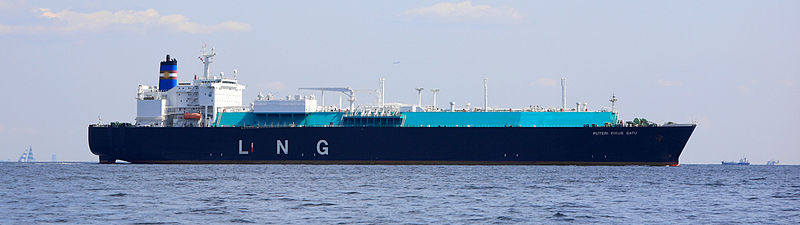
That’s been accompanied by large new investments in gas, including a recent agreement to take nearly two million tonnes per year of liquefied natural gas shipments from a $5.1 billion export facility called Woodfibre LNG proposed for the west coast of British Columbia.
Revelations concerning BP’s private knowledge about the dangers of gas expansion were contained in a trove of documents—some labelled “confidential”—released by Democrats in early May as part of a joint House and Senate investigation into the oil and gas industry’s climate obstruction.
“The fossil fuel industry evolved from denying climate science to spreading disinformation and perpetuating doublespeak about the safety of natural gas and its commitment to reducing greenhouse gas emissions,” the Joint Staff Report argues.
BP didn’t respond to questions from DeSmog related to the report.
Documents contained in the report, which were obtained via federal subpoenas, suggest that the highest levels of BP leadership have been privately made aware of potential climate disruption caused by natural gas. Comments on a draft outline for a 2017 speech by BP’s then-CEO Robert Dudley articulate that fear explicitly.
“You don’t say anything about concerns about so-called lock-in, the idea that, once built, gas locks in future emissions above a level consistent with 2 degrees, at least without CCUS,” the comments read, referring to expensive and frequently underperforming carbon capture utilization and storage technologies.
A confidential 2018 presentation from BP notes that while gas may release less emissions when burned than coal, those climate gains can be erased by leakages of the “potent” greenhouse gas methane. “Methane (CH₄) accounts for 20% of GHGs [greenhouse gas emissions],” a slide from the presentation notes. “Oil and gas accounts for nearly a quarter of this 20%.”
The presentation acknowledges the concern, widely reported in the media by that point, that “gas doesn’t support climate goals when you take methane emissions into account.” BP appears to have seen such worries as an “opportunity” for the company, however.
The company intended to launch a communications campaign that could “position BP as [a] strong gas player” in part by “demonstrating leadership on methane challenge,” the slide reads.
Yet the oil and gas producer had been warned that a failure to limit global temperature rise to below 2 degrees could be catastrophic for humankind and the planet. During a 2016 town hall event for BP in Houston, Princeton researchers noted “innovation in the energy sector has been dramatically affected by the arrival of shale gas and oil and low energy prices.”
One result, they noted, is that “fossil fuels are so abundant that, for even a weak climate target, attractive fossil fuel will be left in the ground.” But if the world fails to limit warming below 2 degrees, “the climate monsters begin to come into the room,” they noted.
As warming approaches 3 degrees, their presentation explained, “we expect a rogue’s gallery, from the loss of all of our coastal cities because of >10 m of sea level rise, to cessation of the ocean’s circulation.”
Yet the company continues to publicly portray the fossil fuel as a climate solution. “As the world seeks secure, affordable and lower carbon energy, global demand for LNG is expected to continue to grow,” a BP executive said last year upon the company signing its latest off-take agreement with Woodfibre LNG in Canada.
This is part of a years-long global campaign to spread “disinformation” about the role of gas “as a bridge fuel to a fossil-free future,” the Congressional report argues. “It is long past time to hold Big Oil accountable for its deception campaign and to take action to undo the harms it has perpetrated.”
A young woman protects herself from the sun in São Paulo, Brazil, on 14 November 2023. Photograph: Sebastião Moreira/EPA
Global concentrations of carbon dioxide, methane and nitrous oxide climbed to unseen levels in 2023, underlining climate crisis
The levels of the three most important heat-trapping gases in the atmosphere reached new record highs again last year, US scientists have confirmed, underlining the escalating challenge posed by the climate crisis.
The global concentration of carbon dioxide, the most important and prevalent of the greenhouse gases emitted by human activity, rose to an average of 419 parts per million in the atmosphere in 2023 while methane, a powerful if shorter-lasting greenhouse gas, rose to an average of 1922 parts per billion. Levels of nitrous oxide, the third most significant human-caused warming emission, climbed slightly to 336 parts per billion.
Through the burning of fossil fuels, animal agriculture and deforestation, the world’s CO2 levels are now more than 50% higher than they were before the era of mass industrialization. Methane, which comes from sources including oil and gas drilling and livestock, has surged even more dramatically in recent years, Noaa said, and now has atmospheric concentrations 160% larger than in pre-industrial times.
Noaa said the onward march of greenhouse gas levels was due to the continued use of fossil fuels, as well as the impact of wildfires, which spew carbon-laden smoke into the air. Nitrous oxide, meanwhile, has risen due to the widespread use of nitrogen fertilizer and the intensification of agriculture.
…
Because of a lag between CO2 levels and their impact, as well as the hundreds of years that the emissions remain in the atmosphere, the timescale of the climate crisis is enormous. Scientists have warned that governments need to rapidly slash emissions to net zero, and then start removing carbon from the atmosphere to bring down future temperature increases.
A taxpayer-funded drive for ‘blue’ hydrogen is good news for fossil-fuel lobbyists, but bad news for the climate crisisMon 4 Dec 2023 12.25 CET
With the impacts of the climate crisis so apparent for all to see, it is becoming ever harder for governments to fob off voters with promises of action tomorrow. At Cop28 we’ll see increasingly overt action by fossil fuel companies and petrostates to preserve their traditional power. But it is just as important to scrutinise emerging so-called green or low-emission solutions, which sound plausible, but are often simply big oil’s business-as-usual in a new guise.
The UK’s much touted low carbon hydrogen standard (LCHS) is an example of this. While hydrogen can be a low-emission fuel, the UK’s plan is quite clearly a fig leaf for “blue” hydrogen – which is made from fossil fuels – and according to one study, is even more at odds with our commitment to limiting global temperature rises to 1.5C than burning coal.
Today, the vast majority of the UK’s hydrogen production is made from natural gas (the marketing term for methane) in a very carbon-intensive process. Blue hydrogen would also be produced from methane, but with promises that the resulting CO2 emissions would be captured and buried underground. But even if most of the CO2 can be safely captured (a very big “if”), blue hydrogen’s full life-cycle emissions are likely still to be high.
That is in part as a consequence of methane leaks across the vast North Sea supply chain. Methane is a very powerful warming gas, so even with relatively low leakage rates, blue hydrogen will be bad news for the climate. Currently, 84% of the UK’s misleadingly named “low carbon” hydrogen capacity under development is of this blue variety.
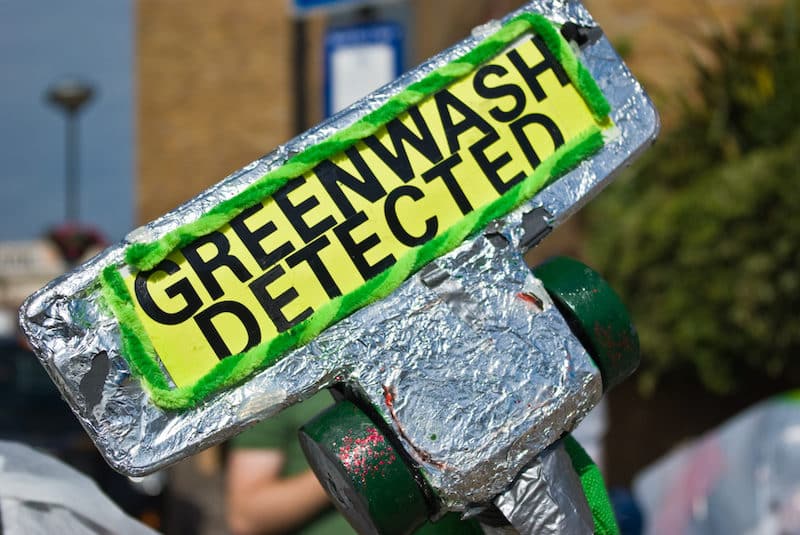
Companies will be awarded substantial taxpayer funding for blue hydrogen plants that are certified compliant with the new LCHS – and here, the hallmarks of lobbying are only too apparent. The LCHS method for calculating life-cycle greenhouse gas emissions appears rigged to greenwash blue hydrogen.
LNG is a fossil fuel whose use is not consistent with the Paris Agreement 1.5C temperature goal. It consists primarily of methane, an extremely powerful greenhouse gas (GHG), which has climate impacts over 80 times greater than carbon dioxide over a 20-year period. Methane leaks into the atmosphere across the full production lifecycle of LNG, and once on the ships, the unburned gas escapes from the smokestacks into the air.
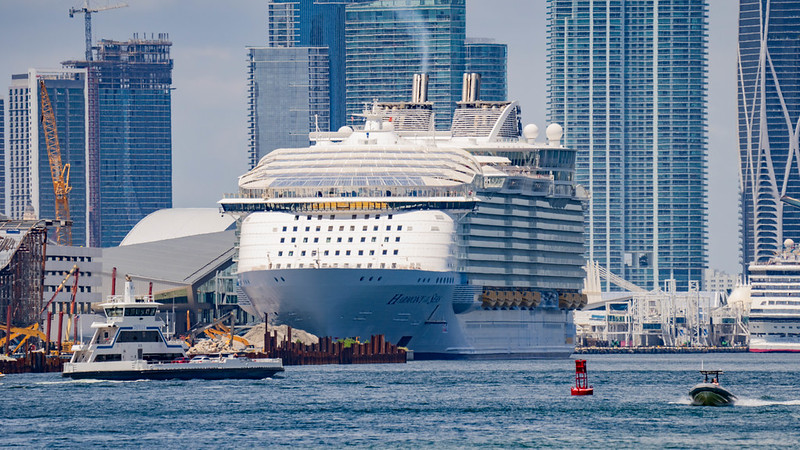
Despite the devastating frontloaded climate impact of methane, to date policymakers have been slow to address its use in regulation, and public awareness of the issue is low. This gives cruise companies the latitude to invest in LNG as an alternative fuel – and they have done so with gusto.
Why do cruise companies love LNG?
There are some benefits to LNG on paper: in the short term it reduces air pollution and CO2 emissions when burned, compared to standard shipping fuel. This has led to some of the world’s biggest cruise companies (including Carnival Corporation & plc and MSC Cruises and Royal Caribbean Group) to portray their cruises as sustainable, and their newest ships “clean”, “green” and “eco-friendly”.
Across the industry, company webpages are littered with references to LNG superimposed on images of idyllic blue seas, thriving coral reefs, and green forests. Most of us aren’t specialists in the climate impacts of differing fuel compositions, and it’s easy to be taken in.
But the reality is that these adverts are a very effective smokescreen for the fact that the true climate effect of LNG is likely worse than if the companies had stuck with dirty heavy marine fuel oil.