Warnings of ‘Permanent’ Damage to People and Planet as Trump EPA Set to Repeal Key Climate Rule

Spread the love

Original article by Brett Wilkins republished from Common Dreams under Creative Commons (CC BY-NC-ND 3.0). 
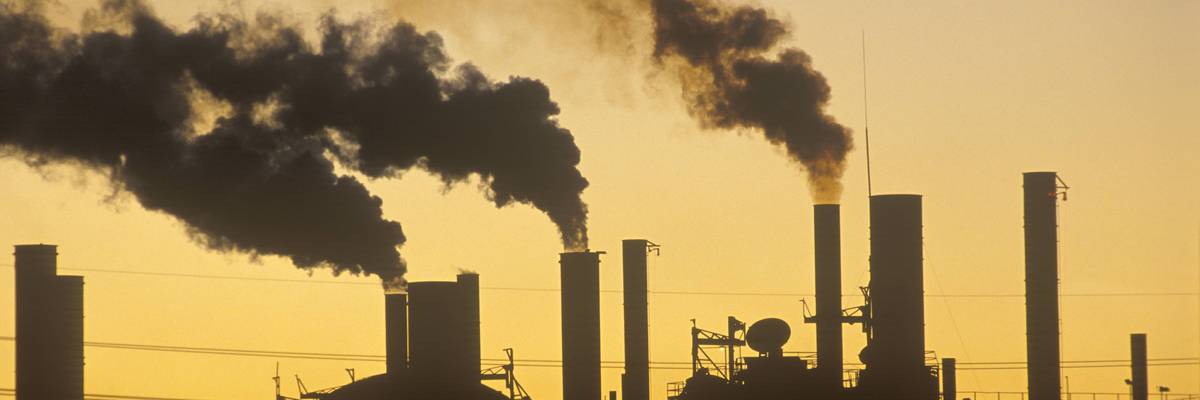
Emissions billow from smokestacks at a factory in Cleveland, Ohio in this undated photo. (Photo by Joe Sohm/Visions of America/Universal Images Group via Getty Images)

One critic blasted the impending move as “an obvious example of what happens when a corrupt administration and fossil fuel interests are allowed to run amok.”

In what experts warn would be the most sweeping rollback of US climate policy ever, the Trump administration is expected this week to repeal the Environmental Protection Agency’s “endangerment finding,” the Obama-era rule empowering climate regulation over the past 15 years.

The endangerment finding determined that six greenhouse gases—carbon dioxide, methane, nitrous oxide, hydrofluorocarbons, perfluorocarbons, and sulfur hexafluoride—caused by burning fossil fuels are a single air pollutant that threatens public health and welfare, rather than treating each gas individually, for regulatory purposes.

RECOMMENDED…
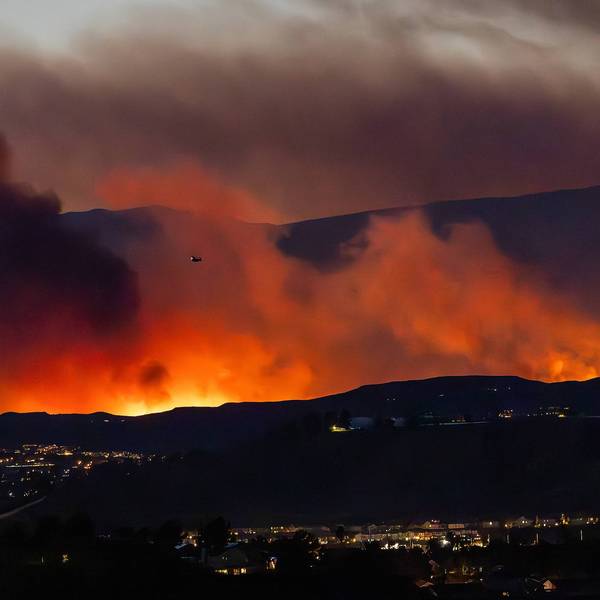
Hughes fire

NASA Releases Global Temperature Data Without Mentioning ‘Climate Change’
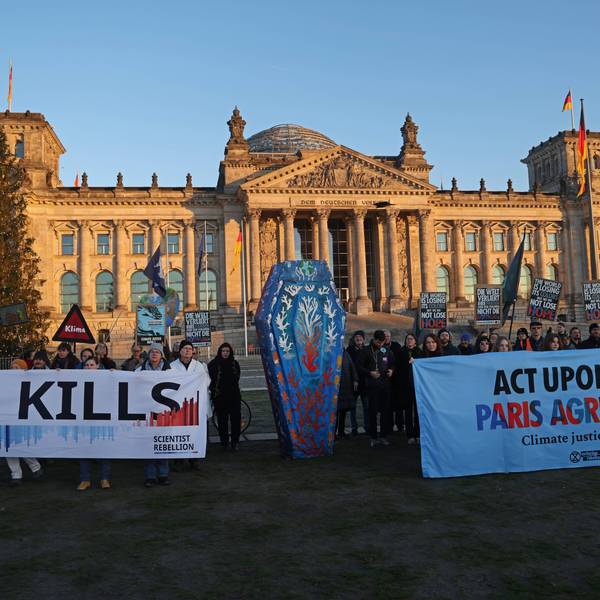
Activists Demand Climate Policies 10 Years On Since Paris Agreement

‘The US Is Becoming a Pariah’: Trump Officially Ditches Paris Agreement, Again

The 2009 finding has served as the legal foundation for EPA climate rules, including limits on power plant emissions and automobile fuel economy standards under the Clean Air Act.

The new rule would end the regulatory requirement to measure and report vehicle emissions, certify the results, and comply with limits. It would also repeal compliance programs and credit provisions.

“This amounts to the largest act of deregulation in the history of the United States,” EPA Administrator Lee Zeldin said in a Monday interview with the Wall Street Journal.

However, Senate Majority Leader Chuck Schumer (D-NY) warned Tuesday on the upper chamber floor that “this week, the Trump administration is set to take one of its most nakedly corrupt steps since Donald Trump returned to office, and that’s saying a lot: a wholesale reversal of essentially all greenhouse gas regulations.”

“Trump is making a radical move that will send shockwaves across the economy—uncertainty for manufacturers, states, regulators everywhere. And it flies in the face, of course, of basic science,” Schumer said. “Let’s be very clear what this announcement represents: It is a corrupt giveaway to Big Oil, plain and simple.”

“Big Oil has worked tirelessly for decades to undermine rules that protect against emissions, and now that they have their guy in the White House, they are taking their biggest swing yet,” the senator added. “Remember, in the spring of 2024, Donald Trump invited top oil executives to Mar-a-Lago and told them, if you raise me a billion dollars to get me elected, I will cut regulations so you can make more money. That devil’s bargain is now coming true.”

Trump is trying to repeal the "endangerment finding" — the scientific investigation that led EPA to conclude that climate change is dangerous to humans.It's scientifically unjustifiable of course, but they're going to have to justify it to a court. That should be fun to watch.

David Roberts (@volts.wtf) 2026-02-10T17:22:26.898Z

Big Oil spent over $445 million to elect Trump and other Republican candidates during the 2024 election cycle.

Gretchen Goldman, president and CEO at the Union of Concerned Scientists (UCS), a nonprofit advocacy group, said in a statement Tuesday that “Zeldin took a chainsaw to the endangerment finding, undoing this long-standing, science-based finding on bogus grounds at the expense of our health.”

“Ramming through this unlawful, destructive action at the behest of polluters is an obvious example of what happens when a corrupt administration and fossil fuel interests are allowed to run amok,” Goldman added.

More than 1,000 scientists and other experts have implored EPA Administrator Lee Zeldin to not repeal the endangerment finding. In a statement last year, the Environmental Protection Network warned that repealing the finding would result in “tens of thousands of additional premature deaths due to pollution exposure” over the next several decades and spark “accelerated climate destabilization with greater risks of heatwaves, floods, droughts, and disease spread.”

While Trump administration officials told the Journal that the new rules would not apply to regulation of emissions from power plants and oil and gas facilities, some said that repealing the endangerment finding could set the stage for additional rollbacks favoring such polluters.

UCS noted Tuesday that the Trump administration “relied heavily on shoddy science in a report developed by a ‘Climate Working Group,’ composed of five skeptics well outside the scientific mainstream in its proposal to repeal the endangerment finding.”

“The report, which was commissioned by the Department of Energy (DOE), has been thoroughly discredited by the scientific community, which found that the report ‘misrepresents the state of climate science by cherry-picking evidence, exaggerating uncertainties, and ignoring decades of peer-reviewed research,’” UCS continued.

On January 30, Judge William Young of the US District Court for the District of Massachusetts, an appointee of former President Ronald Reaganruled that the DOE violated the law when Energy Secretary Chris Wright—the former CEO of a fracking company who denies there is a climate emergency—handpicked the five researchers for the dubious report.

Republicans have been working toward killing the endangerment finding for years. Project 2025, the Heritage Foundation-led blueprint for a right-wing overhaul of the federal government, explicitly mentions the rule as ripe for repeal. Project 2025’s policy lead, Russell Vought, now directs Trump’s Office of Management and Budget (OMB).

OMB Acting Administrator of the Office of Information and Regulatory Affairs Jeffrey Clark—a purveyor of the “Big Lie” that Democrats stole the 2020 election—has also been working hard at dismantling federal climate regulations, which he once likened to a “Leninistic” plot to control the US economy.

“Instead of rising to the challenge with necessary policies to protect people’s well-being, the Trump administration has shamefully abandoned EPA’s mission and caved to the whims of deep-pocketed special interests,” Goldman said. “Sacrificing people’s health, safety, and futures for polluters’ profits is unconscionable. We all deserve better and this attack against the public interest and the best available science will be challenged.”

Climate scientist Michael Mann called the campaign to repeal the endangerment finding “a reminder that, while some of the damage that Trump [and the] GOP are doing might seem temporary, the damage they’re doing to the planet is permanent.”

Or, as Cardiff University ecologist Aaron Thierry put it, “You can repeal an endangerment finding. You can’t repeal the endangerment.”

Original article by Brett Wilkins republished from Common Dreams under Creative Commons (CC BY-NC-ND 3.0). 

Orcas discuss Donald Trump and the killer apes' concept of democracy. Front Orca warns that Trump is crashing his country's economy and that everything he does he does for the fantastically wealthy.
Orcas discuss Donald Trump and the killer apes’ concept of democracy. Front Orca warns that Trump is crashing his country’s economy and that everything he does he does for the fantastically wealthy.
Donald Trump urges you to be a Climate Science denier like him. He says that he makes millions and millions for destroying the planet, Burn, Baby, Burn and Flood, Baby, Flood.
Elon Musk urges you to be a Fascist like him, says that you can ignore facts and reality then.

Continue ReadingWarnings of ‘Permanent’ Damage to People and Planet as Trump EPA Set to Repeal Key Climate Rule

Keeping promises on renewables, energy efficiency and methane ‘would avoid nearly 1C of global heating’

Spread the love

https://www.theguardian.com/environment/2025/nov/19/keeping-promises-on-renewables-energy-efficiency-and-methane-would-avoid-nearly-1c-of-global-heating

More than 160 governments are nominally signed up to the global methane pledge. Photograph: Orjan F Ellingvag/Corbis/Getty Images

Analysis published at Cop30 summit shows adhering to pledges offer world hope of avoiding climate breakdown

Sticking to three key climate promises – on renewables, energy efficiency and methane – would avoid nearly 1C of global heating and give the world hope of avoiding climate breakdown, analysis published at the Cop30 climate summit suggests.

Governments have already agreed to triple the amount of renewable energy generated by 2030, double global energy efficiency by then, and make substantial cuts to methane emissions.

If they follow through on these promises – still a big if, even though countries are meeting for climate crisis talks in Brazil this week – it would be a “gamechanger”, shaving 0.9C from projected temperature rises this century, according to the Climate Action Tracker coalition.

Achieving all of these measures, among G20 countries alone, would reduce global greenhouse gas emissions by 18bn tonnes in 2035 – enough to cut the rate of global heating by a third in the next decade, and halve it by 2040.

Bill Hare, chief executive of Climate Analytics, one of the organisations behind the report, said: “If [governments] achieve this by 2035, it would be a gamechanger, quickly slowing the rate of warming in the next decade and lowering global warming this century from 2.6C to about 1.7C.”

https://www.theguardian.com/environment/2025/nov/19/keeping-promises-on-renewables-energy-efficiency-and-methane-would-avoid-nearly-1c-of-global-heating

Orcas comment on killer apes destroying the planet by continuing to burn fossil fuels.
Donald Trump urges you to be a Climate Science denier like him. He says that he makes millions and millions for destroying the planet, Burn, Baby, Burn and Flood, Baby, Flood.
Nigel Farage urges you to ignore facts and reality and be a climate science denier like him and his Deputy Richard Tice. He says that Reform UK has received £Millions and £Millions from the fossil fuel industry to promote climate denial and destroy the planet.
Continue ReadingKeeping promises on renewables, energy efficiency and methane ‘would avoid nearly 1C of global heating’

Gas flaring created 389m tonnes of carbon pollution last year, report finds

Spread the love

https://www.theguardian.com/environment/2025/jul/18/gas-flaring-created-389m-tonnes-carbon-pollution-last-year-report

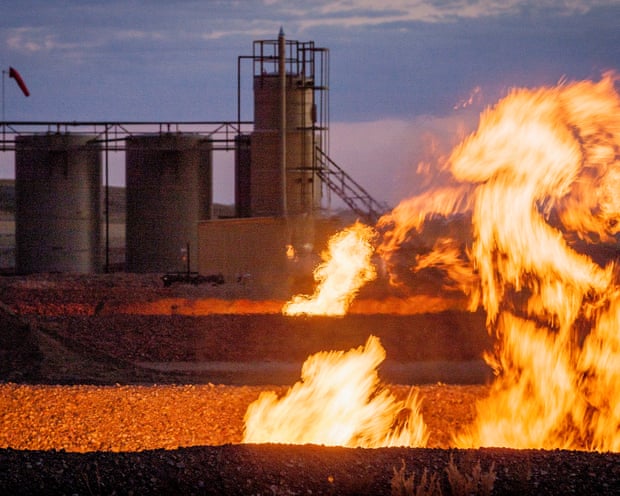
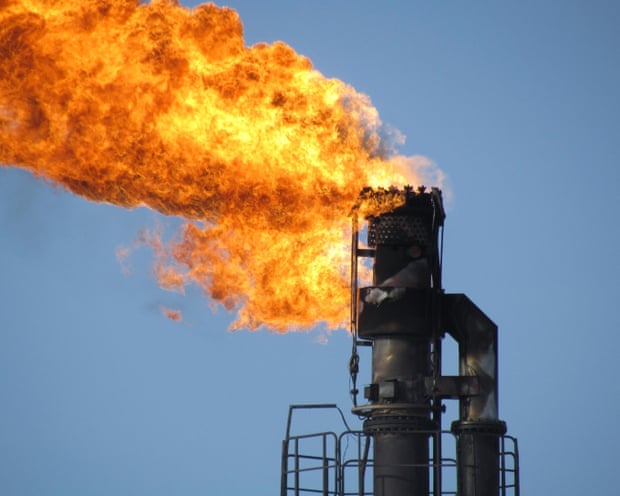
Flaring is a way to get rid of gases such as methane that arise when pumping oil out of the ground. Photograph: Eremeychuk Leonid/Alamy

Rules to prevent ‘enormous waste’ of fuel are seen as weak and poorly enforced and firms have little incentive to stop

The fossil fuel industry pumped an extra 389m tonnes of carbon pollution into the atmosphere last year by needlessly flaring gas, a World Bank report has found, in an “enormous waste” of fuel that heats the planet by about as much as the country of France.

Flaring is a way to get rid of gases such as methane that arise when pumping oil out of the ground. While it can sometimes keep workers safe by relieving buildups of pressure, the practice is routine in many countries because it is often cheaper to burn gas than to capture, transport, process and sell it.

Global gas flaring rose for a second year in a row to reach its highest level since 2007, the report found, despite growing concerns about energy security and climate breakdown.

It found that 151bn cubic metres (bcm) of gas were burned during oil and gas production in 2024, up by 3bcm from the year before.

Original article continues

https://www.theguardian.com/environment/2025/jul/18/gas-flaring-created-389m-tonnes-carbon-pollution-last-year-report

Nigel Farage urges you to ignore facts and reality and be a climate science denier like him. He says that Reform UK has received millions and millions from the fossil fuel industry to promote climate denial and destroy the planet.
Donald Trump urges you to be a Climate Science denier like him. He says that he makes millions and millions for destroying the planet, Burn, Baby, Burn and Flood, Baby, Flood.
Neo-Fascist Climate Science Denier Donald Trump says Burn, Baby, Burn.
Continue ReadingGas flaring created 389m tonnes of carbon pollution last year, report finds

Guest post: Why 2024’s global temperatures were unprecedented, but not surprising

Spread the love

 Original article by Prof Piers Forster and Dr Debbie Rosen republished from Carbon Brief under a CC license.

Human-caused greenhouse gas (GHG) emissions in 2024 continued to drive global warming to record levels.

This is the stark picture that emerges in the third edition of the “Indicators of Global Climate Change” (IGCC) report, published in Earth System Science Data

IGCC tracks changes in the climate system between Intergovernmental Panel on Climate Change (IPCC) science reports.

In doing so, the IGCC fills the gap between the IPCC’s sixth assessment (AR6) in 2021 and the seventh assessment, expected in 2028.

Following IPCC methods, this year’s assessment brings together a team of over 60 international scientists, including former IPCC authors and curators of vital global datasets.

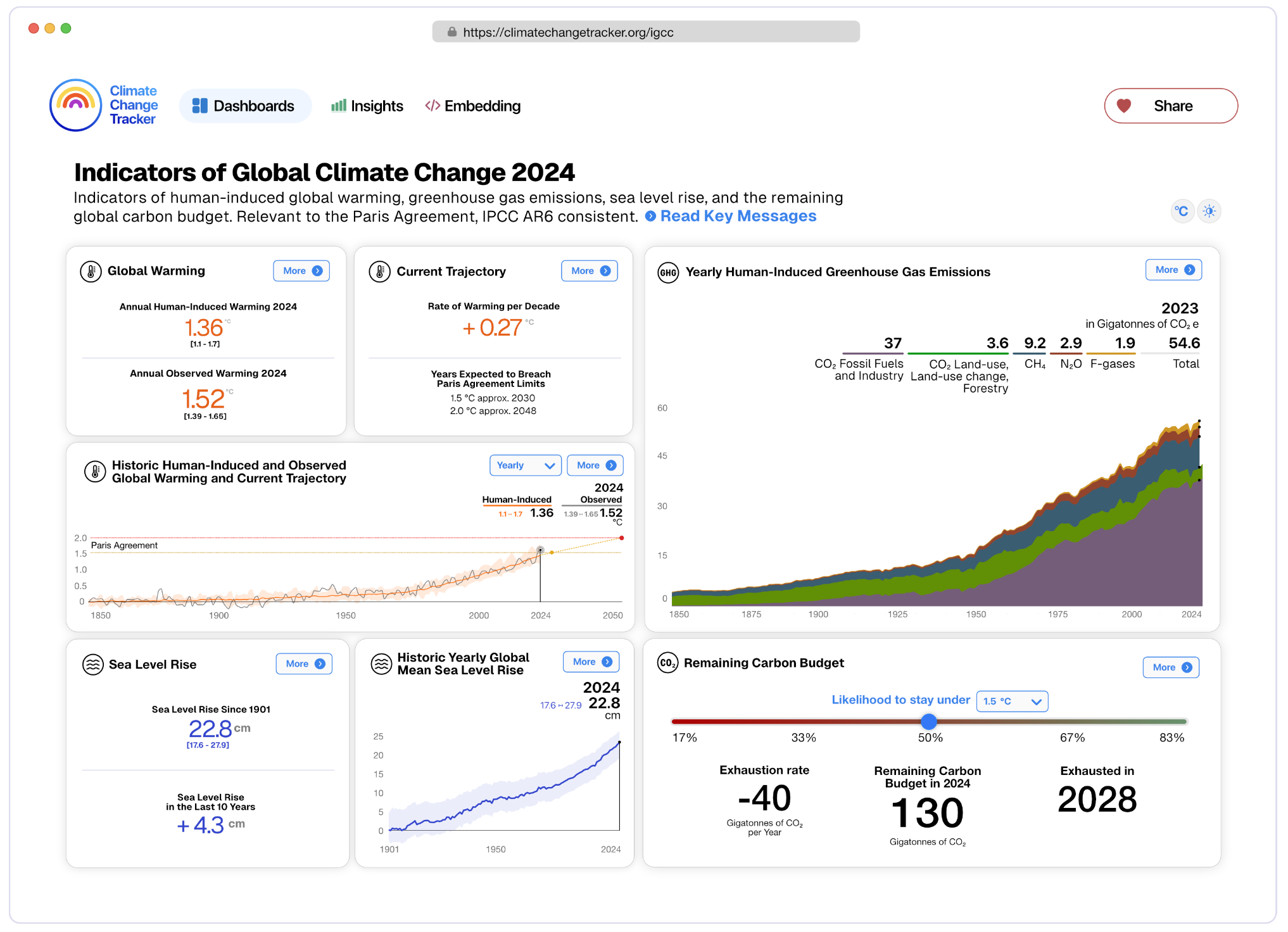
As in previous years, it is accompanied by a user-friendly data dashboard focusing on the main policy-relevant climate indicators, including GHG emissions, human-caused warming, the rate of temperature change and the remaining global carbon budget.  

Below, we explain this year’s findings, highlighting the role that humans are playing in some of the fundamental changes the global climate has seen in recent years.

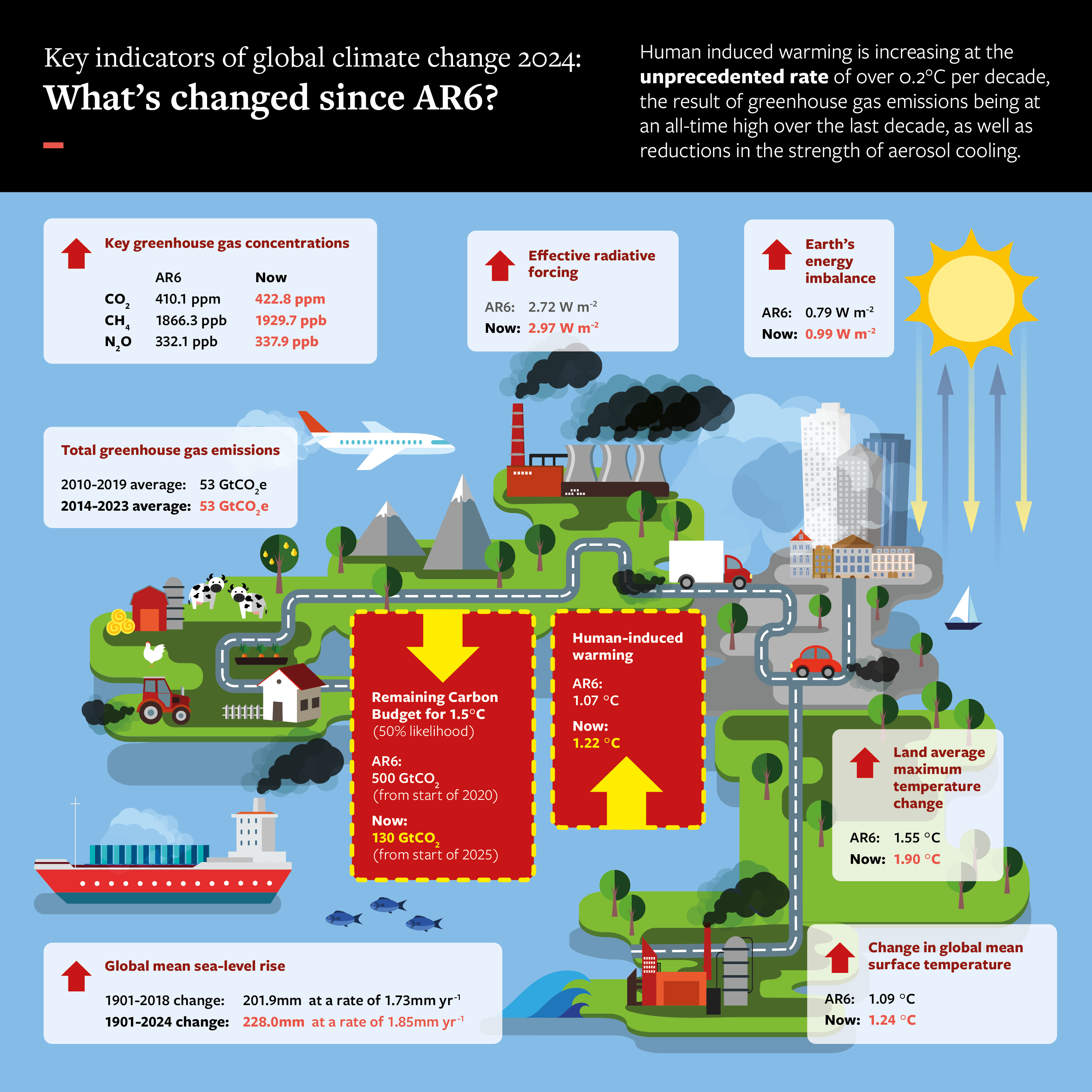
Infographic: Key indicators of global climate change 2024: What's changed since AR6?
Headline results from an analysis of key climate indicators in 2024, compared to the IPCC AR6 climate science report. Source: Forster et al. (2025)

(For previous IGCC reports, see Carbon Brief’s detailed coverage in 2023 and 2024.)

An ‘unexceptional’ record high

Last year likely saw global average surface temperatures hit at least 1.5C above pre-industrial levels. This aligns with other major assessments of the Earth’s climate.  

Our best estimate is a rise of 1.52C (with a range of 1.39-1.65C), of which human activity contributed around 1.36C. The rest is the result of natural variability in the climate system, which also plays a role in shaping global temperatures from one year to the next.

Our estimate of 1.52C differs slightly from the 1.55C given by the World Meteorological Organisation (WMO) state of the global climate 2024 report, published earlier this year. This is because they make slightly different selections on which of the available global land and ocean temperature datasets to include. (The warming estimate has varied by similar amounts in past years and future work will aim to harmonise the approaches.)

The height of 2024’s temperatures, while unprecedented in at least the last 2,000 years, is not surprising. Given the high level of human-induced warming, we might currently expect to see annual temperatures above 1.5C on average one year in six. 

However, with 2024 following an El Niño year, waters in the North Atlantic were warmer than average. These conditions raise this likelihood to an expectation that 1.5C is surpassed every other year.

From now on, we should regard 2024’s observed temperatures as unexceptional. Temperature records will continue to be broken as human-caused temperature rise also increases.

Longer-term temperature change

Despite observed global temperatures likely rising by more than 1.5C in 2024, this does not equate to a breach of the Paris Agreement’s temperature goal, which refers to long-term temperature change caused by human activity.

IGCC also looks at how temperatures are changing over the most recent decade, in line with IPCC assessments.

Over 2015-24, global average temperatures were 1.24C higher than pre-industrial levels. Of this, 1.22C was caused by human activity. So, essentially, all the global warming seen over the past decade was caused by humans.

Observed global average temperatures over 2015-24 were also 0.31C warmer than the previous decade (2005-14). This is unsurprising given the high rates of human-caused warming over the same period, reaching a best estimate of 0.27C per decade.

This rate of warming is large and unprecedented. Over land, where people live, temperatures are rising even faster than the global average, leading to record extreme temperatures.  

But every fraction of a degree matters, increasing climate impacts and loss and damage that is already affecting billions of people. 

Driven by emissions

Undoubtedly, these changes are being caused by GHG emissions remaining at an all-time high.

Over the last decade, human activities have released, on average, the equivalent of around 53bn tonnes of CO2 into the atmosphere each year. (The figure of 53bn tonnes expresses the total warming effect of CO2 and other greenhouse gases, such as methane and nitrous oxide, using CO2 as a reference point.) 

Emissions have shown no sign of the peak by 2025 and rapid decline to net-zero required to limit global warming to 1.5C with no or limited “overshoot”.  

Most of these emissions were from fossil fuels and industry. There are signs that energy use and emissions are rising due to air conditioning use during summer heatwaves. Last year also saw high levels of emissions from tropical deforestation due to forest fires, partly related to dry conditions caused by El Niño.  

Notably, emissions from international aviation – the sector with the steepest drop in emissions during the Covid-19 pandemic – returned to pre-pandemic levels.

The amount of CO2 in the atmosphere, alongside the other major GHGs of methane (CH4) and nitrous oxide (N2O), is continuing to build up to record levels. Their concentrations have increased by 3.1, 3.4 and 1.7%, respectively, since the 2019 values reported in the last IPCC assessment.   

At the same time, aerosol emissions, which have a cooling effect, are continuing to fall as a result of important efforts to tackle air pollution. This is currently adding to the rate of GHG warming. 

Notably, cutting CH4 emissions, which are also short-lived in the atmosphere, could offset this rise. But, again, there is no real sign of a fall – despite major initiatives such as the Global Methane Pledge.

The effect of all human drivers of climate change on the Earth’s energy balance is measured as “radiative forcing”. Our estimate of this radiative forcing in 2024 is 2.97 Watts per square metre (W/m2), 9% above the value recorded in 2019 that was quoted in the last IPCC assessment.

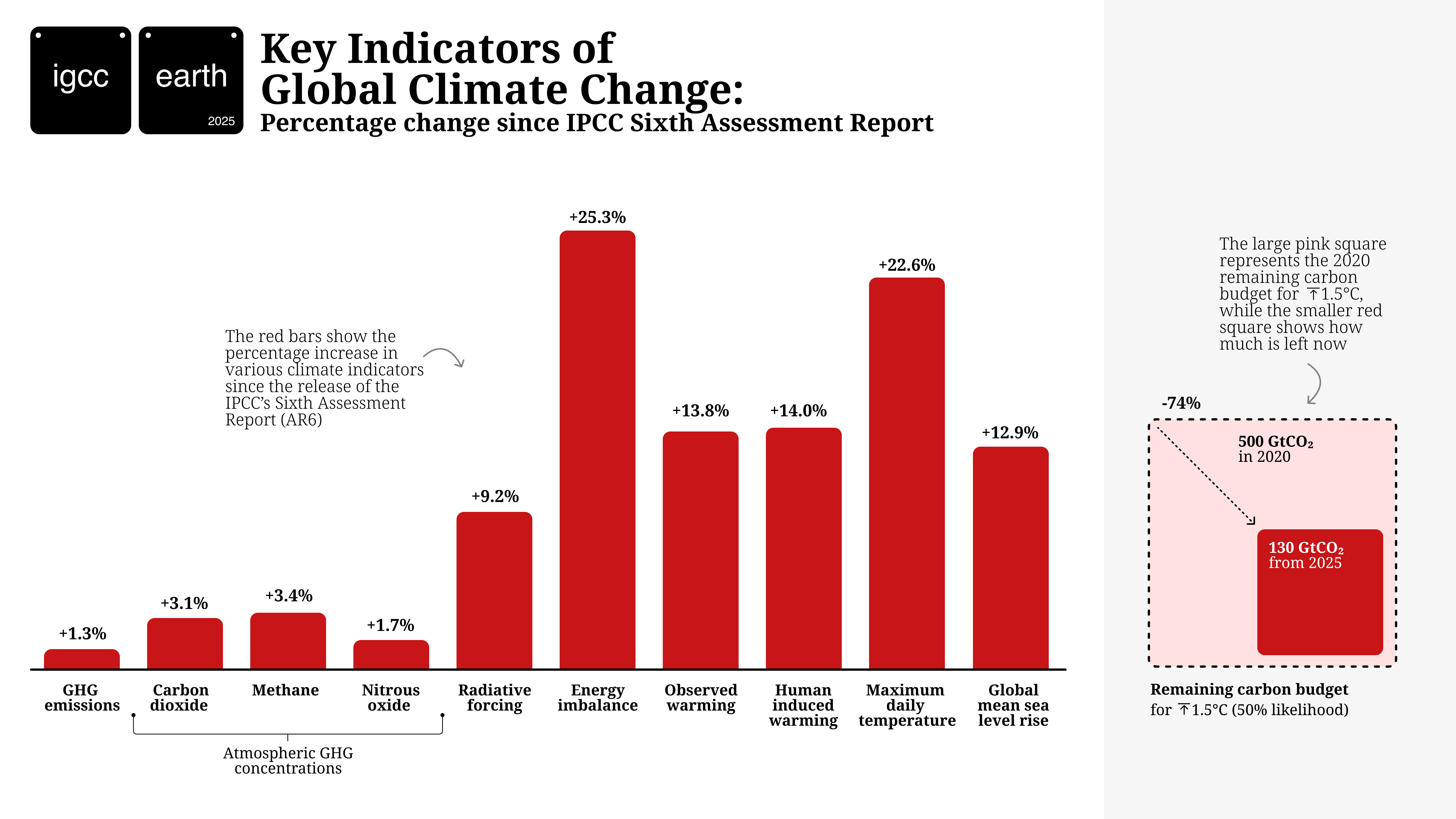
This is shown in the figure below, which illustrates the percentage change in an array of climate indicators since the data update given in the last IPCC climate science report.

Bar chart: Key Indicators of Global Climate Change: Percentage change since IPCC Sixth Assessment Report
Percentage changes in key climate indicators in 2024, compared to the IPCC AR6 climate science report. The remaining carbon budget given on the right is the only indicator to show a reduction and is the change since IPCC AR6, presented as a shrinking box. Source: Forster et al. (2025)

Continued emissions and rising temperatures are meanwhile rapidly eating into the remaining carbon budget, the total amount of CO2 that can be emitted if global warming is to be kept below 1.5C. 

Our central estimate of the remaining carbon budget from the start of 2025 is 130bn tonnes of CO2. 

This has fallen by almost three-quarters since the start of 2020. It would be exhausted in a little more than three years of global emissions, at current levels.

However, given the uncertainties involved in calculating the remaining carbon budget, the actual value could lie between 30 and 320bn tonnes, meaning that it could also be exhausted sooner – or later than expected.  

Beyond global temperatures

Our assessment also shows how surplus heat is accumulating in the Earth’s system at an accelerating rate, becoming increasingly out of balance and driving changes around the world.

The data and their changes are displayed on a dedicated Climate Change Tracker platform, shown below.

Webpage screenshot: Indicators of Global Climate Change 2024
Snapshot of Climate Change Tracker

The radiative forcing of 2.97 W/m2 adds heat to the climate system. As the world warms in response, much of this excess heat radiates to space, until a new balance is restored. The residual level of heating is termed the Earth’s “energy imbalance” and is an indication of how far out of balance the climate system is and the warming still to come.   

This residual rate of heat entering the Earth system has now approximately doubled from levels seen in the 1970s and 1980s, to around 1W/m2 on average during the period 2012-24.  

Although the ocean is storing an estimated 91% of this excess heat, mitigating some of the warming we would otherwise see at the Earth’s surface, it brings other impacts, including sea level rise and marine heatwaves

Global average sea level rise, from both the melting of ice sheets and thermal expansion due to deep ocean warming, is included in the IGCC assessment for the first time. 

We find that it has increased by around 26mm over the last six years (2019-24), more than double the long-term rate. This is the indicator that shows the clearest evidence of an acceleration

Sea level rise is making storm surges more damaging and causing more coastal erosion, having the greatest impact on low-lying coastal areas. The 2019 IPCC special report on the oceans and cryosphere estimated that more than one billion people would be living in such low-lying coastal zones by 2050.

Multiple indicators

Overall, our indicators provide multiple lines of evidence all pointing in the same direction to provide a clear and consistent – but unsurprising and worsening – picture of the climate system.

It is also now inevitable that global temperatures will reach 1.5C of long-term warming in the next few years unless society takes drastic, transformative action – both in cutting GHG emissions and stopping deforestation.

Every year of delay brings reaching 1.5C – or even higher temperatures – closer.  

This year, countries are unveiling new “nationally determined contributions” (NDCs), the national climate commitments aimed at collectively reducing GHG emissions and tackling climate change in line with the Paris Agreement.

While the plans put forward so far represent a step in the right direction, they still fall far short of what is needed to significantly reduce, let alone stop, the rate of warming.

At the same time, evidence-based decision-making relies on international expertise, collaboration and global datasets. 

Our annual update relies on data from NASA and the National Oceanic and Atmospheric Administration (NOAA) and input from many of their highly respected scientists. It is this type of collaboration that allows scientists to generate well-calibrated global datasets that can be used to produce trusted data on changes in the Earth system. 

It would not be possible to maintain the consistent long-term datasets employed in our study if their work is interrupted

At a time when the planet is changing at the fastest rate since records began, we are at risk of failing to track key indicators – such as greenhouse gas concentrations or deep ocean temperatures – and losing core expertise that is vital for understanding the data.

Mapped: How climate change affects extreme weather around the world

Attribution|

18.11.24

Guest post: What 1.5C overshoot would mean for climate impacts and adaptation

Global temperature|

11.11.24

Guest post: The growing threat of climate-sensitive infectious diseases

Extreme weather|

15.10.24

Guest post: How to minimise the risks from overshooting the 1.5C limit

Global temperature|

09.10.24

Forster, P. M. et al. (2025) Indicators of Global Climate Change 2024: Annual update of key indicators of the state of the climate system and human influence, Earth System Science Data, doi:10.5194/essd-17-2641-2025

 Original article by Prof Piers Forster and Dr Debbie Rosen republished from Carbon Brief under a CC license.

Neo-Fascist Climate Science Denier Donald Trump says Burn, Baby, Burn.
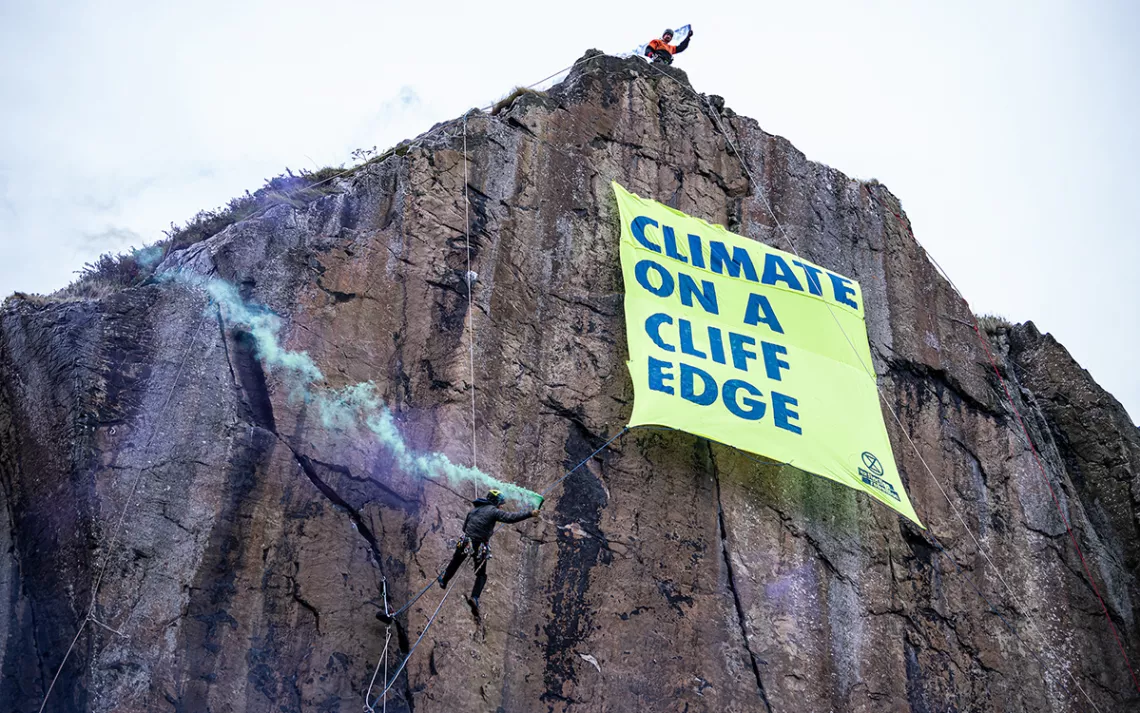
Experienced climbers scale a rock face near the historic Dumbarton castle in Glasgow, releasing a banner that reads “Climate on a Cliff Edge.” One activist, dressed as a globe, symbolically looms near the edge, while another plays the bagpipes on the shores below. | Photo courtesy of Extinction Rebellion and Mark Richards
Elon Musk urges you to be a Fascist like him, says that you can ignore facts and reality then.
Continue ReadingGuest post: Why 2024’s global temperatures were unprecedented, but not surprising

Arctic Tundra Has Turned From ‘Carbon Sink to Carbon Source’ in Dangerous Flip: NOAA

Spread the love

Original article by Julia Conley republished from Common Dreams under Creative Commons (CC BY-NC-ND 3.0).

A view of Brooks Range as seen from the Dalton Highway on May 10, 2024 in North Slope Borough, Alaska. (Photo: Lance King/Getty Images)

“This is yet one more sign, predicted by scientists, of the consequences of inadequately reducing fossil fuel pollution,” said one scientist.

Permafrost in the Arctic has stored carbon dioxide for millennia, but the annual Arctic Report Card released by the National Oceanic and Atmospheric Administration reveals a concerning shift linked to planetary heating and a rising number of wildfires in the icy region: The tundra is now emitting more carbon than it is storing.

The report card revealed that over the last year, the tundra’s temperature rose to its second-highest level on record, causing the frozen soil to melt.

The melting of the permafrost activates microbes in the soil which decompose the trapped carbon, causing it to be released into the atmosphere as planet-heating carbon dioxide and methane.

The release of fossil fuels from the permafrost is also being caused by increased Arctic wildfires, which have emitted an average of 207 million tons of carbon per year since 2003.

“Our observations now show that the Arctic tundra, which is experiencing warming and increased wildfire, is now emitting more carbon than it stores, which will worsen climate change impacts,” said Rick Spinrad, administrator of NOAA. “This is yet one more sign, predicted by scientists, of the consequences of inadequately reducing fossil fuel pollution.”

Sue Natali, a scientist at the Woodwell Climate Research Center in Massachusetts and one of 97 international scientists who contributed to the Arctic Report Card, told NPR that 1.5 trillion tons of carbon are still being stored in the tundra—suggesting that the continued warming of the permafrost could make it a huge source of planet-heating greenhouse gas emissions.

Along with the “Arctic tundra transformation from carbon sink to carbon source,” NOAA reported declines in caribou herds and increasing winter precipitation.

The report card showed that the autumn of 2023 and summer of 2024 saw the second- and third-warmest temperatures on record across the Arctic, and a heatwave in August 2024 set an all-time record for daily temperatures in several communities in northern Alaska and Canada.

The last nine years have been the nine warmest on record in the Arctic region.

“Many of the Arctic’s vital signs that we track are either setting or flirting with record-high or record-low values nearly every year,” said Gerald (J.J.) Frost, a senior scientist with Alaska Biological Research, Inc. and a veteran Arctic Report Card author. “This is an indication that recent extreme years are the result of long-term, persistent changes, and not the result of variability in the climate system.”

Brenda Ekwurzel, a climate scientist at the Union of Concerned Scientists, emphasized that the continuous release of fossil fuel emissions from oil and gas extraction and other pollution has caused the Arctic to warm at a faster rate than the Earth as a whole over the past 11 years.

“These combined changes are contributing to worsening wildfires and thawing permafrost to an extent so historic that it caused the Arctic to be a net carbon source after millennia serving as a net carbon storage region,” said Ekwurzel. “If this becomes a consistent trend, it will further increase climate change globally.”

The Arctic Report Card was released weeks before President-elect Donald Trump is set to take office. Trump has pledged to slash climate regulations introduced by the Biden administration and to increase oil and gas production. He has mused that sea-level rise will create “more oceanfront property” and has called the climate crisis a “hoax,” while his nominee for energy secretary, Chris Wright, the CEO of the fracking company Liberty Energy, has claimed that climate warming is good for the planet.

“These sobering impacts in the Arctic are one more manifestation of how policymakers in the United States and around the world are continuing to prioritize the profits of fossil fuel polluters over the well-being of people and the planet and putting the goals of the Paris climate agreement in peril,” said Ekwurzel. “All countries, but especially wealthy, high-emitting nations, need to drastically reduce heat-trapping emissions at a rapid pace in accord with the latest science and aid in efforts of climate-vulnerable communities to prepare for what’s to come and help lower-resourced countries working to decrease emissions too.”

Original article by Julia Conley republished from Common Dreams under Creative Commons (CC BY-NC-ND 3.0).

Experienced climbers scale a rock face near the historic Dumbarton castle in Glasgow, releasing a banner that reads “Climate on a Cliff Edge.” One activist, dressed as a globe, symbolically looms near the edge, while another plays the bagpipes on the shores below. | Photo courtesy of Extinction Rebellion and Mark Richards
Continue ReadingArctic Tundra Has Turned From ‘Carbon Sink to Carbon Source’ in Dangerous Flip: NOAA