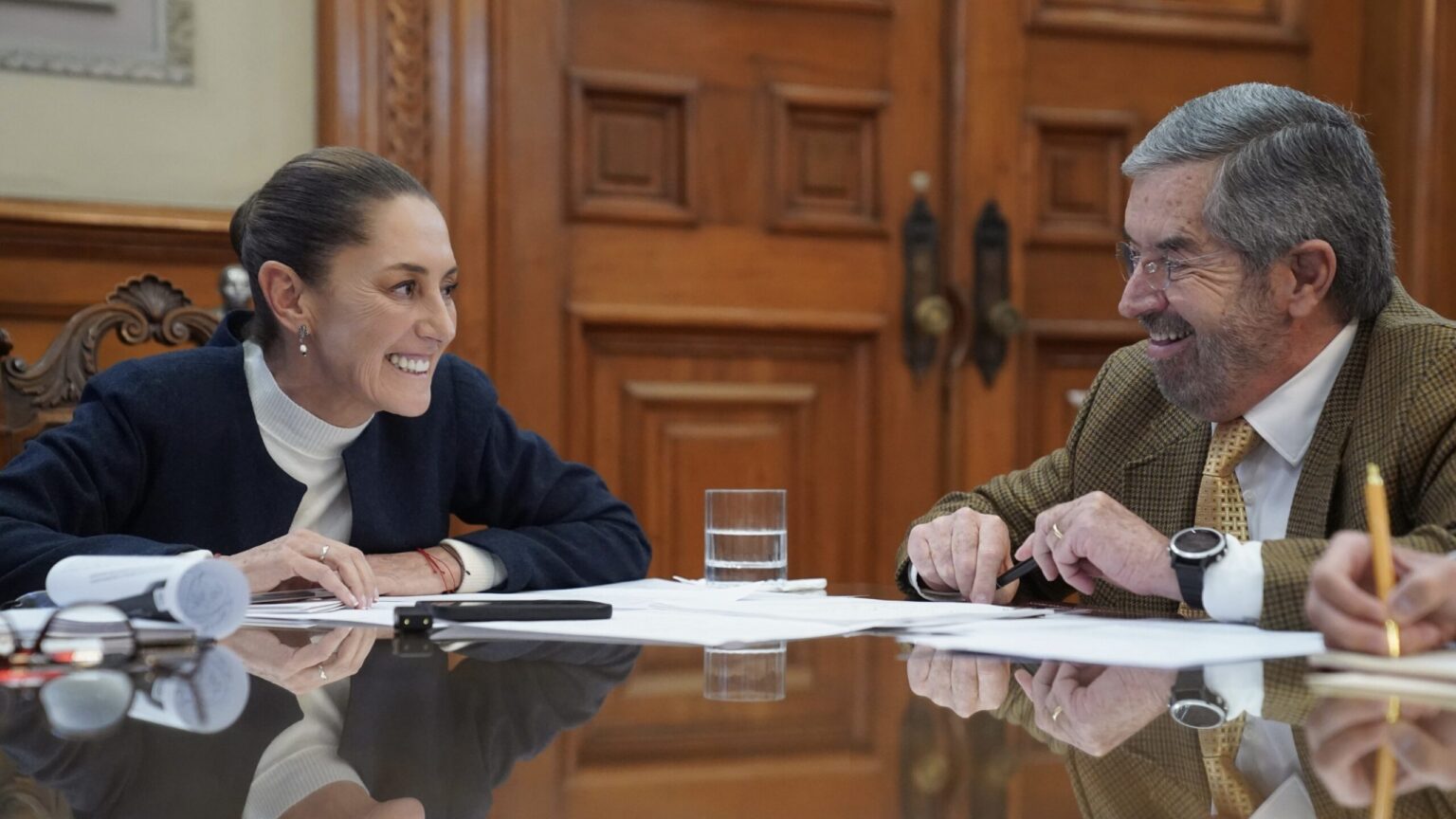
Mexican President Claudia Sheinbaum speaking on the phone to US president-elect Donald Trump. Photo: Presidencia MX
The Mexican President told the press that it is not true that she informed the US President-elect that she would close the border between both countries, contradicting statements from Trump about their conversation
The tensions between Mexican President Claudia Sheinbaum and US president-elect Donald Trump are growing, with Trump continuing to launch accusations and threats at the Southern neighbor of the US, only to be met with a firm and resolute Sheinbaum.
On November 25, Trump, in a post on his media platform Truth Social, threatened to impose a 25% tariff on Mexican and Canadian products until illegal migration and drug imports into US territory were stopped. He also threatened that products coming from China will have to pay 10% more tariffs if the Asian country does not further control the sale of certain chemicals from which fentanyl is made. The three targeted countries responded clearly and firmly (more so China and Mexico than Canada) to Trump’s warnings and pointed out that if the threat were to become a reality, a real “trade war” could be unleashed.
For her part, the Mexican President stated in her daily morning press conference on November 26 that the imposition of new tariffs will not reduce drug consumption in the United States, nor will it curb illegal migration to the United States; on the contrary, “it would cause the United States and Mexico inflation and job losses.”
That same day, Sheinbaum and Trump spoke on the phone and addressed several issues of interest to both nations, such as immigration, drug trafficking, drug consumption, and more. However, in the aftermath of their conversation, two versions have emerged of what was said and agreed on, with Trump insisting that Mexico has agreed to effective “clos[e] our Southern Border” to “stop the illegal invasion of the USA”.
Donald Trump said through his social network, Truth Social “Just had a wonderful conversation with the new President of Mexico, Claudia Sheinbaum Pardo. She has agreed to stop Migration through Mexico, and into the United States, effectively closing our Southern Border. We also talked about what can be done to stop the massive drug inflow into the United States, and also, the US consumption of these drugs. It was a very productive conversation!”
The president-elect added “Mexico will stop people from going to our Southern Border, effective immediately. THIS WILL GO A LONG WAY TOWARD STOPPING THE ILLEGAL INVASION OF THE USA. Thank you!!!”
However, for the Mexican head of state, this version is far from the truth.
Sheinbaum’s version
For her part, Sheinbaum reported on X “I had an excellent conversation with President Donald Trump. We addressed the Mexican strategy on the migration phenomenon and I shared that no caravans are arriving at the northern border because they are being taken care of in Mexico. We also talked about strengthening collaboration on security issues within the framework of our sovereignty and the campaign we are carrying out in the country to prevent the consumption of fentanyl.”
However, the Mexican President said that at no time did she communicate to Trump that she would order the closure of the Mexican-US border: “In our conversation with President Trump, I explained to him the comprehensive strategy that Mexico has followed to address the migratory phenomenon, respecting human rights. Thanks to this, migrants and caravans are attended to before they arrive at the border. We reiterate that Mexico’s position is not to close borders but to build bridges between governments and between peoples.”
In an official visit to the state of Nuevo León, the Mexican leader highlighted that trade ties between the United States and Mexico are very deep, so a trade war would only bring higher inflation and a contraction of the GDP of the countries involved. In the case of the United States, Sheinbaum said that Mexican remittances are partially consumed in the United States, so a disruption could imply a major disruption of the US economy; she also noted that a reduction in migration would increase the US social security debt by 13%.
The Mexican president also announced last week that in her letter to Trump, she called on the head of state to remove the economic sanctions and blockade on Cuba and Venezuela, and that respectful and open dialogues be established between all nations of the continent.
President-elect Donald Trump speaks at meeting of the House GOP conference, November 13, 2024, in Washington
DONALD TRUMP is forcing the labour movement around the world to take an attitude towards trade.
The bland assumptions of free trade which have been accepted as the norm for decades are going to be challenged by the new US administration.
This week Trump has announced that he will impose punitive tariffs “on day one” on China and on immediate neighbours Canada and Mexico.
These are in response to alleged failures in the three countries in controlling migration towards the United States and/or the illicit export of constitutive elements of fentanyl, part of the vast drug addiction problem that has developed in the US.
As such, these tariffs can be seen for what they are — attempts to bully countries into line with US policy, including into dealing with internal problems which Washington seems unable to fix on its own.
They are of a piece with the promiscuous use of sanctions by both Republican and Democratic administrations to coerce foreign states into supporting aggressive US policies around the world. Those should be opposed by anyone who values national independence and international law.
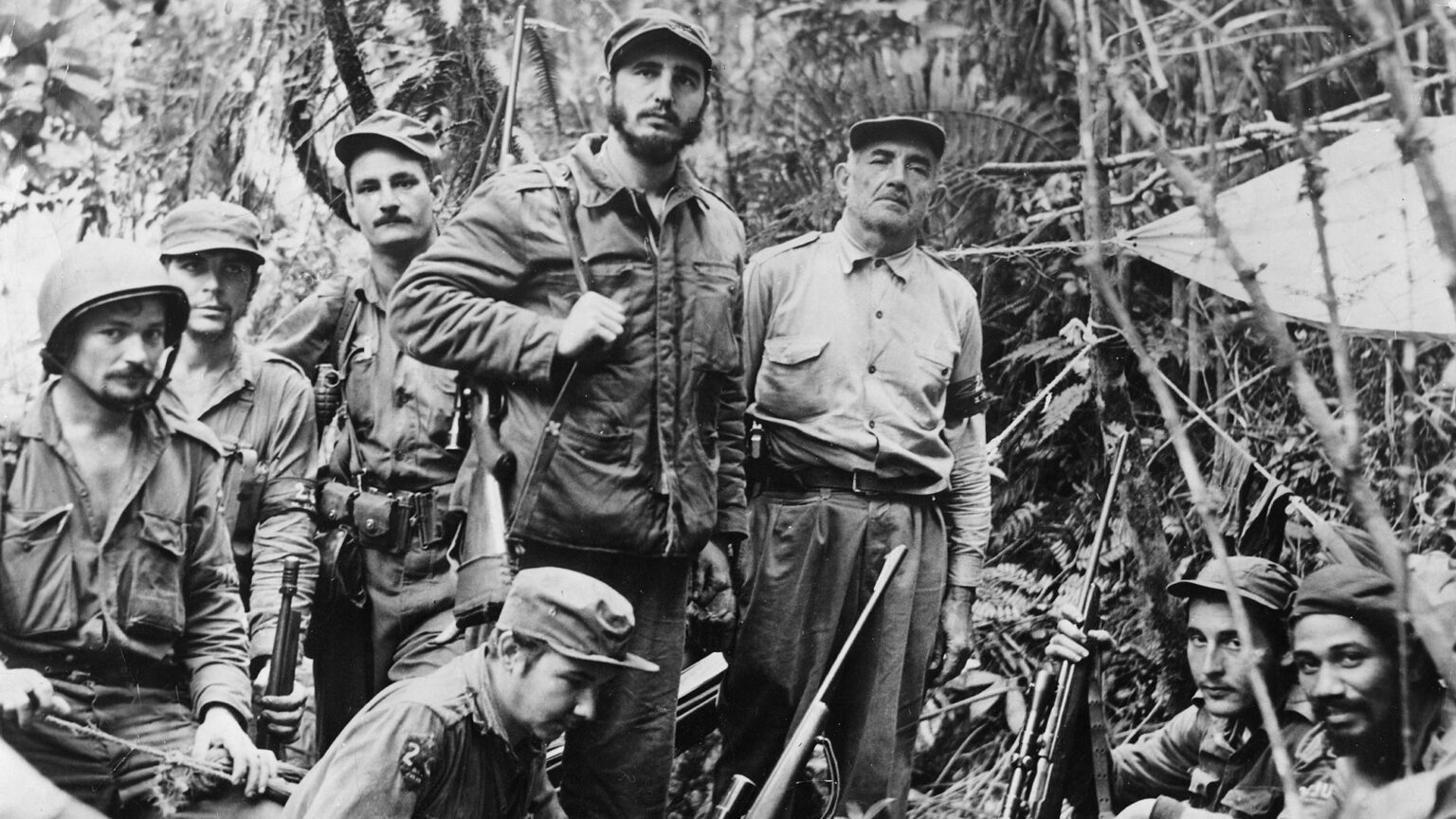
Fidel Castro in the Sierra Maestra with Guillermo García, Ernesto “Che” Guevara, Universo Sánchez, Raúl Castro, Crescentio Pérez, Jorge Sotus, and Juan Almeida. Photo: Wikimedia Commons
August 13 marks the anniversary of the birth of Marxist and communist revolutionary Fidel Castro, one of the most influential political leaders of the 20th century. Read our series of articles about the political life of the revolutionary leader.
Fidel Castro was born in Biran, in the east of the island of Cuba, in 1926, and died in Havana on November 25, 2016. His historical figure however, transcends the time in which he lived. Even when historians study the period in the region before the Cuban Revolution, they always keep in mind that, during the 1950s, on a Caribbean island, social, economic, and political changes would take place that would transform the entire history of the continent.
In this case, Fidel’s name cannot be detached from a process that shook the foundations of the entire Latin American and Caribbean society. Although the “Comandante” himself disavowed the simplification of revolutionary and historical processes to a few names, it seems that human memory prefers to engrave in its memory certain individuals rather than economic forces, cultural disputes, or political ideas. At least this has been the case with Fidel, whose figure is tied to the destiny of a country, just as Bolívar is tied to Venezuela, Juarez to Mexico, and Martí to Cuba.
The young student
Fidel studied at a Jesuit school, and perhaps because of this he always maintained an unyielding intellectual discipline, as well as an almost stoic confidence in the unity of any political group that has clear general objectives. At university, he studied law and social sciences. There he began to read several books on politics while presiding over the Federation of University Students (FEU), a space which he was active in during the struggle against the government of Ramón Grau San Martín, and in which he began to denounce the bloody dictatorship of the infamous Rafael Trujillo in the Dominican Republic.
As president of the FEU, he traveled to Colombia to attend the Inter-American Student Conference and meet personally with Jorge Eliecer Gaitan, the Colombian politician, whose assassination, a few hours before his meeting with the young Fidel, would set off a historical process in Colombian society that began with the famous “Bogotazo”.
Once he finished his university studies, he tried to enter national politics by running for the House of Representatives in 1952, but the disastrous coup d’état of Fulgencio Batista overthrew the government of Carlos Prío Socarrás and prohibited future elections. Fidel tried to denounce Batista before the courts for violating the constitution, but the denunciation was denied. Faced with this adversity, the young Fidel understood that elections and legal denunciations were not an adequate way to engage in political struggle at that time in Cuba.
The beginning of the revolutionary struggle
That is how several young revolutionaries decided to follow the path of armed struggle. On July 26, 1953, they attacked two military bases (the “Moncada” in Santiago de Cuba and the “Carlos Manuel de Céspedes” in Bayamo) which stored thousands of weapons and were located in areas where the people were mostly opposed to the Batista dictatorship. They had hoped that the attack would provoke sympathy among the population and the young military who doubted the dictatorship. But all plans, including the escape plans, failed. More than 80 young revolutionaries were tortured and killed by the repressive forces.
Fidel quickly understood that not every military failure necessarily implies a political failure. In the trial against him, he gave a famous and brilliant self-defense in which he defended two fundamental theses. In the first place, he said that the intellectual author of the attack was named José Martí, implying that the Cuban independence hero, who had died more than 50 years ago, inspired the sovereign ideals of the young revolutionaries. This implied that the revolutionary struggle in Cuba had not ended with Independence from Spain, but continued, thus establishing a political thesis to be followed by the various revolutionary movements in Latin America and the Caribbean during the sixties and seventies of the 20th century: the struggle for independence has not ended because there is still imperialist subjugation. Secondly, he concluded that, although they had been defeated and imprisoned, they were right to act in that way, and that historical time would know how to judge better what at that time seemed a risky adventure of a few young people: “History will absolve me,” Castro said before the judge.
He was imprisoned for almost two years on the Isla de Pinos before being acquitted and banished from Cuba on May 15, 1955. Batista thus hoped to get rid of an uncomfortable political prisoner, although in reality, by doing so, he sentenced himself (in the not-too-distant future) to be defeated militarily and to die in exile in the Spain of fellow dictator Francisco Franco.
After prison, Fidel Castro traveled to the United States and Mexico. In Mexico, he trained (under an ex-combatant of the Spanish Civil War named Alberto Bayo) and organized an expedition of fighters, among them Ernesto “Che” Guevara. The emerging political-military group was called the “26th of July Movement”, in honor of the attack on the military bases. The purpose was clear: to defeat the Batista dictatorship and create a more equitable country. Several months earlier Fidel said in the Palm Garden Hotel in New York City that “In the year 1956 we will be free or we will be martyrs. This struggle began for us on March 10, has lasted almost four years and will end on the last day of the dictatorship or on our last day.”
The Cuban Revolution
Aboard the now revered yacht Granma, a group of 82 expedition members left the coast of Veracruz for Cuba on November 25, 1956. They arrived in Cuba on December 2. Fidel imitated Martí’s military strategy, which consisted of disembarking in the eastern part of the country and approaching the capital from the extreme east of Cuba, passing through the Sierra Maestra, a slight mountain range on the island.
At first, it seemed that the new revolutionary struggle would fail…again. Batista’s army had discovered Castro’s plans and attacked the revolutionary troops with all its might. In Santiago de Cuba, the dictatorship managed to suppress the urban uprising commanded by Frank País, also a member of the Movement 26 of July, in support of the landing of the Granma (which, however, was several days late in arriving). They also quickly discovered the place of arrival of Castro and the rest of the combatants, attacking the guerrillas by air and sea.
After several combats, dispersions, persecutions, and regroupings, only 17 of the 82 original expedition members survived. Despite the obvious adversity, Fidel exclaimed upon meeting with the few survivors: “Now we will win the war!”, which shows a position of historical certainty that Che Guevara would explain years later: “Fidel was certain that, if we left Mexico, we would reach Cuba. If we arrived in Cuba, we would disembark. If we disembarked, we would fight. And if we fight, we will win.
During the coming months, hundreds of new fighters joined Castro’s troops, which were eventually divided into five columns commanded by him, his brother Raul, Camilo Cienfuegos, Che Guevara, and Juan Almeida. However, Batista’s army had more than 70,000 soldiers, so the Movement 26 of July launched a guerrilla war in various parts of the country. Batista launched a military offensive called “Operation Summer”, in which he sent 17 battalions to destroy the Rebel Army, but they were surprised with a series of victories by the revolutionary forces.
Fidel’s popularity began to increase. The Revolutionary Directory, another anti-Batista armed group, attacked the Presidential Palace in Havana to assassinate Batista but were defeated. Despite this, Batista’s invincible image began to be demystified. In addition, the dictatorship increased extrajudicial assassinations and torture against political opponents (the most famous case is the death of Frank País), which eroded the government’s public image. On September 5, the Cienfuegos naval base revolted along with several members of the Movement 26 of July. The government responded to the uprising with a bombing in which more than 400 people died. The majority of the Cuban people repudiated the cruelty with which Batista’s troops acted. The government’s repression only made the revolutionaries more popular.
In addition, after several interviews with international media, Fidel and his followers began to gain support outside Cuba, while denouncing the horrendous crimes of the Batista dictatorship.
During several months of armed struggle, Fidel proved to be the only leader capable of uniting the different factions opposing the dictatorship. The most important political movements recognized that he was the only figure capable of commanding the overthrow of Batista. In addition, Fidel proved to be a very astute military strategist, withdrawing his troops in difficult moments and counter attacking fearlessly when he found the slightest opportunity to gain territory. In this way, he managed to conquer most of the East and Center of the country by the end of 1958. Guevara and his troops managed to take the city of Santa Clara, the last strategic defense of Havana.
Despite the attempt of several military men to carry out an orderly withdrawal of Batista and his troops, Fidel ordered a final attack against the forces of the dictatorship. In this way, Castro sought to curtail the installation of a puppet government and assure the establishment of a truly revolutionary government. “Revolution yes, military coup no!” was Fidel’s phrase repeated by radio throughout the Caribbean island. Batista managed to flee Cuba with the support of US Ambassador Earl T. Smith.
Despite the apparent impossibility of the geopolitical situation, the Cuban Revolution triumphed on January 1, 1959 just to the south of the United States.
Fidel was right: victory was possible in Cuba despite all possible disadvantages. It was a matter of finding the right strategy. The Cuban Revolution inspired dozens of political groups to fight to seize power throughout Latin America and across the Global South, often with Cuban support. Thus began a new era in the history of the Caribbean island, which will never forget the name of Fidel Castro.
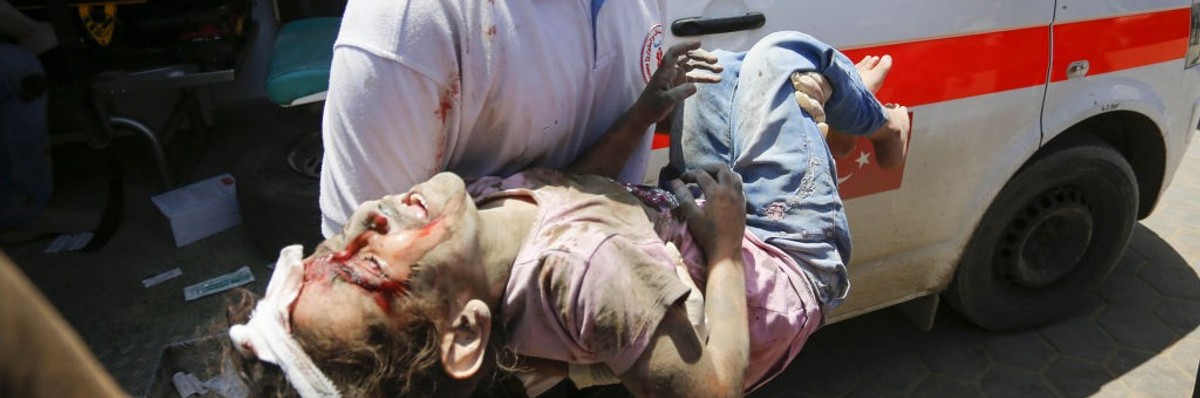
Palestinian child, injured in the Israeli attack on Abu Aisha family house is taken to Al-Aqsa Martyrs Hospital in Deir al-Balah, Gaza on June 14, 2024. (Photo by Ashraf Amra/Anadolu via Getty Images)
A joint statement calls on “all States to ensure full co-operation with the Court for it to carry out its important mandate of ensuring equal justice for all victims of genocide, war crimes, [and] crimes against humanity.”
Ninety-three nations on Friday, all them state parties to the Rome Statute that created the International Criminal Court, reiterated their support for the ICC as it assesses an application for arrest warrants of high level Israeli government officials accused of perpetrating war crimes in Gaza.
The 93 countries—including Canada, Bangladesh, Belgium, Ireland, Afghanistan, Costa Rica, Chile, Germany, France, Mongolia, Mexico, New Zealand, and scores of other—cited separate ICC statements defending its mandate for independence and upheld in their joint statement “that the Court, its officials and staff shall carry out their professional duties as international civil servants without intimidation.”
Though neither nation is named in the joint statement, both the United States and Israel have publicly condemned ICC chief prosecutor Karim Khan for his May 20 arrest warrant applications for Israeli Prime Minister Benjamin Netanyahu and Defense Minister Yoav Gallant over alleged “war crimes” and “crimes against humanity” in the Gaza Strip.
Khan also submitted arrest warrants for Hamas leaders Yahya Sinwar, Mohammed Diab Ibrahim Al-Masri, and Ismail Haniyeh for their alleged roles in the October 7 attack on southern Israel. Following Khan’s announcement in May, U.S. President Joe Biden said, “Whatever this prosecutor might imply, there is no equivalence—none—between Israel and Hamas. We will always stand with Israel against threats to its security.”
In April it was reported that the U.S. government was working behind the scenes to block the ICC from issuing any arrest warrants targeting Israel officials. Neither Israel nor the U.S. is party to the Rome Statute, though the United Nations has recognized the ICC’s jurisdiction over the Occupied Palestinian Territories (OPT), where the alleged war crimes by the occupying power, Israel, took place.
After Khan made his application for warrants, White House spokesperson Karine Jean-Pierre said, “We’ve been really clear about the ICC investigation. We do not support it.” On June 4, Republicans in the U.S. House of Representatives, along with 42 Democrats, passed a measure that would sanction ICC officials if the arrest warrants for any Israeli officials were approved or carried out.
Balakrishnan Rajagopal, the United Nations Special Rapporteur on the right to adequate housing, was among those who applauded Friday’s public statement.
Rajagapol thanked the signatory nations “for defending the ICC and standing up against the bullies, including the relics from the U.S. Senate whose idea of engaging with the world is to use threats,” a possible reference to Sen. Lindsay Graham (R-S.C.) who denounced Khan’s applications as “outrageous,” applauded the House approval of sanctions, and vowed further punishment for the ICC.
Such punitive measures and high-profile threats directed at the ICC appeared to be the exact kind of intimidation Friday’s joint pledge of support is responding to.
93 governments sign this statement of support for the International Criminal Court after others criticized the prosecutor's request for arrest warrants for senior Israeli officials and it emerges that the Israeli government had threatened the prosecutor to avoid investigation. pic.twitter.com/4BwBUsOOzR
“The ICC, as the world’s first and only permanent international criminal court, is an essential component of the international peace and security architecture,” the statement reads. “We therefore call on all States to ensure full co-operation with the Court for it to carry out its important mandate of ensuring equal justice for all victims of genocide, war crimes, crimes against humanity and the crime of aggression, grave crimes that threaten the peace, security and well-being of the world.”
With their show of unified support for the ICC and its mandate, the countries said they aim to “contribute to ending impunity for such crimes and preventing their recurrence while defending the progress we have made together to guarantee lasting respect for international humanitarian law, human rights, the of law and the enforcement of international criminal justice.”
The progressive leader is making history as the first woman president in North America and has vowed to follow in the footsteps of her colleague President López Obrador in building an anti-neoliberal economic development model
Dr. Claudia Sheinbaum won the presidential election in Mexico on June 2, making her the first female president of Mexico. The scientist, public servant, Nobel Peace Prize winner, and longtime activist ran with the “Let’s Continue Making History” Coalition composed of the Movement for National Regeneration (MORENA), the Labor Party (PT), and the Green Ecologist Party of Mexico. With 58% of the votes (according to INE quick count at 1:25 am (UTC-6)), Sheinbaum defeated Xóchitl Gálvez Ruíz who was the candidate of the right-wing Force and Heart for Mexico Coalition of PRI-PAN-PRD. Jorge Álvarez Máynez came in third with around 10% of the total vote share.
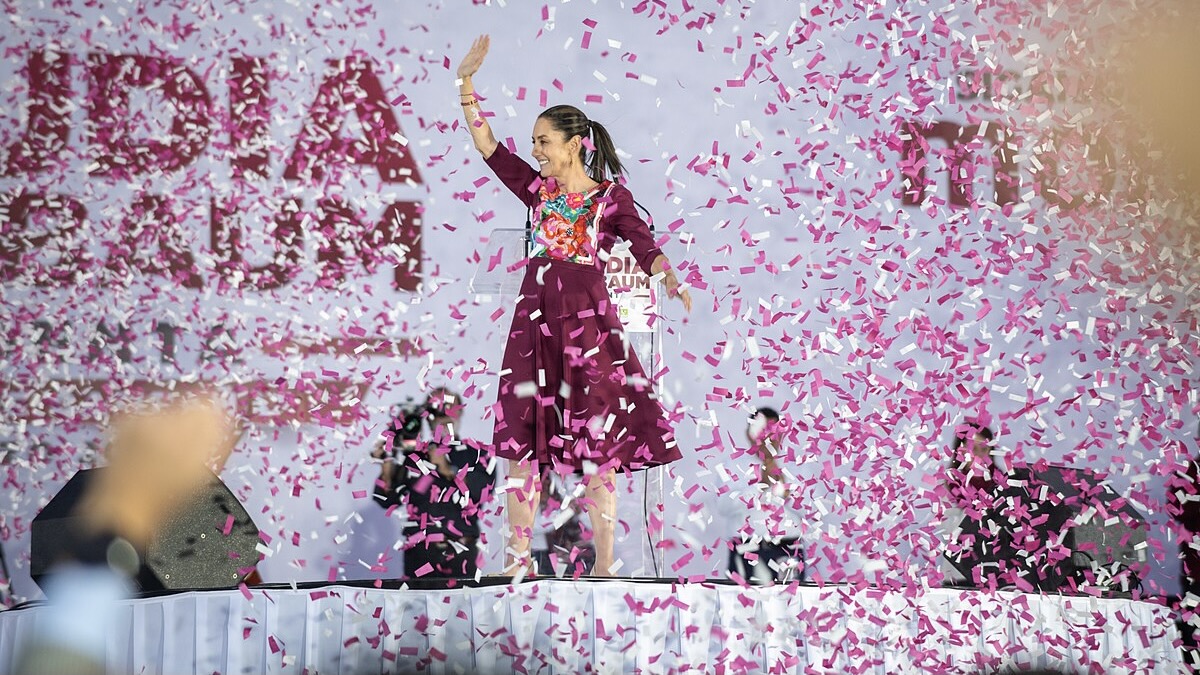
Sheinbaum addressed thousands of supporters in the Zocalo in the center of Mexico City to celebrate her victory. “I feel excited and thankful, for the recognition that you have given to the Fourth Transformation of public life of Mexico. Here as we have always done, I promise to not let you down. Today, the people of Mexico have made possible the continuity and advance of the Fourth Transformation, and also for the first time in 200 years, we women have arrived to the presidency of the Republic!”
Earlier in a press conference, Sheinbaum also announced that MORENA had achieved a majority in the Chamber of Deputies and was set to also win a majority in the Senate. Clara Brugada, the former mayor of Iztapalapa, won the race for head of government of Mexico City.
Sheinbaum’s party MORENA had announced her victory in a press conference about an hour and a half after polls had closed and all major exit polls projected her victory with a 2:1 margin, which they characterized as an irreversible trend. The President of MORENA, Mario Delgado, had stated: “Today sovereignty, independence, and democracy have also triumphed. The people have shown that they will not be deceived, not with hate campaigns nor with lies. The votes defeated the bots!”
The National Electoral Institute (INE) began to release results of the quick count at 8:00 pm (Mexico City time). Just before midnight on Sunday, the Council President of the National Electoral Institute (INE), Guadalupe Taddei Zavala, released a message to announce that based on the preliminary results of the rapid count, Dr. Claudia Sheinbaum is set to win the presidency with a wide margin over right-wing candidate Xóchitl Gálvez. She added that between 58.9-61.7% of the electorate had participated in Sunday’s local and federal elections.
Tensions had begun to rise in the period after voting when conservative candidate Gálvez Ruiz, instead of accepting her overwhelming defeat, confirmed in the exit polls and the preliminary results of INE, called on her supporters to remain vigilant and suggested she is in fact be the winner. She then published a series of tweets, echoing the same messages of “vigilance” and wrote, “They want you to go to bed thinking that they beat you. They lie like always.” Analysts had been alerting to a situation wherein Gálvez would “cry fraud” and attempt to undermine the results of the election in light of her predictable defeat.
However, this narrative was quickly debunked after the official results confirmed the landslide victory of the MORENA candidate. When Sheinbaum announced her victory, she confirmed that Gálvez had called to congratulate her moments earlier.
Claudia Sheinbaum vows to continue making history
Sheinbaum will be the first woman president of Mexico and North America, and has vowed to continue the project of the “Fourth Transformation” inaugurated by President Andrés Manuel López Obrador, led by the principle of “Mexican Humanism”. The anti-neoliberal socio economic project has had enormous success across Mexico in raising the standard of living for the majorities in the country through the increase in minimum wage, expanded social and economic programs to increase access to key rights of education, housing, healthcare, and more. AMLO will finish his term in office with a 80% approval rating, according to Gallup polls.
Sheinbaum spoke about the importance of the 4T project in an interview with Peoples Dispatch and BreakThrough News in April 2023, “states have to give the rights to the people. What do we think is a right? Education, health, a home, pension for all the elders. We also believe in strategic areas of the economy such as energy. The state has to be part of this, especially electricity, oil and mainly and now lithium…it’s important and it’s going to be very important in the future…You cannot have private investment measured only by GDP or international investment. You have to measure investment, public and private, in wealth for the people. And that’s the big difference with neoliberalism that believed that everything was going to be solved by the market.”
Mexico’s northern neighbor, the United States, is its most important trading partner. During AMLO’s six-year term, he managed to maintain a mostly amicable relationship with both Donald Trump and Joe Biden, but also did not shy away from holding his ground on key issues. For example, as president, AMLO was one of the strongest voices on topics which directly contradict US policy such as the US blockade of Cuba, the imprisonment and persecution of Julian Assange, and the subordination of the region to corporate and imperialist interests. AMLO was also a driving figure in reinvigorating spaces of regional integration and served as pro-tempore president of the Community of Latin American and Caribbean States (CELAC). How Sheinbaum relates to her northern neighbor and the rest of the region will be a defining feature of her presidency.