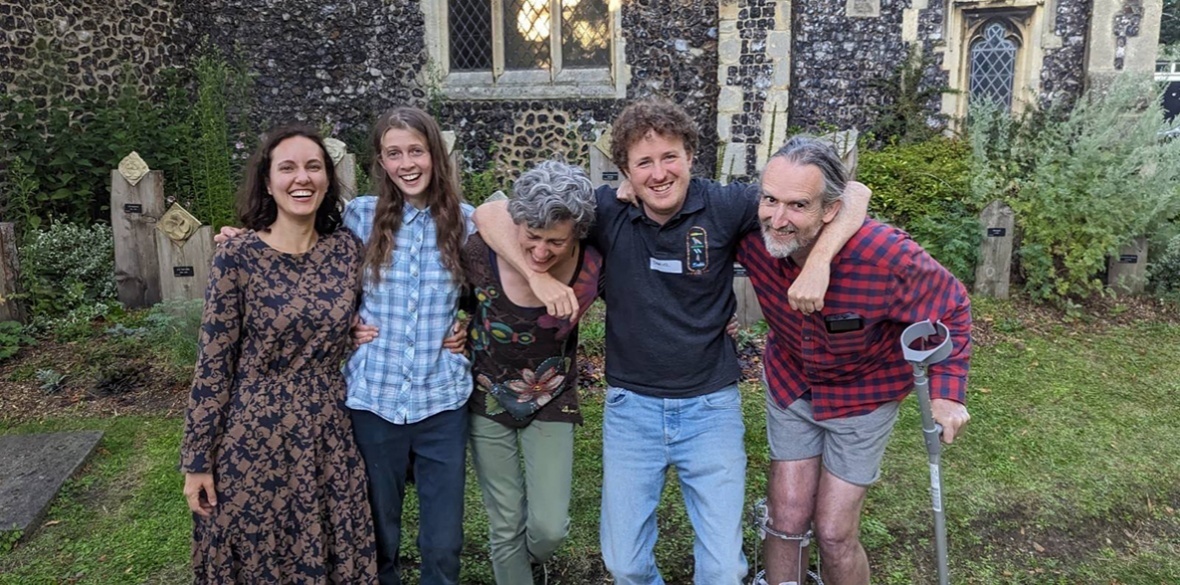
The Whole Truth Five (from left to right) Lucia Whittaker De Abreu, Cressida Gethin, Louise Lancaster, Daniel Shaw and Roger HallamPhoto: Just Stop Oil
SIXTEEN non-violent Just Stop Oil protesters handed draconian sentences since July have been granted an extraordinary mass hearing before the Court of Appeal next year, it was announced on Saturday.
The hearing on January 29 and 30 at the Royal Courts of Justice in London will examine four separate cases involving activists from the group. Key points of contention will include whether conscientious motivation should be considered a mitigating factor.
The outcome is anticipated to be a defining moment for protest rights in Britain.
The 16 include the “Whole Truth Five,” who organised a protest on the M25 calling for a halt to new oil and gas licences. Roger Hallam, Cressida Gethin, Louise Lancaster, Daniel Shaw, and Lucia Whittaker De Abreu received a combined total of 21 years for their action.
At the time, UN special rapporteur Michel Forst said the verdict marked a dark day for “anyone concerned with the exercise of their fundamental freedoms” in Britain.
…
Spokesman for the Free Political Prisoners campaign Lex Korte said: “A subset of judges have responded all too eagerly to the call from the disgraced Lord Walney, the arms and oil industry lobbyist, to jail peaceful climate campaigners for longer than if they’d committed serious crimes of sexual violence.
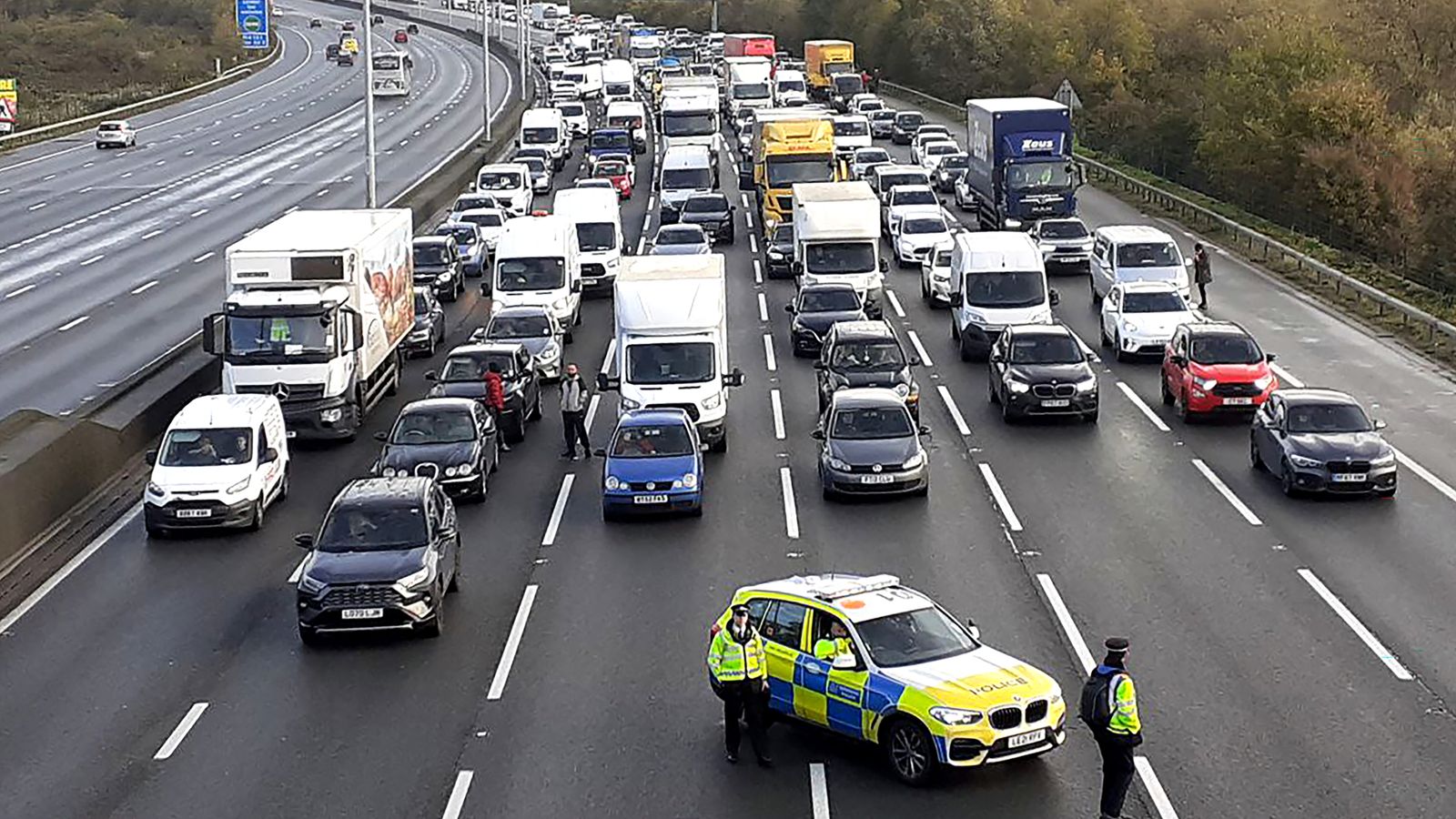
Delays on the M25 from a Just Stop Oil protest. Pic: Just Stop Oil/PA
Protesters now face up to two years in prison, but there has been international condemnation of the increasing severity of sentences for non-violent protest.
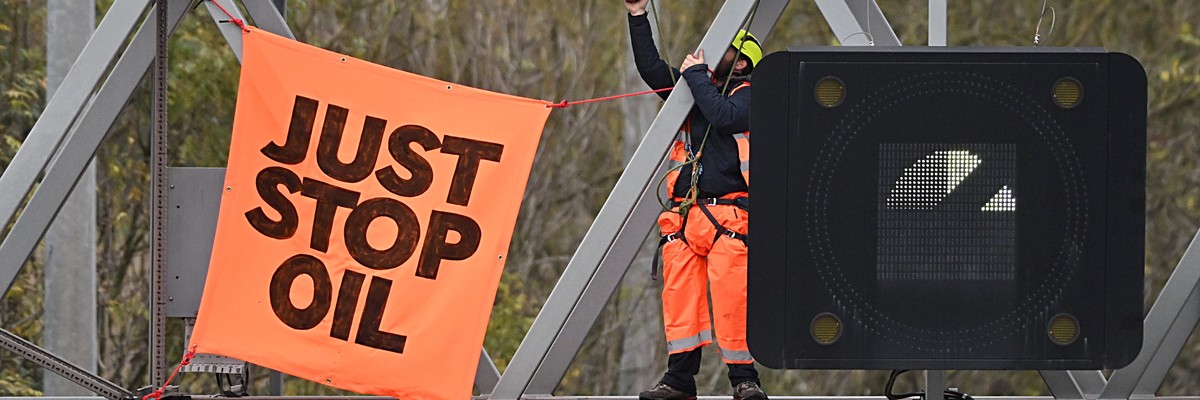
Five Just Stop Oil activists have just been jailed for up to two years after they climbed gantries over the M25 motorway and caused temporary gridlock.
For many of the 181,000 motorists the Highways Agency estimated were delayed in November 2022 by the coordinated four-day-long campaign of disruption, it may feel like justice served.
But there has been international condemnation of the increasing severity of sentences for non-violent protest.
“There can be no justification for the level of sentences that are being imposed,” says Raj Chada, a solicitor at Hodge Jones & Allen who represented one of the activists – a 77-year-old woman.
“These are sentences which have traditionally been reserved for violent offences. And in the UK, we’ve always said that no matter what the protest, even if it is disruptive, you get credit for it being non-violent,” said Mr Chada.
The latest sentences, of between two years and 20 months, follow those in July of jail terms between four and five years for Just Stop Oil campaigners who planned and recruited volunteers for the M25 protest.
“Today marks a very dark day for fundamental human rights in the UK,” wrote Michel Forst, the United Nations Special Rapporteur on Environmental Defenders, who attended their trial at Southwark Crown Court.
…
Lawyers representing some of the Just Stop Oil activists sentenced in both recent court cases said they would appeal the length of sentences.
The Court of Appeal has previously upheld judges decisions in protest cases, meaning the UK’s recent record on punishing environmental activists is likely to end up before the European Court of Human Rights.
An activist puts up a banner reading “Just Stop Oil” atop an electronic traffic sign along M25 on November 10, 2022 in London, United Kingdom. (Photo: Leon Neal/Getty Images)
“Rulings like today’s set a very dangerous precedent, not just for environmental protest but any form of peaceful protest,” a U.N. official said.
In a decision that one United Nations official called “beyond comprehension,” a U.K. judge on Thursday sentenced five Just Stop Oil activists to a combined 21 years in prison over a Zoom call in which they discussed plans to disrupt London’s orbital M25 highway.
The sentences are believed to be the longest on record for nonviolent protest in U.K. history, The Guardian reported.
“The sentences handed to the five Just Stop Oil campaigners are utterly disproportionate,” environmentalist and author George Monbiot wrote on social media. “Four and five years in prison for peaceful protest? This is what you might expect in Russia or Egypt, not in a supposed democracy.”
“Why are we punishing the people trying to prevent disaster while allowing the oil company giants causing it to reap super profits?”
The five activists—Roger Hallam, Daniel Shaw, Louise Lancaster, Lucia Whittaker De Abreu, and Cressida Gethin—were found guilty last week of conspiring to cause a public nuisance due to a four-day direct action protest on the M25 that Just Stop Oil ultimately held in November 2022. All of the defendants participated in a Zoom call in which they planned to recruit volunteers for the protest, which was intended to pressure the U.K. government to end oil and gas exploration in the North Sea, a policy that the incoming Labour government has now adopted. The Zoom call had been infiltrated by a Sun journalist, who shared its contents with the Metropolitan Police.
On Thursday, Judge Christopher Hehir sentenced Hallam to five years in prison and Shaw, Lancaster, De Abreu, and Gethin to four each.
🧡 The #WholeTruthFive being cheered as they leave court and are taken to prison.
⛓️ They have received 4 and 5 year prison sentences after a zoom call about a nonviolent action being planned in 2022. This is not what a functioning democracy looks like. pic.twitter.com/JKKg2f8gtb
The sentences sparked outrage from humans rights advocates and environmental campaigners.
Michel Forst, U.N. special rapporteur on environmental defenders who also observed part of the trial, said the sentencing “marks a dark day for peaceful environmental protest, the protection of environmental defenders, and indeed anyone concerned with the exercise of their fundamental freedoms in the United Kingdom.”
Forst added: “Rulings like today’s set a very dangerous precedent, not just for environmental protest but any form of peaceful protest that may, at one point or another, not align with the interests of the government of the day.”
Former Green Party leader and Member of Parliament Caroline Lucas called the sentences “obscene.”
“Why are we punishing the people trying to prevent disaster while allowing the oil company giants causing it to reap super profits?” she asked on social media.
Current Deputy Leader of the Green Party Zack Polanski said: “‘Conspiracy to commit a public nuisance’ is a deeply authoritarian description that should send shivers down the spine of all of us who want to live in a free society. Even worse when the real crime is consecutive governments who have played down the climate emergency.”
Campaigners and experts also criticized the trial itself, in which Hehir did not allow the defendants to present evidence about the climate crisis to explain their actions.
“Defendants should be allowed to explain why they have decided to use nonconventional but yet peaceful forms of action, like civil disobedience, when they engage in environmental protest,” Forst told The Guardian after attending part of the trial.
Bill McGuire, emeritus professor of geophysical and climate hazards at University College London—who Hehir did not allow the defendants to call as a witness—called the trial and verdict a “farce.”
“They mark a low point in British justice, and they were an assault on free speech,” McGuire in a statement said Thursday. “The judge’s characterization of climate breakdown as a matter of opinion and belief is completely nonsensical and demonstrates extraordinary ignorance. Similarly to suggest that the climate emergency is irrelevant in relation to whether the defendants had a reasonable case for action is crass stupidity.”
The verdict and sentencing also come amid an increasing crackdown on climate protest, both globally and in the U.K. The previous longest known civil disobedience sentences in the country were also for Just Stop Oil activists.
“The U.K. is a nightmare for climate activists from this point of view, in the sense that the sentences imposed in other countries are neither that harsh, nor that widespread,” Forst said July 12.
Greenpeace U.K.’s program director Amy Cameron said on Thursday: “These sentences are not a one-off anomaly but the culmination of years of repressive legislation, overblown government rhetoric, and a concerted assault on the right of juries to deliberate according to their conscience. It’s part of the mess the Labour government has inherited from its predecessor, and they must fix it by giving back to people the right to protest that’s been slowly being taken away from them.”
Forst also called on the new government to reverse course.
“Given the gravity of the situation, I urge the new United Kingdom government, with absolute urgency and without undo delay, to take all necessary steps to ensure that Mr. Shaw’s sentence is reduced in line with the United Kingdom’s obligations under the Aarhus Convention,” Forst wrote on Thursday.
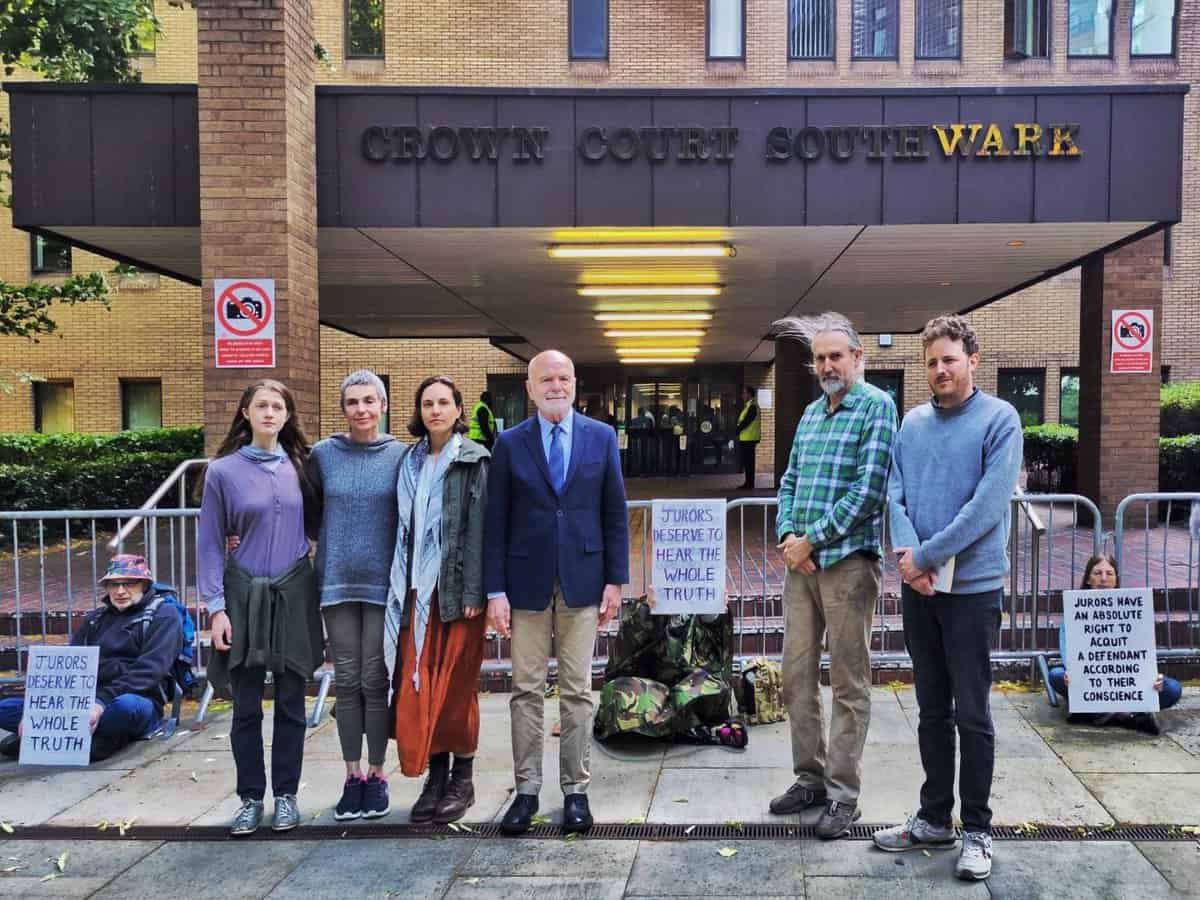
UN Special Rapporteur on Environmental Defenders under the Aarhus Convention Michel Forst attended the trial of five Just Stop Oil supporters at Southwark Crown Court. He attended as an observer because of his serious concerns.
Prosecution of five Just Stop Oil activists over M25 protest led to chaotic scenes in court and concerns about ‘judicial persecution’
As part of his role as UN rapporteur for environmental defenders, Michel Forst has been watching proceedings against climate activists at courts across Europe.
But he may not have seen anything like what unfolded at Southwark crown court in London over the past two and a half weeks, where five Just Stop Oil activists were convicted for conspiring to cause gridlock on the M25 in November 2022.
On the days Forst visited, he witnessed three of the five defendants being arrested in court and dragged to the cells, protesters outside attempting to warn jurors they were not hearing the full case and a judge desperately trying to maintain control over his courtroom.
The judge, Christopher Hehir, had ruled that information about climate breakdown could not be entered into evidence, and could only be referred to by defendants briefly as the “political and philosophical beliefs” that motivated them – which he would tell the jury were in any case irrelevant to their deliberations.
But the defendants had other plans. They sought to turn Hehir’s court into a “site of civil resistance”, causing as much disruption as necessary to ensure that if the jury could not see their evidence on climate breakdown, then the jurors could at least be in no doubt it was being kept from them.
By the time the jury retired to consider a verdict, police had been called into court no fewer than seven times, four of the five defendants had been remanded to prison and 11 others were facing contempt of court proceedings for protests outside the courtroom.
…
By the end of the trial, Whittaker De Abreu, the only one who had not represented herself, was the only defendant left in court.
As a punishment for their “persistent disruption”, Hehir slashed the time given to each defendant from one hour to 20 minutes. He further prohibited any mention of the climate crisis, the legal defences he had disallowed or the principle of jury equity – the idea that jurors can acquit based on their conscience.
As Hallam, Shaw, Lancaster and Gethin gave their speeches from behind the reinforced glass screen of the dock, they each proceeded to flout Hehir’s prohibitions, arguing they had been denied a right to a fair trial.
Hallam told jurors: “It’s blindingly obvious to us here first that you have not been given all the evidence you need. You cannot be sure of our guilt if you are not sure that you have not been given the evidence … we have received no good reason why we are not allowed to tell you what is blindingly obvious, namely what I’m not allowed to speak about. If you are not allowed to hear the blindingly obvious then it’s not a fair trial is it?”
It took just a day’s deliberations for the jury to unanimously find them guilty.
Given the recent history of UK climate protest trials, in which defendants have been sentenced to jail for merely mentioning the words “climate change”, and notwithstanding the dramatic arrests in court, Forst said he was surprised the judge gave them an opportunity to mention climate breakdown at all.
“But the little latitude they had to mention climate change was in the meantime emptied of its very meaning by the fact that, overall, the jury was told to ignore most of it,” he added.
UN Special Rapporteur on Environmental Defenders under the Aarhus Convention and former UN Special Rapporteur on Human Rights Defenders Michel Forst is attending the ongoing trial of five Just Stop Oil supporters at Southwark Crown Court today. He is attending as an observer because of his serious concerns.
The special rapporteur’s office released a statement on 24th June detailing his views regarding the criminal prosecution of Daniel Shaw in this trial. The statement can be read here.
The Aarhus Convention, to which the UK is a signatory, aims to promote environmental democracy by ensuring public access to information, participation in decision-making, and access to justice in environmental matters. The Special Rapporteur monitors the implementation of the convention’s provisions by its parties, ensuring compliance with obligations related to access to justice. Additionally, the Special Rapporteur investigates complaints from individuals or groups alleging violations of their rights under the Aarhus Convention, assesses specific cases, and makes recommendations to ensure compliance.
Daniel Shaw, Cressie Gethin, Lucia De-Abreu-Whittaker, Louise Lancaster and Roger Hallam are currently on trial at Southwark Crown Court, charged with conspiracy to cause a public nuisance in connection with the M25 gantry actions in November 2022. They were arrested either pre-emptively in police raids at their homes after attending a Zoom call in which a Sun journalist was present, or arrested travelling near the M25 respectively. The Sun alleged it had ‘infiltrated’ the meeting and boasted of tipping off the police and enabling National Highways to secure a public injunction.
Some of these five were imprisoned for up to 113 days without trial. They were released subject to stringent conditions including a 10 pm to 7 am house curfew, not to be within a one-mile radius of the M25, no contact with other defendants and not to participate in any climate change demonstration.
In another trial involving Just Stop Oil supporters, which was the first under the new Public Order Act 2023 for a Section 7 offence, Judge Hehir who is overseeing the current proceedings barred all legal defences from the defendants and prohibited any mention of the climate crisis to the jury. This trial concluded with a conviction, and Judge Hehir is expected to sentence the defendants at a future date.