A demonstrator holds a Union Jack flag, during an anti-immigration protest outside the Britannia International Hotel in Canary Wharf, London, Britain, July 27, 2025. Photo: REUTERS/Jaimi Joy
‘My concern is the safety of bringing fascism to my neighborhood.’
Earlier this month, the Mail on Sunday claimed to reveal “the shocking scale of serious crime committed by migrants living in hotels in communities across Britain”.
The newspaper’s investigation claimed that the scale of a “migrant crime wave” had “until now been unknown”. It showed that at least 312 asylum seekers have been charged with an “astonishing” 708 alleged criminal offences in just three years.
The investigation was endorsed by shadow home secretary Chris Philp. Scratch its surface and all it reveals is the prejudice of the Mail, campaigners say.
They point out that the Mail’s figures include innocent people who’ve been acquitted, as well as those yet to be found guilty of any crime. They add that the 312 who’ve been charged represent a fraction of the tens of thousands of people who have passed through asylum accommodation in the three years reported on by the Mail.
“Describing this as a ‘migrant crime wave’ is not only completely dishonest but incredibly dangerous, at a time when families forced to live in asylum hotels are being threatened on their doorstep by violent crowds,” Nathan Phillips, head of campaigns at migrant charity Asylum Matters, told Novara Media.
By this point, it was too late. The Mail’s scaremongering appears to have had a direct role in sparking at least one anti-migrant protest, due to take place on Saturday. The protest has been endorsed by Stephen Yaxley-Lennon AKA Tommy Robinson, currently in Tenerife while police investigate his alleged assault of a man at St Pancras station.
Alongside its piece on the migrant “crime wave”, the Mail published an accompanying report focusing on the number of crimes linked to one hotel that also houses asylum seekers: the Barbican Thistle in Islington, north London. The day after the article was published, a Facebook group sprang up organising a protest at the accommodation, carrying the Mail’s headline as its header image.
The Mail’s report on the Barbican Thistle said that 41 residents of the hotel had been charged with 90 crimes over the past three years. Once again, the sensationalist framing only told part of the story. A coalition of local residents, community groups and anti-racist campaigners who are opposing Saturday’s demonstration called the Mail’s claims “inflammatory, misleading, and politically motivated.”
A meeting of the child poverty taskforce. From left to right: Mayor of the North East Kim McGuinness, work and pensions secretary Liz Kendall and education secretary Bridget Phillippson. Image: Department for Education/ Flickr
Tory ministers presented reforms to disability benefits as a way to support disabled people into work – and they would have seen many worse off by at least £416.19 per month
The Department for Work and Pensions’ (DWP) consultation into plans to slash billions of pounds from disability benefits has been ruled unlawful in a damning High Court judgement.
In a judgment published this morning (16 January), Mr Justice Calver said that the judicial review, brought by disability activist Ellen Clifford, had “surmounted the substantial hurdle of establishing that the consultation was so unfair as to be unlawful”.
Repeatedly describing the DWP consultation in autumn 2023 as “misleading”, “rushed” and “unfair”, he said:
• The consultation documents failed to highlight the “substantial” loss of benefits facing those affected by the proposals.
• The consultation gave the “misleading impression” that changes were required to ensure deaf and disabled people could access employment support, when they could already choose to access this voluntarily.
• Despite the consultation presenting the changes as being solely about helping disabled people into work, in reality “costs savings was at least one of the two bases, if not the central basis, on which decisions would be taken on which policies would be taken forward by the government”.
• The eight-week consultation was unlawfully short in the circumstances.
Reassuring report based on long-debunked climate contrarian
The Washington Post (10/24/24) claims that “the rise in billion-dollar disasters, while alarming, is not so much an indicator of climate change as a reflection of societal growth and risky development.”
As the country begins to vote in an election that will be hugely consequential for the climate crisis, the central task of news outlets’ climate beats should be informing potential voters of those consequences. Instead, the Washington Post‘s “Climate Lab” seems to be working hard to cast doubt on whether climate change is really causing weather disasters to be more expensive.
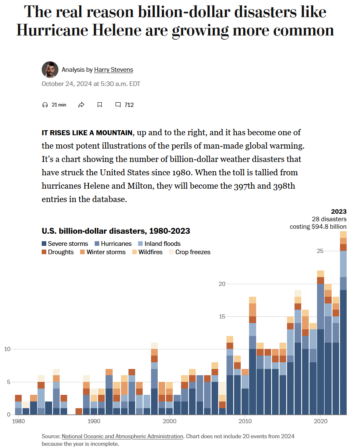
In a lengthy piece (10/24/24) headlined “The Real Reason Billion-Dollar Disasters Like Hurricane Helene Are Growing More Common,” Post Climate Lab columnist Harry Stevens highlighted a NOAA chart depicting a notable increase in billion-dollar weather disasters hitting the US that he says is widely used by government reports and officials “to help make the case for climate policies.” But, in fact, Stevens tells readers:
The truth lies elsewhere: Over time, migration to hazard-prone areas has increased, putting more people and property in harm’s way. Disasters are more expensive because there is more to destroy.
The takeaway is clear: The (Democratic) government is lying to you about the supposedly devastating impacts of climate change.
Distorting with cherry-picked data
The problem is, it’s Stevens’ story that’s doing the misleading. It relies heavily on the work of one source, Roger Pielke Jr., a longtime climate contrarian beloved by climate denial right-wingers, who cherry-picks data to distort the truth.
What’s worse, from a media critic’s perspective, is that it’s not even a new story; it’s been debunked multiple times over the years. Pielke—a political scientist, not a climate scientist, which Stevens never makes clear—has been promoting this tale since 1998, when he first published a journal article that purported to show that, as Stevens describes, “after adjusting damage to account for the growth in people and property, the trend [of increasing economic costs from weather disasters] disappears.”
A review of Roger Pielke’s book The Climate Fix in the journal Science (11/26/10) accused him of writing “a diatribe against the IPCC and other scientists that is based on highly selective and distorted figures and his own studies.”
When Pielke published the argument in his 2010 book, the journal Science (11/26/10) published a withering response, describing the chapter as “a diatribe against the IPCC and other scientists that is based on highly selective and distorted figures and his own studies.” It detailed the multiple methodological problems with Pielke’s argument:
He makes “corrections” for some things (notably, more people putting themselves in harm’s way) but not others. Some adjustments, such as for hurricane losses for the early 20th century, in which the dollar value goes up several hundred–fold, are highly flawed. But he then uses this record to suggest that the resulting absence of trends in damage costs represents the lack of evidence of a climate component. His record fails to consider all tropical storms and instead focuses only on the rare land-falling ones, which cause highly variable damage depending on where they hit. He completely ignores the benefits from improvements in hurricane warning times, changes in building codes, and other factors that have been important in reducing losses. Nor does he give any consideration to our understanding of the physics of hurricanes and evidence for changes such as the 2005 season, which broke records in so many ways.
Similarly, in discussing floods, Pielke fails to acknowledge that many governing bodies (especially local councils) and government agencies (such as the US Army Corps of Engineers) have tackled the mission of preventing floods by building infrastructure. Thus even though heavy rains have increased disproportionately in many places around the world (thereby increasing the risk of floods), the inundations may have been avoided. In developing countries, however, such flooding has been realized, as seen for instance this year in Pakistan, China and India. Other tenuous claims abound, and Pielke cherry-picks points to fit his arguments.
That year, climate expert Joe Romm (Climate Progress, 2/28/10) called Pielke “the single most disputed and debunked person in the entire realm of people who publish regularly on disasters and climate change.”
Debunked a decade ago
In response to Pielke, climate scientist Kerry Emanuel (538, 3/31/14) pointed out that it’s not necessarily appropriate to normalize damages by gross domestic product (GDP) if the intent is to detect an underlying climate trend,” since “GDP increase does not translate in any obvious way to damage increase,” as “wealthier countries can better afford to build stronger structures and to protect assets.”
Pielke peddled the story in 538 (3/19/14) four years later—and lost his briefly held job as a contributor for it, after the scientific community spokeoutagainst it in droves, as not being supported by the evidence.
The backlash led 538 to give MIT climate scientist Kerry Emanuel (3/31/14) a column to rebut Pielke, in which she explained that while it’s of course true that “changing demographics” have impacted the economic costs of weather disasters, Pielke’s data didn’t support his assertion “that climate change has played no role in the observed increase in damages.” She pointed to the same kinds of methodological flaws that Science did, noting that her own research with Yale economist Robert Mendelsohn projected that through the year 2100, “global hurricane damage will about double owing to demographic trends, and double again because of climate change.”
That all happened ten years ago. So why is Pielke’s same old ax-grinding getting a platform at the Washington Post shortly before Election Day?
Stevens does tell readers—quite far down in the article—that Pielke has “clashed with other scientists, journalists and government officials” over his research—though Stevens doesn’t give any details about those clashes, or about Pielke’s reputation among climate scientists more generally.
Stevens also briefly notes that Pielke was recently hired by the American Enterprise Institute, which Stevens characterizes as “center-right,” but more helpfully might have characterized as “taking millions from ExxonMobil since 1998.” But in the same paragraph, Stevens also takes pains to point out that Pielke says he’s planning to vote for Harris, as if to burnish Pielke’s climate-believer bonafides.
Pielke agrees with Pielke
Roger Pielke “agrees with studies that agree with Pielke” (Environmental Hazards, 10/12/20).
Stevens tells Post readers that the science is firmly on Pielke’s side:
Similar studies have failed to find global warming’s fingerprint in economic damage from hurricanes, floods, tornadoes and crop losses. Of 53 peer-reviewed studies that assess economic damage from weather events, 52 could not attribute damage trends to global warming, according to Pielke’s 2020 review of the literature, the most recent and comprehensive.
You’ll notice Stevens just used Pielke’s own review to bolster Pielke’s argument. But the journal that published that review (Environmental Hazards, 8/5/20) immediately followed up with the publication of a critique (10/12/20) from researchers who came to the opposite conclusion in their study on US hurricanes. They explained that there are “fundamental shortcomings in this literature,” which comes from a disaster research “field that is currently dominated by a small group of authors” who mostly use the same methodology—adjusting historical economic losses based strictly on “growth in wealth and population”—that Pielke does.
The authors, who wrote a study that actually accounted for this problem and did find that economic losses from hurricanes increased over time after accounting for increases in wealth and population, point out that Pielke dismissed their study and two others that didn’t agree with his own results essentially because they didn’t come to the same conclusions. As the authors of the critique write drily: “Pielke agrees with studies that agree with Pielke.”
A phony ‘consensus’
Stevens includes in his article an obligatory line that experts say
disputing whether global warming’s influence can be found in the disaster data is not the same as questioning whether climate change is real or whether society should switch from fossil fuels.
He also adds that
many scientists say that global warming has intensified hurricanes, wildfires, droughts and other extreme weather, which must be leading to greater economic losses.
Note that he frames it as only “many,” and suggests they are only using (faulty, simplistic) logic, not science. But of course, climate change is intensifying extreme weather, as even Stevens has reported as fact recently (in the link he provides in that passage). In contrast, Stevens writes that
the consensus among disaster researchers is that the rise in billion-dollar disasters, while alarming, is not so much an indicator of climate change as a reflection of societal growth and risky development.
But in fact, as mentioned above, there’s not consensus even among disaster researchers (who are primarily economists). And the “many scientists” who disagree with Pielke aren’t the scientists the Post chooses to focus on. While Stevens quotes a number of different experts, including some who disagree with Pielke, they are not given anywhere near the space—or credence—Pielke and his arguments are. (Pielke’s name appears 15 times across the article and its captions.)
When he does get around to quoting some of the scientists, like MIT’s Emanuel, whose research shows that extreme weather events are intensifying, Stevens presents the conflicting conclusions as a back-and-forth of claims and counterclaims, giving the last word in that debate to a disaster researcher whose goal is to refocus blame for disasters on political decisions—like supporting building in vulnerable locations—rather than climate change.
Changes in our built environment, and governments’ impact on those changes, are certainly an important subject when it comes to accounting for and preventing billion-dollar disasters—which virtually no one disputes. (Indeed, the four government reports Stevens links to in his second paragraph as supposedly misusing the NOAA data explicitly name some variation of “increased building and population growth” as a contributing factor to growing costs.) It’s simply not an either/or question, as the Post‘s teaser framed it: “Many blame global warming. Others say disasters are more expensive because there is more to destroy.” So it’s bizarre and frankly dangerous that ten years after climate scientists debunked Pielke’s claim that there’s no evidence climate change is increasing extreme weather costs, Stevens would take, as the “urgent” question of the moment, “Is global warming to blame” for the growing billion-dollar disaster tally?
By giving the impression that the whole thing is basically a government scam to justify climate policies, Stevens’ direct implication is that even if climate change is indisputable, it doesn’t really matter. And it feeds into climate deniers’ claims that the climate change-believing government is lying about climate change and its impacts, at a time when a large number of those deniers are seeking office.
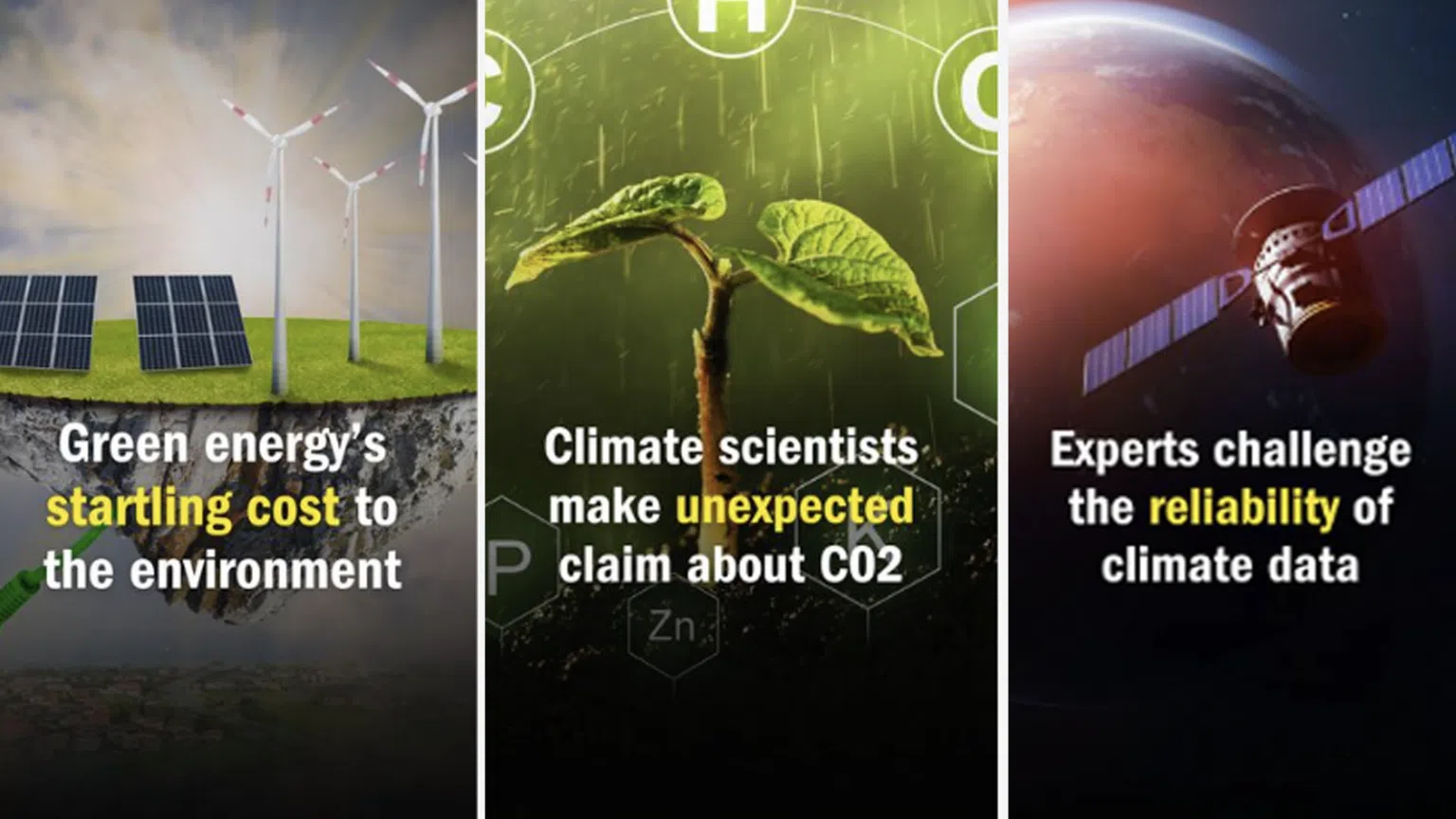
A mashup of three Epoch Times adverts posted on Meta. Credit: The Epoch Times / Meta
Campaigners have referred the Epoch Times to the UK advertising regulator for “stoking the climate culture war” on social media.
The pro-Trump Epoch Times has run hundreds of anti-climate social media adverts in Europe since the beginning of 2024 that have been seen millions of times, DeSmog can reveal.
Epoch Times accounts in Europe have run 425 adverts on Facebook, Instagram, and X (formerly Twitter) that have attacked or undermined climate science, green energy, or climate action since the start of the year. These adverts have been run in the UK, Germany, Slovakia, and Bulgaria, appearing on social media feeds at least 2.3 million times across Facebook and Instagram, and 3.1 million times on X.
These anti-climate ads were active for 22 days on average on Meta platforms (Facebook and Instagram), while they were displayed for 9.5 days on average on X.
Four of the adverts posted by Epoch Times on Meta have now been referred to the Advertising Standards Agency (ASA), a UK watchdog, by the campaign group Global Witness. The group is calling for the ASA to open an investigation into whether the Epoch Times breached the Committee of Advertising Practice (CAP) Code and, if so, to ban these adverts.
The Epoch Times claims to be the fastest growing independent news outlet in the United States. It claims to host websites across 22 languages in 35 countries, publishing online and in print. The publication has gained a substantial online following in recent years, amassing more than 10 million followers across its various Facebook accounts.
Based in New York, the Epoch Times is affiliated with the Falun Gong new religious movement in China and is staunchly anti-communist. Though the source of its income isn’t publicly declared, former employees told the New York Times that the publication was financed “by a combination of subscriptions, ads and donations from wealthy Falun Gong practitioners.”
The publication has propelled itself on Facebook by filling its feeds with viral, feel-good videos alongside its often partisan news coverage.
According to NewsGuard, an independent company that rates the credibility of news sites, Epoch Times articles “frequently include distorted, misleading, or unsubstantiated claims.” The Epoch Times claims on its website that its reporters are “guided by the highest code of conduct and ethics”.
The Epoch Times spent at least $1.5 million on adverts in support of then Republican President Donald Trump from 2018 to 2019 – more than any group other than the Trump campaign.
The publication was banned from advertising by Meta following these revelations, and the social media company told DeSmog that it ”continues to enforce this ban”. However, a number of Epoch Times offshoots have been allowed to promote climate science denial across Europe this year.
Many of these adverts have explicitly questioned the contribution of carbon dioxide (CO2) to climate change. The adverts have featured statements including “Several climate scientists say CO2 is essential and higher levels are not a problem”, and “What if more CO2 is actually good for the environment?”
The UN’s Intergovernmental Panel on Climate Change (IPCC), the world’s foremost climate science body, has stated that carbon dioxide “is responsible for most of global warming” since the late 19th century, which has increased the “severity and frequency of weather and climate extremes, like heat waves, heavy rains, and drought”.
The adverts ran for months, and reached millions of people, despite Meta’s pledge to tackle climate misinformation. Ten were removed prior to DeSmog contacting Meta, of which six were removed over a failure to include an appropriate advertising disclaimer.
“After sowing division and disinformation in the U.S., everyone in the UK should be alarmed that the Epoch Times is using the same playbook here,” said Nienke Palstra, campaign strategy lead at Global Witness. “We have already seen politicians trying to stoke a climate culture war and the Epoch Times is spending big to tap into this sentiment. We cannot allow the future of our planet to be put at threat for the political gain of extremists and populists.”
A spokesperson for the Epoch Times told Global Witness that scientists have always differed in their opinion on climate change and that “To ban different opinions does not help a civilised open society and erodes freedom of speech.”
Climate Denial Content
The bulk of the anti-climate adverts seen by DeSmog were posted by Epoch Times London, a Facebook page created in October 2023 that has fewer than 600 followers.
Many of the adverts posted by Epoch Times London questioned climate science, for example claiming that “the greenhouse effect is real but irrelevant”, and that “new studies undercut the ‘scientifically empty’ global warming narrative.”
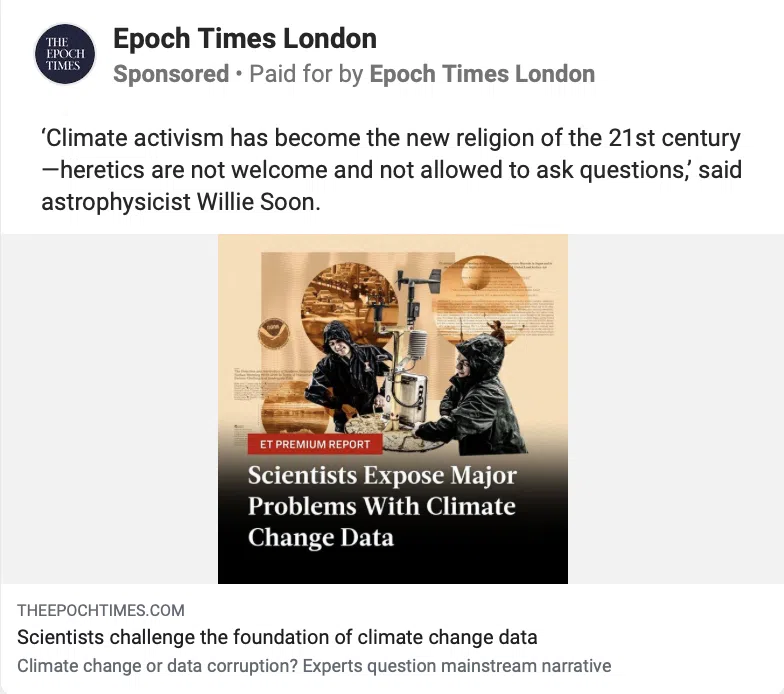
One advert entitled “Scientists Expose Major Problems With Climate Change Data” was linked to an Epoch Times article that claimed climate change can be best explained by “natural variation”. The article also said that attempts to create a scientific consensus around human-caused climate change are the product of “deliberate fraud” according to “some experts.”
The same article quoted Willie Soon, a scientist who has cast doubt on climate science and who has openly admitted accepting research funding from fossil fuel interests.
A number of the Epoch Times London adverts suggested that the consensus on climate change is based on a wilful misinterpretation of evidence by the scientific community, asking questions such as “Climate change or data corruption? Experts question mainstream narrative.”
DeSmog’s analysis found that Epoch Times London ran at least 392 unique adverts on Meta since the start of the year that attacked or attempted to undermine climate science, green energy, or climate action.
Of those adverts, 146 were still active prior to DeSmog contacting Meta. According to an analysis of Meta’s ad archive, Epoch Times London has spent between £12,600 and £51,715 on its anti-climate advertising since the start of the year, with those adverts having been seen between 1.9 million and 2.5 million times. Meta has now blocked Epoch Times London’s ability to post adverts.
According to Companies House, Epoch Times London was incorporated in 2014. The publication drew criticism in the UK in 2020 for posting free editions of its paper to Brighton and Hove residents, the front page of which included claims that the Chinese Communist Party had deliberately covered up evidence of COVID-19’s existence.
Following complaints from constituents, Lloyd Russell-Moyle, the Labour MP for Kemptown in Brighton, publicly criticised the Epoch Times in the House of Commons and called on Royal Mail to stop posting its print edition.
Epoch’s European Operations
Elsewhere in Europe, DeSmog has seen evidence of anti-climate advertising from Epoch Times-affiliated accounts.
The most prolific source of these adverts has been the German Epoch Times account on X, which has run 61 anti-climate adverts since the beginning of the year, reaching at least 1.5 million people and appearing 3.2 million times on X feeds across the German-speaking world.
Of the adverts that made a funding declaration, all stated that they were paid for Epoch Times Europe Gmbh, a company that has existed in Germany since at least 2009 according to the country’s company register.
A number of these adverts directly questioned the role of CO2 on climate change, saying that “CO2, especially anthropogenic emissions, hardly play a role”, “Climate change: CO2 not to blame”, “Climate change is too complex to blame on CO2”, and “CO2 is the most expensive fraud in history.”
While there were fewer ads run on Meta in Germany than in the UK, they still generated at least 100,000 impressions, representing an ad spend of between €1,500 and €3,777.
An account run by German Epoch Times journalist Erik Rusch has also run at least 24 anti-climate adverts since its creation in January – though the adverts state that they were paid for by Rusch.
Some of the adverts run by Epoch Times Germany suggested that wind turbines produce nefarious health effects, including claims such as, “Don’t ignore the health effects: Doctor warns against wind turbines”, and “Wind energy under scrutiny: Dr Bellut-Staeck on the low-frequency risks to humans and animals.”
One of the German adverts quoted Fritz Vahrenholt, who is a scientific advisor to the UK’s leading climate science denial group, the Global Warming Policy Foundation (GWPF).
Other adverts promoted by the German Epoch Times, as well as Epoch Times London, quoted fellow GWPF advisor Richard Lindzen. In one of these adverts, Lindzen was quoted as saying: “If we could get rid of 60 percent of CO2, we would all be dead.”
Germany Epoch Times adverts also linked back to articles on its website, directing readers to the claim by climate science denier John F. Clauser that the perceived climate threat is a “dangerous corruption of science.”
Another advert quoted Lindzen as asking, “Is climate change the existential threat we’ve been led to believe?” and linked to an Epoch Times interview with Lindzen on its YouTube series “American Thought Leaders”.
Former UK Prime Minister Liz Truss was recently interviewed on this series, while a parallel series, “British Thought Leaders”, has interviewed a number of climate science deniers. Since the beginning of March, this series has featured Martin Durkin, Rupert Darwall, and GWPF advisor Gwythian Prins. These interviews were headlined: “The Science Simply Does Not Support the Ridiculous Hysteria Around Climate At All”, “This Obsession With Carbon Dioxide Emissions Has Led to Tragedy”, and “The World Is at War – The West’s Green Policies Are Playing Into Our Enemy’s Hands”.
Epoch Times Bulgaria has posted three anti-climate ads since the beginning of the year, one of which was entitled “scientists alarmed that there is no real evidence that CO2 is causing climate change”.
Meta has pledged to take action against false narratives on climate change, and the platform has committing to using a “suite of tools, such as fact checking and labels, to help combat climate misinformation.”
In May 2021, Facebook said that it would begin attaching informational labels to posts about climate change, directing users to the platform’s new “Climate Science Information Center”.
However, research conducted in 2022 by the Center for Countering Digital Hate found that Facebook is failing to flag at least half of climate misinformation content.
“Despite claiming to take climate misinformation seriously, Meta has a history of allowing climate disinformation posts with high-engagement to go unchecked,” said Ilana Berger, senior climate and energy disinformation researcher at the misinformation watchdog Media Matters. “If Meta is committed to combating climate disinformation on its platform, it must at the very least consistently enforce its existing policies.”
Meanwhile, following his takeover of Twitter in 2022, Elon Musk has slashed the number of staff who identify harmful content and misinformation. X did not respond to DeSmog’s request for comment.
“Climate misinformation threatens all of our futures – and with elections pending across Europe, the stakes could not be higher,” said Richard Wilson, director of the campaign group Stop Funding Heat. “But the same money that is fuelling this problem could also be the key to a solution. If enough advertisers speak out, and urge Facebook and Twitter to stop climate lies being promoted through their platforms, they will have to clean up their act.”
Suella Braverman has been called out over claims made this week that the government has hit record breaking police recruitment targets.
The government are declaring a victory for saying they have delivered a manifesto target of recruiting 20,000 more police officers in England and Wales, as Braverman appealed to the right-wing press by boasting that there are now more officers than ever before in the history of policing.
However this claim has come under rigorous scrutiny, not just from a fact checking charity but also from the Police Federation itself.
Whilst this number is correct based on an increase between 2019 and March 2023, the figures follow a substantial decline in police numbers from 2010 to 2017 – estimated by the charity Full Fact to be a fall of almost 22,000 officers.
Figures revealed that there are actually only around 3,500 more officers now than there were in 2010, due to the huge drop in numbers before 2017.