The UK farmer protests you probably haven’t heard about

Spread the love
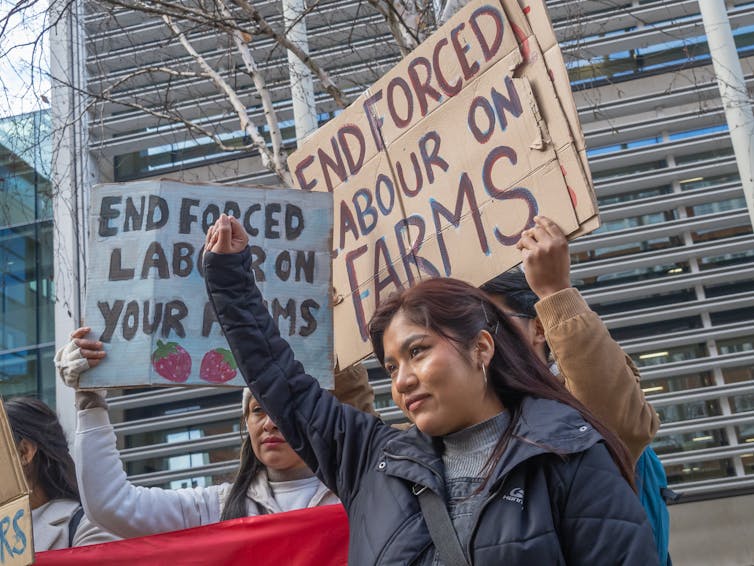
Fruit pickers and farm workers protesting labour abuses on British farms. Peter Marshall

Alex Heffron, Lancaster University

Farm owners have besieged parliament with tractors in order to protest new subsidy schemes and inheritance tax arrangements. The farm workers who milk cows, drive machinery and pick crops have grievances too, yet their demands have been less publicised. So, what do they want?

I am a farmer based in the south-west of Wales and a researcher of farming policy. I recently joined a protest by a group of Latin American farm workers known as “Justice is Not Seasonal”, outside the Home Office in London.

The group accused soft fruit supplier Haygrove, which operates farms on three continents and supplies veg box delivery schemes including Riverford and Abel and Cole, of presiding over poor living and working conditions, failing to pay workers and charging inflated flight costs for overseas workers. Haygrove has an annual turnover in excess of £50 million.

Haygrove denies these allegations. In response to a case brought forward by the trade union United Voices of the World and the charity Anti Trafficking and Labour Exploitation Unit, the Home Office has made an interim decision stating there are reasonable grounds that one of the affected workers, Julia Quecaño Casimiro, has been subjected to human trafficking and modern slavery.

The case tribunal is due to be held soon although it has been a slow, arduous process reaching this point.

In an article for the BBC, a spokesperson for Haygrove said that Casimiro’s claims were “materially incorrect and misleading”. Haygrove’s practices are audited by third-party organisations including the Home Office, and the company takes “great care” in ensuring fair recruitment and working processes, the spokesperson said.

Various trade unions and organisations attended the protest, including the Landworkers’ Alliance, United Voices of the World, Independent Workers’ union of Great Britain, Unite and Solidarity Across Land Trades.

Conspicuously absent was the National Farmers’ Union, which predominantly represents farm owners. This highlights the divergent class interests that exist within terms like “farmer”.

More workers and more exploitation

There are 160,000 UK farm workers (as opposed to owners and managers). Of these, some of the most gruelling agricultural work is done by around 45,000 seasonal migrant workers, either in fields in all weather or in the sweltering heat of polytunnels.

The UK attracts migrant farm workers with six-month temporary visas. A United Nations special rapporteur, Tomoya Obokata, an expert in human rights law and modern slavery, has suggested that the UK is breaking international law with its seasonal work scheme by failing to investigate instances of forced labour. Claims of exploitation and bullying on UK farms are also becoming more common. Meanwhile, in an effort to appease farm managers, the UK government recently announced a five-year extension of this scheme.

Food and farming organisations have urged the UK to produce more fruit and vegetables as part of a wider shift towards a less carbon-intensive food system.

To scale up domestic production will require more workers harvesting crops in poor conditions, especially migrant workers who don’t have the same legal rights as British citizens.

Seasonal migrant workers, for example, cannot bring family members to the UK and have no access to benefits, while their visas are often tied to one place of work which typically includes accommodation which leaves them particularly vulnerable to abuse. A call for increased labour, without a call for improved conditions, could mean more exploitation on British farms.

Exploitation is not limited to the allegations of a few bad apples either. It is so widespread that it threatens the resilience of the UK’s food system.

A recent report found that more than half of migrants at risk of labour abuse work in the food system. A more resilient food supply will require better working conditions, pay and housing for workers in this sector, the report concludes.

Higher prices don’t mean better welfare

It’s tempting to ask consumers to pay more for their food so that farm workers might earn more. However, higher prices are no guarantee of better conditions. Leaving aside rising inflation and stagnating wages which make it harder for consumers to buy ethically, organic farms already sell produce at a premium and some are also among those accused of mistreating workers.

This is even a problem among small-scale organic food producers, as documented by Solidarity Across Land Trades. A report by this land worker’s union found that some small farms use bogus traineeships to justify paying workers as little as £1.41 per hour. This is despite the produce usually being sold for more than conventional supermarket prices.
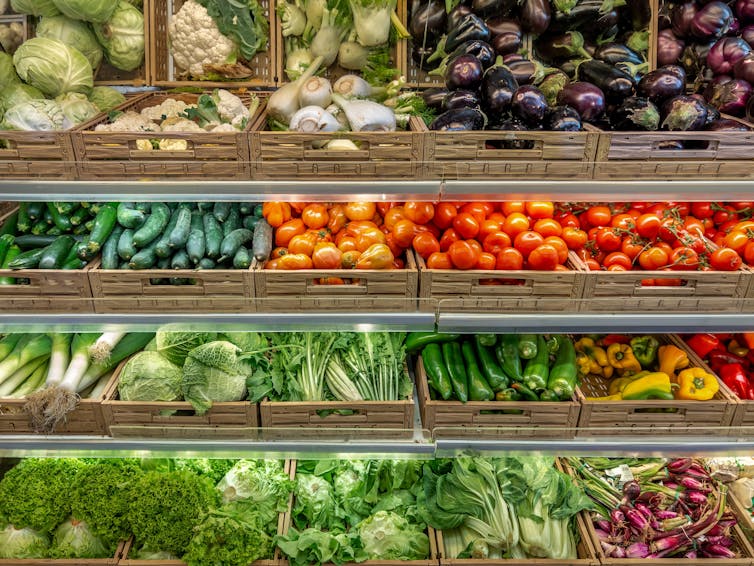
Crates of fruit and vegetables in a shop aisle.
Greener diets depend on increased fruit and vegetable production. Framarzo/Shutterstock

The structural problems of the food system are more complicated than the price consumers pay for food. There is also the question of who gets to be heard, who is valued and who is deemed worthy of rights and dignity when food production takes place under a system of class-based exploitation. These challenges cannot be solved at the checkout alone.

The ecological crisis demands transitions away from diesel-powered machinery and chemical fertilisers and herbicides produced with fossil fuels. Farm workers are needed to carry out the transition towards more sustainable practices, but there will be no green transition unless these workers have a stake in it.

This idea of “a just transition” has gained traction in recent years, and it is just as relevant to farmers and farm workers as it is to workers in other sectors, such as oil and gas. But what might it look like?

The demands made by Justice Is Not Seasonal are a good place to start: an end to forced labour and exploitation on UK farms and full accountability for those responsible, fair wages and safe working conditions, residency rights and access to justice and remediation.


Don’t have time to read about climate change as much as you’d like?
Get a weekly roundup in your inbox instead. Every Wednesday, The Conversation’s environment editor writes Imagine, a short email that goes a little deeper into just one climate issue. Join the 40,000+ readers who’ve subscribed so far.


Alex Heffron, PhD Candidate in Geography, Lancaster University

This article is republished from The Conversation under a Creative Commons license. Read the original article.


Continue ReadingThe UK farmer protests you probably haven’t heard about

UK care agencies accused of exploiting foreign workers caught in debt traps

Spread the love

https://www.theguardian.com/society/article/2024/jun/02/uk-care-agencies-accused-of-exploiting-foreign-workers-caught-in-debt-traps

Many foreign care workers in the UK say they are lured over on false promises that cause them to amass serious debts. Composite: Guardian Design/Getty Images/Alamy/PA/Reuters.

Guardian Exclusive: Experts raise alarm over ‘national scandal’ that has hallmarks of trafficking and modern slavery

British social care agencies have been accused of exploiting foreign workers, leaving people living on the breadline as they struggle to pay off debts run up while trying to secure jobs that fail to materialise.

Dozens of people working for 11 different care providers have told the Guardian they paid thousands of pounds to agents to secure jobs working in UK care homes or residential care, with most finding limited or no employment when they arrived.

Many are now struggling to pay off huge debts in their home countries and having to work in irregular jobs for below the minimum wage.

Labour and the Conservatives are now under pressure to tackle the issue if they win next month’s election. The Tories recently banned foreign care workers bringing their dependents to the UK with them, a ban Labour said last week it would keep in place in an effort to bring net immigration down.

But experts say the ban has failed to tackle the deeper issue of exploitation of the workers themselves, many of whom are still in the UK and living in poverty, afraid to leave their employers for fear of losing their visa status.

The Royal College of Nursing (RCN) has now written to the leaders of all three major national parties to demand a full government inquiry into treatment of migrant care workers when parliament returns.

Prof Nicola Ranger, the acting general secretary of the RCN, said: “The exploitation of migrant care workers is a national scandal but little has been done to tackle it.

“A chronically understaffed social care sector has supercharged its recruitment of staff from overseas and a lack of regulation and enforcement has allowed some employers to profit from the mistreatment of migrants.”

She added: “An urgent government investigation into exploitation across the social care sector must be a priority for whoever wins the general election. Lives are being ruined daily and this work has to start as soon as possible.”

Article continues at https://www.theguardian.com/society/article/2024/jun/02/uk-care-agencies-accused-of-exploiting-foreign-workers-caught-in-debt-traps

Continue ReadingUK care agencies accused of exploiting foreign workers caught in debt traps

Revealed: How ‘unfit’ PPE helped former playboy buy two mansions

Spread the love

Original article by Adam Bychawski republished from Open Democracy under a Creative Commons Attribution-NonCommercial 4.0 International licence.

Glove tycoon Robert Gros splashed millions on luxury homes and planned to build cinema, disco and golf simulator

An estimated £27m worth of gowns supplied by Gros’s company were later deemed “not fit for use”. Image: Katia Ponnampalam, Creative Commons Attribution-Share Alike 4.0 International license.

A former ‘playboy’-turned-businessman made a fortune supplying PPE during the pandemic, even though the NHS may be unable to use millions of the gowns his company delivered, openDemocracy can reveal.

Chemical Intelligence Limited was awarded a £126m contract to supply 21 million medical gowns that were desperately needed to protect NHS workers treating Covid patients in May 2020. But data released to openDemocracy through freedom of information law shows the Department of Health and Social Care later deemed 4.5 million of them – worth an estimated total of £27m – “not fit for use” in the NHS. 

Lawyers acting on behalf of Robert Gros, the sole owner and CEO of Chemical Intelligence, said Gros could not comment because he “did not recognise these figures or amounts”.

The bumper PPE contract allowed Gros, 51, to turn around his business, which had made losses two years running prior. Chemical Intelligence declared profits of £33m for the year up to September 2020 according to accounts filed on Companies House. It had just two employees, including Gros, when it landed the multi-million pound government contract.

Gros personally splashed out on a £4m country pile just four months after he clinched the PPE deal. In 2021, after his company reported a further £31m in profits, he bought a second £2m country home and asked for planning permission to fit a basement bowling alley in the first.

The businessman then paid himself £7m in dividends in January 2022 – after having already loaned himself £6m the year before. Two months later, he transferred £40m in dividends to a holding company that he entirely owns. 

Gros would only answer our questions through his lawyers, who told us that he has paid all the necessary corporation tax and that the £4om would “continue to be reinvested” in his business.

The £126m contract was one of many for which the government apparently paid over the odds as demand for PPE skyrocketed during the pandemic and it did not have enough stockpiled. Gowns cost the government 1,260% more than they did before the pandemic, according to the National Audit Office.

A fifth of gowns supplied by Chemical Intelligence were labelled “not fit for use” because they “failed the technical, clinical or regulatory compliance assessment”, openDemocracy understands. The department would not elaborate on why the gowns failed checks, but according to the data released under FOI their value has been written down to £0.

“The department has processes in place to review the quality of PPE and determine whether products are suitable to be released to the frontline,” said a spokesperson. “Upon receipt, a sample of each product is reviewed by DHSC’s Technical and Regulatory Assurance team.

“A proportion of this stock was classified as ‘do not supply’. Stock in this category has not necessarily fallen short of standards and in many cases these products can be used in other settings.”

Gros’s lawyers insisted that all the PPE the company had supplied was “fit for purpose and use”, suggesting the DHSC may have been mistaken in its record-keeping. The department confirmed that Chemical Intelligence also supplied £35m worth of face masks and disposable surgical aprons under separate contracts also awarded in 2020, none of which was deemed unusable.

Of the £12bn the government spent in total on PPE, £4bn worth cannot be used by the NHS because it doesn’t meet the right standards, according to a 2022 report by the Public Accounts CCommittee of MPs.

Gros’s lawyers said that the sharp rise in profits for Chemical Intelligence was not all down to PPE deals he struck during the pandemic, and threatened openDemocracy with an injunction if we revealed details about his mansions.

The businessman, who had a reputation as a “playboy” in the late 1990s after dating a string of soap stars, appears to have made the most of his new fortune. The Cambridgeshire house he bought a few months after the contract was signed had six bedrooms, four reception rooms, a swimming pool and a gym, all heated by three boilers.

Three months later, he lodged a planning application with Cambridge City Council to more than double the size of the property. The proposed plan included the addition of a basement housing a dance floor, a two-lane bowling alley, a golf simulator, a room for arcade machines and a cinema.

Gros was forced to withdraw the application after it was rejected by planners for being too “modern” in style; neighbours had also raised concerns about the potential noise from the proposed bowling alley and dance floor. He resubmitted a new application in November, which was approved in April.

In June 2021, through another company of which he was the sole owner, Gros bought a second mansion with six bedrooms, three garages and an outdoor pool for £2m in a neighbouring village.

Chemical Intelligence, which Gros founded in 2012, develops medical examination gloves, which have been licensed to and manufactured by Malaysian firm Hartalega since 2017.

Hartalega is one of several Malaysian glove manufacturers that have been accused of using modern slavery. A leaked report by the Home Office in 2019 found there was “strong evidence” to suggest that the majority of Malaysian glove manufacturers that supply the NHS, which include Hartalega, “exhibit forced labour indicators”.

Lawyers acting for Chemical Intelligence said that the company “takes the issue of modern slavery extremely seriously and carried out its own due diligence to seek to satisfy itself that throughout the manufacturing process all of the correct procedures and safeguards are in place”.

Chemical Intelligence was one of 58 suppliers awarded a contract to supply medical gloves to the NHS in January 2022, but no information has been published on whether it has yet done so.

Original article by Adam Bychawski republished from Open Democracy under a Creative Commons Attribution-NonCommercial 4.0 International licence.

Whatever you’re interested in, there’s a free openDemocracy newsletter for you. HAVE A LOOK

Continue ReadingRevealed: How ‘unfit’ PPE helped former playboy buy two mansions