Italy’s Unions Lead General Strike for Gaza

Spread the love

Original article by Brett Wilkins republished from Common Dreams under Creative Commons (CC BY-NC-ND 3.0). 
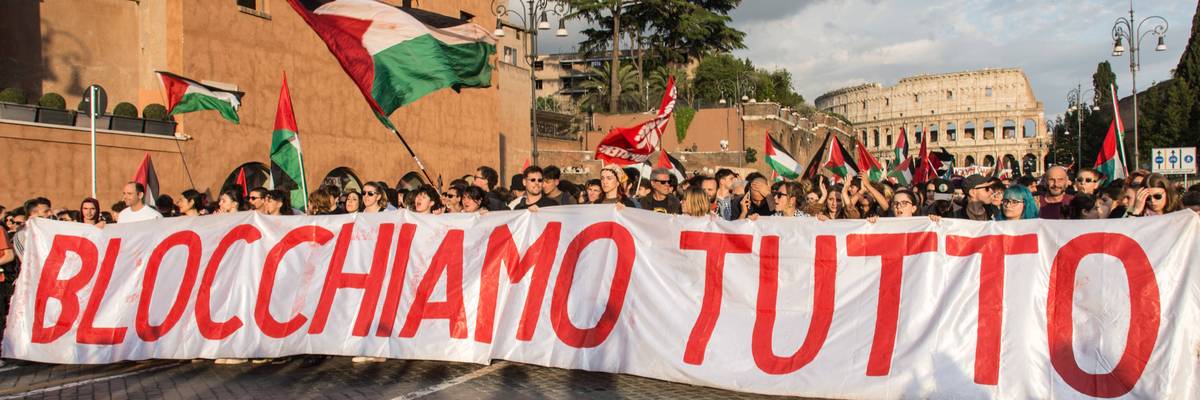
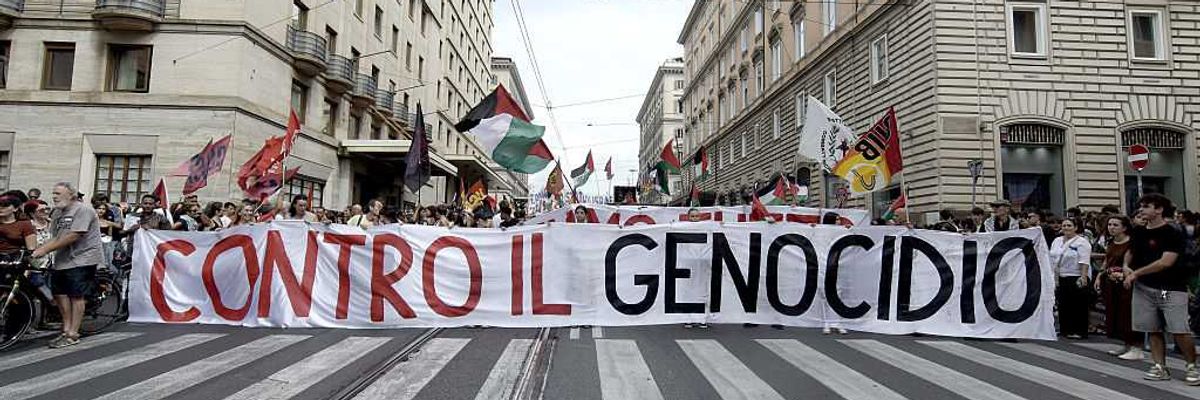
Palestine defenders rally with a banner reading, “Against the Genocide” in Rome on September 22, 2025. (Photo by Simona Granati/Corbis via Getty Images)

“Meloni should take a stand with the facts against those who have slaughtered 20,000 children, rather than limiting herself to saying ‘I do not agree,’” said one critic of Italy’s right-wing prime minister.

Italian labor unions led a massive 24-hour general strike on Monday to protest Israel’s ongoing genocide in Gaza, with estimates of hundreds of thousands of demonstrators rallying in dozens of cities across Italy.

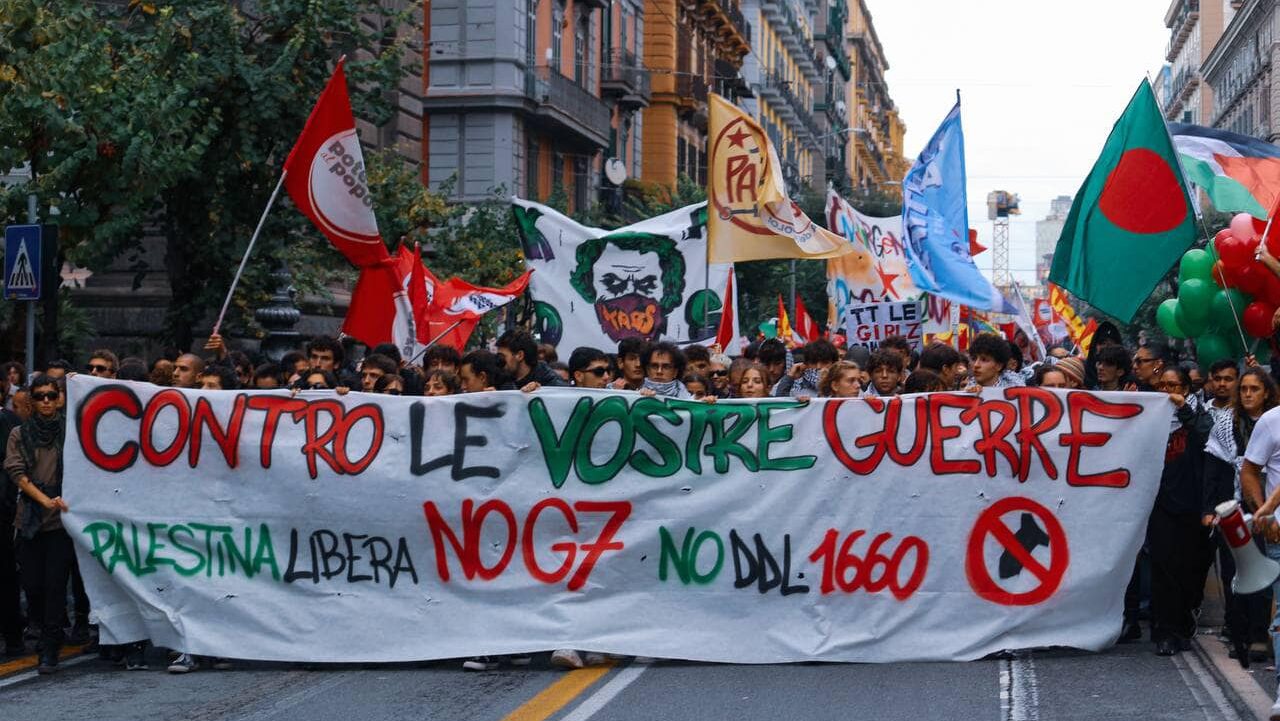
Protesters took to squares, streets, transport hubs, ports, university campuses, and other spaces in more than 75 cities and towns, rallying under the call to “Block Everything.” Places including schools, train stations, and retail stores were shut for the day.

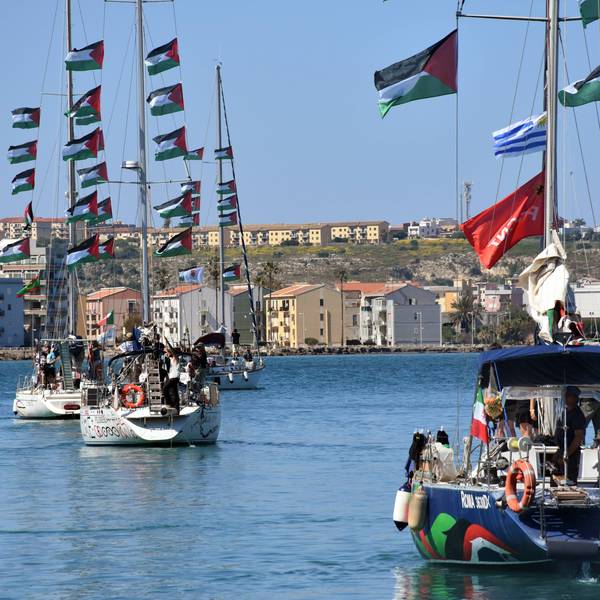
“The strike is called in response to the ongoing genocide in the Gaza Strip, the blockade of humanitarian aid by the Israeli army, and the threats directed against the… Global Sumud Flotilla, which has on board Italian workers and trade unionists committed to bringing food and basic necessities to the Palestinian population,” explained Unione Sindacale di Base (USB), a grassroots union confederation known for its militant stance on labor and political issues.

In Rome, tens of thousands of Palestine defenders rallied at the Termini rail station, Italy’s largest, with many of the demonstrators occupying the building.

While protest activities snarled traffic in some parts of the Italian capital, many Roman motorists showed solidarity with the demonstrators by honking their horns and raising their fists into the air.

Watch: Pro-Gaza protesters who blocked a highway near Rome were met with visible solidarity from drivers. Regional news coverage of the paralyzed Central Station showed only people expressing support for the protest.Source: Paolo Mossetti on X (@paolomossetti)

Drop Site (@dropsitenews.com) 2025-09-22T18:35:27.997Z

Milan saw an estimated 50,000 people turn out to locations including the central rail station, where some protesters damaged property and clashed with police, who said 10 people were arrested and 60 officers were injured.

“If we don’t block what Israel is doing, if we don’t block trade, the distribution of weapons and everything else with Israel, we will not ever achieve anything,” protester Walter Montagnoli, who is the Base Unitary Confederation’s (CUB) national secretary, told The Associated Press at a march in Milan.

In Bologna—home to the world’s oldest continuously operating university—students occupied lecture halls and thousands of demonstrators took to the streets, including the Tangenziale, the ring highway around the city, where police attacked them with water cannons and tear gas.

Dockworkers and other demonstrators marched and blocked ports in cities including Genoa, Trieste, and Livorno.

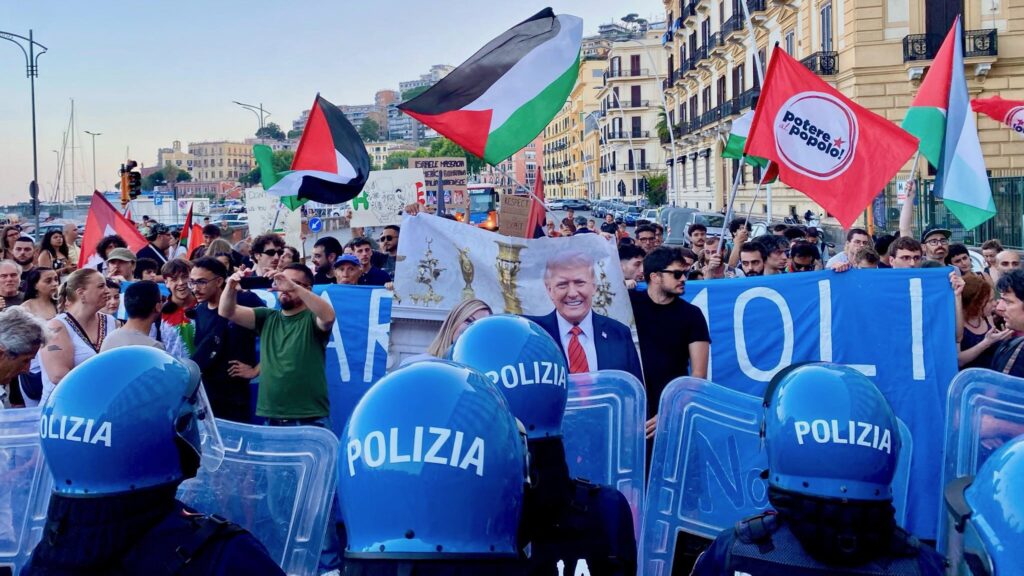
Thousands of protesters also blocked the main train station in Naples.

Source: Potere al Popolo via X (@potere_alpopolo)

Drop Site (@dropsitenews.com) 2025-09-22T18:06:50.797Z

In the Adriatic seaside resort of Termoli, hundreds of student-led Palestine defenders rallied in St. Anthony’s Square and, with Mayor Nicola Balice’s permission, draped a Palestinian flag from the façade of City Hall.

“Faced with such an important subject, the genocide in Palestine, we students… said this would be a nonpartisan demonstration because in the face of what is happening in the Gaza Strip—hospitals bombed, children killed every day—there can be no political ideology,” said one Termoli protester. “We must all be united.”

Some participants in Monday’s general strike pointed the finger at their own government.

“In the face of what is happening in Gaza you have to decide where you are,” Italian General Confederation of Labor leader Maurizio Landini told La Stampa. “If you don’t tell the Israeli government that you have to stop and don’t send them more weapons, but instead you keep sending them… you actually become complicit in what’s happening.”

While European nations including Ireland, Norway, Spain, Slovenia, the United Kingdom, Portugal, France, Luxembourg, and Denmark have formally recognized Palestine or announced their intent to do so since October 2023, Italy has given no indication that it will follow suit. More than 150 of 193 United Nations member states have recognized Palestine.

Although increasingly critical of Israel’s 718-day genocidal assault—which has left at least 241,000 Palestinians dead, wounded, or missing in Gaza—right-wing Italian Prime Minister Giorgia Meloni has been accused of complicity in genocide for actions including presiding over arms sales to the government of Israeli Prime Minister Benjamin Netanyahu, who is wanted by the International Criminal Court for alleged war crimes and crimes against humanity. Meloni has rejected the ICC warrants and said Netanyahu would not be arrested if he enters Italy.

“Meloni should listen to the voice of those who are peacefully protesting and asking her to act, rather than curling up to Washington to protect her friend, the war criminal Netanyahu,” Giuseppe Conte, who leads the independent progressive Five Star Movement, said Monday on social media. “Meloni should take a stand with the facts against those who have slaughtered 20,000 children, rather than limiting herself to saying, ‘I do not agree.’ And she should stop running away from the debate in Parliament.”

Original article by Brett Wilkins republished from Common Dreams under Creative Commons (CC BY-NC-ND 3.0). 

Continue ReadingItaly’s Unions Lead General Strike for Gaza

Italian left party demands answers over police infiltration scandal

Spread the love

Original article by Ana Vračar republished from peoples dispatch under a Creative Commons Attribution-ShareAlike 4.0 (CC BY-SA) license.

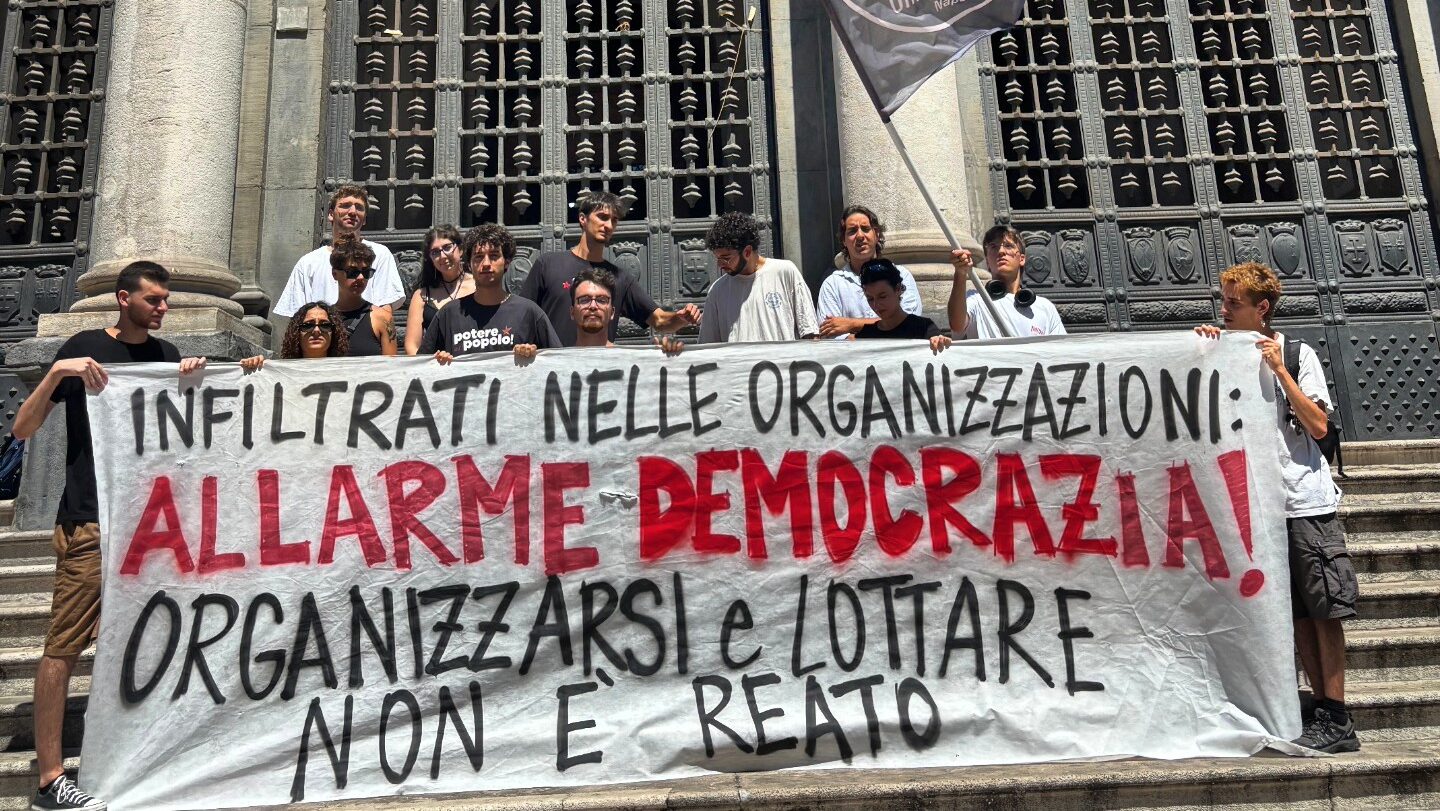
Activists protesting against police infiltrations in Italy. Source: Cambiare Rotta/Facebook

Potere al Popolo is pressing the Meloni government to explain five police infiltration attempts targeting the party’s youth organizations.

Italian left party Potere al Popolo! (Power to the People!) continues to demand full government transparency following revelations that multiple police agents infiltrated the party’s youth groups, Collettivo Autorganizzato Universitario (Self-Organized University Collectives, CAU) and Cambiare Rotta (Changing Course). For approximately eight months, undercover police officers infiltrated or attempted to infiltrate chapters in Naples, Milan, Bologna, and Rome, only to be uncovered through by the party’s internal investigation and independent media outlet Fanpage.

Speaking to Peoples Dispatch, Giuliano Granato, one of Potere al Popolo’s spokespeople, stated that the party is exploring all potential avenues for action, emphasizing that it will not wait passively in the meantime. A key priority is compelling the relevant institutions, including Prime Minister Giorgia Meloni and Interior Minister Matteo Piantedosi, to publicly explain what happened. “They owe the public some answers,” Granato says. “Who ordered this operation? Who planned it? And on what grounds?”

Read more: Italian left party uncovers more cases of police infiltration in their ranks

Meloni’s government and institutions, however, are not known for responding transparently to uncomfortable questions. This became evident again after the first case was exposed in May, when official statements ranged from evasive to outright absurd. One explanation offered, Granato recalls, was that the officer who infiltrated the youth group in Naples had done so not as part of an official assignment, but rather because he had “fallen in love with a Potere al Popolo activist.”

“Are we now supposed to believe five officers from the same training course all suddenly fell in love with five of our activists at the same time?”

Another line of defense claimed that while the infiltrations were official operations, they did not target Potere al Popolo as a political party, but only the specific youth collectives. Yet, even if one was to accept the dubious legitimacy of undercover operations in youth organizations on campuses, that explanation raises new questions. As Granato notes, there are many youth collectives across Italy active on similar issues, including Palestine solidarity and housing. “And yet, the only ones where infiltrators were discovered are the ones organically tied to Potere al Popolo.”

A state increasingly intolerant of dissent

Granato also stresses the importance of keeping public attention on the issue. Since the revelations in May, Potere al Popolo! has received solidarity from grassroots networks and trade unions, civil society organizations, and even a few opposition parties that submitted formal inquiries to the government. “In contrast to this, there has been no media uptake of the case,” Granato said. “Apart from Fanpage, only Il Fatto Quotidiano and il manifesto covered it. The rest of the mainstream media landscape? Radio silence. All the big self-declared progressive media ignored it.”

“This is a very grave thing,” he continues, “because these are the same center-left media that now and then raise concerns about Meloni’s authoritarian drift.” By choosing not to cover the infiltrations in Potere al Popolo, Granato suggests, they show that they will only raise issues when it benefits them, ignoring the public interest when it doesn’t.

The tendency is particularly worrying in the current context, Granato says, considering the infiltration of Potere al Popolo is not an isolated case but part of a broader trend. He points to connections to other recent cases, such as the surveillance of Fanpage journalists and of activists from Mediterranea Saving Humans, who have challenged the government’s deadly migration policies through their work. He also mentions the government’s so-called security decree and an ongoing campaign against the right to strike. “If we connect all these little dots, what emerges is a picture of a government and institutions that are less and less tolerant of dissent,” Granato explains.

Read more: “Disarmiamoli!” brings 30,000 to Rome against NATO and war

Yet it is not individual dissent they are afraid of. Instead, what state authorities and institutions fear is collective dissent that organizes people and gives them the tools to change the status quo, Granato says. This fear is one of the reasons why they would want to infiltrate Potere al Popolo, as they recognize it as a political force capable of posing a real threat to the structures they want to protect.

One way to resist this tendency, Granato concludes, is to remain persistent in showing solidarity, including to those who have been infiltrated by the police. “Publicly showing solidarity means publicly showing there’s still a democratic fabric that hasn’t been destroyed, both in Italy and beyond.”

Original article by Ana Vračar republished from peoples dispatch under a Creative Commons Attribution-ShareAlike 4.0 (CC BY-SA) license.

Continue ReadingItalian left party demands answers over police infiltration scandal

Italian left party uncovers more cases of police infiltration in their ranks

Spread the love

Original article by Ana Vračar republished from peoples dispatch under a Creative Commons Attribution-ShareAlike 4.0 (CC BY-SA) license.

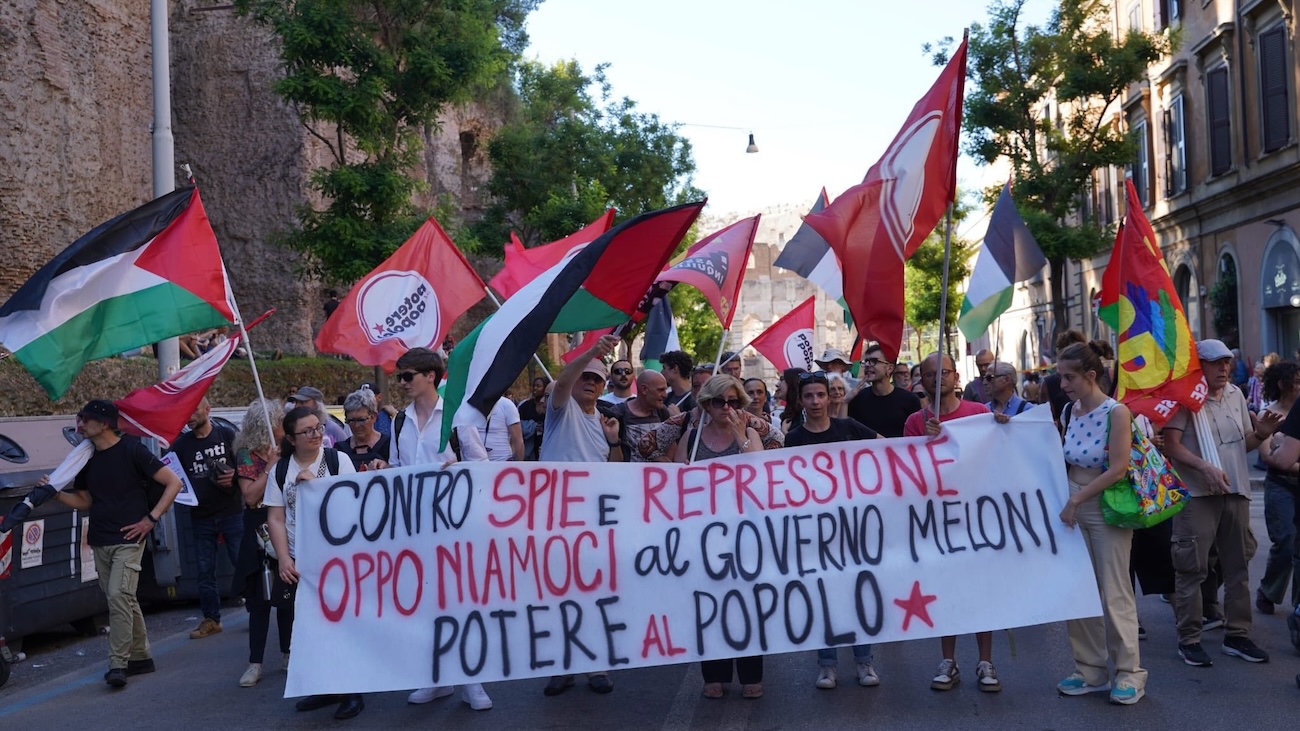
Potere al Popolo activists with banner reading: “Against spies and repression. Let’s stand up to the Meloni government”. Photo: Potere al Popolo

Following the exposure of an undercover operation in its Naples chapter, Potere al Popolo has reported additional cases of police spying in other Italian cities.

After discovering that a young police officer had infiltrated Potere al Popolo (Power to the People) in Naples at the end of May, the party, together with media outlet Fanpage, uncovered four similar cases in Milan, Bologna, and Rome. The officers approached the organization primarily through one of its youth collectives, Cambiare Rotta (Changing Course), between October and November 2024, shortly after graduating from the same police course and just before being assigned to the Central Police Directorate for Crime Prevention, an agency dedicated to investigating terrorism.

Read more: Police targets Potere al Popolo in undercover operation

During this period, the officers actively participated in demonstrations against the cost of living crisis, in solidarity with Palestine, and in anti-militarization actions. They often presented themselves as out-of-town students with few connections at local universities. Their involvement went deep: some supported election campaigns for official student bodies. At the same time, other activists noticed inconsistencies – none of the identified officers engaged in activities beyond political work, for example, an unusual pattern in youth organizing.

While the infiltration operations in Naples, Milan, and Bologna lasted about eight months, the effort in Rome was short-lived. Activists there quickly grew suspicious of the officer’s background story and the way he tried to approach the organization.

Italian left party uncovers more cases of police infiltration in their ranks
Protestors take the streets to demonstrate against rearmament and NATO. Photo: Potere al Popolo

By late June, all those identified had ceased contact with Potere al Popolo, but one officer was present at a demonstration in Bologna when news of the Naples infiltration broke publicly last month. “The moment there was a public denunciation in that demonstration in Bologna, about the Naples episode, this person disappeared from one day to the next,” said Giuliano Granato of Potere al Popolo. “We haven’t heard from him since.”

A threat to democratic rights and structures

Back in May, the party had denounced the Naples case as a disturbing sign of the government’s authoritarian drift, undermining the democratic character of Italian society and constitutional values. That warning has since prompted several parliamentary parties to demand explanations from Prime Minister Giorgia Meloni’s government – none of which have been provided. With these new revelations, alongside confirmed instances of journalists being spied on, concerns are mounting over the administration’s trajectory.

“It shows us the path of repression this government is taking through, and I quote Giorgia Meloni’s own words, ‘regime methods’,” said Anita Palermo of Potere al Popolo Rome. “We appeal to social and democratic forces, associations, and citizens to mobilize so that political activity in this country can take place in a democratic way, without fear of police infiltration.”

During a press conference on June 27, Granato added that the infiltration and surveillance of political parties, humanitarian organizations working with migrants, and journalists were indicative of the government’s own fear. The fact that they are prepared to launch such operations shows that the government is terrified of dissent, he said.

“But dissent is the salt of democracy,” Granato added, insisting that the experience of Potere al Popolo has far broader relevance. “If the state can plant an undercover officer inside a political party, it can do the same to a union or a newsroom.”

Read more: “Disarmiamoli!” brings 30,000 to Rome against NATO and war

Trade unions and social collectives have condemned the police operations as a clear attack on political and civil rights. Many interpret it as part of the Meloni government’s increasingly repressive stance toward political opposition. This comes at a moment when Potere al Popolo, alongside grassroots unions, is leading a national campaign against war, NATO, and the European Union’s rearmament agenda.

According to the Unione Sindacale di Base (USB), the attack on Potere al Popolo and its affiliated groups is emblematic of the broader political climate. “It’s a snapshot of the cultural and political values of a class that has openly aligned itself with war and rearmament,” the union said.

“And in a climate of war, the first targets are those who oppose it clearly and unequivocally, voices that must be preemptively silenced even when they act with full transparency,” the USB warned. “The ‘war system’ and all its economic and social ramifications … allows no dissent because it demands we all silently enlist in its cause. And that cause crushes democracy, packing away our freedoms in the attic.”

Original article by Ana Vračar republished from peoples dispatch under a Creative Commons Attribution-ShareAlike 4.0 (CC BY-SA) license.

Continue ReadingItalian left party uncovers more cases of police infiltration in their ranks

Naples protests G7 “lords of war”healthcare

Spread the love

Original article by Ana Vračar republished from peoples dispatch under a Creative Commons Attribution-ShareAlike 4.0 (CC BY-SA) license.

Source: Ex OPG occupato – Je so’ pazzo/Facebook

Over 2,000 people took to the streets of Naples against soaring military spending in Europe and increased repression of dissent as G7 defense ministers convened for high-level talks

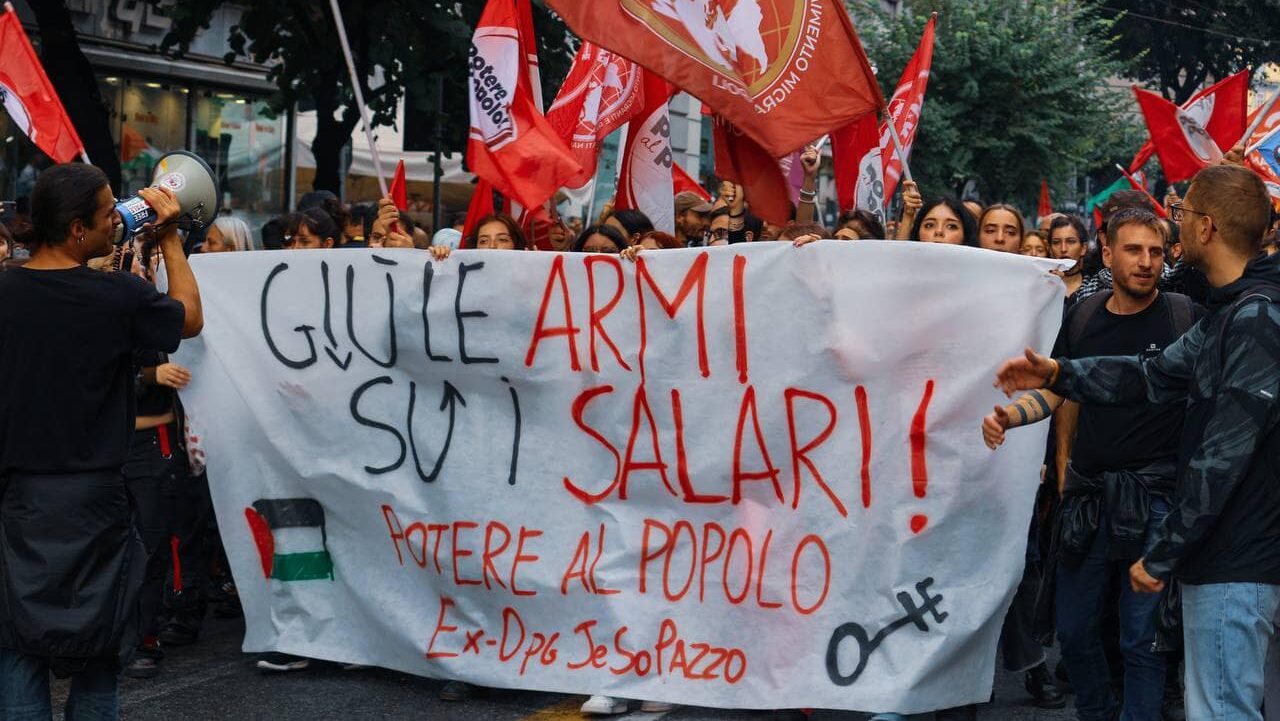
Thousands of people took to the streets of Naples on October 19, demonstrating against the G7 military agenda and Italy’s proposed reforms that would limit the freedom to dissent. Protesters, representing a host of organizations including student associations, trade unions, and community centers, rallied against Prime Minister Giorgia Meloni’s government’s policies, demanding a shift in priorities toward social needs instead of military spending. Side by side with the protest in Naples, demonstrations were held in dozens of cities across Italy, as reported by the left political party, Power to the People (Potere al Popolo).

Protesters carrying a banner reading “Cut the weapons, raise the wages!”. Source: Ex OPG occupato – Je so’ pazzo/Facebook

The protest was organized to counter a G7 defense ministers’ meeting that took place in Naples from October 18 to 20, with a focus on global military goals. The meeting was seen by protesters as yet another example of Western countries deepening their involvement in wars, including the ongoing genocide in Gaza and the war in Ukraine, instead of pursuing agendas of social justice and peace. In the lead-up to the meeting, local activists voiced their opposition, stating that “lords of war” were not welcome in their city.

“Never has so much been spent on war, and as a result, war is rampant everywhere,” the associations organizing the march asserted during the preparations. “We refuse to host a meeting in our city that supports the war economy our government has chosen to follow.”

Two central issues dominated the protest in Naples: the West’s support for Israel as it continues to exterminate the people of Gaza and the increasing repression of dissent at home, embodied in Meloni’s proposed security bill. Many protesters pointed out the link between military aggression abroad and domestic policies that seek to criminalize dissent. European countries continue to actively repress solidarity with Palestine and others, like Italy, are doing so while attempting to silence voices against their policies.

Read more: Pro-Palestine activists are under attack in Europe

The new security bill seeks to impose severe restrictions on protests, including strikes and environmental activism. Progressive associations argue that this is a blatant attempt to stifle opposition and consolidate power, and some of them saw Saturday’s protest as a test run for the government’s strategy of suppressing future mobilizations. Days before the protest, authorities tried to restrict the march route, forcing organizers to end the demonstration a kilometer away from the G7 meeting site.

Despite these attempts, protesters refused to be stopped. They briefly broke through the set course of the rally, marching in areas originally declared off-limits by the authorities. In response, police deployed tear gas and used other forms of violence against them. Naples’ historic center has systematically been blocked off to popular protests, and things are set to get worse if the new bill is passed, protesters said. Because of that, community groups including Ex OPG – Je so’ pazzo called upon people to continue resisting.

“We believe this repressive project must be stopped, and more importantly, we see it as a reflection of the Meloni government’s fear of what might still be burning beneath the surface of the seeming calm in the country,” they said.

Read more: Meloni government targets dissent with a new security bill

Saturday’s protest marked an important moment of resistance against the shrinking of democratic space in Italy, as well as to the strengthening of the armament agenda in Europe. Demonstrators announced they were ready to continue fighting against the security bill and expressed determination to challenge Meloni’s government over announced cuts to social support.

“Today, this square is sending a loud message: if the government thinks it can ignore social needs, public healthcare, workers’ rights, and housing in favor of pouring billions into military spending, it’s headed in the wrong direction,” said Chiara Capretti from Power to the People.

Original article by Ana Vračar republished from peoples dispatch under a Creative Commons Attribution-ShareAlike 4.0 (CC BY-SA) license.

Continue ReadingNaples protests G7 “lords of war”healthcare

Julian Assange to be made honorary citizen of Rome

Spread the love
Julian Assange speaks at London's Ecuadorian Embassy
Julian Assange speaks at London’s Ecuadorian Embassy

https://www.reuters.com/world/europe/julian-assange-be-made-honorary-citizen-rome-2023-10-19/?rpc=401&

ROME, Oct 19 (Reuters) – Jailed WikiLeaks founder Julian Assange will become an honorary citizen of Rome by early next year following a vote this week by its local assembly, the city’s former mayor Virginia Raggi said on Thursday.

Assange, 52, has been in London’s high-security Belmarsh prison since 2019 and is wanted in the United States over the release of confidential U.S. military records and diplomatic cables in 2010.

Other Italian cities have taken similar steps. The northern city of Reggio Emilia granted Assange citizenship last month, while Naples is set to follow shortly.

If extradited to the United States, Assange risks a sentence of up to 175 years in a maximum-security prison.

https://www.reuters.com/world/europe/julian-assange-be-made-honorary-citizen-rome-2023-10-19/?rpc=401&

Continue ReadingJulian Assange to be made honorary citizen of Rome