Military personnel take part in a military parade to commemorate the 80th anniversary of Japan’s World War II surrender held in front of Tiananmen Gate in Beijing, Wednesday, Sept. 3, 2025
CHINA’S parade marking 80 years since victory over Japan has prompted alarmist coverage in Western media.
The sight of Xi Jinping, Russia’s Vladimir Putin and North Korea’s Kim Jong Un together has led to panicky talk of an “axis of upheaval” aimed at toppling the so-called “rules-based order” — with pundits’ dismay increased by the Shanghai Co-operation Organisation summit just before, where Indian Prime Minister Narendra Modi appeared alongside Putin and Xi.
Their anxieties were stated with typical bluntness by US President Donald Trump, who asked Xi to “give my regards to Vladimir Putin and Kim Jong Un, as you conspire against the United States of America.”
…
China has not been at war since the 1970s — whereas the US has hardly been at peace since then, and since the late 1990s Britain has joined it in attacking Yugoslavia, Afghanistan, Iraq and Libya, wars of aggression that expose the West’s “rules-based order” as a sham.
If China is strengthening its armed forces, maybe that’s because a US general predicted two years ago that his country would be at war with China by now. Even so, it spends far less per head on the military (1.7 per cent of GDP) than any Nato state and less than a third of what the US spends. The US’s Nato alliance accounts for 75 per cent of worldwide military spending.
As for its nuclear arsenal, China is the only UN security council member with a no-first-strike policy and the only one to store warheads and delivery systems separately to prevent accidental or knee-jerk launches.
So we should not fall for talk of a need to rearm against an “axis of upheaval” — as if the long trail of destabilisation and destruction left by Nato wars does not suggest that cap better fits the Western alliance.
We should recognise that the threat to peace comes first and foremost from our own governments — and their determination to prevent the rise of a multipolar world, which all on the left should welcome.
Donald Trump urges you to be a Climate Science denier like him. He says that he makes millions and millions for destroying the planet, Burn, Baby, Burn and Flood, Baby, Flood.Elon Musk urges you to be a Fascist like him, says that you can ignore facts and reality then.
The strike was called by the trade unions and farmers groups against anti-workers labor codes and failures of the government to enact a legal support price for farm products.July 09, 2025 by Abdul Rahman
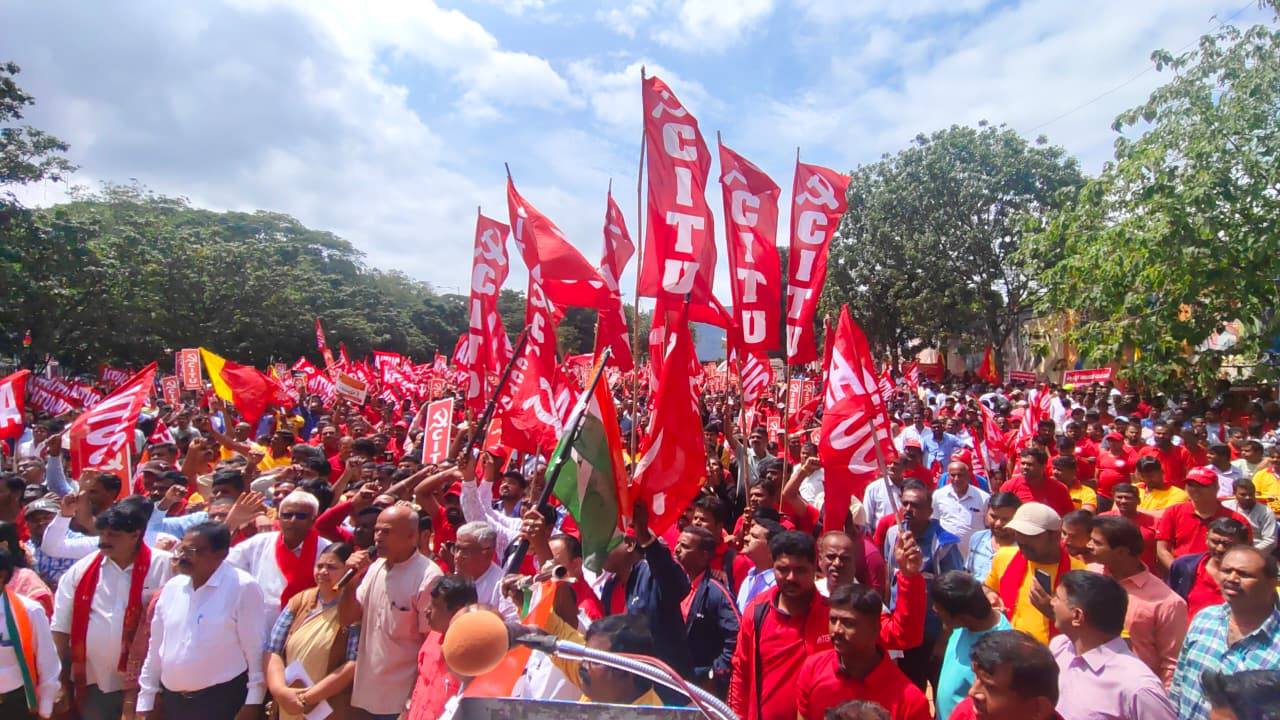
National strike against the “anti-worker” labor codes of the Modi government on July 9. Photo: CPI(M)
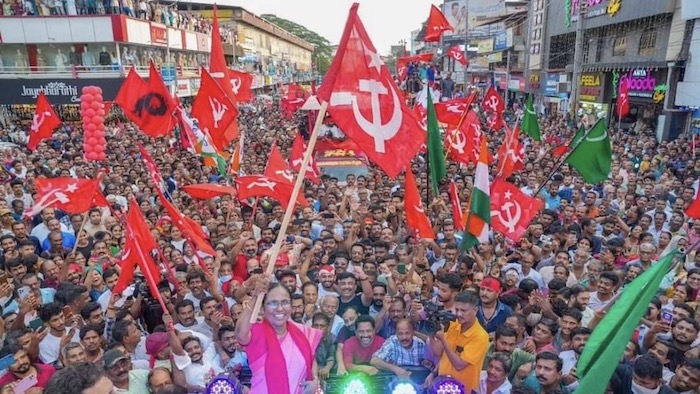
Millions took to the streets all over India on Wednesday, July 9, to observe a national strike call made by Central Trade Unions (CTU). They are striking against the anti-worker policies adopted by the ultra-right-wing government in the country.
CTU is a platform of all the major trade union federations in the country, spanning the ideological and political spectrum. It includes the Center for Indian Trade Unions (CITU), the All India Trade Union Congress (AITUC), the Indian National Trade Union Congress (INTUC) and several others.
The strike was also supported by all the major groups of farmers, students, women, and various professional unions such as teachers, journalists, and IT employees in the country.
According to various estimates, more than 250 million workers and farmers – both in organized and unorganized sectors – directly participated in the strike and protests across the country.
Workers in other organized sectors such as ports, airports, and banking also participated alongside those in various public sectors.
The strike affected most of the industrial activities in the country, particularly industries related to mining.
In several places, workers blocked the movement of trains, blocked highways, and picketed factory gates to mobilize greater support. In some cases, such as the Kochi refinery in the southern state of Kerala, workers defied court orders and observed the strike.
A total shut down of all major business was observed in various states in the country such as Kerala, Tripura, Bihar, Jharkhand, and others.
Anti-worker labor codes must be withdrawn
The workers were demanding immediate withdrawal of the new labor codes enacted by the ultra-right-wing government led by Narendra Modi at the center in 2020. CTU claims the four new labor codes are anti-worker, depriving them of their basic rights, including the right to collective bargaining, which was won through a historic and painful worker’s struggle.
The other major demands include:
The end of the privatization and contractualization of jobs
A national minimum wage of Rs. 26,000 (USD 303)
Improvements in working conditions across all sectors for all kinds of workers
The strike also supported the demands raised by the country’s major farmers groups, led by the Samyukta Kisan Morcha (SKM), for a legal minimum support price for all farm produce, the waiving of loans for farmers, an end to all forced land acquisition, and better employment opportunities.
The strike was originally scheduled for May 19. It had to be postponed following the war-like situation in the region created after India attacked several locations inside neighboring Pakistan, accusing it of supporting armed groups who carried out attacks on tourists in Pahalgam.
Popular action defeats government lies
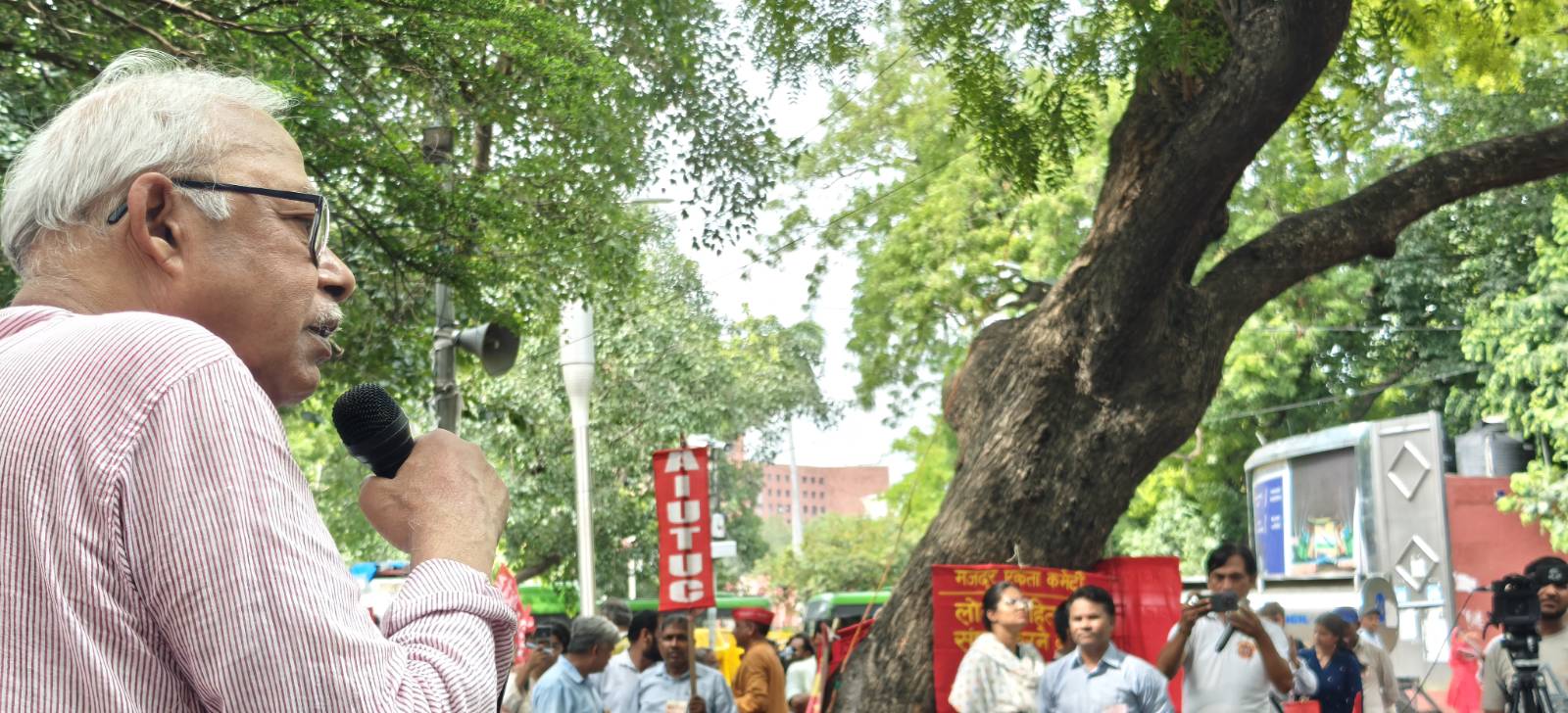
A central protest rally was held in the national capital Delhi. The protest was attended by all the constituents of CTU and SKM, the farmers collective which has extended support to the strike.
CPI(M) Politburo Member and CITU General Secretary Tapan Sen addresses a strike demonstration in Jantar Mantar, New Delhi. Photo: CPI (M)
Addressing the rally, Tapan Sen, general secretary of CITU and a member of the Communist Party of India (Marxist) polit bureau, claimed that the success of the strike demolishes the myths created by the Modi government about the so-called economic prosperity his government’s policies have created.
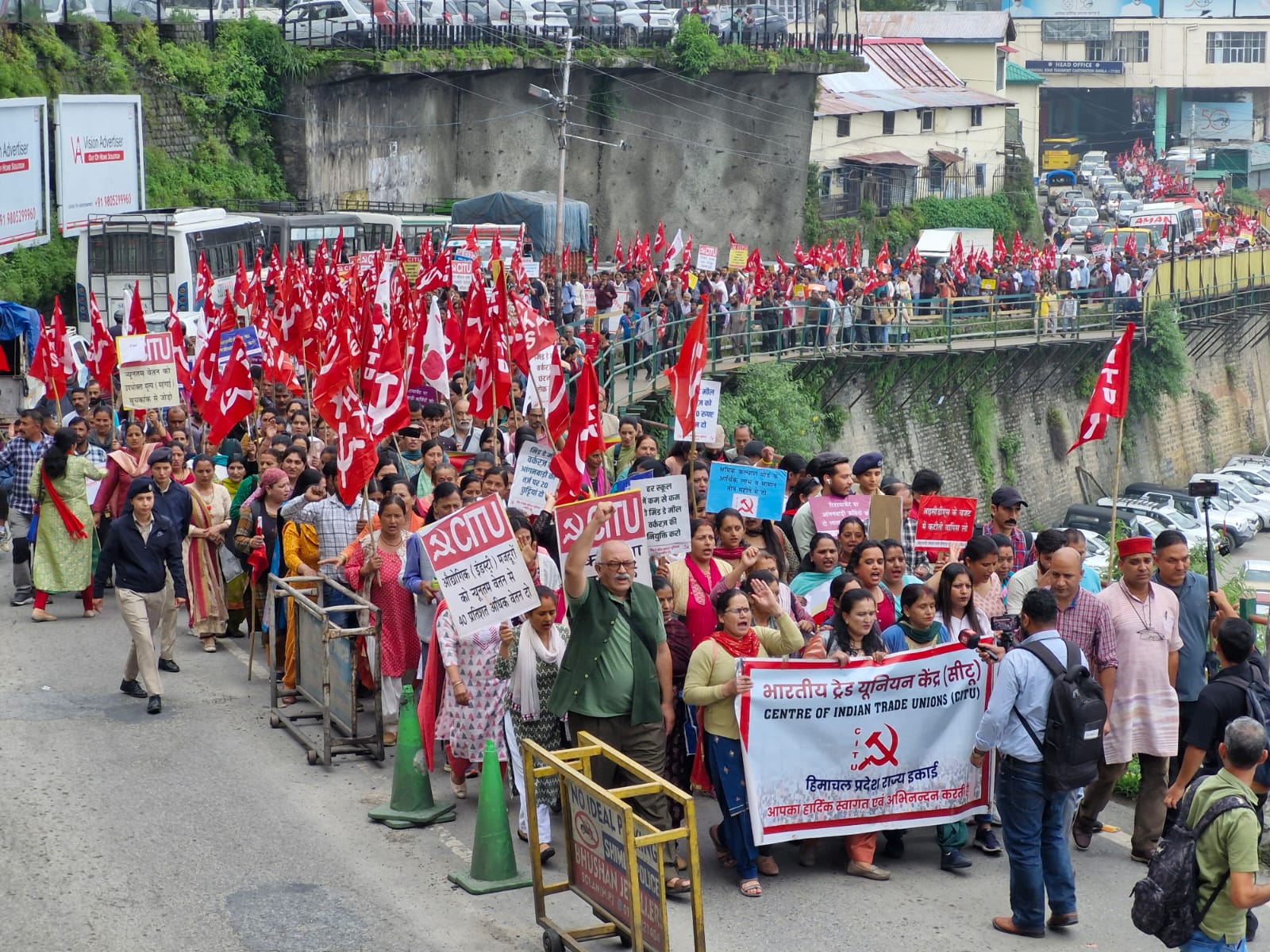
Strike demonstration in Shimla, Himachal Pradesh. Photo: CPI (M)
Most Indians today are struggling to find a decent source of livelihood and those who have one are struggling to protect it from the effects of the various wrongful and pro-corporate policies of the Bharatiya Janata Party (BJP)-led government, Sen underlined.
The lies about India being the third or fourth largest economy in the world, propagated by the present government in the country and magnified by the complicit media, have been exposed by the sheer number of people who participated in today’s strike. It establishes the fact that under Modi’s decade-long rule the condition of the working classes in India has gone from bad to worse, Sen told the protesters gathered at the rally.
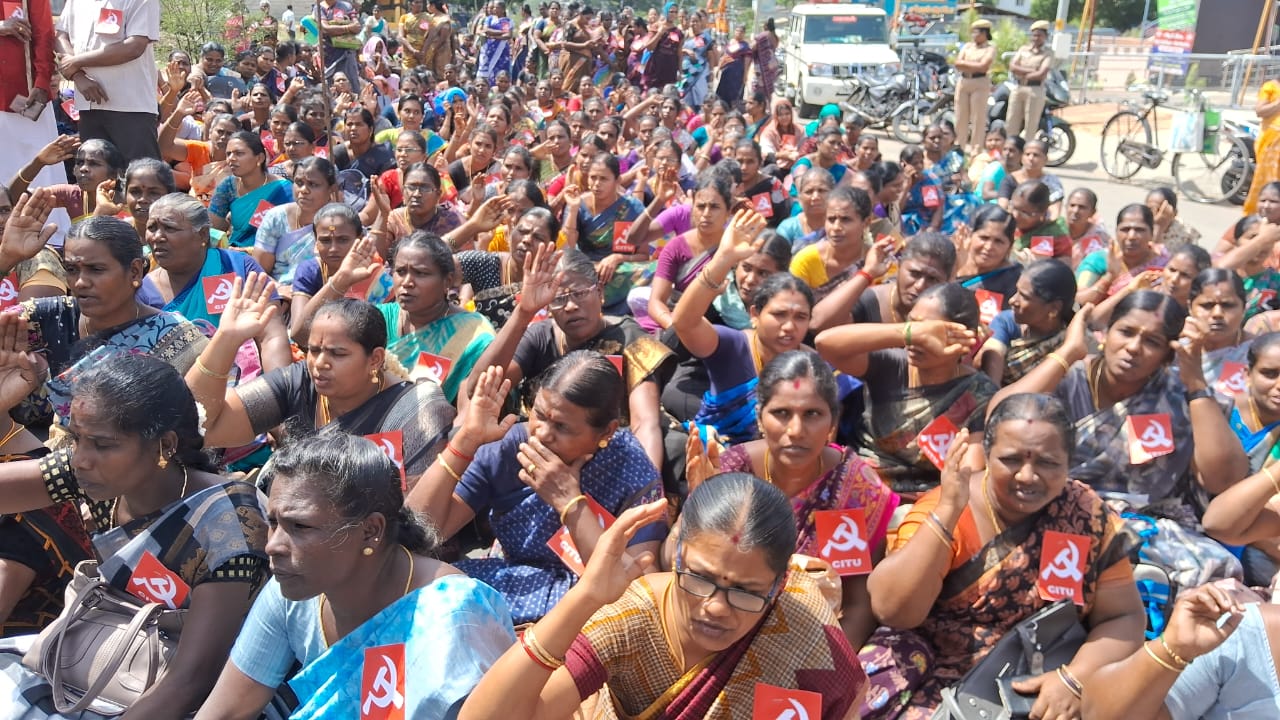
Photo: CPI(M)
Sen also warned the government against going ahead with the proposed trade deal with the US, claiming that would further compromise the interest of workers and farmers in India.
Amarjeet Kaur, general secretary of the AITUC, claimed that the BJP used pro-government unions to divide the working classes in the country and falsely called the strike “illegal”.
“The attempts to divide the working class, so that the interest of its corporate bosses are protected, was defeated by the successful strike” Kaur declared. She noted that this was the fourth such strike since 2020 and more such strikes will happen in the future, with more intensity, if the government fails to correct its ways and take back the four draconian labor codes, and enact laws which really benefit the working classes of this country.
Indian Prime Minister Narendra Modi may still be popular after a decade in power but his government’s failures to address basic livelihood issues for the majority of the people may give an advantage to the opposition.
India, the world’s most populous nation, is in the middle of its 18th national elections. Two of the eight phases are already over, sealing the fate of over one third of representatives. However, the fight is still on for the majority of the seats. The incumbent Narendra Modi-led right-wing government, seeking a third straight term, is facing an upbeat center and left alliance led by Congress.
This national election for India’s lower house of the parliament, called the Lok Sabha (the house of the people), is stretched between April 19 and June 1 and takes place in eight phases. The votes will be counted on June 4 and results will be declared on the same day.
India is a parliamentary democracy with the first past the poll system. It is divided into 543 constituencies for the national elections with each constituency electing a single member for the Lok Sabha each. The party or alliance which wins the majority of seats (272) in the Lok Sabha elects the prime minister and forms the central government.
Though India has a multiparty system, most of the parties this time are aligned with the two major pre-poll alliances seeking popular mandate. The ruling Bharatiya Janata Party (BJP) led right-wing National Democratic Alliance (NDA) and the Congress-led, center-left opposition, Indian National Developmental Inclusive Alliance (I.N.D.I.A.) or just INDIA.
All the major left parties are part of the INDIA alliance and are contesting a large number of seats in states of Kerala, West Bengal, Tamil Nadu, Bihar and elsewhere with an objective to increase the presence of the left in the Indian parliament.
Along with the national election, three states/provinces, Odisha, Andhra Pradesh in the country’s south-east, and Sikkim in the north-east, will also elect members of their respective state assemblies.
Key issues
Unlike the last national elections in India when Prime Minister Narendra Modi was able to use the popular polarization of votes around the issue of nationalism and national security, the present elections are largely being fought on the issue of his government’s failure on all major fronts affecting the majority of the population, principally economic issues such as price rises and unemployment.
Indians are facing an unprecedented rise in the prices of all major essential commodities which has, in the absence of corresponding rise in the income, created a major crisis of living for the majority of the households in the country but particularly among the urban poor. India has seen an unprecedented decline in its standing on the annual global hunger index despite being one of the major food producers in the world and world’s fastest growing economy.
The rising inequality and the growing perception of the Modi government being pro-big capital and allegations of cronyism have also become a major poll issue. Opposition parties have pointed out that while select corporate houses in the country have risen and made tremendous profits, it is at the cost of most of the small and medium sized enterprises in the country as well as public sector entities.
The International Labor Organization (ILO) report on rising unemployment among educated youth in India has also attracted the attention of major opposition parties and become a major poll issue.
Apart from the major economic issues, the opposition has raised the issue of alleged threats to democracy under the BJP rule. They have accused BJP of trying to suppress the voices of dissent by misusing the central law enforcement agencies. Several opposition leaders such as sitting chief minister of Delhi, Arvind Kejriwal, and former chief minister of Jharkhand, Hemant Soren, were arrested in allegedly trumped up corruption charges. BJP has also been accused of intimidating opposition leaders to switch sides using the threats of persecution or by offering them money.
BJP and NDA have rejected most of the claims made by the opposition and instead accused INDIA alliance partners of being corrupt. The right-wing alliance has also declared that the INDIA alliance and particularly Congress is against the interest of the majority community in the country. It has sought the third term by also claiming it has been able to keep the Indian economy afloat amidst the challenges of COVID-19 and global recession.
Uncertain predictions
In the last elections in May 2019, the BJP-led NDA won 353 seats. BJP alone scored over 37% of votes and over 300 seats. It now seeks an over two-third majority in the ongoing elections with a slogan of “abki baar, 400 paar” (More than 400 seats in this election). While most of the pre-poll surveys predict a comfortable win for the NDA, the opposition has rejected those surveyed as compromised and claimed that the NDA will not get a majority.
There are over 970 million eligible voters in the country of over 1.4 billion according to the Election Commission of India (ECI). A significant number of them are first time voters who are facing the challenges of unemployment and price increases, and the opposition is hoping they will vote for their agenda which promises more jobs and increased social spending.
The left and other constituents of the INDIA alliance also believe that the most important factor in the revival of the opposition’s fate would be the farmers and workers who have faced complete neglect during the BJP rule in the last decade and even faced state repression during the months-long farmers’ agitation at Delhi’s borders and during the COVID-19 lockdowns.
The opposition also believes that there is growing disenchantment among Dalits and other marginalized sections of the Indian society from the Narendra Modi government as there is a growing threat to affirmative action and social justice policy measures enshrined in the Indian constitution due to BJP’s aggressive pro-corporate and pro-market orientation.
Will the BJP-led NDA fall under the weight of its own contradictions as the center-left alliance predicts, or will the BJP’s pro-corporate politics prevail? On June 4, the world will find out.

 Military personnel take part in a military parade to commemorate the 80th anniversary of Japan’s World War II surrender held in front of Tiananmen Gate in Beijing, Wednesday, Sept. 3, 2025