In visit to Tel Aviv, Milei affirms support to Israel and declares Marx was “satanic”

Spread the love

Article by Pablo Meriguet republished from peoples dispatch under a Creative Commons Attribution-ShareAlike 4.0 (CC BY-SA) license.
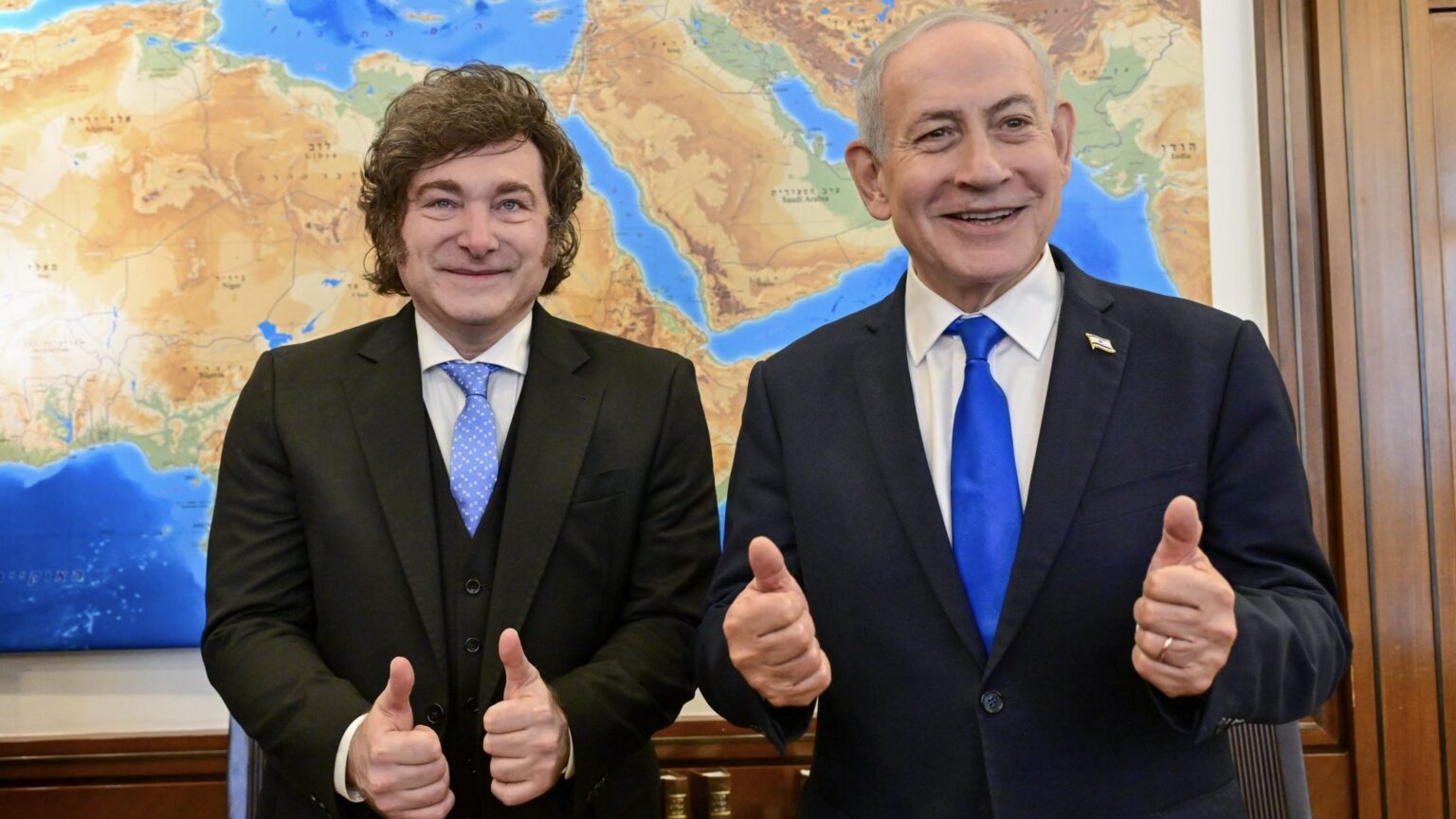
Argentine President Javier Milei and Israeli PM Benjamin Netanyahu. Photo: Netanyahu / X

On his third trip to Israel, Milei signed security agreements, sang, and gave speeches accusing Marx of being satanic. Taken together, his activities in West Asia amount to more than just an official visit.

Argentine President Javier Milei made a three-day visit to Israel to mark Independence Day. During his trip, Israeli President Isaac Herzog awarded Milei in Jerusalem with the highest honor his country bestows on a civilian: the Presidential Medal of Honor.

“Your message crossed borders and resonated across generations: a message of morality, of humanity, of aligning one’s moral compass, of recognizing the depth of pain, and of offering comfort,” Herzog told Milei.

Such an “honor” comes as no surprise. Milei has not only publicly expressed his support for Israel in its regional and global conflicts, but has likely become Israel’s most important Western ally after the United States.

The Isaac Agreements

During his recent visit, Milei signed the so-called “Isaac Agreements” alongside his counterpart, Benjamin Netanyahu, which outline a set of bilateral commitments in the areas of security (including intelligence cooperation), diplomacy, trade, culture, and even education.

The multidimensional agreement also includes a section on technological cooperation, which covers collaboration on artificial intelligence, model development, and the training of specialists. A common stance was also agreed upon for international forums, as well as the promotion of a neoliberal policy of economic openness.

According to Milei, the Isaac Agreements, inspired by the Abraham Agreements (signed in 2020 by Israel and several Arab countries), seek to “unite efforts in the fight against terrorism, anti-Semitism, and drug trafficking, with an open invitation to all nations that share these values and wish to join.”

During his visit, Milei also demonstrated his support for Tel Aviv amid the war against Iran by designating Iran’s Islamic Revolutionary Guard Corps and the Quds Force as terrorist organizations. These measures come on top of those already taken, such as his expulsion on April 2 of Iran’s top diplomat, Mohsen Soltani Tehrani, from Argentina.

In addition, Milei has promised to open a direct air route between the two nations, which, he said, he hopes will promote closer relations between them: “Starting in November, the first-ever direct air route between Buenos Aires and Tel Aviv will begin operating, and our nations will be closer than ever, deepening an unbreakable bond between two countries that were there for one another when fate demanded it.”

From singer to speaker

Milei also drew attention at the official ceremony marking Israel’s 78th Independence Day when, in front of the nation’s top officials, he sang Nino Bravo’s song “Libre” alongside several other artists.

In addition, Milei lit one of the 12 torches representing the 12 tribes of Israel. There, Milei reaffirmed his intention to move the Argentine embassy in Israel from Tel Aviv to Jerusalem, something Argentine diplomacy has historically resisted, despite Israel’s requests.

While asserting that “Argentina and Israel are not only partners, but friendly nations,” Milei, in a clearly theological and mystical tone, stated that the Maccabees taught him the importance of God’s favor: “From them we learned that victory on the battlefield does not come from the number of soldiers, but from the forces that come from heaven,” the president stated, adding categorically: “Light always triumphs over darkness.” This quote has been interpreted as a reference to the current war in which Israel is engaged.

It appears that the Argentine president’s newfound interest in religious matters continued during his trip. Bar-Ilan University awarded him an honorary doctorate. In his keynote address, Milei went so far as to claim that Marxism is a “satanic theory” opposed to “Judeo-Christian values”. Amid applause, Milei claimed that Marx was a “Satanist”, a statement that has been strongly criticized by scholars worldwide, who have emphasized that Marx was an atheist, meaning that Milei’s claims (as someone who served as a professor before entering politics) lack any historical or intellectual rigor.

Finally, Milei visited the Western Wall, where he prayed before heading to Ben Gurion Airport to return to Argentina. Taken as a whole, Milei’s activities in Israel demonstrate not only a clear alignment with Israel’s foreign policy but also an attempt to ideologically justify, in every possible way he can (whether by singing or giving lectures), the supremacy of the geopolitical sector behind which he has positioned the Argentine executive branch.

This political spirit was likely expressed most clearly by the Argentine president himself:

“We will not be able to coexist with certain cultures,” a statement that has sparked controversial reactions in his country over what right-wing libertarian Javier Milei actually meant.

Article by Pablo Meriguet republished from peoples dispatch under a Creative Commons Attribution-ShareAlike 4.0 (CC BY-SA) license.

Keir Starmer explains that UK is actively supporting Israel's genocidal expansion and repeats his previous quotation that he supports Zionism "without qualification". Keir Starmer said “I said it loud and clear – and meant it – that I support Zionism without qualification.” here: https://www.jewishnews.co.uk/keir-starmer-interview-i-will-work-to-eradicate-antisemitism-from-day-one/
Keir Starmer explains that UK is actively supporting Israel’s genocidal expansion and repeats his previous quotation that he supports Zionism “without qualification”. Keir Starmer said “I said it loud and clear – and meant it – that I support Zionism without qualification.” here: https://www.jewishnews.co.uk/keir-starmer-interview-i-will-work-to-eradicate-antisemitism-from-day-one/

dizzy: Mad Neo-Liberal chainsawist Argentine President Javier ” Israel’s most important Western ally after the United States” Milei meets Benjamin Netanyahu -> Donald Trump ‘reviews’ UK claim to the Falkland Islands.

Continue ReadingIn visit to Tel Aviv, Milei affirms support to Israel and declares Marx was “satanic”

Keir Starmer’s Labour is a lost cause. But there’s still hope for the left

Spread the love

Original article by Paul Rogers republished from openDemocracy under a Creative Commons Attribution-NonCommercial 4.0 International licence.

Zack Polanski, Zarah Sultana and Jeremy Corbyn offer hope for the British left
 | Ben Montgomery/Stringer / Leon Neal/Staff / Kristian Buus/Contributor / Getty Images / Composition by James Battershill

In choosing big business over ordinary people, the PM has sacrificed the heart of the Labour Party. So what next?

Labour’s political position is increasingly the reverse of the ‘for the many, not the few’ policy pursued under former leader Jeremy Corbyn. The party has embraced corporate capture and the main features of neoliberalism, albeit with incredibly poor timing, as the neoliberal economic model drives runaway wealth that increases dissent across much of the world.

It is no coincidence that, at the same time, when it should be coasting along on a huge parliamentary majority won less than 18 months ago, Labour has been plunged into political disarray and seen its lead disappear in the polls.

By cosying up to big business and failing to offer anything to substantially improve the lives of ordinary people up and down the country, Keir Starmer’s New-New Labour has seen a collapse in its general support and, more significantly, its membership.

The Labour Party has lost 300,000 of the 550,000 members it had in the Corbyn era. While it has been able to recoup the financial support offered by these ordinary members from a few big donors, it has in the process lost the heart of the party.

Many issues demonstrate this, but a few stand out. The government’s repeated refusal (now rumoured to be U-turned on at next month’s Budget) to lift the two-child benefit cap. Its flagship welfare bill (already U-turned on), which would have cut Universal Credit and Personal Independence Payments for millions of vulnerable people. The decision, announced in February of this year, to cut the foreign aid programme to increase military spending.

And then came perhaps the biggest problem of all for Starmer’s Labour: Gaza, where the UK government’s continuing support for Israel as it engages in genocide still beggars belief for many. There have been 32 mass demonstrations in London in the past two years, the most recent being one of the largest protests ever held in the UK. That level of political activity will continue, given Israeli prime minister Binyamin Netanyahu seems determined to avoid a peaceful outcome, and Starmer is unlikely to stand up to him or, by extension, the US.

Widespread dismay and depression on the backbenches may ebb and flow, but at this point, it feels like even a change of leadership may not be enough for a real change in fortune.

The government’s current predicament is the main reason why Westminster politics is so uncertain. Looking at the UK-wide parties, the far-right Reform UK is leading polls with vote shares that vary but are typically over 30%, having soaked up plenty of support as a substantial protest vote. If that persists through to the next general election in 2029, it will likely put Nigel Farage into Downing Street.

Labour’s support, meanwhile, is hovering at around 20%, the Tories more like 15% and the Liberal Democrats rather less.

And until three months ago, the Greens were still weak in polling terms – despite having made some progress since last year’s election – and millions on the left were still disenfranchised, having been disillusioned with Starmer’s Labour leadership.

Two things have changed; the first being Zack Polanski winning the Green Party leadership at the start of September. He has brought a more radical and left-wing perspective to the party, which has led to a jump in the polls and an 80% increase in new members. The Greens announced this week that its membership now stands at 126,000 – more than either the Conservatives or the Lib Dems.

The second change is in the fortunes of the new Your Party group, fronted by Corbyn and former Labour MP Zarah Sultana. While the party’s initial request for expressions of interest received a massive 800,000 responses – at which point it appeared likely to provide a serious challenge to Starmer’s Labour – it ran into internal disagreements six weeks ago that knocked it right back and led to a period of utter dismay and anger among supporters.

Those feelings have eased somewhat over the past two weeks, as Your Party has published draft versions of its constitution, standing orders and an organisational strategy, all of which are to be discussed and developed before being decided at a large national conference in Liverpool at the end of November. The documents, including a draft political statement, are open to all and will no doubt be subject to intense debate and plenty of disagreement, but they do appear to be a genuine attempt at accountability that is a very long way from the opacity of the Labour Party.

A typical meeting of supporters, of which there are hundreds around the country, still sees some of the anger of a few weeks ago, but now also more determination to see things through. If the new party can recapture the mood of three months ago – and particularly if it and the Greens are willing to work with one another – then there may be some hope for the disenfranchised left.

One of the most interesting aspects of these rapid political changes is the potential for the three figureheads of these two parties to have a substantial impact.

Zarah Sultana, with an often combative style, appeals particularly to younger and frustrated audiences, while Zack Polanski’s normal and measured approach is persistently disarming for Reform’s far-right politicians. Then there is Jeremy Corbyn, who is already a national figure known for a long-term commitment to a progressive agenda and a remarkable personal following.

These are very early days in a time of rapid political change. Reform is still on the up, but compared with just three months ago, there is now a lot more reason for hope on the left.

Sign up to openDemocracy’s free Daily Email

Keir Starmer explains that he feels no shame or guilt benefitting personally from gifts from the rich and powerful while insisting on policies of severe austerity causing suffering and death.
Keir Starmer says that the Labour Party under his leadership all feel a small part of Scunthorpe.
Keir Starmer objects to criticism of the IDF. He asks how could anyone object to them starving people to death, forced marches like the Nazis did, bombing Gaza's hospitals and universities, mass-murdering journalists, healthworkers and starving people queuing for food, killing and raping prisoners and murdering children. He calls for people to stop obstructing his genocide for Israel.
Keir Starmer objects to criticism of the IDF. He asks how could anyone object to them starving people to death, forced marches like the Nazis did, bombing Gaza’s hospitals and universities, mass-murdering journalists, healthworkers and starving people queuing for food, killing and raping prisoners and murdering children. He calls for people to stop obstructing his genocide for Israel.
Continue ReadingKeir Starmer’s Labour is a lost cause. But there’s still hope for the left