Neoliberalism or not? Ecuador heads to the polls on November 16

Spread the love

Original article by Peoples Dispatch republished form peoples dispatch under a Creative Commons Attribution-ShareAlike 4.0 (CC BY-SA) license.
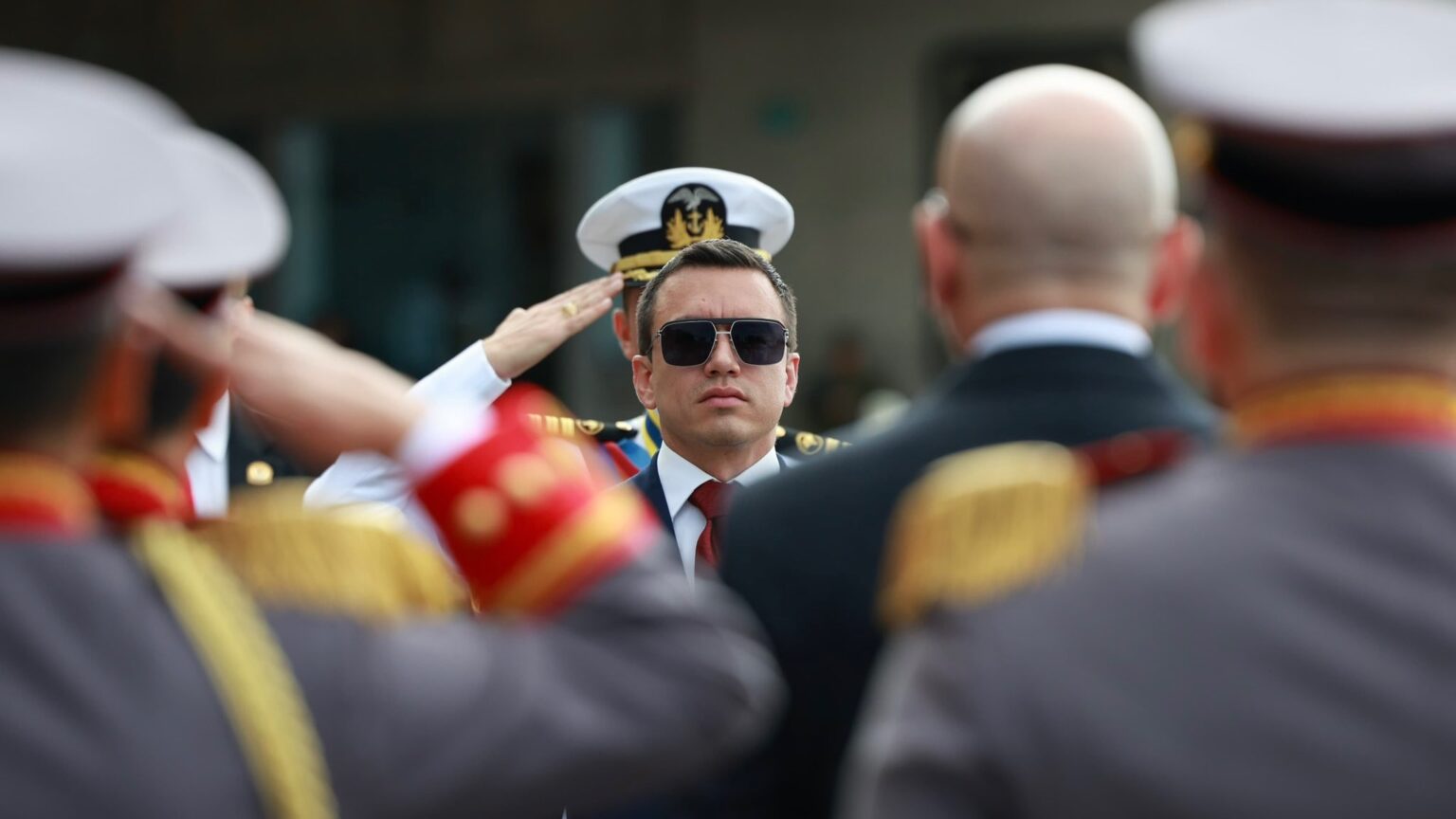
Ecuadorian President Daniel Noboa. Photo: X

Ecuadorians will vote on whether to convene a constituent assembly, accept foreign military bases, stop funding political parties, and reduce the number of legislators. The process has been promoted by President Noboa and seeks to bring the country closer to a neoliberal model.

This Sunday, November 16, Ecuadorians will go to the polls to vote on the so-called “2025 Popular Consultation”. The referendum was called by right-wing President Daniel Noboa, who seeks to change the country’s legal framework to, analysts claim, advance his neoliberal political project.

The government’s need for a new constitution

Without a doubt, the most important question in the referendum concerns the possibility of establishing a Constituent Assembly to draft a new constitution. Ecuador is currently governed by the 2008 Constitution, written during the administration of Rafael Correa, which, while responding to various needs of the former president’s social democratic project at the time, also includes a series of demands that various social movements and left-wing political parties had fought for over decades of struggle.

Among the rights included in the current constitution are the: 

  • prohibition of labor flexibility
  • prohibition of the establishment of foreign military bases
  • progressive strengthening of public health and education 
  • granting of rights to nature (a legal novelty in the world)
  • and many others

In short, it is a constitution that guarantees rights, something that contradicts a series of basic principles of neoliberalism, which has greatly annoyed certain economic elites in the country who are now promoting its radical transformation. To do so, Noboa and his allies have decided to rely on a discourse that mixes uncertainty with political attack.

In a recent interview, when asked what type of constitution he would promote if a constitutional process were to be convened, President Noboa said that he would reveal that information the day after winning the referendum. This has generated a series of criticisms of the executive branch’s secrecy, as this secrecy could be hiding a series of rights eliminations and anti-popular measures that the executive branch is planning.

Read More: Noboa opens door to US military bases

This seems to be the case if we take into account the statements made by some government spokespeople who have talked about introducing hourly work, eliminating free public education at universities, and eliminating the rights of nature. In short, the drafting of a neoliberal constitution.

Noboa has also sought to justify the need for a new constitution because, he claims, the current one protects criminals: “When the YES vote wins, criminals, thieves, and murderers will no longer have anywhere to hide,” he said. However, several analysts and journalists have seen these statements as a manipulation of what the current constitution actually says, in order to justify a massive vote in favor of the government.

Using Correísmo as a scapegoat: Noboa’s repeated strategy

Finally, the executive branch has once again resorted to a strategy that has brought it success in the past: labeling the current constitution as “Correísta” (i.e., belonging to former President Correa’s political party). Although Correísmo is one of the main political forces in the country, its opposition has also generated a kind of unity among various sectors of society that find in their rejection of Correísmo a banner of unity.

For example, in recent days, as the government’s campaign has accelerated on all fronts, photographs were published of former Correísta Vice President Jorge Glas, who was transferred to a maximum-security prison recently inaugurated by the government, where the country’s most dangerous prisoners will be held, according to Noboa.

Glas was convicted for allegedly participating in a corruption scheme, although these convictions have been criticized by former President Correa (who also has several court convictions against him, although he lives abroad) as acts of political persecution.

“Jorge Glas among the most ‘dangerous’ prisoners? Shameless! Everything about you is showmanship, malice, and falsehood … [Noboa] I must admit that you are achieving your goal: to accustom people to showmanship, cruelty, lies, ineptitude, and dishonesty,” Correa posted on X, in response to the news of Glas’s transfer.

Allowing the installation of foreign military bases

Another of the most controversial questions is whether the constitution will be reformed to allow the installation of foreign military bases. The current constitution expressly prohibits this. From the outset, Noboa has sought to remove this sovereign restriction, especially after his clear alignment with Washington’s foreign policy and his declared alliance with Israel.

A few days ago, US Secretary of Homeland Security Kristi Noem visited Ecuador, specifically Manta, where a US military base operated at the beginning of the 21st century until the arrival of the Correa government, which did not renew the agreement. Many have seen this visit as a clear statement of intent regarding the location and purpose of the possible military base.

According to Noboa, the arrival of foreign soldiers would help to halt the most serious crisis of violence in Ecuador’s history, which is part of a territorial dispute between drug trafficking groups and which, in 2025 alone, has left more than 7,000 dead, despite the government’s claims that its “Plan Fénix” (security plan) is yielding positive results.

However, several security experts have questioned whether the real intention behind the installation of military bases has anything to do with the government’s urgency to stop structural violence in the country. Rather, they claim that it is part of a broader geopolitical project by the United States to secure strategic military positions in the face of rivalry with China in the South Pacific Ocean.

Read More: What else is behind the “fight” against drug trafficking in Latin America?

Reduction of legislators and defunding of political parties

The last two questions seek to reform the constitution to reduce the number of assembly members from 151 to 73. According to the government, the large number of national assembly members represents an unnecessary expense for the state coffers, and it argues that a reduction would generally improve the level of public debate among legislators.

However, several voices have spoken out against this proposal because, they claim, it seeks to reduce the representation of political groups in the legislature, promoting a kind of two-party system between ADN (the ruling party) and the Citizen Revolution (Correísmo). In addition, the reduction in the number of assembly members directly impacts provinces with smaller populations, where several assembly members are currently elected, but under Noboa’s reform, they would only have one or two representatives. According to the promoters of the NO vote, this would lead to a reduction in political representation and a deterioration of democracy.

Noboa also proposes that the state stop contributing a certain amount of money to political parties. Currently, the constitution guarantees that political parties that receive a minimum percentage of the popular vote are entitled to public funds to develop, conduct election campaigns, etc. The executive branch argues that this is wasted money.

On the contrary, several voices see the decision as a way to exile political parties that do not have powerful financiers or do not belong to the large economic groups in the democratic game, as is the case with Noboa, son of the richest man in Ecuador and member of one of the country’s oligarchic families. Or, seen from the other side, that political parties allied with or belonging to the wealthiest have an unfair advantage over parties that do not have enormous resources.

Read More: Authoritarianism, austerity, repression, and false narratives: the crisis in Ecuador

This is the opinion of former presidential candidate Andrés Arauz, who said: “[The purpose behind the question] is to make politics unequal. Thus, the ability to get your message across as a candidate depends on whether you are a millionaire, whether you can afford to buy advertising space on television or radio. It does not depend on whether you are poor and have good ideas, in which case your message can still be heard. This is the oligarchization of political debate:”

Two visions for the country: only one is possible

Sunday will be one of the most important elections in the country’s recent history. At stake is something deeper than a presidency or a mayoralty: it is the political definition of the country’s model.

On the one hand, there is the recent past, which, after a complex process of political convergence, managed to produce one of the most progressive constitutions guaranteeing rights in the nearly 200 years of republican history.

On the other hand, the future of a country almost completely aligned with neoliberal doctrine and Washington’s geopolitical project (which are linked) is being projected. Ecuador, unlike its neighbors, has been a curious country that has resisted political projects that seek to neoliberalize its economy, as happened during the governments of the 1990s and early 2000s, when social mobilizations even overthrew presidents who were close to this economic policy.

Likewise, the last three administrations (Lenín Moreno, Guillermo Lasso, and Daniel Noboa) have had a clear neoliberal agenda that has not been able to be fully implemented, partly due to popular mobilizations and citizen response, but also due to a constitution that protects certain rights that would need to be eliminated to pave the way for ultra-liberalism.

Original article by Peoples Dispatch republished form peoples dispatch under a Creative Commons Attribution-ShareAlike 4.0 (CC BY-SA) license.

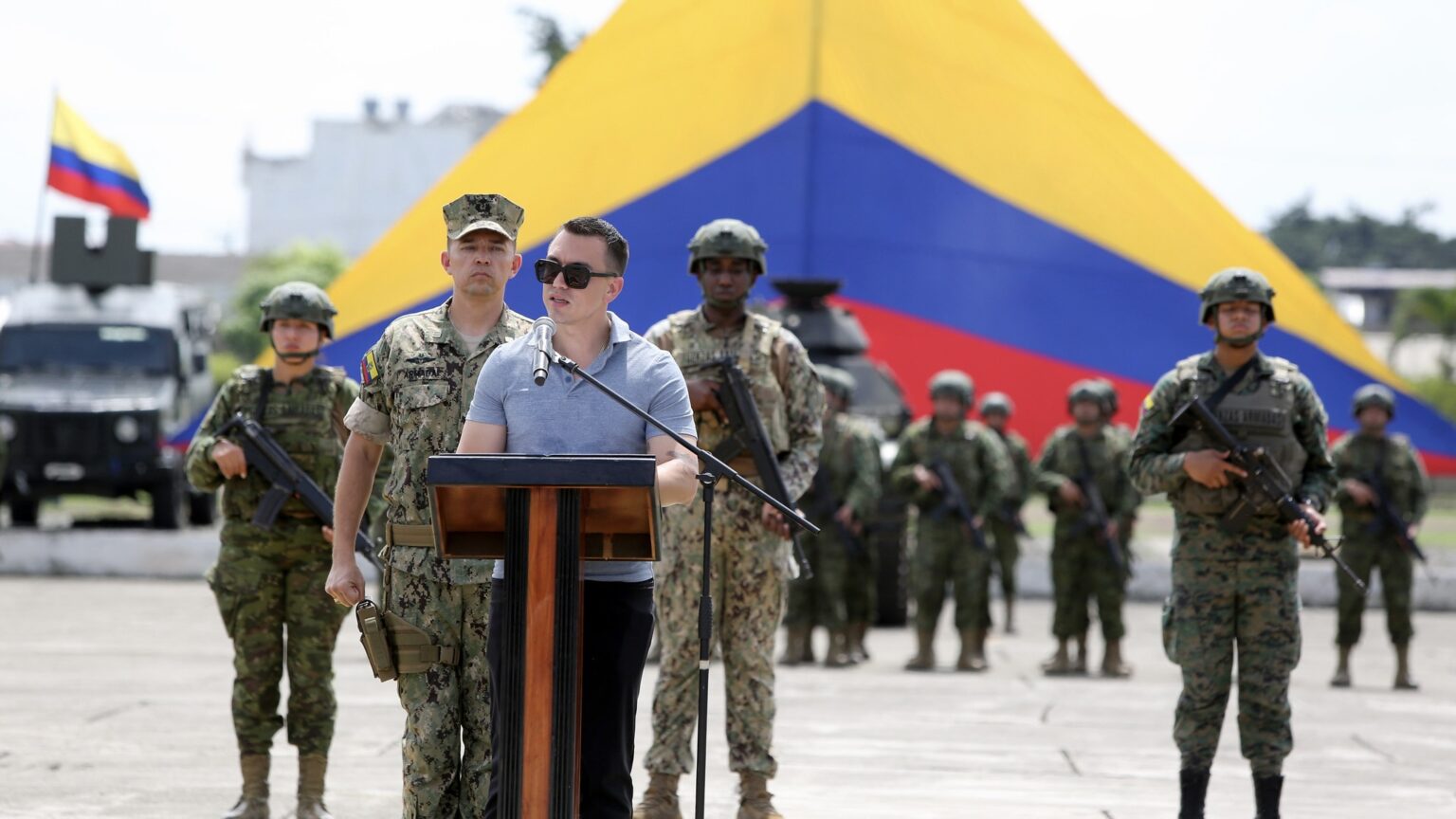
Continue ReadingNeoliberalism or not? Ecuador heads to the polls on November 16

When María Corina Machado wins the Nobel Peace Prize, “peace” has lost its meaning

Spread the love

Original article by Michelle Ellner republished from peoples dispatch under a Creative Commons Attribution-ShareAlike 4.0 (CC BY-SA) license.
In 2002, former US President George W. Bush meets María Corina Machado, then director of Súmate, an "independent democratic civil society group" funded by the US government to "oversee the electoral process in Venezuela". Source: White House/Eric Draper
In 2002, former US President George W. Bush meets María Corina Machado, then director of Súmate, an “independent democratic civil society group” funded by the US government to “oversee the electoral process in Venezuela”. Source: White House/Eric Draper

Venezuelan opposition figure María Corina Machado was awarded the Nobel Peace Prize, but there’s nothing peaceful about her politics

When I saw the headline María Corina Machado wins the Peace Prize, I almost laughed at the absurdity. But I didn’t, because there’s nothing funny about rewarding someone whose politics have brought so much suffering. Anyone who knows what she stands for knows there’s nothing remotely peaceful about her politics.

If this is what counts as “peace” in 2025, then the prize itself has lost every ounce of credibility. I’m Venezuelan-American, and I know exactly what Machado represents. She’s the smiling face of Washington’s regime-change machine, the polished spokesperson for sanctions, privatization, and foreign intervention dressed up as democracy.

Machado’s politics are steeped in violence. She has called for foreign intervention, even appealing directly to Benjamin Netanyahu, the architect of Gaza’s annihilation, to help “liberate” Venezuela with bombs under the banner of “freedom,” She has demanded sanctions, that silent form of warfare whose effects – as studies in The Lancet and other journals have shown – have killed more people than war, cutting off medicine, food, and energy to entire populations.

Machado has spent her entire political life promoting division, eroding Venezuela’s sovereignty, and denying its people the right to live with dignity.

This is who María Corina Machado really is:

  • She helped lead the 2002 coup that briefly overthrew a democratically elected president, and signed the Carmona Decree that erased the Constitution and dissolved every public institution overnight.
  • She worked hand in hand with Washington to justify regime change, using her platform to demand foreign military intervention to “liberate” Venezuela through force.
  • She cheered on Donald Trump’s threats of invasion and his naval deployments in the Caribbean, a show of force that risks igniting regional war under the pretext of “combating narcotrafficking.” While Trump sent warships and froze assets, Machado stood ready to serve as his local proxy, promising to deliver Venezuela’s sovereignty on a silver platter.
  • She pushed for the US sanctions that strangled the economy, knowing exactly who would pay the price: the poor, the sick, the working class.
  • She helped construct the so-called “interim government,” a Washington-backed puppet show run by a self-appointed “president” who looted Venezuela’s resources abroad while children at home went hungry.
  • She vows to reopen Venezuela’s embassy in Jerusalem, aligning herself openly with the same apartheid state that bombs hospitals and calls it self-defense.
  • Now she wants to hand over the country’s oil, water, and infrastructure to private corporations. This is the same recipe that made Latin America the laboratory of neoliberal misery in the 1990s.

Machado was also one of the political architects of “La Salida,” the 2014 opposition campaign that called for escalated protests, including guarimba tactics. Those weren’t “peaceful protests” as the foreign press claimed; they were organized barricades meant to paralyze the country and force the government’s fall. Streets were blocked with burning trash and barbed wire, buses carrying workers were torched, and people suspected of being Chavista were beaten or killed. Even ambulances and doctors were attacked. Some Cuban medical brigades were nearly burned alive. Public buildings, food trucks, and schools were destroyed. Entire neighborhoods were held hostage by fear while opposition leaders like Machado cheered from the sidelines and called it “resistance.”

She praises Trump’s “decisive action” against what she calls a “criminal enterprise,” aligning herself with the same man who cages migrant children and tears families apart under ICE’s watch, while Venezuelan mothers search for their children disappeared by US migration policies.

Machado isn’t a symbol of peace or progress. She is part of a global alliance between fascism, Zionism, and neoliberalism, an axis that justifies domination in the language of democracy and peace. In Venezuela, that alliance has meant coups, sanctions, and privatization. In Gaza, it means genocide and the erasure of a people. The ideology is the same: a belief that some lives are disposable, that sovereignty is negotiable, and that violence can be sold as order.

If Henry Kissinger could win a Peace Prize, why not María Corina Machado? Maybe next year they’ll give one to the Gaza Humanitarian Foundation for “compassion under occupation.”

Every time this award is handed to an architect of violence disguised as diplomacy, it spits in the face of those who actually fight for peace: the Palestinian medics digging bodies from rubble, the journalists risking their lives in Gaza to document the truth and the humanitarian workers of the Flotilla sailing to break the siege and deliver aid to starving children in Gaza, with nothing but courage and conviction.

But real peace is not negotiated in boardrooms or awarded on stages. Real peace is built by women organizing food networks during blockades, by Indigenous communities defending rivers from extraction, by workers who refuse to be starved into obedience, by Venezuelan mothers mobilizing to demand the return of children seized under US ICE and migration policies and by nations that choose sovereignty over servitude. That’s the peace Venezuela, Cuba, Palestine, and every nation of the Global South deserves.

Michelle Ellner is a Latin America campaign coordinator of CODEPINK.


Original article by Michelle Ellner republished from peoples dispatch under a Creative Commons Attribution-ShareAlike 4.0 (CC BY-SA) license.

Continue ReadingWhen María Corina Machado wins the Nobel Peace Prize, “peace” has lost its meaning

Authoritarianism, austerity, repression, and false narratives: the crisis in Ecuador

Spread the love

Original article by Pilar Troya Fernández republished from peoples dispatch under a Creative Commons Attribution-ShareAlike 4.0 (CC BY-SA) license.

Ecuadorian President Daniel Noboa in January 2025. Photo: Presidencia Ecuador

Ecuadorian President Daniel Noboa has not only deepened the crisis in the country, but is also attempting to change the country’s institutions and laws through loopholes and force.

Daniel Noboa’s government in Ecuador is characterized by the implementation of neoliberal austerity policies dictated by the IMF, the violent repression of social protests, and a series of legal reforms aimed at increasing state authoritarianism, and aligning the country with US foreign policy. All this is taking place amid an unprecedented security crisis.

The security crisis

During the first half of 2025, Ecuador recorded 4,619 homicides, setting a new historical record and representing a 47% increase over the same period in 2024. This figure makes the country the most violent on the continent. No one knows what the Phoenix Plan, implemented by the Noboa government since 2024, consists of, and it has not produced positive results. On the contrary, citizen insecurity has worsened. The constant states of emergency that have militarized the country have also failed to reverse the situation.

Austerity policies

Re-elected in April 2025, Daniel Noboa has implemented a far-right program aligned with the demands of the IMF. In June, he dismissed 5,000 civil servants and merged four ministries. In the most serious case, environmental responsibilities were transferred to the Ministry of Natural Resources and Hydrocarbons, highlighting the government’s extractivist orientation. These measures represent the path toward the minimal state advocated by neoliberalism and respond to the conditions of the latest IMF loan.

On September 12, Noboa withdrew the subsidy on diesel, whose price rose from USD 1.80 to USD 2.80 per gallon until December. Subsequently, the price would depend on a band system tied to international market prices. This measure triggered a national transport strike on September 13, with transport workers quickly reaching an agreement with the government in exchange for subsidies, and subsequently the national strike called by the Confederation of Indigenous Nationalities of Ecuador (CONAIE) on September 18, demanding the repeal of the measure, a reduction in the VAT from 15% to 12%, no mining, respect for prior consultation, and more investment in education and health. It should be noted that public hospitals are in precarious conditions, without medicines or supplies. The media reports that patients who required dialysis treatment died because they did not receive it.

Submission to the United States and constitutional reforms

On June 3, the National Assembly, where the government has a majority, approved an amendment to Article 5 of the Constitution allowing foreign military bases. This amendment required the approval of the Constitutional Court and subsequently a referendum. On September 5, the Constitutional Court rejected four of the eight questions that Noboa had sent for popular consultation and referendum, including this issue.

Authoritarian laws and the Constitutional Court as the last bastion

In June 2025, the government managed to pass three new laws that were sent as economically urgent without actually being so: on Intelligence, National Solidarity, and Public Integrity. The progressive camp filed 23 constitutional challenges with the Constitutional Court because they violate rights related to children and adolescents, freedom of expression, intimacy, and privacy, among others. The Court provisionally suspended 16 articles of these laws, prompting a smear campaign organized by the government, which accused the Court of leaving the country defenseless against crime.

The National Solidarity Law sought to institutionalize the concept of “internal armed conflict” that Noboa used in a decree in January 2024. This implied: free use of the military in police operations; prior pardon for security personnel for potential crimes and human rights violations; criminalization of opposition organizations by classifying them as armed groups; and treatment of areas, movable and immovable property presumed to belong to criminal groups as military targets.

The Intelligence Law sought to intercept any communication without a court order, require information within two days without a court order, access personal data without a court order, reinstate confidential expenses (non-transparent discretionary funds), and incinerate documents rather than keep them on file.

On September 27, the Constitutional Court definitively rejected two of the laws, the National Security Law and the Public Integrity Law, as flagrantly unconstitutional.

The Constitutional Court is the only state body that the Noboa government does not control. The National Court of Justice and the Attorney General’s Office have supported the government by implementing lawfare against the opposition, especially Rafael Correa’s Citizen Revolution party, while failing to investigate any of the signs of corruption in the current government. These include million-dollar contracts with companies owned by Noboa’s relatives, new mining concessions that also lead to his relatives, 48 generators purchased to provide electricity, of which 30 are not compatible with the Ecuadorian system, and the scandal of the contract with Progen for the electrical system, for which USD 149 million was paid without results, leaving open the possibility that last year’s 14-hour daily blackouts will be repeated.

Read more: Ecuador in the dark: Daniel Noboa increases power cuts to 14 hours a day

Abuses, protests, and repression

On September 16, in Cuenca, the country’s third largest city with 800,000 inhabitants, the largest environmental march in the country’s history took place: 100,000 people marched against the Loma Larga mining project in the Quimsacocha area, which would put water sources for agricultural and human use at risk. The project had been suspended by a local court for failing to comply with prior consultation and environmental requirements.

On September 19, Noboa ordered the National Electoral Council, by decree, to organize a National Constituent Assembly without seeking the opinion of the Constitutional Court, which constitutes a violation of the Constitution and was interpreted as an attempted coup d’état. The Court admitted five constitutional challenges and the execution of the decree was blocked, although the CNE quickly launched the call for elections for the Constituent Assembly.

At the time of publication of this article, the national strike called by CONAIE continued after 20 days, with support in several cities, especially from students. Roadblocks, protests, and shutdowns are spreading throughout the country, but are strongest in the Sierra, where the Indigenous movement is the main actor in the popular camp.

Tanks and military vehicles repressed the protests in the province of Imbabura, even firing on unarmed Indigenous communities. The Minister of Government, Zaida Rovira, said that it was a humanitarian convoy “ambushed by terrorist structures”. The convoy arrived without prior warning while all internet communication was interrupted, and there is no terrorist group linked to the incident. Efraín Fuérez was killed by the military in a nearby area. A Spanish journalist reporting from the area, Lautaro Bernat, was deported.

Read more: One dead and nearly 100 arrested amid heavy repression of protests in Ecuador

At least 100 people have been detained and 10 are missing. On September 26, twelve detainees were sent to one of the maximum security prisons where a prison massacre had taken place the day before, killing 17 people. These massacres have been repeated even with prisons under military control since 2024. These people were falsely accused of terrorism and of having criminal records. The government has frozen the bank accounts of popular leaders and organizations without a court order, claiming without evidence that the strike is being financed by the Venezuelan drug trafficking organization, “Tren de Aragua”.

The former president of CONAIE, Leonidas Iza, leader of the 2019 and 2022 uprisings, suffered an attempt on his life by agents of the National Intelligence Directorate on August 18, 2025. Four children from a suburb of Guayaquil were tortured and extrajudicially executed by the military in December 2024. The level of authoritarianism is such that the US State Department itself denounces it in a report that points to serious human rights violations in Ecuador between 2024 and 2025. International reports show that since 2024 there has been an increase in crimes of abuse of power in the execution of official duties, torture, forced disappearances, and extrajudicial executions.

Noboa’s response to the Constitutional Court’s rejection of the two laws was, on September 30, to send a new urgent economic law to facilitate donations to the National Police and the Armed Forces.

There are no negotiations with the actors on strike. Faced with demands for more democracy and state investment, the government responds with austerity, increased repression, and a communication strategy that seeks to establish the false narrative that all protesters are criminals and/or terrorists. In line with this, on October 8, the presidential guard, after attacking an Indigenous demonstration in the province of Cañar, broke the windows of the presidential motorcade’s vehicles and then claimed that it was an attempt to assassinate the president. This would be the first time that an attempt has been made to assassinate a president by throwing stones at the presidential motorcade, which is protected by the military, police, and private security, who had been warned about the protest by the mayor days earlier.

Pilar Troya Fernández is an Ecuadorian anthropologist with a master’s degree in gender studies and a researcher at the Tricontinental Institute for Social Research. She was an advisor to the National Secretariat of Planning, an advisor to the National Secretariat of Higher Education, Science, Technology, and Innovation, and Deputy Secretary General of Higher Education in Ecuador. She currently resides in Brazil.

This article was produced by Globetrotter.

Original article by Pilar Troya Fernández republished from peoples dispatch under a Creative Commons Attribution-ShareAlike 4.0 (CC BY-SA) license.

Continue ReadingAuthoritarianism, austerity, repression, and false narratives: the crisis in Ecuador

Fighting the Neoliberal-Fascist Coup by Trump and Musk

Spread the love

Original article by William E. Connolly republished form Common Dreams under Creative Commons (CC BY-NC-ND 3.0).

Federal employees rally in support of their jobs outside of the Kluczynski Federal Building on March 19, 2025 in Chicago, Illinois. The rally was organized by the National Treasury Employees Union to voice concerns about the mass firing of federal workers by the controversial Department of Government Efficiency (DOGE) which is led by billionaire businessman Elon Musk. (Photo by Scott Olson/Getty Images)

Time is short during a fascist takeover attempt. And Trump and Musk are moving at breakneck speed. The stakes could not be higher.

At what junctures do Elon Musk and Donald Trump, each proceeding from a distinctive starting point, forge a new and hyper-dangerous coalition? Well, the Afrikaner refugee joins an extreme version of neoliberalism to a fascist drive to state takeover, and the fascist orange man, who demands unfettered state power and loves tariffs, nonetheless caters to neoliberal drives to concentrate wealth, income, and power even more extremely at the highest reaches of society. Together, they pursue what is best called oligopolistic fascism.

What’s more, while both may have once believed the old Friedrich Hayek story of how market deregulation secures a robust economy of steady growth, each displays active signs today of no longer believing the very ideology he pedals. Musk does so through his project of planetary escapism and his obsession with driving Inspector Generals from governmental institutions; Trump does so through his constant lies and belligerent demonization of vulnerable people who disagree with him. Indeed, each contains within himself a minor voice sliding into the major voice of the other. They both now believe that the old order that has sustained their extreme privileges can now only be protected by fascist means.

So, let’s define our terms a bit more closely. Neoliberalism was a market theory, most prominently developed by Friedrich Hayek in the 1960s and 1970s as a series of rejoinders to a Keynesian model of growth and social welfare. Neoliberalism promised rapid and sustained economic growth, if the state would radically reduce regulation of private corporations, subsidize them whenever needed, severely limit the power of labor unions, create a court system committed to neoliberal jurisprudence, and, most importantly (and too often less noted by critics), install a national ideology of regular individuals committed to a market regime–a national ideology saturating schools, unions, churches, the government, the media, think tanks, and universities.

In this ideology each individual and institution sees itself as first and foremost a participant and beneficiary of a privately owned market economy. Hayek himself emphasized these themes in his neoliberal social philosophy, a social philosophy that included an economic theory but extended well beyond it to include all other social and state institutions. This all found elaborate expression, for instance, in his 1970 book Rules and Order. In it he emphasizes how the Supreme Court must set rules beyond the powers of legislative revision to nurture the sinews of a neoliberal economy. And he says a neoliberal ideology “may well be something whose widespread acceptance is the indispensable condition for most of the particular things we strive for.” (Rules of Order, p. 58). He knew that minority groups who refused or could not imbibe this ideology had to be controlled by other means. A neoliberal regime along Hayek’s lines, then, is one in which the prison population grows.

In fact the neoliberal order in the United States, supported actively by neoliberal Supreme Court justices, has pushed previously unheard of wealth concentrations to the top of the social hierarchy; supported a unitary President; increased economic insecurity for workers, the poor and mid-level professionals; encouraged hi-tech, super-rich bros to pour vast amounts of money into right wing electoral campaigns; restricted state efforts to fend off climate change and help the poor; and supported media gaslighting to deny the contributions a neoliberal economy makes to accelerating climate wreckage and periodic crises. You can take the 2008 economic meltdown, during the G. W. Bush administration, to be a notable instance of the latter.

What about fascism? Well, fascist movements seek to secure capitalist states by new means during hard times. This was true even in the most extreme instance, when Hitler in Nazi Germany protected large private industrialists as he attacked Jews, social democrats, labor unions, homosexuals, the Romani, and communists. In Mein Kampf, the Jews were defined to be the “red thread” that tied them, social democrats and communists together in one phalanx. To attack the Jews was thus to attack these other organizations and movements too. The regime was inaccurately called “National Socialism”; a closer label would be “National Capitalism,” an economic regime of private profit in which a fascist state became the key definer and regulator of life.

How does a distinctive aspiration to fascism proceed today? It does so by promulgating “big lies” to mobilize hatred in its base; fostering an extreme version of white, Christian nationalism; ransacking state regulatory institutions; intimidating the media, courts, unions, localities, and universities; engaging in coups; mobilizing private militia to intimidate vulnerable elements of the populace; treating immigrants of color to be inferior and “vile” people; and joining with other autocratic states to weaken democracy and promote oligarchical rule. Indeed, today Trump treats immigrants of color and their liberal supporters to be the red threads tying all his enemies together. And he never acknowledges how the very anti-climate policies he promotes accelerate the desperate marches from South to North that he castigates so fervently.

As I previewed in a 2017 book, Aspirational Fascism, Trump has profound fascist aspirations, displayed prominently today in promulgating a battery of big lies, fostering a violent coup attempt after he lost an election, aligning with Putin in foreign policy, pardoning all those who participated in his 2021 violent coup attempt, attacking universities, insisting upon the hegemony of a unitary president who sidelines Congress, the states and (increasingly) courts, and unleashing Musk to reshape the state.

What draws Musk and Trump so closely together now?

Well, Musk shows signs of losing faith in the neoliberal ideology that informed his thinking hitherto, while continuing to deploy it strategically to clean out the federal government of officials—the “Deep State”—who could expose fraud and regulate corporate excesses. To take one instance, he has moved from an earlier stance of concern about accelerating climate wreckage to saying, even as he knows better, that climate change is real but moving at a very slow pace. Even after more extreme hurricanes, the Los Angeles wildfires, and other destructive events.

And Trump, who knew in fact that he had lost the 2020 election, has joined belligerently the project of heaping more and more wealth on the extremely wealthy at the expense of those working and middle class white nationalists who provide a key portion of his political base. The tax cut for the rich he is pushing through Congress shows that. He may well think he will not need to cater to that portion of his base so much, after he has silenced the media, universities, unions, progressive churches, and Democratic Party. He has already silenced critical Republicans and high rolling donors.

What about white working- and middle-class members of the Trump/Musk base? They have displayed signs not so much of believing all the Trumpian lies peddled to them as embracing the lies because of the ways they unsettle liberal elites on both coasts and activate racist impulses already there. Not too many Trump supporters believed the ugly story about Haitian immigrants eating dogs and cats. They merely loved to hear and repeat the story. That is why intense media efforts to expose Trump’s lies have not penetrated the armored base. That protective armor itself was forged during a period when the democratic left had lost touch with the needs and insecurities of those constituents, while focusing only on their ugly racist and misogynist tendencies. In fact, curtailments of racism and misogyny need to be pursued in tandem with reductions in class inequality, if either agenda is to succeed. But it remains to be seen whether Democrats can learn this lesson.

Today, the neoliberal/fascist nexus is taking another turn. While it focuses white working class attention on violent immigrant deportations, it also plans to weaken Medicaid, Medicare, and Social Security severely, perhaps even to destroy them. Why? To give yet another huge tax break to the superrich who also finance their campaigns. Increasing numbers of the old base are now beginning to see through this scam by the scammer they used to love. It turns out the “Deep State” contains many essential services and protections, now on the block.

The Trump/Musk team hopes to complete dismantling and then reordering the Deep State before the base catches on. Then, once the media, universities and liberal donors have been intimidated sufficiently, it will be too late to protest effectively. That is the plan.

The urgent task today is to expose this nexus and its plan at every turn, in every possible venue, and by all democratic means necessary, from publicity to protest to electoral mobilization. For time is short during a fascist takeover attempt. And Trump and Musk are moving at breakneck speed. The stakes could not be higher, nor the urgency more acute.

Original article by William E. Connolly republished form Common Dreams under Creative Commons (CC BY-NC-ND 3.0).

Neo-Fascist Climate Science Denier Donald Trump says Burn, Baby, Burn.
Elon Musk urges you to be a Fascist like him, says that you can ignore facts and reality then.
Continue ReadingFighting the Neoliberal-Fascist Coup by Trump and Musk