Everyone But Egomaniacal Trump Knows His Iran War Is Reckless, Unjustified, and Strategically Incoherent

Spread the love

Original article by Ramzy Baroud republished form Common Dreams under Creative Commons (CC BY-NC-ND 3.0). 
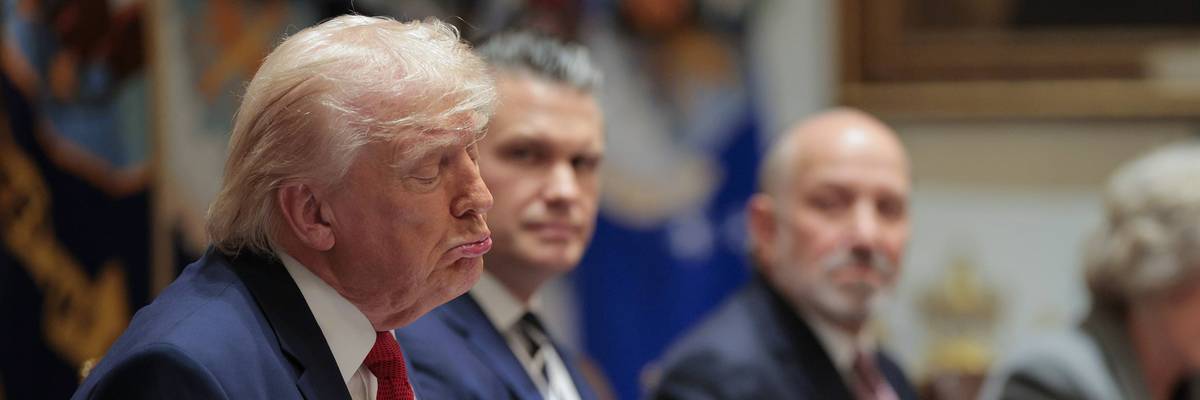
WASHINGTON, DC – MARCH 26: U.S. President Donald Trump reacts as he speaks during a Cabinet meeting in the Cabinet Room of the White House on March 26, 2026 in Washington, DC. This is Trump’s second Cabinet meeting of 2026 and the first since the United States and Israel began attacking Iran on February 28. (Photo by Chip Somodevilla/Getty Images)

The US president, trapped by his own ego, has wrought unparalleled destruction to the people of Iran, the Middle East, and the world.

The judgment on the Trump administration’s war on Iran is already largely settled across mainstream media, public opinion, and much of the analytical sphere.

What remains supportive of the war is limited to two predictable camps: official government discourse and the president’s most loyal supporters, along with entrenched pro-Israel constituencies.

RECOMMENDED…
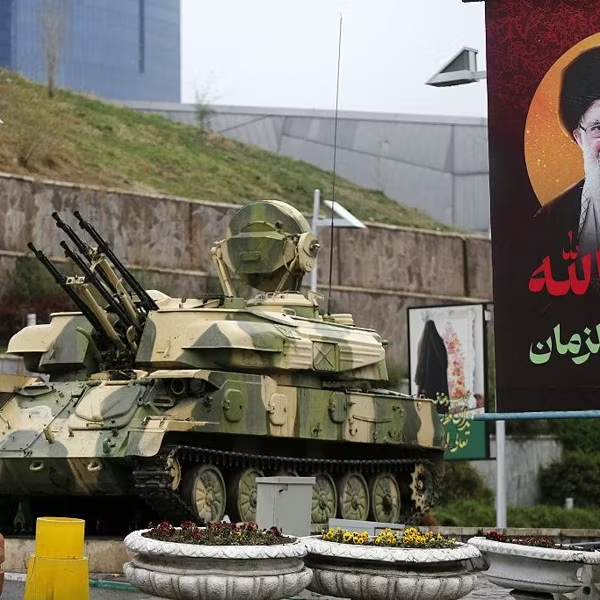
'This War Is Dumb as Hell': Military Historian Assesses Trump's Disaster in Iran

‘This War Is Dumb as Hell’: Military Historian Assesses Trump’s Disaster in Iran
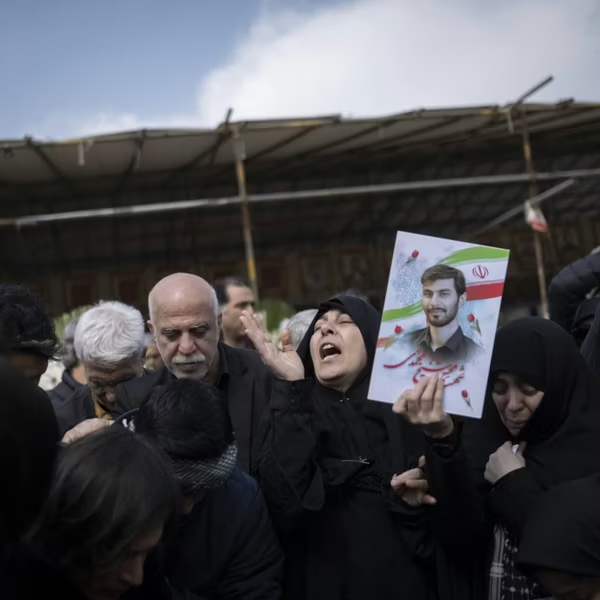
Tehran's Cemetery Amid U.S.-Israeli Military Campaign

Amid Alarm That Trump Has No Plan for Iran, Critic Contends None ‘Could Possibly Justify This’

Beyond these circles, the war is widely understood as reckless, unjustified, and strategically incoherent.

Among the wider American public, this conclusion is not abstract. It is shaped by growing unease, economic anxiety, and a mounting sense that the war lacks both purpose and direction.

A defeat in Iran would not simply be a policy failure; it would represent the collapse of that identity. For a leader driven by narcissistic imperatives, such a collapse is existential, threatening not only his political standing but his relationship with his own base.

Since the outbreak of the war on February 28, 2026, polling has consistently pointed in one direction. A Pew Research poll in late March found that 61 percent of Americans disapprove of Trump’s handling of the conflict.

Another AP-NORC survey showed that six in ten Americans believe US military action against Iran has already “gone too far,” while even Fox News polling found 58 percent opposition.

These numbers confirm a broader trend that began early in the war and has only intensified. Reuters reported on March 19 that just 7 percent of Americans support a full-scale ground invasion.

In that same reporting, nearly two-thirds of respondents said they believe Trump is likely to pursue one anyway, highlighting a growing disconnect between policy and public will.

Days later, Reuters noted that Trump’s approval rating had dropped to 36 percent, with rising fuel prices and economic instability cited as key drivers.

The longer the war continues, the more its consequences are internalized by ordinary Americans, turning distant conflict into immediate economic pressure.

Among the American intelligentsia, opposition is no longer confined to traditional anti-war circles. It now spans ideological boundaries, including segments of Trump’s own political base.

Reporting from the 2026 Conservative Political Action Conference, The Guardian observed that many MAGA supporters warned the war risks becoming another “forever war.”

This convergence is significant, reflecting not a passing disagreement but a deeper structural shift in public perception.

Yet mainstream media—from CNN to Fox News—has largely avoided confronting what many Americans already recognize: that the war aligns closely with the agenda of Israeli Prime Minister Benjamin Netanyahu.

Within Washington itself, unease is also becoming more explicit. The Wall Street Journal reported in March that lawmakers from both parties are increasingly skeptical of the administration’s approach.

At the strategic level, the war’s foundational assumptions have already begun to unravel. Israel’s early calculations that escalation might trigger internal collapse in Iran have failed to materialize.

Iran’s political system remains intact, its leadership stable, and its military cohesion unbroken under Supreme Leader Ali Khamenei.

At the same time, Tehran has demonstrated its ability to retaliate across multiple fronts, targeting Israeli territory and US military assets in the region.

Its geographic leverage over the Strait of Hormuz continues to exert pressure on global energy markets, amplifying its strategic position despite sustained attacks.

The structural reality is therefore unavoidable. Regime change in Iran would require a massive ground invasion, a broad coalition, and a prolonged occupation.

Even under such conditions, success would remain uncertain, as the experience of Iraq has already demonstrated with devastating clarity.

This raises the central question: why continue a war whose strategic premises are already collapsing?

Part of the answer lies not in strategy, but in psychology. A substantial body of political psychology research, frequently cited in relevant 2026 analyses, describes Trump’s leadership style as deeply narcissistic. Traits such as grandiosity, hypersensitivity to criticism, and an overriding need to project dominance are not incidental—they actively shape decision-making.

Trump’s rhetoric has long relied on humiliation, domination, and spectacle, framing politics as a contest of strength rather than negotiation.

Within this framework, escalation becomes a psychological necessity. To retreat risks appearing weak, while compromise risks humiliation.

For a leader whose identity is built on projecting strength, such outcomes are politically and personally intolerable.

This dynamic is reinforced by the broader culture of the administration, where senior officials have repeatedly relied on language such as “obliteration” and “total destruction.”

Such rhetoric, however, has not been matched by evidence of a coherent long-term strategy, exposing a widening gap between performance and planning.

At the same time, the administration’s fixation on masculine power—on dominance, strength, and spectacle—has contributed to a profound underestimation of its adversary.

Iran is not a fragmented state waiting to collapse, but a regional power with decades of experience in asymmetric warfare and strategic resilience.

Yet Trump appears to have operated under the assumption that American power alone guarantees outcomes, an illusion reinforced by past displays of military force.

Reuters reported in late March that Trump is now increasingly pressured to “end the war” quickly, as the administration confronts what it described as “only hard choices.”

The same report cited officials acknowledging that there is no clear exit strategy, leaving the administration caught between escalation and political fallout.

One official told Reuters that there are “no easy solutions” left, underscoring the depth of the strategic impasse.

Another added that any withdrawal would have to be framed carefully to avoid appearing as a defeat, reflecting the administration’s concern with optics as much as outcomes.

This is where the psychological dimension becomes decisive. Trump has constructed a political identity rooted in strength, dominance, and victory.

A defeat in Iran would not simply be a policy failure; it would represent the collapse of that identity. For a leader driven by narcissistic imperatives, such a collapse is existential, threatening not only his political standing but his relationship with his own base.

This is why some analysts—and even figures within Trump’s own orbit—have begun to float a theatrical exit strategy. As Reuters reported on March 14, White House adviser David Sacks stated bluntly that the United States should “declare victory and get out” of the war on Iran, calling for disengagement despite the absence of a clear strategic outcome.

Such a move would allow Trump to claim success while disengaging from an increasingly untenable conflict, preserving the image of strength even in the face of strategic failure.

But this reveals the deeper truth of the war. The “victory” being pursued is not military—it is psychological.

The US-Israeli war on Iran is therefore not only a moral and legal crisis. It is also a geopolitical catastrophe shaped, in no small part, by the psychology of a leader unwilling to confront the consequences of his own disastrous decisions.

Original article by Ramzy Baroud republished form Common Dreams under Creative Commons (CC BY-NC-ND 3.0). 

Climate science denier Donald Trump confirms that he knows nothing about democracy and that more liquid gold is being secured according to his policy of global privateering.
Donald Fuhrump says that Amerikkka doesn't bother with crimes or charges anymore, not being 100% Amerikkkan and opposing his real estate intentions is enough.
Donald Fuhrump says that Amerikkka doesn’t bother with crimes or charges anymore, not being 100% Amerikkkan and opposing his real estate intentions is enough.
Orcas discuss how Trump was re-elected and him being an obviously insane, xenophobic Fascist.

Continue ReadingEveryone But Egomaniacal Trump Knows His Iran War Is Reckless, Unjustified, and Strategically Incoherent

Israel Says IDF Will Stay in Lebanon for Months as It Expands Ground Invasion in South

Spread the love

Original article by Julia Conley republished from Common Dreams under Creative Commons (CC BY-NC-ND 3.0).

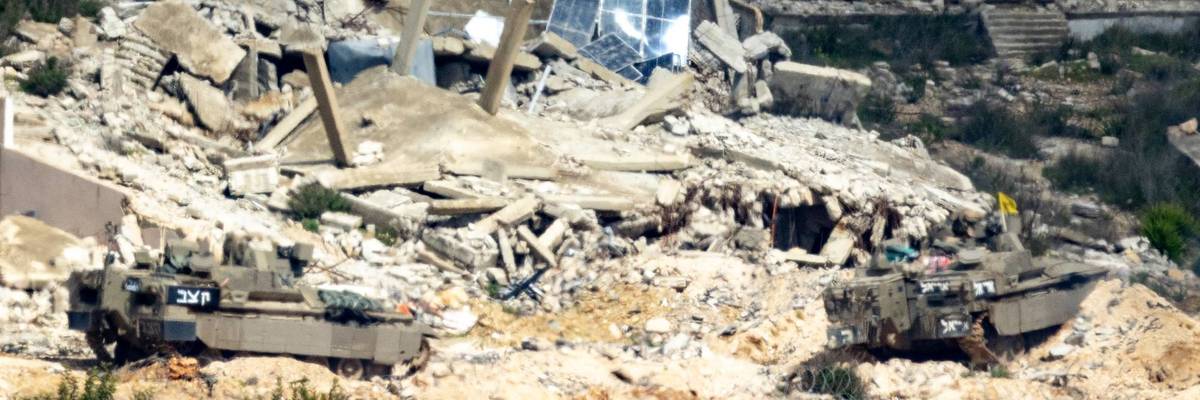
Israeli army vehicles maneuver across the border inside a destroyed Lebanese village as seen from the Upper Galilee in northern Israel on March 16, 2026. (Photo by Odd Andersen/AFP via Getty Images)

“There is no clear exit strategy for this war. While in theory Israel is trying to coerce Lebanon into disarming Hezbollah, it is unlikely that can happen,” said one analyst.

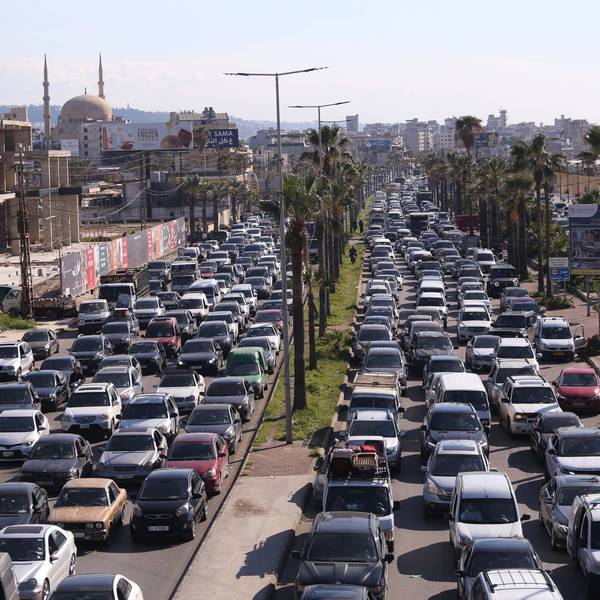
More than 800,000 Lebanese people who have been forced from their homes in southern Lebanon in the last two weeks have little hope of returning soon as the Israeli government on Monday announced its military had begun “limited and targeted ground operations” in and around the strategic southern town of Khiam, a stronghold of Hezbollah.

The ground attacks represent a significant expansion of the Israel Defense Forces’ ground operations. On March 2, when Hezbollah fired rockets into Israel in retaliation for the US and Israel’s killing of Iran’s supreme leader, Ayatollah Ali Khamenei, Israel began sending troops into Lebanon to bolster the presence the IDF has had there in five areas since a 2024 ceasefire.

RECOMMENDED…

Mass displacement in Lebanon following Israeli airstrikes

Israel Gives ‘Mass Expulsion Order’ to Civilians as It Invades Southern Lebanon

Israel Continues Air Strikes And Ground Offensive In Lebanon

From Lebanon to Iran, Says Sanders, US Must End Complicity in ‘Netanyahu’s Wars’

Until now, ground forces have conducted “limited incursions,” Axios reported.

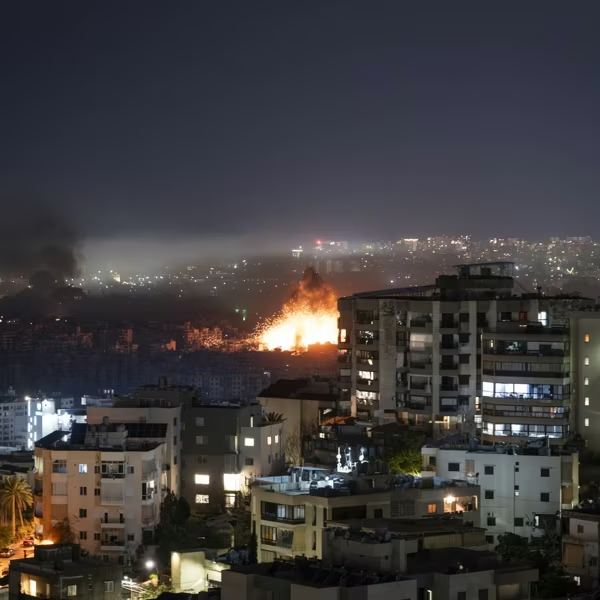
Israel has also launched airstrikes in Lebanon, killing at least 850 people—including 107 children and 66 women—since it was joined by the US late last month in abruptly ending diplomatic negotiations and attacking Iran.

The Times of Israel reported that the IDF carried out “massive airstrikes and artillery shelling ‘to remove threats’” over the weekend before the 91st “Galilee” Regional Division began raiding the eastern section of southern Lebanon in attacks that the military said killed several Hezbollah operatives.

Israel conducted raids on towns including Burj Qalawiya, Sultyaniya, Chaqra, Qantara, and as-Sawana on Monday, according to Al Jazeera Arabic, with the military saying the 91st Division had “begun limited and targeted ground operations against key Hezbollah strongholds in southern Lebanon.”

A major target of the ramped up ground attacks was Khiam, a Hezbollah stronghold that lies at a strategic junction of roads leading to the eastern and western sections of southern Lebanon.

“What Israel has been trying to do is really cut the supply lines and the difficult capabilities of Hezbollah, so it’s unable to bring in more weapons and fighters to areas south of the Litani River,” reported Zeina Khodr of Al Jazeera.

Israeli Defense Minister Israel Katz said that due to what the IDF claimed will be “limited and targeted ground operations,” close to a million people who have fled their homes in southern Lebanon “will not return to their homes south of the Litani River until the security of the residents of [northern Israel] is guaranteed.”

While claiming the operation in southern Lebanon will be “limited,” Katz also said the operation is intended to resemble Israel’s assault on Gaza, which has continued despite a ceasefire that was reached last October, has killed more than 75,000 Palestinians, and has been called a genocide by leading human rights groups and scholars.

Dozens of healthcare workers have been killed in Israeli strikes since the IDF began attacking Lebanon earlier this month; in Gaza, more than 1,500 doctors, nurses, and medics have been killed in October 2023. One attack that killed two paramedics this week in the southern village of Kfarsir was reportedly a “double-tap” strike in which first responders were killed when they arrived to help victims of an initial strike on a building.

The charity group Save the Children on Monday described children “clutching beloved pets and toys as they flee their homes in Lebanon due to the escalating conflict,” and said nearly 300,000 children are among those who have been forcibly displaced.

More than 130,000 people are sheltering in overcrowded schools that have been repurposed as refugee shelters, said the group, and families have had to leave their homes without time to gather crucial documents, clothes, or medications.

“Many families were forced to flee in the middle of the night with nothing, and children miss their homes, their villages, their friends, and their schools,” said Nora Ingdal, country director for Save the Children Lebanon. “I met a child who told me, ‘I’m not able to play here and I just want to go back to my village as soon as possible.’ One child I met clutched his blue toy car, as it was the only thing he had managed to bring from home.”

“Hostilities must end and children must be protected at all costs,” said Ingdal. “We know children are always the most impacted in any conflict, and the psychological impacts last long after any conflict ends.”

The IDF is reportedly calling up 450,000 reservists to carry out the ground invasion, and the Israeli newspaper Yedioth Ahronoth reported that a senior Northern Command official told reservists in a briefing that the operation could continue “until Shavuot,” a Jewish holiday falling between May 21-23.

“We will stay as long as necessary,” the official said.

Lebanese security sources told Reuters Monday that the IDF had effectively taken control of Khiam and were advancing west toward the Litani River, which could cut off parts of southern Lebanon from the rest of the country.

Katz has also threatened to seize territory in the southern area in an effort to uproot Hezbollah.

Geopolitical analyst Shaiel Ben-Ephraim said Israel appears to be using “coercive diplomacy” and expressing a willingness to hold direct talks with Lebanon in the coming days.

“Israel is applying the Daheyia Doctrine, which uses overwhelming, disproportionate force against civilian infrastructure in areas controlled by Hezbollah to deter future attacks,” said Ben-Ephraim. “However, they plan to use this increasingly against Lebanese infrastructure to coerce Lebanon into a deal.”

“There is no clear exit strategy for this war. While in theory Israel is trying to coerce Lebanon into disarming Hezbollah, it is unlikely that can happen,” he said.

US Sen. Chris Murphy (D-Conn.) emphasized that the expanded ground operation in Lebanon is one of several crises unfolding as a result of President Donald Trump’s decision to launch attacks against Iran with Israel.

“A broader, regional war is breaking out,” said Murphy. “Trump has no endgame. Iran and its proxies can create chaos indefinitely.”

“All of this was totally foreseeable,” he added. “Frankly, it’s why previous presidents weren’t so stupid to start a war like this. Trump has lost control of the war. His best course now is to cut his losses and end it. That’s the only way to prevent an even bigger disaster.”

Original article by Julia Conley republished from Common Dreams under Creative Commons (CC BY-NC-ND 3.0).

Experiencing issues with this image not appearing. I suspect because it's so critical of Zionist Keir Starmer's support of and complicity in Israel's genocides.
Genocide denier and Current UK Prime Minister Keir Starmer is quoted that he supports Zionism without qualification. He also confirms that UK air force support has been essential in Israel’s mass-murdering genocide. Includes URLs https://www.declassifieduk.org/keir-starmers-100-spy-flights-over-gaza-in-support-of-israel/ and https://youtu.be/O74hZCKKdpA
Keir Starmer objects to criticism of the IDF. He asks how could anyone object to them starving people to death, forced marches like the Nazis did, bombing Gaza's hospitals and universities, mass-murdering journalists, healthworkers and starving people queuing for food, killing and raping prisoners and murdering children. He calls for people to stop obstructing his genocide for Israel.
Keir Starmer objects to criticism of the IDF. He asks how could anyone object to them starving people to death, forced marches like the Nazis did, bombing Gaza’s hospitals and universities, mass-murdering journalists, healthworkers and starving people queuing for food, killing and raping prisoners and murdering children. He calls for people to stop obstructing his genocide for Israel.
Orcas discuss Genocide-supporting and complicit Zionists. Donald Trump, Keith Starmer, David Lammy, Rachel Reeves, Angela Rayner and Wes Streeting are acknowledged as evil genocide-complicit and supporting cnuts.

Continue ReadingIsrael Says IDF Will Stay in Lebanon for Months as It Expands Ground Invasion in South