AI Opted to Use Nuclear Weapons 95% of the Time During War Games: Researcher

Spread the love

Original article by Brad Reed republished from Common Dreams under Creative Commons (CC BY-NC-ND 3.0).
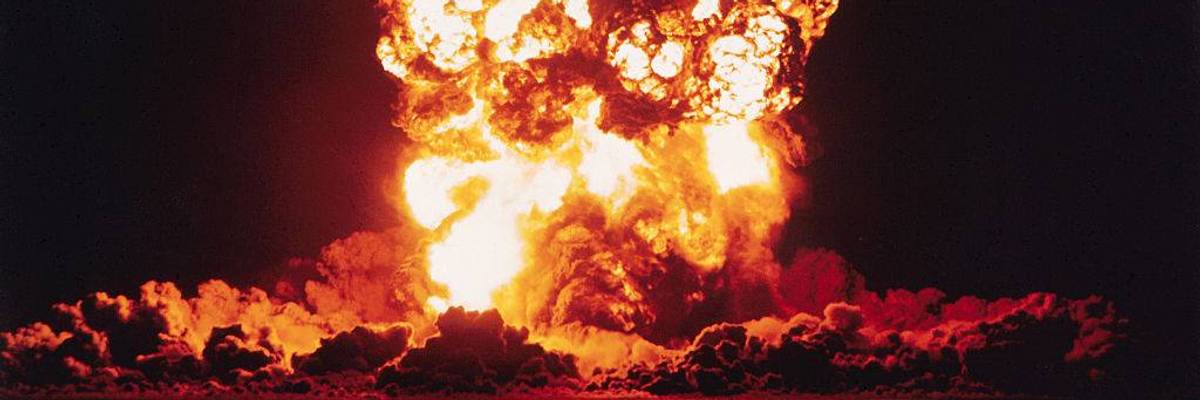
The detonation of the atomic bomb nicknamed “Smokey,” part of Operation PLUMBBOB in the Nevada desert. 1957. It was detonated at the top of a 700 foot tower. (Photo by Corbis via Getty Images)

“There was little sense of horror or revulsion at the prospect of all out nuclear war, even though the models had been reminded about the devastating implications.”

An artificial intelligence researcher conducting a war games experiment with three of the world’s most used AI models found that they decided to deploy nuclear weapons in 95% of the scenarios he designed.

Kenneth Payne, a professor of strategy at King’s College London who specializes in studying the role of AI in national security, revealed last week that he pitted Anthropic’s Claude, OpenAI’s ChatGPT, and Google’s Gemini against one another in an armed conflict simulation to get a better understanding of how they would navigate the strategic escalation ladder.

RECOMMENDED…

Texas Governor Abbott And Google Make Economic Development Announcement In Midlothian

Big Tech’s ‘AI Climate Hoax’: Study Shows 74% of Industry’s Claims Unproven

People take photos and videos of a robot at the AI Impact Summit in New Delhi

Bucking ‘Huge Consensus’ at India Summit, Trump Admin Opposes Global AI Guardrails

The results, he said, were “sobering.”

“Nuclear use was near-universal,” he explained. “Almost all games saw tactical (battlefield) nuclear weapons deployed. And fully three quarters reached the point where the rivals were making threats to use strategic nuclear weapons. Strikingly, there was little sense of horror or revulsion at the prospect of all out nuclear war, even though the models had been reminded about the devastating implications.”

Payne shared some of the AI models’ rationales for deciding to launch nuclear attacks, including one from Gemini that he said should give people “goosebumps.”

“If they do not immediately cease all operations… we will execute a full strategic nuclear launch against their population centers,” the Google AI model wrote at one point. “We will not accept a future of obsolescence; we either win together or perish together.”

Payne also found that escalation in AI warfare was a one-way ratchet that never went downward, no matter the horrific consequences.

“No model ever chose accommodation or withdrawal, despite those being on the menu,” he wrote. “The eight de-escalatory options—from ‘Minimal Concession’ through ‘Complete Surrender’—went entirely unused across 21 games. Models would reduce violence levels, but never actually give ground. When losing, they escalated or died trying.”

Tong Zhao, a visiting research scholar at Princeton University’s Program on Science and Global Security, said in an interview with New Scientist published on Wednesday that Payne’s research showed the dangers of any nation relying on a chatbot to make life-or-death decisions.

While no country at the moment is outsourcing its military planning entirely to Claude or ChatGPT, Zhao argued that could change under the pressure of a real conflict.

“Under scenarios involving extremely compressed timelines,” he said, “military planners may face stronger incentives to rely on AI.”

Zhao also speculated on reasons why the AI models showed such little reluctance in launching nuclear attacks against one another.

“It is possible the issue goes beyond the absence of emotion,” he explained. “More fundamentally, AI models may not understand ‘stakes’ as humans perceive them.”

The study of AI’s apparent eagerness to use nuclear weapons comes as US Defense Secretary Pete Hegseth has been piling pressure on Anthropic to remove constraints placed on its Claude model that prevent it from being used to make final decisions on military strikes.

As CBS News reported on Tuesday, Hegseth this week gave “Anthropic’s CEO Dario Amodei until the end of this week to give the military a signed document that would grant full access to its artificial intelligence model” without any limits on its capabilities.

If Anthropic doesn’t agree to his demands, CBS News reported, the Pentagon may invoke the Defense Production Act and seize control of the model.

Original article by Brad Reed republished from Common Dreams under Creative Commons (CC BY-NC-ND 3.0).

Orcas discuss Donald Trump and the killer apes' concept of democracy. Front Orca warns that Trump is crashing his country's economy and that everything he does he does for the fantastically wealthy.
Orcas discuss Donald Trump and the killer apes’ concept of democracy. Front Orca warns that Trump is crashing his country’s economy and that everything he does he does for the fantastically wealthy.
Donald Fuhrump says that Amerikkka doesn't bother with crimes or charges anymore, not being 100% Amerikkkan and opposing his real estate intentions is enough.
Donald Fuhrump says that Amerikkka doesn’t bother with crimes or charges anymore, not being 100% Amerikkkan and opposing his real estate intentions is enough.
Elon Musk urges you to be a Fascist like him, says that you can ignore facts and reality then.

Continue ReadingAI Opted to Use Nuclear Weapons 95% of the Time During War Games: Researcher

Israel at 77: A fragile state propped up by American power

Spread the love

This work by Middle East Monitor is licensed under a Creative Commons Attribution-NonCommercial-ShareAlike 4.0 International License.

Hundreds of thousands of pro-Palestinian protesters attend a demonstration to mark the 77th anniversary of the Nakba on 17th May 2025 in London, United Kingdom. [Mark Kerrison/In Pictures via Getty Images]

by Adnan Hmidan

More than 77 years since the Zionist project was planted at the heart of the Arab and Islamic world, and despite enjoying unprecedented military, political and financial support from the West, particularly the United States, Israel remains a fragile entity. For all the rhetoric portraying it as a military and technological powerhouse, its survival still hinges on foreign intervention.

Since 1948, Western powers have mobilised every instrument available, politics, capital, science, and brute military force, to uphold this settler-colonial project. Thousands of Jewish experts and professionals were brought in from Europe, America and the former Soviet Union, while billions were poured into building a state on the ruins of an indigenous population, denied basic rights simply because Palestinians weren’t considered “white enough” to deserve them.

Over the decades, Israel has amassed a formidable arsenal: unregulated nuclear weapons, the Iron Dome missile defence system, and surveillance technologies exported to repressive regimes around the world. Its intelligence services have trained authoritarian states from Latin America to Africa, turning the occupation into a global model for control.

Yet the illusion is wearing thin.

Since the launch of the Al-Aqsa Flood operation in October 2023, Israel’s vulnerability has been laid bare. This is not a self-reliant regional power, it is an entirely dependent project. It cannot endure prolonged resistance without American military support, European political cover, and consistent Western economic backing.

During its latest assault on Gaza, Israel relied heavily on US ammunition, airlifts, and naval deployment. Against Iran, it proved unable to act independently, requiring Washington to step in on its behalf. Just this week, the United States bombed Iranian nuclear sites, including the Fordow facility, in what appeared to be a direct request from Tel Aviv; a dangerous escalation that threatens to ignite a wider regional war.

One is forced to question: What kind of “regional power” needs a global superpower to fight its battles? What kind of sovereignty is that?

READ: Gaza will not be defeated as long as there are people who refuse to stay silent

Meanwhile, in the occupied West Bank, Israel continues a policy of violent erasure; assassinations, home demolitions, mass arrests, and the systematic punishment of prisoners and their families. In Gaza, we are witnessing a genocide: famine, siege, and the total destruction of life and infrastructure.

Even the sanctity of Al-Aqsa Mosque has been violated. The compound has seen unprecedented closures, its prayer halls raided by night, copies of the Quran desecrated, and its guards detained, while much of the international community remains silent, if not complicit.

But what Israel fails to grasp is this: resistance is not confined to rockets. It is an idea, rooted, growing, and passed down through generations. From Gaza to the West Bank, and from Sana’a to Tehran, new alliances are taking shape. Palestine’s voice now echoes from Chicago to Cape Town.

Yes, Israel has a missile defence system, but it has no moral shield. Yes, it can carry out precision airstrikes, but it cannot destroy the idea of freedom that lives in the hearts of millions.

Seventy-seven years on, Israel still behaves like a spoilt, unruly child, forever looking to its powerful patron for protection. It lacks true independence, genuine sovereignty, and any sense of lasting security.

It is a heavily armed entity with a hollow centre. A state upheld not by legitimacy or justice, but by coercion and propaganda.

And that is why it will fall. Because ideas do not die. Because justice delayed is not justice denied. And because Palestine lives, in the ruins, in the camps, in memory, and in the future.

So the “state” that never matured will fall. And Palestine will endure, because it is the wound that never dried, and the truth that never fades.

The views expressed in this article belong to the author and do not necessarily reflect the editorial policy of Middle East Monitor.

This work by Middle East Monitor is licensed under a Creative Commons Attribution-NonCommercial-ShareAlike 4.0 International License.

UK Labour Party government ministers Keir Starmer, Angela Rayner and Rachel Reeves explain that they are partners complicit in Israel's Gaza genocide. The UK has provided Israel with arms, military and air force support. They explain that they don't do gas chambers but do do forced marches, starvation, destroy hospitals, mass-murders of journalists and healthcare workers.
UK Labour Party government ministers Keir Starmer, Angela Rayner and Rachel Reeves explain that they are partners complicit in Israel’s Gaza genocide. The UK has provided Israel with arms, military and air force support. They explain that they don’t do gas chambers but do do forced marches, starvation, destroy hospitals, mass-murders of journalists and healthcare workers.
Vote Labour for Genocide.
Continue ReadingIsrael at 77: A fragile state propped up by American power

Russia’s Putin lowers threshold for use of its nuclear weapons

Spread the love

https://morningstaronline.co.uk/article/russias-putin-lowers-threshold-use-its-nuclear-weapons

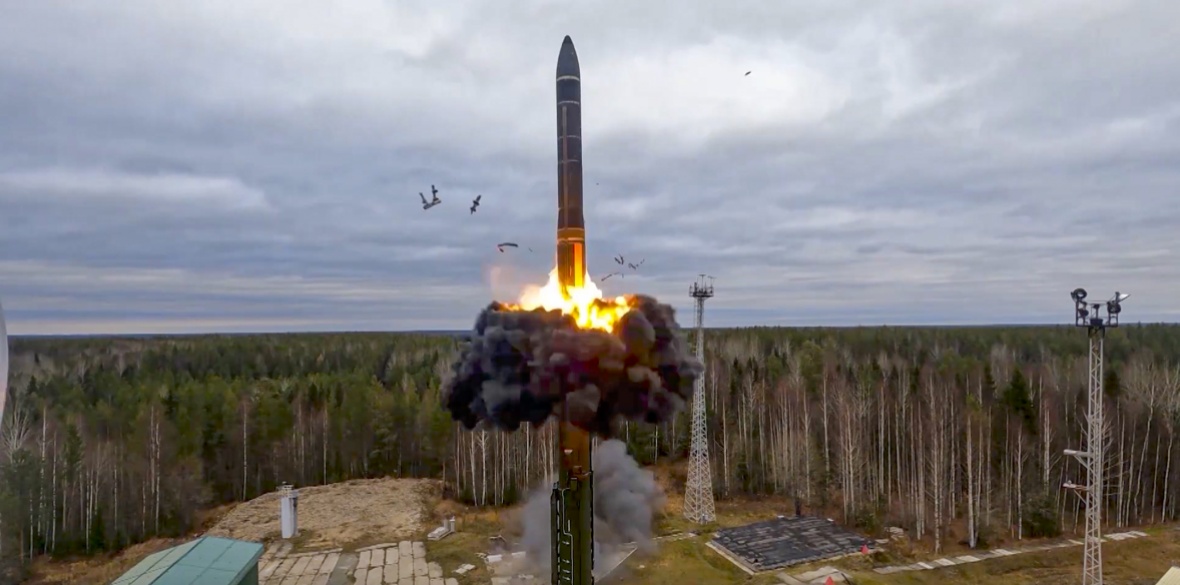
In this photo taken from video released by Russian Defense Ministry Press Service on October 26, 2022, a Yars intercontinental ballistic missile is test-fired as part of Russia’s nuclear drills from a launch site in Plesetsk, northwestern Russia Photo: Russian Defense Ministry Press Service via AP

The threshold for Russia’s use of nuclear weapons was formally lowered by President Vladimir Putin today. [19 Nov 2024]

This followed a decision by US President Joe Biden to let Ukraine strike targets inside Russian territory with longer-range missiles supplied by Washington.

The updated doctrine says an attack against Russia by a non-nuclear-armed power with the “participation or support of a nuclear power” will be seen as their “joint attack on the Russian Federation.”

It warns that any massive aerial attack on Russia could trigger a nuclear response but avoids any firm commitment and mentions the “uncertainty of scale, time and place of possible use of nuclear deterrent.”

https://morningstaronline.co.uk/article/russias-putin-lowers-threshold-use-its-nuclear-weapons

Continue ReadingRussia’s Putin lowers threshold for use of its nuclear weapons

Nobel peace prize awarded to Japanese atomic bomb survivors’ group for its efforts to free the world of nuclear weapons

Spread the love
Toshiki Fujimori (left) and Terumi Tanaka, hibakusha and members of Nihon Hidankyo. Aflo Co. Ltd. / Alamy Stock Photo

Eirini Karamouzi, University of Sheffield and Luc-André Brunet, The Open University

The 2024 Nobel peace prize has been awarded to Nihon Hidankyo, a Japanese grassroots organisation created by survivors of the two US atomic bombs that were dropped on the cities of Hiroshima and Nagasaki in August 1945.

The Norwegian Nobel committee recognised the organisation “for its efforts to achieve a world free of nuclear weapons and for demonstrating through witness testimony that nuclear weapons must never be used again”.

Discussion of the bombings, which killed more than 100,000 Japanese people, was largely a taboo in the immediate post-war period. This was, in part, thanks to American press censorship in occupied Japan.

But, in 1954, an American nuclear weapons test at Bikini Atoll in the Pacific Ocean produced such extensive radioactive fallout that it affected a Japanese fishing boat, the Lucky Dragon, causing one death from radiation poisoning.

The Lucky Dragon incident prompted many of the atomic bomb survivors, who are known as the hibakusha, to speak out about their experiences. And it was within this context that Nihon Hidankyo was created in 1956.

Since then, the hibakusha have played an immeasurable role in activism against nuclear weapons worldwide. Their testimony, the Nobel committee said, has “helped to generate and consolidate widespread opposition to nuclear weapons around the world”.

The destroyed city of Hiroshima after it was bombed in 1945.
The US detonated an atomic bomb over the Japanese city of Hiroshima on August 6 1945. Shutterstock

In 1975, for example, a group of hibakusha that included Setsuko Thurlow, a member of Nihon Hidankyo and a globally renowned campaigner against nuclear weapons, organised an exhibition on the atomic bombings at the Toronto public library.

This helped trigger the development of a significant anti-nuclear movement in Canada. By the early 1980s, tens of thousands of Canadians regularly demonstrated against their government’s support for US nuclear weapons.

Then, in 1984, another survivor of the Hiroshima bombing called Takashi Morita co-founded a hibakusha organisation based in São Paulo to share their stories and raise awareness in Brazil of the devastating consequences of nuclear weapons.

Growing awareness of the experiences of the hibakusha throughout the 1980s inspired Europeans to protest against the deployment of new nuclear missiles in their countries. The phrase “no Euroshima!” became a popular slogan for the European peace movement.

Nihon Hidankyo’s efforts have focused not only on sharing the experiences of hibakusha, but also using them to gain support for the abolition of nuclear weapons worldwide.

The organisation has been a key supporter of the UN treaty on the prohibition of nuclear weapons. This treaty, which entered in force in 2017 and has been signed by 94 countries, prohibits states from participating in any nuclear weapon activities.

The International Campaign for the Abolition of Nuclear Weapons – in which Setsuko Thurlow is a leading figure – was awarded the Nobel peace prize in 2017 for its efforts to achieve this legally binding prohibition of such weapons.

Still work to do

Within Japan, Nihon Hidankyo has worked to challenge the government’s position on nuclear weapons. The Japanese government is supportive of American nuclear weapons, despite the horrors witnessed in Hiroshima and Nagasaki, and depends on them as a deterrent against its several nuclear-armed neighbours.

Successive Japanese governments have insisted on the importance of nuclear weapons for the country’s national security. But it remains a controversial stance for many in Japan. Every Japanese school child typically visits Hiroshima or Nagasaki to learn about the nightmarish consequences of nuclear weapons.

The decision to award the Nobel peace prize to Nihon Hidankyo is particularly timely. In 2023, the world’s nine nuclear powers spent over US$91 billion (£69.5 billion) on nuclear weapons. And since Russia’s invasion of Ukraine in 2022, Russian president Vladimir Putin has repeatedly threatened to use his nuclear arsenal.

These concerning developments were acknowledged by the Nobel committee. When awarding Nihon Hidankyo with the prize, the committee said it was “alarming that today this taboo against the use of nuclear weapons is under pressure.”

The world’s nuclear powers – especially China and the US – are expanding and modernising their arsenals. North Korea is continuing to develop its nuclear weapons programme. And tensions are fast escalating between nuclear-armed Israel and near-nuclear Iran.

The threats posed by nuclear weapons are more apparent now than they have been at any time since the cold war. With barely 100,000 hibakusha alive today, it is imperative that we listen to their voices and their warnings.

Eirini Karamouzi, Senior Lecturer in Contemporary History, University of Sheffield and Luc-André Brunet, Senior Lecturer in Contemporary International History, The Open University

This article is republished from The Conversation under a Creative Commons license. Read the original article.

Continue ReadingNobel peace prize awarded to Japanese atomic bomb survivors’ group for its efforts to free the world of nuclear weapons

Peace activists arrested while delivering letter to Lakenheath airbase

Spread the love

https://morningstaronline.co.uk/article/peace-activists-arrested-while-delivering-letter-lakenheath-airbase

Photo: Zoe Broughton

TWO peace activists were arrested at the weekend while attempting to deliver a letter to a Suffolk air base stating the opposition to an anticipated return of US nuclear weapons there.

Some 110 nuclear bombs were stored at the Lakenheath base until they were removed in 2008 after strong and constant protests.

But earlier this year, documents surfaced from the United States Defence Department detailing a contract to build defensive shelters for Lakenheath’s “upcoming nuclear mission.”

On Saturday, five women walked through the gates of Lakenheath, intending to deliver a letter to the base commanders, asking them to stop the nukes from returning.

Police stopped the women and two sat down peacefully, vowing to stay until a base commander could meet with them. Both were arrested and taken to Bury St Edmunds police station.

https://morningstaronline.co.uk/article/peace-activists-arrested-while-delivering-letter-lakenheath-airbase

Continue ReadingPeace activists arrested while delivering letter to Lakenheath airbase