Jensen Huang, CEO of Nvidia. A DeSmog collage. Credit: Simon Liu / Office of the President (Huang, CC-BY-2.0); Wikimedia Commons (Petrobas, CC-BY-SA-4.0); Wikimedia Commons (Nvidia, CC-Zero); Ivan Mlinaric (Amazon rainforest, CC-BY-2.0)
The tech giant was in Rio de Janeiro hawking AI software to fossil fuel firms just days before crucial climate crisis negotiations in the Amazon.
As world leaders prepared to descend on the small city of Belém in the Brazilian Amazon for the COP30 climate summit, artificial intelligence (AI) chip-manufacturer Nvidia was instead peddling its energy-guzzling AI tools to Brazilian oil and gas companies, DeSmog can reveal.
During the Offshore Technology Conference (OTC) in Rio de Janeiro last week, a gathering of over 23,000 oil and gas representatives, Nvidia sent a senior energy staffer to sell bespoke AI software to help oil giants dredge up ever-vaster troves of fossil fuels. Nvidia did so even though the tech giant markets itself as a creator of AI-driven climate crisis solutions, and has made the (contested) claim that 100 percent of its prodigious electricity consumption comes from renewable sources.
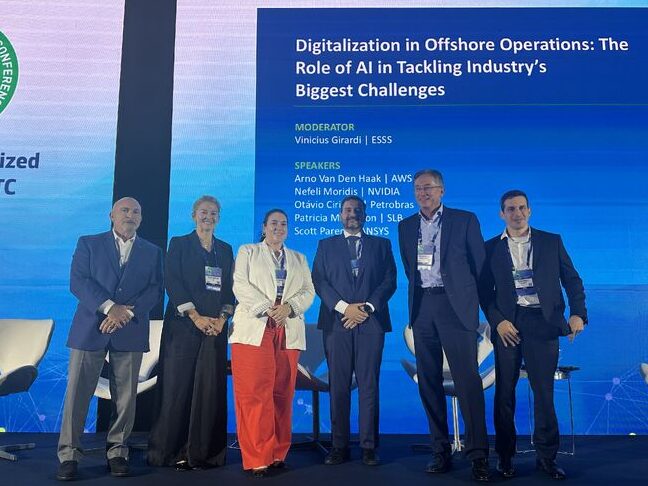
The company’s Global Head of Subsurface Energy Solutions, Nefeli Moridis, who is on the board of the Society of Petroleum Engineers International, joined an OTC Conference panel on 29 October which discussed how to use AI to tackle the “biggest challenges” in offshore oil and gas operations – including “optimizing production.”
A promotional banner for an event at the 2025 Offshore Technology Conference (OTC) in Rio de Janeiro.
Credit: OTC Brasil / Linkedin
The panel also featured representatives from the tech giant Amazon Web Services (AWS), who talked about “why Brazil is uniquely positioned to lead the global offshore AI transformation”, alongside a senior figure from one of the conference’s “master sponsors” – Brazilian state-owned oil and gas company Petrobras.
Petrobras, which has already garnered criticism for accelerating its exploration of new oil and gas reserves ahead of COP30, was granted a new license in late October from the Brazilian government (also a master sponsor) to drill on the Amazon coast.
“What a great discussion! Robotics can – and will – be leveraged in offshore environments to push the boundaries of what’s possible,” Moridis promised on social media platform LinkedIn after speaking on the panel.
An event at the 2025 Offshore Technology Conference (OTC) in Rio de Janeiro.
Speakers included Otávio Ciriblli from Petrobras (far-right); Nefeli Moridis from Nvidia (third from left); Arno Van Den Haak, Amazon Web Services (second from right).
Credit: OTC Brasil / Linkedin
Nvidia’s decision to flog its technology to fossil fuel firms at the OTC Conference was not a one-off. The tech giant, which was recently crowned the world’s largest public company and donated $1 million to Donald Trump’s inauguration ceremony, has a long history of selling its wares to oil and gas companies.
On the “oil and gas operations powered by AI” page of its website, Nvidia celebrates its recent work developing an AI assistant for Saudi Aramco, a customAI chatbot with expertise about chemicals for Shell, and an AI tool for Petrobras to “speedup… reservoir simulations”.
The contradiction between Nvidia’s climate claims and its courtship to oil and gas giants, particularly in the shadow of the upcoming COP30 negotiations, has sparked outrage among campaigners.
“This kind of hypocrisy undermines the credibility of tech companies heading into COP – they can’t present themselves as climate leaders while marketing AI to expand fossil fuel production,” said Holly Alpine, a former Microsoft employee turned campaigner for Enabled Emissions, which fights to stop big tech from enabling fossil fuel industry expansion.
Tech companies have been selling their services to the fossil fuel industry for a long time. A 2023 survey by consulting firm EY reported that 92 percent of fossil fuel companies are already using AI for their operations.
Nvidia’s Climate Contradictions
It is still unclear whether Nvidia will be attending COP30 – especially given the company’s increasing closeness to the administration of U.S. President Donald Trump, which has reversed American climate policy so dramatically that some experts are now calling the U.S. a “petrostate”.
The Trump administration has pulled out of attending COP in Brazil this year.
Nvidia, regardless of the company’s closeness to Trump, continues to trumpet its climate credentials.
Just a month ago at New York Climate Week, the world’s largest discussion of climate crisis solutions outside COP, Nvidia’s Head of Sustainability Joshua Parker spoke on a panel that celebrated the company’s “innovative climate technologies”, which Parker argued will “advance sustainability solutions at an unprecedented pace”.
Nvidia also had a presence at past COP summits. At COP29 in Baku, Azerbaijan, Nvidia sent its senior sustainability leader to sell the idea that “AI has the potential to make other sectors much more energy efficient”.
The previous year, at COP28 in Dubai, United Arab Emirates, Nvidia joined up with the Commonwealth Secretariat for a panel about using AI to support climate action in nations vulnerable to climate change, including to track sea level rise in countries like Tonga.
Its climate pledges are not without controversy. Nvidia’s claim that 100 percent of its electricity consumption in 2025 is powered by renewable energy was challenged by a report from Greenpeace in October that ranked Nvidia last among tech giants on the decarbonisation of its supply chain.
The Greenpeace report said that Nvidia relies on suppliers that use fossil fuels to power their operations, and criticised the company for failing to release data on how much electricity those suppliers use. In the 2025 fiscal year, Nvidia suppliers produced 6 million tonnes of CO2, according to Greenpeace – double what they produced just two years earlier.
Alpine goes further. “A company cannot claim to lead on climate while its technology drives the very emissions it vows to eliminate – or claim transparency while concealing those risks from shareholders,” she told DeSmog.
Nvidia was approached for comment.
Beyond Nvidia
This phenomenon goes well beyond Nvidia and COP30.
AWS and Microsoft, which fielded two of the OTC Conference’s AI panel speakers (the Microsoft representative did not ultimately attend), reportedly make vast sums from the fossil fuel industry.
A 2024 report by the group Amazon Employees for Climate Justice goes so far as to claim that by this year, AWS “could be making $9.6 billion annually from the oil and gas industry alone – about 10 percent of AWS revenue.”
Amazon is not hiding its work with these companies. In response to DeSmog, Amazon stated: “The energy industry should have access to the same technologies as other industries. We will continue to provide cloud services to companies in the energy industry to make their legacy businesses less carbon intensive and help them accelerate development of renewable energy businesses.”
As for Microsoft, documents viewed by The Atlantic last year suggest that oil and gas revenues may account for a market opportunity of $35 billion to $75 billion each year for the firm. Alpine told the Financial Times this may constitute up to half of the company’s cloud revenue.
Alpine’s campaign group, Enabled Emissions, argues that tech companies selling AI for fossil fuel expansion are causing “staggering emissions” by enabling increased oil and gas drilling with their software.
“AI isn’t neutral – it’s shaping the pace and scale of fossil fuel expansion,” Alpine told DeSmog.
AI at COP30
As the energy-intensity of the AI boom skyrockets, and big tech firms water down or even completely rescind their climate commitments, they are also reportedly shrinking from visibility at climate events.
Last year, the Financial Times reported that big tech firms had already begun stepping back from participation at COP29 compared to previous years.
On 28 October, Microsoft’s founder Bill Gates, a philanthropist worth an estimated $118 billion, wrote a memo addressed to COP30 attendees saying climate change won’t cause “humanity’s demise.”
Gates’s arguments in the memo have drawn outcries of dismay from some of the world’s top climate scientists, who have pointed out that “this memo is already being championed by those seeking to misinform and sow doubt about climate change and delay climate progress – up to and including the executive branch of the United States government.”
Whether big tech firms attend or not, COP30 is expected to involve discussions of the threats to climate change posed by the immense amounts of energy needed to fuel the global AI energy boom, as well as efforts to address the climate crisis using AI – an effort critics say is misguided.
“The fact is that the climate crisis is not primarily a technological problem: we have most if not all of the tech we need to fix it,” Adam Becker, science journalist and author, previously told DeSmog.
“Tech oligarchs think that they can burn fossil fuels with impunity and clean it up later with a magic wand given to them by a machine god. But that isn’t going to happen. The reality is that we need to save ourselves from the machinations of these cruelly myopic billionaires.”
The government has signed vast deals with gas-loving, Trump-donating AI giants.
When U.S. President Donald Trump landed for what he called the “exquisite honour” of an unprecedented second state visit to the UK this September, he brought along a retinue of his favourite Silicon Valley tech bosses for dinner with King Charles.
Among the guests seated in the gold-flecked banquet hall of Windsor Castle: Jensen Huang, CEO of the artificial intelligence (AI) chip-manufacturer Nvidia, which has recently skyrocketed into the position of the world’s largest public company, and Sam Altman, founder and CEO of ChatGPT creator OpenAI. Recently, these two tech CEOs seem to have earned a direct line to President Trump and, unsurprisingly, the bedrock of that influence appears to be money – earlier this year, Nvidia and Altman both donated $1 million (£750,000) to Trump’s inauguration ceremony.
When they landed in London, they quickly applied their skills of political influence to Labour.
Altman and Huang’s visit to the UK accompanied the signing of Trump and Prime Minister Keir Starmer’s £150 billion “U.S.-UK Technology Prosperity Deal”, an agreement which includes £31 billion in investments from American tech companies to construct fleets of gargantuan “hyperscaler” AI-ready data centres across Britain.
Stargate UK, a massive AI infrastructure project from OpenAI, Nvidia, and UK AI startup Nscale, is only one of several huge new initiatives introduced via the deal.
On the first day of the big visit, Nvidia threw a press conference to celebrate its pledge to invest a further £2 billion in UK AI.
“This is a historic day,” Starmer rhapsodised about the Nvidia investment while standing next to Huang, lit by the glow of a towering Nvidia logo.
Huang handed Starmer a framed golden Nvidia supercomputer as a gift, embossed with an inscription which Huang asked the prime minister to share.
“This is the UK’s age of AI,” Starmer read out to rising cheers in the audience. “A new industrial revolution begins!”
One glaring omission from Starmer and Huang’s “revolution”? Any mention of how the UK will power an explosion of water and energy-voracious AI data centres – the vast warehouses of supercomputers needed to run the likes of ChatGPT and Google’s Gemini – without completely upending the UK’s net zero commitments.
Instead, on the same day, Huang declared Nvidia’s plans to power its UK AI with fossil fuels.
“Sustainable power like nuclear and wind and of course all of that solar is all going to contribute, but I’m also hoping that gas turbines can also contribute,” he told The Times.
Starmer has claimed that home-grown clean energy is “in the DNA” of his government, yet Labour has so far said little about Nvidia’s plans for fossil fuel-powered AI in Britain – or how it intends to hit its net zero targets while charging headlong into this big tech bonanza.
Too Much, Too Quickly
Labour has already been widely accused of growing too close to U.S. big tech companies.
In recent months, the government has signed wide-ranging deals with seven Trump-supporting U.S. tech giants – Nvidia, OpenAI, Instagram and Facebook creator Meta, software company Microsoft, online retail behemoth Amazon, search engine pioneer Google, and enigmatic “spy tech” company Palantir.
Together, these tech firms have donated a combined $7.5 million (£5.6 million) to President Trump, a figure that doesn’t count the unspecified amounts Meta, Microsoft, Amazon, Google, and Palantir reportedly gave for the construction of Trump’s new White House ballroom.
The Trump administration has pursued an anti-immigrant, anti-democratic, pro-fossil fuel agenda, which has included an eight-fold increase in weapons expenditure for Immigration and Customs Enforcement officers carrying out deadly immigration raids across the country, and over $1 trillion (£760 billion) in defence spending, largely for weapons, shipbuilding, and military aircraft.
Trump has so far sent National Guard troops into five U.S. cities and cut nearly $60 billion (£45 billion) in aid funding worldwide.
Labour has already struck deals that would see Trump’s big tech allies train the UK workforce in AI, collaborate with the British military, house the UK’s classified information, and “modernise” the NHS. These deals have prompted widespread concerns about their lack of transparency and the threats they pose to UK data security.
Now, further concern is growing that Labour is encouraging American AI companies to run roughshod over the UK’s renewable energy transition.
“Starmer’s investment deals with U.S. big tech threaten to give them priority access to Britain’s resources – be they energy, water, or personal data – rather than using these resources to meet public need. They will drive a coach and horses through our climate commitments,” Nick Dearden, director of campaign group Global Justice Now, told DeSmog.
That threat revolves around the government’s efforts to aggressively woo U.S. big tech to ramp up multi-billion pound AI data centre investments at its designated AI “Growth Zones”.
To date, several big tech firms have heeded the call. In the past few months, Microsoft has invested £22 billion, Google’s parent company Alphabet has pledged £5 billion, and Amazon – the biggest owner of data centres in the world – has promised £8 billion for UK AI development.
Oliver Hayes, head of policy at campaign organisation Global Action Plan, agrees with Dearden’s concerns. “By striking deals with U.S. tech companies that are gung-ho about gas-fired data centres, ministers are opening yet more doors for lobbyists, exposing bill-payers to greater pain, and jeopardising UK climate targets,” he told DeSmog.
Microsoft, Google, and Amazon have all already watered down or wholly abandoned their sustainability pledges in the last year due to the surging energy demands of their AI businesses.
OpenAI hasn’t even created one. This summer, the firm hired as its energy chief a former Trump-administration natural gas evangelist who promoted exports of American liquefied natural gas (LNG) to Europe in the wake of Russia’s invasion of Ukraine.
“One way of looking at AI is that its main use is as a vehicle to give the fossil fuel industry one last reason to expand,” wrote American environmentalist Bill McKibben in response to the hire.
Meanwhile, many of the people running these tech giants have veered into outright climate science denial.
Microsoft’s Bill Gates made headlines last week for making what he called a “strategic pivot” on climate change, claiming that it “will not lead to humanity’s demise. People will be able to live and thrive in most places on Earth for the foreseeable future”.
His words contradict the position of hundreds of leading climate scientists across the world, who when surveyed by The Guardian said they expect that the earth will warm by at least 2.5C by the end of the century, which the UN’s climate agency has reported would lead to “catastrophic climate breakdown”.
Trump’s Tech Bros vs. Climate Change
Nvidia’s Jensen Huang is not the only American tech boss with a proclivity for powering data centres with natural gas. Nearly all of the companies partnering with Labour have already embraced it.
Fossil gas as an AI energy “solution” is an import from Trump’s U.S. – the world’s top producer of liquefied natural gas. In July, Trump lauded the idea of powering data centres using fossil fuels while flanked by oil and gas executives.
A growing cadre of U.S. tech giants – including OpenAI, Oracle, Meta, xAI, and Microsoft – are installing gas turbine generators at their data centre sites in the U.S. and Ireland to provide energy to their supercomputer complexes. Amazon previously applied to build one, though eventually withdrew its plans. At the end of October, Google joined the list, announcing its investment in a gas plant with carbon capture for its data centres in the U.S. Midwest.
And many big tech companies are not shy about claiming that these projects are just the beginning.
Microsoft’s vice president for energy, Google’s chief investment officer, OpenAI’s Altman, Amazon’s vice president for global data centres, and Nvidia’s senior director of corporate sustainability have all publicly supported the idea of their companies relying on natural gas as an energy source for AI data centres.
Mark Zuckerberg, Jeff Bezos, Elon Musk and others at Donald Trump’s 2025 inauguration. Credit: WSJ / YouTube
Now, several of these tech giants have set their sights on powering the UK AI boom with gas.
In a June meeting of the government’s newly formed AI Energy Council, which includes Google, Amazon Web Services, and Microsoft, Labour ministers were pressured to consider that “temporary on-site generation, including natural gas fuel cells” could be an “interim measure” to avoid delays in connecting data centres to the UK’s notoriously backlogged energy grid.
The Tony Blair Institute, a think tank with a strong influence on Starmer’s government and deep ties to Trump-supporting American billionaire tech mogulLarry Ellison, the CEO of Oracle, has added its voice to this chorus. The institute argued in a report published in July that dedicated gas power sources will be needed to provide reliable energy to UK data centres as a “bridging measure” to give time for the country’s renewable energy networks to develop.
Campaigners are quick to point out that powering data centres with gas would decimate the UK’s climate targets.
“Off-grid gas plants are a climate catastrophe which could lead to hundreds of millions of tonnes of additional carbon emissions from the tech sector. They would delay the phase out of fossil gas in Europe when we need to speed up the transition to renewable energy,” Jill McCardle of renewable energy campaign group Beyond Fossil Fuels told DeSmog.
This fact doesn’t seem to have deterred the big tech elite.
Microsoft’s Bill Gates, Amazon CEO Jeff Bezos’ Earth Fund, Google’s former CEO Eric Schmidt, and Altman have all said, in one way or another, that the AI boom will be worth its skyrocketing emissions because artificial intelligence will help to solve the climate crisis.
“I don’t want to say this because climate change is so serious and so hard of a problem,” Altman said in a 2023 interview, “but I think once we have a really powerful super intelligence, addressing climate change will not be particularly difficult for a system like that.”
Schmidt has argued that pursuing artificial general intelligence (AGI) – a supercomputer as smart or smarter than a human – is the best way to solve the climate crisis, because “we are never going to meet our climate goals anyway”.
Bill Gates told journalists last year that “data centres are, in the most extreme case, a 6 percent addition [to global energy needs] but probably only 2 percent to 2.5 percent. The question is, will AI accelerate a more than 6 percent reduction? And the answer is: certainly.”
Critics say – nonsense.
“The fact is that the climate crisis is not primarily a technological problem: we have most if not all of the tech we need to fix it,” Adam Becker, science journalist and author of More Everything Forever: AI Overlords, Space Empires, and Silicon Valley’s Crusade to Control the Fate of Humanity, told DeSmog.
“Tech oligarchs think that they can burn fossil fuels with impunity and clean it up later with a magic wand given to them by a machine god. But that isn’t going to happen. The reality is that we need to save ourselves from the machinations of these cruelly myopic billionaires.”
Starmer’s Silence
Will Labour regulate the climate-destroying impulses of these tech behemoths?
“This AI frenzy needs to be regulated or big tech will burn dirty fossil fuels to power it,” McCardle warned DeSmog.
Hayes of Global Action Plan added: “Ministers should immediately and unequivocally announce that data centres will not be permitted to connect to the gas grid. Silicon Valley has money to burn, so if they want to put enormous demands on the UK’s energy system, they should pay for new renewables to supply it.”
However, Labour ministers haven’t yet put the kibosh on gas-powered AI.
During the president’s state visit in September, Starmer and Trump – whose administration has reversed American climate policy so dramatically that some experts are now calling the U.S. a “petrostate” – held a press conference for the Technology Prosperity Deal.
With the camera rolling, Trump addressed Nvidia’s gas-embracing CEO directly.
“AI is taking over the world. You’re taking over the world, Jensen [Huang]. I don’t know what you’re doing here. All I can say is we both hope you’re right.”
Through the whole exchange, Starmer sat with folded hands next to the American president, chuckling.
Labour’s Tech Courtships: A Primer
Microsoft
Microsoft, which has donated $750,000 (£560,000) to Trump and recently rolled back its “moonshot” sustainabilitygoals amid a surge in its AI emissions, already operates several data centres in the UK and currently has plans to build a £106 million AI-ready hyperscaler data centre in Leeds.
During Trump’s state visit, and as part of the new U.S.-UK Technology Prosperity Deal, Microsoft announced its plans to invest $30 billion (£22.5 billion) to “power [the UK’s] AI future”.
Microsoft’s links with Labour go deeper than this huge infusion of Trump-affiliated cash. It has partnered with Labour on a number of projects, including joining Amazon in training millions of workers in AI skills, and signing a deal to provide Microsoft’s AI software at a discount to the UK public sector.
Though the company still pays lip service to its commitment to sustainably-powered AI, it is working with fossil fuel companies – selling its AI services to fossil fuel companies including ExxonMobil and Chevron – and actively embracing fossil fuel-based energy options.
As for gas-powered AI, Microsoft’s Vice President of Energy, Bob Hollis, told CNBC in March that powering more data centres with natural gas paired with carbon capture was “not off the table”.
Microsoft already operates a data centre campus powered by off-grid gas generators in Ireland, and had been slated to build a data centre next to a coal plant in the U.S. state of Wisconsin until local opposition stopped the project.
Google
Labour’s deal-making with Google, which gave $1 million (£750,000) to Trump’s inauguration and quietly deleted all sustainability targets from its website in September, has been extensive.
Labour has granted Google a £400 million defence contract to use its cloud services for “classified information sharing”, has signed a partnership with the firm to help the government – including the NHS and local councils – to “modernise”, alongside an agreement for the company to help “upskill” British workers with AI.
Google’s parent company Alphabet – which opened a £735 million data centre in Hertfordshire with Chancellor Rachel Reeves earlier this year – announced a £5 billion investment in UK-based AI research and infrastructure in September to coincide with Trump’s visit.
Google – whose carbon emissions soared by nearly 50 percent between 2019 and 2024 – claims it has signed a deal with Shell to supply “95 percent carbon-free energy” for its UK investments. However, this claim is called into question by the company’s planned hyperscaler data centre in Essex, which will belch out 570,000 tonnes of CO2 each year.
The company has also begun advocating for the use of fossil fuels to meet data centre energy demands.
In August, Google’s Chief Investment Officer Ruth Porat praised a speech by the U.S. Interior Secretary Doug Burgum in which he pushed to expand the use of fossil fuels for powering data centers. Porat called Burgum’s comments “fantastic” – “[b]ecause I think it is very clear that to realise the potential of AI, you have to have the power to deliver it.”
A Google policy brief has also detailed the company’s intention to pursue “accelerating innovation and investment in affordable, reliable, and secure energy technologies, including geothermal, advanced nuclear, and natural gas generation with carbon capture”.
Meta
Meta, which donated $1 million (£750,000) to Trump’s inauguration fund, is currently building “Hyperion”, three massive gas-powered data centres in Louisiana larger than the size of Manhattan. The firm is also pursuing a “titan cluster” of data centres in Ohio dubbed “Prometheus”, powered by its own gas plant.
It is also currently working on a $1 million (£750,000) initiative with Labour to provide “government-owned” AI tools for “high-security use cases like language translation for national security” and “speeding up the approvals process for house building”.
At the end of January, former Deputy Prime Minister Nick Clegg, who was Meta’s president of global affairs at the time, hosted a dinner with former Labour Prime Minister Tony Blair where tech entrepreneurs met with government investment ministers.
It is unknown whether Meta currently has plans to invest in UK data centres.
Palantir
Palantir, a mysterious spy tech company that builds databases of personal information, is run by a Trump-supporting climate science denier. However, that hasn’t stopped Labour from working with the firm.
In September, the government announced a £1.5 billion “strategic partnership” to “boost military AI and innovation”, in which Palantir will collaborate with the UK military to “develop AI-powered capabilities already tested in Ukraine to speed up decision making, military planning and targeting.”
The partnership comes on top of Palantir’s ongoing five-year £330 million NHS contract, awarded in 2023 by Rishi Sunak’s Conservative government, to create a data platform for personal health information that has spurred fears over the privacy of patient medical records.
The company’s co-founder and chairman, Peter Thiel, is a long-time Trump donor, having given at least $1.75 million (£1.31 million) to Trump campaigns from 2016 to 2020.
OpenAI is not hiding its intention to embrace off-grid gas as the energy source for its data centre construction frenzy in the UK, or its cosy relationship with Trump.
Sam Altman, OpenAI’s CEO, is closely aligned with both Trump and several climate deniers, having donated $1 million (£750,000) to the president’s inauguration.
Nevertheless, in July, Labour deepened its relationship with the creator of ChatGPT – signing a memorandum of understanding with OpenAI to “turbocharge” UK AI.
The government is already using ChatGPT in “Humphrey”, a Whitehall tool designed to “speed up the civil service by taking away admin burdens”, as well as “Consult”, an AI tool which “speeds up the policy making process by automatically sorting public responses to consultations.”
OpenAI has already started powering data centres with gas. Its U.S. Stargate Project site in Texas, slated to become one of the largest data centre sites in the world, is installing off-grid gas turbines to power its operations.
The firm has chosen not to disclose the carbon footprint of ChatGPT-5, its most advanced AI model to date, despite the fact that researchers told The Guardian it uses “significantly more energy than GPT-4o”. The company, which is rapidly expanding across the globe, does not have publicly announced climate or sustainability targets.
These choices are reflected in the views of Altman, who said in a U.S. Senate hearing in May that “in the short term, I think [the future of powering AI] probably looks like more natural gas.”
Altman has also said that he thinks AI will solve climate change, despite the technology’s ever-expanding demand for power.
Altman’s history with climate deniers goes back to the beginning of his career when Thiel served as his mentor. The OpenAI CEO also previously donated $32,000 (£23,000) to climate denier Michael Shellenberger’s failed 2022 campaign for Governor of California.
Shellenberger has made extensive claims denying the severity of climate change, including that “humans are not causing a ‘sixth mass extinction’”, “the Amazon is not ‘the lungs of the world’”, and “climate change is not making natural disasters worse”.
Shellenberger is well known for his nuclear energy advocacy, which aligns with Altman’s own long-held positions.
In a 2015 blog on Altman’s personal website, he argued,:“The 20th century was the century of carbon-based energy. I am confident the 22nd century is going to be the century of atomic energy.”
Nvidia
Nvidia’s ties to Labour go well beyond its role in the freshly-announced Stargate UK data centre project.
The supercomputer chip company, which donated $1 million (£750,000) to Trump in January, has pledged to invest £2 billion to develop the UK AI sector and to deploy 120,000 advanced computer chips across the UK.
Earlier in the summer, the government also announced that it would collaborate with Nvidia on training the UK workforce via a “nationwide AI talent development pipeline”. An agreement was also forged for Nvidia to provide AI resource tools to UK universities.
Amazon
In June, Amazon, which donated $1 million to Trump’s inauguration and is the biggest owner of data centres in the world, pledged to invest £40 billion in the UK over three years, which includes a £8 billion investment in UK data centres.
It is also part of a Labour government initiative to provide. AI training to UK workers.
The UK government’s reliance on Amazon goes well beyond its Labour-era deals – it has won £1.7 billion in UK government contracts since 2016.
Though Amazon announced a plan in 2019 to eliminate or offset all company carbon emissions by 2040, its emissions spiked by about 40 percent by 2023, around the time that it stopped reporting its electricity usage.
It has also recently come under fire for obscuring the full extent of its data centre water consumption.
The company has since expressed interest in running its data centres on gas. Amazon Web Services (AWS) applied for planning permission in 2024 to build a gas-powered data centre in Oregon, but eventually withdrew the plans.
At an energy summit this April, Kevin Miller, Amazon’s vice president of global data centres, announced to a room of oil and gas executives that “to have the energy we need for the grid [to power data centres], it’s going to take an ‘all of the above’ approach for a period of time.”
Jeff Bezos, Amazon’s founder, dreams of a world powered by ever-expanding energy consumption, including AI data centres powered by solar in space.
“Everybody on this planet is going to want to be a first-world citizen using first-world amounts of energy, and the people who are first-world citizens today using first-world amounts of energy. We’re going to want to use even more energy,” he told the audience at a private event at the exclusive Yale Club of New York City in 2019.
To achieve this grand energy expansion, Bezos envisions a solar system populated by a “trillion” people living on space stations.
“[We] don’t want to face a civilisation of stasis… if we just stay on this planet – that’s the long-term issue. You have to capture more of the sun’s output,” he said.
Science journalist Adam Becker called Bezos’s space station utopia “a distraction from solutions to the climate crisis here and now”.
He added: “It’s sad to see one of the wealthiest people in the world waste his power and influence on something so pointless instead of actually helping with the biggest problem that humanity has ever faced.”
Elon Musk urges you to be a Fascist like him, says that you can ignore facts and reality then.Donald Trump urges you to be a Climate Science denier like him. He says that he makes millions and millions for destroying the planet, Burn, Baby, Burn and Flood, Baby, Flood.Nigel Farage urges you to ignore facts and reality and be a climate science denier like him and his Deputy Richard Tice. He says that Reform UK has received £Millions and £Millions from the fossil fuel industry to promote climate denial and destroy the planet.
Jensen Huang of Nvidia speaks about the future of artificial intelligence and its effect on energy consumption and production at the Bipartisan Policy Center on September 27, 2024 in Washington, DC. (Photo by Chip Somodevilla/Getty Images)
“The oligarchic dozen is richer than ever, and they are endowed with extreme material power that can be used to pursue narrow political interests at the expense of democratic majorities,” according to the author of a new analysis.
Just 12 U.S. billionaires now have a collective net worth of over $2 trillion—a figure that amounts to a little less than a third of total federal spending in 2023—according to an analysis out Tuesday from Inequality.org, a project of the Institute for Policy Studies (IPS).
The $2 trillion number is also twice the amount of wealth that the top 12 US billionaires held in 2020, according to researchers at IPS, a progressive organization.
The full list of 12 billionaires includes Jeff Bezos, Bill Gates, Mark Zuckerberg, Warren Buffett, Elon Musk, Steve Ballmer, Larry Ellison, Larry Page, Sergey Brin, Jim Walton, Rob Walton, and Jensen Huang.
“This is an unsettling new milestone for wealth concentration in the United States. The oligarchic dozen is richer than ever, and they are endowed with extreme material power that can be used to pursue narrow political interests at the expense of democratic majorities,” wrote the author of the analysis, Omar Ocampo, a researcher at IPS.
New to the “oligarchic dozen” is Jensen Huang, the co-founder and CEO of the tech company Nvidia. Nvidia, which became the most valuable publicly traded company this year, has seen its profits jump thanks to the world’s ravenous appetite for the artificial intelligence chips that the firm produces. According to the analysis, Huang’s personal wealth “has skyrocketed from $4.7 billion in 2020 to $122.4 billion—a mind-boggling 2,504 percent increase—over the last four years.”
Each of the billionaires on the list “owns or is a controlling shareholder of a business that is investing billions of dollars in artificial intelligence,” according to Ocampo, which raises concerns about their respective carbon footprints.
Fueling AI is energy intensive, and AI data centers in the U.S. are largely powered by fossil fuels, meaning their proliferation poses a threat to the environment and a transition to a green economy.
Ocampo also discusses the political reach of the billionaires on the list. Elon Musk and Jeff Bezos, who respectively own X and The Washington Post, “have both purchased large media platforms, which has granted them the ability to set the terms of public debate with the hopes of influencing public opinion in their favor.”
Musk specifically has established himself as a major power broker within the GOP. The billionaire spent hundreds of millions helping to re-elect Donald Trump and is now poised to play a major role in the president-elect’s administration, helping oversee a new advisory committee tasked with slashing government spending.
As of early December, Trump had tapped an “unprecedented” total of seven reported billionaires for key positions in his administration, according to a separate piece of analysis by Inequality.org.
“We see the effects of this growing concentration of wealth and economic inequality everywhere—plutocratic influence on our politics, wealth transfers from the bottom to the top, and the acceleration of climate breakdown,” Ocampo wrote on Tuesday.