Political thinker Saif al-Din Abdel-Fattah: The events in Gaza have revived global opposition to aggression and genocide

Spread the love

This work by Middle East Monitor is licensed under a Creative Commons Attribution-NonCommercial-ShareAlike 4.0 International License

Hamas’ armed wing, the Izz ad-Din al-Qassam Brigades hold a Palestinian flag as they destroy a tank of Israeli forces in Gaza City, Gaza on October 07, 2023. [Hani Alshaer – Anadolu Agency]

by Abdou Ibraheem

The Arab Book Fair in Istanbul, held in the second week of last August, featured an important new book: “The Dictionary of Resistance: The Al-Aqsa Flood and Its Centrality in the Coming Great Change” by Prof. Dr. Saif al-Din Abdel-Fattah, Professor of Political Theory and Thought at Cairo University.

In this book, Abdel-Fattah closely follows the Al-Aqsa Flood since its outbreak on October 7, 2023. We met the political thinker and discussed with him his vision of the Flood, the role of resistance against the occupation, his interpretation of Palestinian steadfastness, and the regional and global reactions — both popular and official.

We also touched on his expectations for the future of the Palestinian cause in light of the Flood and its repercussions. Below is the full dialogue:

1. Your reading of the Al-Aqsa Flood from the very first day was unique. You even stopped your then-ongoing series of articles titled “Ambiguous Concepts” and immediately began what you called “The Dictionary of Resistance.” Why did you consider this event so early on as worthy of such a shift?

It is important to emphasise that speaking about the Flood has a story. My interest in resistance and its role goes back to an earlier period, when I supervised the distinguished researcher Basheer Abu al-Qaraya’s dissertation entitled “The Intifada Model.” It was a valuable study about resistance when it took the form of an uprising.

So, when the Al-Aqsa Flood erupted on 7 October 2023, it was essential to address this major event. It was not just another incident — I sensed that it would have a tremendous impact and far-reaching echoes. I therefore halted my “Ambiguous Concepts” series and immediately turned to focus on the Flood.

I saw that the continuity of the event and escalation of its effects warranted close monitoring, exploring its different dimensions and perspectives, and reflecting on the idea of resistance and everything tied to it; the Palestinian cause and the state of the Muslim Ummah in light of this Flood.

I regarded the Flood as one of God’s extraordinary days — a day that highlights the methodology of Tawhid (monotheism), its link to the meanings of struggle and resistance, and its potential to build the Ummah and its future. Hence began the important series “The Dictionary of Resistance,” which I started publishing on 13 October 2023.

Political thinker Saif al-Din Abdel-Fattah.

Political thinker Saif al-Din Abdel-Fattah.

2.When your book was published in August 2025, it carried the subtitle “The Al-Aqsa Flood and Its Centrality in the Coming Great Change.” This phrase has great significance. Could you elaborate on what you mean by this “great change,” and how you see the Flood as central to it?

As mentioned earlier, this matter relates to the value and stature of the event not only historically but also for the future — and its centrality to the great coming change. There are certain catalysts for the Ummah, and one of the most important of them was the Flood.

The Al-Aqsa Flood of 7 October expressed a form of centrality for the Ummah, even if the response was not as strong as hoped. This day’s centrality lay in several things, most importantly that it directly confronted the Zionist entity — one of the greatest acts of resistance and struggle against it.

This confrontation confirmed two important points:

  1. That the ultimate liberation of Jerusalem, Al-Aqsa Mosque, and Palestine is possible.
  2. That this artificial, fragile entity — no matter how strong or arrogant it appears — is inherently vulnerable not only to defeat but to disappearance altogether.

The idea of Israel’s demise is not, as some dismissively say, mere wishful thinking by dreamers in our Arab and Islamic world. Rather, it is being discussed at multiple levels — even among Zionist thinkers themselves and globally. Some now openly speak of foreseeing the end of this fabricated entity. Mass demonstrations worldwide have confirmed the call for the full liberation of Palestine, the return of Palestinians to their land, and for those who occupied it to return to where they came from, since they have no legitimate claim to it.

As for the “great change,” it is inevitable. Catalysts like the Flood — and earlier, the Battle of the Sword of Jerusalem and the stone-throwing Intifadas — are preludes to it. This great change will affect the entire region — the Arab and Muslim world, which has long been fragmented for many reasons.

The time has come to view this change wisely, with balance and determination, and to invest in ensuring it becomes a change for us and not against us. This requires awareness of the divine laws (sunan) governing such transformations. Without that awareness, we cannot manage this coming change.

This transformation will touch all the factors that led to the Ummah’s decline, weakness, and backwardness. It will mark a historical turning point of great importance — raising questions of how, why, and when change should occur, and by what means. The great change is inevitable, and everyone must prepare for it. The Ummah must seize the opportunity of the Flood and others like it to strengthen its unity, collective identity, and effectiveness, and to reclaim its rightful place.

3.You often speak of “comprehensive civilisational resistance.” What do you mean by that, especially in the context of the Al-Aqsa Flood?

Resistance is not limited to weapons and military confrontation. It is a broad, comprehensive concept that encompasses all aspects of life. It includes culture, education, knowledge, economy, media, and values.

When we speak of civilizational resistance, we are talking about a project that mobilizes all resources of the Ummah in confronting oppression, occupation, and colonialism. The Al-Aqsa Flood showed us that true resistance integrates military steadfastness with cultural, intellectual, and spiritual dimensions.

This comprehensive vision of resistance is essential if we want the Flood to lead to lasting change, not just temporary victories.

READ: Trump: Gaza deal “pretty close”, opposes West Bank annexation

4. In your writings, you often contrast two concepts: “weakness” and “steadfastness.” How do you see these ideas reflected in the Palestinian experience?

There is a difference between weakness and steadfastness. Weakness means surrender, loss of will, and collapse in the face of aggression. Steadfastness, however, is the ability to persevere, to endure trials, and to transform suffering into strength.

The Palestinians have embodied steadfastness in its most profound sense. Despite siege, displacement, massacres, and continuous war, they have preserved their identity, culture, and will to resist. This is not weakness; it is resilience that inspires the entire Ummah.

The Flood brought this distinction to light once again. It showed that the occupation, despite its weapons and Western support, is fragile, while the steadfastness of the oppressed Palestinians is stronger than the aggressor’s power.

5. Some argue that October 7, 2023, was just a military operation, while you see it as an event of “civilizational meaning.” How do you explain this?

Indeed, the Flood was a military operation in form, but in content it carried civilisational significance. It was not only about breaking through a border or capturing soldiers. It symbolised a confrontation between truth and falsehood, between an oppressed people and an occupying power.

Its meanings extended beyond the battlefield:

– It revived the centrality of Palestine in the global conscience.

– It disrupted the normalisation projects that sought to erase the cause.

– It exposed Western hypocrisy in supporting occupation and covering up genocide.

Thus, the Flood was not a passing military event but a moment that restructured the intellectual, cultural, and moral narrative worldwide.

6. The “normalisation” trend and the Abraham Accords have been heavily debated. How did the Flood affect these projects, in your view?

Normalisation sought to make the occupation a natural, accepted reality — to erase Palestine from memory. The Abraham Accords were presented as if they marked the end of the conflict.

But the Flood came like a thunderbolt that shattered these illusions. It reminded everyone — Arabs, Muslims, and the world — that the occupation is illegitimate and that Palestine remains the central cause.

Many who once promoted normalisation now feel ashamed and silenced. The popular will in the Arab and Muslim worlds, which always rejected normalisation, has found new strength. The Flood restored the cause to its rightful place at the heart of our identity and our future.

7. You emphasise the role of psychological warfare. How do you see this playing out in the context of the Flood and the ongoing war on Gaza?

Psychological warfare is central to this battle. The occupation has long depended on instilling fear, despair, and hopelessness among Palestinians and Arabs. It wants us to believe it is invincible.

But the Flood shattered this image. 7 October showed that the enemy is not invincible, that its security doctrine can be breached, and that its army can be humiliated. This was a massive psychological blow to the Zionist entity and its supporters.

On the other hand, the Palestinians and the wider Ummah gained psychological strength. Hope was revived, faith in resistance renewed, and the certainty that liberation is possible became stronger.

The occupation continues its massacres to try to restore its deterrent image, but even here it is failing — the more it kills, the more it exposes its moral bankruptcy to the world.

8. What about the media dimension? How did the media shape the perception of the Flood and its aftermath?

Media is part of the battlefield. The occupation has global media institutions, Western political cover, and propaganda machinery. But today, alternative media, social media, and citizen journalism have exposed its crimes in real time.

The images from Gaza — the bombed homes, the massacred families, the steadfast children — have reached every corner of the earth. They cannot be hidden anymore.

This has changed global public opinion. For the first time, millions in the West are openly condemning Israel and questioning their governments’ blind support for it. The media war is no longer one-sided; it has become a space of resistance too.

9. In your book you speak of “epistemological frameworks” in reading the Flood. Could you explain what you mean?

Yes. The way we understand events depends on the frameworks of knowledge we use. If we view the Flood through a purely military or political lens, we reduce it to numbers — casualties, rockets, statistics.

But if we adopt a civilisational framework, we see its deeper meanings: the revival of identity, the reaffirmation of the cause, the exposure of global injustice, the awakening of the Ummah.

It is essential to build our own epistemology of resistance, rooted in our values and history, rather than adopting the narrow frameworks imposed by Western media or political elites. Only then can we grasp the true magnitude of the Flood.

10. Some analysts argue that the Flood has isolated Palestinians further. Others say it has revived the cause. Where do you stand?

Without hesitation, I say: the Flood has revived the cause. Palestine today is more central than it has been in decades.

Look at the global demonstrations: in London, New York, Cape Town, Jakarta, Istanbul, and beyond — millions marched for Gaza. Universities witnessed unprecedented solidarity. Even Jewish voices around the world rose to condemn Zionist crimes.

Yes, Western governments continue to support the occupation, but their peoples are shifting. The moral tide is turning. And within the Arab and Muslim worlds, the cause has returned to the center of consciousness, after years of neglect.

So, far from isolating the Palestinians, the Flood has connected them more deeply to global movements for justice and liberation.

11. Looking ahead, what do you foresee for the future of the Palestinian cause after the Flood?

The Flood has already reshaped the landscape. The Palestinian cause has re-emerged as a defining issue — not only regionally but globally.

In the near future, I expect:

– Greater polarisation: between those who stand for justice and liberation and those who support oppression and genocide.

– Deepening crisis for the Zionist entity: militarily, politically, and morally. It will face existential questions more seriously than ever before.

– Strengthened resolve among Palestinians: the conviction that steadfastness and resistance can achieve what negotiations and concessions never could.

In the long run, I believe the Flood will be remembered as the opening chapter of the decline of the occupation and the revival of the Ummah. The road is long, but the direction has been set.

12. What practical lessons should Muslims and pro-Palestinian movements draw from the Flood?

Several key lessons:

  1. Unity of the cause: Palestine must remain central to our identity, politics, and culture. Any attempt to sideline it is betrayal.
  2. Resistance is multidimensional: military struggle is vital, but so is intellectual, cultural, media, and economic resistance.
  3. Steadfastness is power: the Palestinian model shows that endurance and faith can overcome even the most brutal oppression.
  4. Awareness of divine laws (sunan): change comes through struggle, sacrifice, and preparation, not wishful thinking.
  5. Mobilising global solidarity: the Flood proved that millions around the world are ready to oppose injustice — this must be cultivated and organized.

13. Finally, how do you personally sum up the meaning of the Al-Aqsa Flood?

For me, the Flood is one of those historic days in which God grants the oppressed people a victory that transcends the battlefield. It is a day that unmasks falsehood, revives faith, and restores dignity.

It showed us that liberation is not only possible — it is inevitable. The Flood reconnected us to Palestine, to Al-Aqsa, and to our collective destiny.

It is both a test and a promise: a test of our awareness, unity, and action — and a promise that justice will prevail, no matter how long it takes.

INTERVIEW: The ‘uncancelled venue’: Palestine Museum offers podium to Palestinian narrative

dizzy: Views expressed are the author’s.

This work by Middle East Monitor is licensed under a Creative Commons Attribution-NonCommercial-ShareAlike 4.0 International License

Experiencing issues with this image not appearing. I suspect because it's so critical of Zionist Keir Starmer's support of and complicity in Israel's genocides.
Genocide denier and Current UK Prime Minister Keir Starmer is quoted that he supports Zionism without qualification. He also confirms that UK air force support has been essential in Israel’s mass-murdering genocide. Includes URLs https://www.declassifieduk.org/keir-starmers-100-spy-flights-over-gaza-in-support-of-israel/ and https://youtu.be/O74hZCKKdpA
Keir Starmer objects to criticism of the IDF. He asks how could anyone object to them starving people to death, forced marches like the Nazis did, bombing Gaza's hospitals and universities, mass-murdering journalists, healthworkers and starving people queuing for food, killing and raping prisoners and murdering children. He calls for people to stop obstructing his genocide for Israel.
Keir Starmer objects to criticism of the IDF. He asks how could anyone object to them starving people to death, forced marches like the Nazis did, bombing Gaza’s hospitals and universities, mass-murdering journalists, healthworkers and starving people queuing for food, killing and raping prisoners and murdering children. He calls for people to stop obstructing his genocide for Israel.
Orcas discuss Genocide-supporting and complicit Zionists. Donald Trump, Keith Starmer, David Lammy, Rachel Reeves, Angela Rayner and Wes Streeting are acknowledged as evil genocide-complicit and supporting cnuts.

Continue ReadingPolitical thinker Saif al-Din Abdel-Fattah: The events in Gaza have revived global opposition to aggression and genocide

Hamas Halts Hostage Release, Citing Deadly Israeli Cease-Fire Violations

Spread the love

Original article by Brett Wilkins republished from Common Dreams under Creative Commons (CC BY-NC-ND 3.0). 

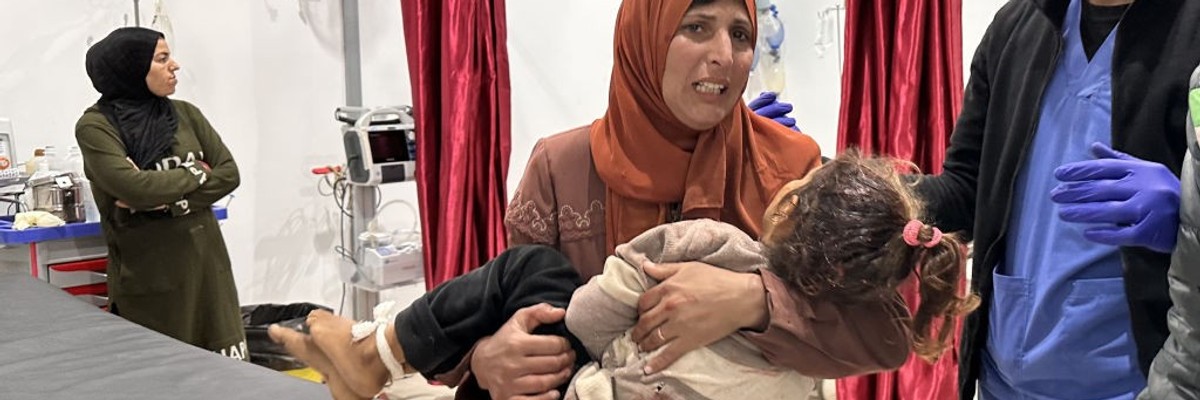
The mother of 5-year-old Neda Muhammed al-Amudi, who was killed in the Israeli army’s January 27, 2025 attack on a horse carriage in the Nuseirat Refugee Camp—a violation of the cease-fire with Hamas—mourns over her body at Awda Hospital in Gaza City, Palestine. (Photo: Fadel A. A. Almaghari/Anadolu via Getty Images.

One group says that Israeli forces have killed at least 110 Palestinians since the cease-fire took effect last month. Among the victims are multiple children, including a 5-year-old girl.

Hamas on Monday announced the suspension of its next planned release of hostages kidnapped during the October 7, 2023 attack on Israel, accusing that country of violating the fragile cease-fire agreement it signed last month.

Abu Obeida, the spokesperson for the Qassam Brigades—Hamas’ armed wing— said in a statement that hostages will “remain in place until the occupying entity complies with past obligations and compensates retroactively.”

“Over the past three weeks, the resistance leadership monitored the enemy’s violations and their noncompliance with the terms of the agreement,” Obeida explained. “These violations include delaying the return of displaced persons to northern Gaza, targeting them with shelling and gunfire in various areas of the Gaza Strip, and failing to allow the entry of relief materials in all forms as agreed upon. Meanwhile, the resistance has fulfilled all its obligations.”

https://twitter.com/AJEnglish/status/1889016749820891469?ref_src=twsrc%5Etfw%7Ctwcamp%5Etweetembed%7Ctwterm%5E1889016749820891469%7Ctwgr%5Ebc123f5e8a05a338d373de06e04bbd405a040a62%7Ctwcon%5Es1_c10&ref_url=https%3A%2F%2Fwww.commondreams.org%2Fnews%2Fisrael-hamas-cease-fire

Sorry, this content could not be embedded.
X

Since the cease-fire took effect on January 19, Israeli forces have bombed and shot civilians in Gaza, killing at least 110 Palestinians, according to the Geneva-based Euro-Mediterranean Human Rights Monitor. Palestinian civilians killed over the past few weeks reportedly include multiple childrenone of them a 5-year-old girl—and an elderly woman.

“Israel continues to commit genocide in the Gaza Strip by denying Palestinians the basic necessities for survival and imposing conditions of life calculated to bring about their physical destruction,” the group alleged on Friday.

Euro-Mediterranean Human Rights Monitor continued:

Since the cease-fire, only a handful of injured and ill Palestinians from Gaza have been permitted to travel abroad for treatment, leaving thousands at risk of death due to Israel’s ongoing denial of their right to receive treatment. In addition to ensuring a severe shortage of specialized medical personnel, generators, fuel, and oxygen stations, Israel has obstructed the rehabilitation of destroyed hospitals and blocked the entry of medical supplies, medications, and equipment.

Further, in addition to blocking equipment needed for maintenance and restoration, the ongoing and illegal restrictions by Israel are preventing the entry of temporary shelters, tents, and basic supplies for the hundreds of thousands of Palestinians whose homes it has destroyed…

Israel is deliberately obstructing the restoration of essential infrastructure, including water and sewage systems, endangering civilian lives and worsening environmental and health crises.

This, after over 15 months of Israeli bombardment and invasion of Gaza left more than 170,000 Palestinians dead, wounded, or missing in Gaza and around 2 million others forcibly displaced, starved, or sickened, according to the Gaza Health Ministry and international humanitarian agencies.

U.S. President Donald Trump—whose proposal for an American takeover and redevelopment of the Gaza Strip into the “Riviera of the Middle East” has sparked international condemnation—said Monday that the cease-fire should end, letting “all hell break loose,” if all the remaining 40 or so Israeli and international hostages are not released by noon on Saturday.

The Qassam Brigades on Monday reaffirmed Hamas’ “commitment to the terms of the agreement as long as the occupation adheres to them.”

Original article by Brett Wilkins republished from Common Dreams under Creative Commons (CC BY-NC-ND 3.0). 

Continue ReadingHamas Halts Hostage Release, Citing Deadly Israeli Cease-Fire Violations

All governments must end complicity with genocide, say Scottish Greens

Spread the love

https://morningstaronline.co.uk/article/all-governments-must-end-complicity-genocide-say-scottish-greens

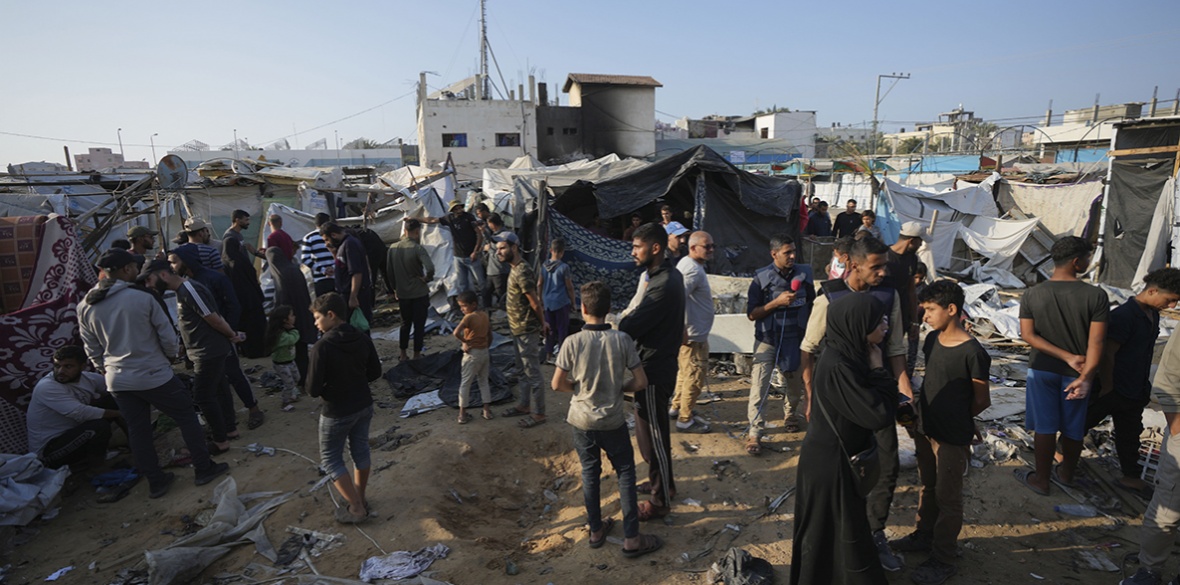
Palestinians gather at the site of an Israeli strike in the courtyard of the Al-Aqsa Hospital where displaced people live in tents, in Deir al-Balah, Gaza Strip, November 9, 2024

THE Scottish Greens used the Armistice Day commemorations today to call on all governments to end their complicity in the Gaza genocide.

The party’s co-leader Patrick Harvie challenged the SNP Scottish government to stop subsidising arms manufacturers, and the Labour government to end all arms sales to Israel as its military continues its bloody assault in Gaza.

Mr Harvie said: “After the horrors of October 7, the last 400 days have seen some of the worst war crimes of this century carried out against the people of Gaza.

“By arming and supporting Israel, the UK has made itself utterly complicit in the destruction.

“How can [Prime Minister Sir] Keir Starmer and his colleagues look at a humanitarian emergency on that scale and decide to continue the arms sales?

https://morningstaronline.co.uk/article/all-governments-must-end-complicity-genocide-say-scottish-greens

Continue ReadingAll governments must end complicity with genocide, say Scottish Greens

Slamming Israeli Media Lies, Freed Hostage Says IDF Strike—Not Hamas—Wounded Her

Spread the love

Original article by Brett Wilkins republished from Common Dreams under a CC licence.

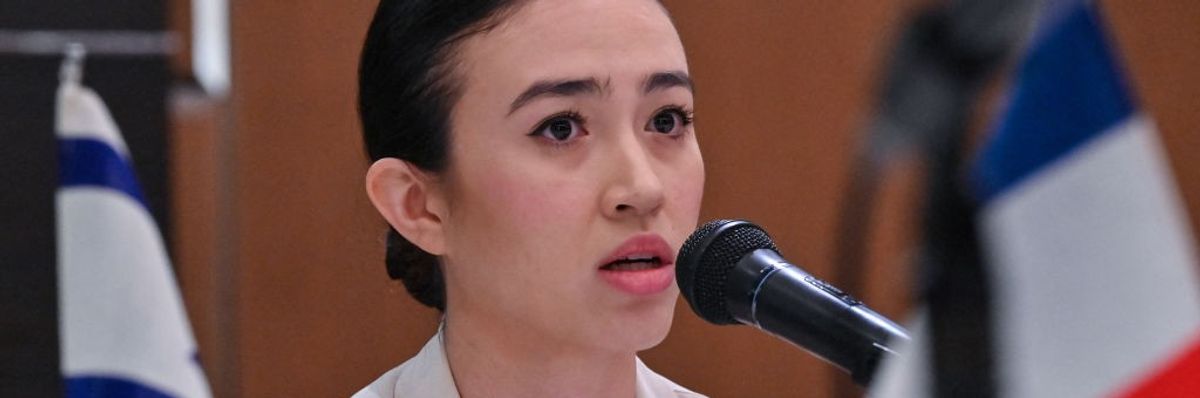
Noa Argamani, an Israeli woman who spent 245 days in Hamas captivity in Gaza after being kidnapped last October 7, meets with representatives of Group of Seven nations in Tokyo on August 21, 2024. (Photo: Richard Brooks/AFP via Getty Images)

“I cannot ignore what happened here over the past 24 hours, taking my words out of context,” said Noa Argamani. “As a victim of October 7, I refuse to be victimized once again by the media.”

An Israeli woman kidnapped by Hamas militants on October 7 and held hostage for 245 days before being rescued lashed out on Friday at Israeli media outlets that twisted her words to make it seem as if she was wounded by her captors when in reality she was injured in an attack by the military in which she once served.

Responding to reports in outlets including The Jerusalem Post—which on Thursday ran the headline “Hamas Beat Me All Over”—Noa Argamani said on Instagram that “I can’t ignore what happened in the media in the last 24 hours.”

“Things were taken out of context,” the 26-year-old navy veteran from Be’er Sheva said of her earlier comments to Group of Seven diplomats in Tokyo. “I was not beaten… I was in a building that was bombed by the Air Force.”

“I emphasize that I was not beaten, but injured all over my body by the collapse of a building on me,” Argamani added. “As a victim of October 7, I refuse to be victimized once again by the media.”

Prominent Israelis including President Isaac Herzog and pro-Israel voices around the world including writer Aviva Klompas and the Australia Israel and Jewish Affairs Council amplified the false claim that Argamani was “beaten” by her captors.

Argamani was partying with her boyfriend Avinatan Or at the Nova rave near the Gaza border when the festival was attacked by Hamas-led militants in the early morning hours of October 7. In now-famous video footage, she is seen begging, “Don’t kill me!” as her captors whisk her away toward Gaza on a motorcycle. Or was also kidnapped and is believed to still be in Hamas custody.

“Every night, I was falling asleep and thinking, this may be the last night of my life,” Argamani said Thursday of her time in captivity.

Argamani was one of four Hamas captives rescued during a June raid on the Nuseirat refugee camp in Gaza, an operation in which Israeli forces killed at least 236 Palestinians, most of them women and children. Three other Israeli hostages taken from the Nova rave were also rescued in the raid.

“It’s a miracle because I survived October 7, and I survived this bombing, and I also survived the rescue,” Argamani said in Tokyo on Thursday.

Argamani’s rescue fulfilled a dying wish from her mother, who had terminal cancer, to be reunited with her daughter before she passed. Argamani was also freed on the birthday of her father, Yakov Argamani, who, from the start of the hostage ordeal, urged Israeli leaders to eschew revenge after the October 7 attack.

There are believed to be around 109 Israelis and others still held captive by Hamas in Gaza. Argamani implored the government to make freeing them its top priority.

“Avinatan, my boyfriend, is still there, and we need to bring them back before it’s going to be too late,” she said Thursday. “We don’t want to lose more people than we already lost.”

More than 1,100 Israelis and others including Thai farmworkers were killed on October 7, at least some of them in so-called “friendly fire” attacks by Israeli forces. The Israel Defense Forces (IDF) employed a protocol known as the “Hannibal Directive” authorizing lethal force against Israeli soldiers in order to prevent them from being taken prisoner by enemy forces. More than 240 Israelis and others were abducted by Hamas and other militants.

Freed hostages have recounted being fired upon by Israeli aircraft as they were being taken by Hamas militants to Gaza. One former captive said in December that “every day in captivity was extremely challenging. We were in tunnels, terrified that it would not be Hamas, but Israel, that would kill us, and then they would say Hamas killed you.”

Numerous Israeli hostages have been killed by their would-be rescuers, including a trio of men who managed to escape from their captors and were waving white flags and shouting for help in Hebrew when they were shot dead by IDF soldiers in Gaza in December, and five Israelis who likely suffocated to death due to a fire sparked by an Israeli assault six months ago on the tunnel where the hostages were being held.

In contrast to former Palestinian prisoners held by Israel—who, along with Israeli whistleblowers, have reported systemic torture, rape, starvation, and even murder committed by their captors—numerous Israelis kidnapped by Hamas have reported being relatively well treated. Other former hostages said they were physically, sexually, and psychologically abused.

Taking civilian hostages is a war crime in itself.

Israel’s 322-day retaliation for October 7 has left at least 144,000 Palestinians dead, wounded, or missing. Nearly all of Gaza’s 2.3 million people have been forcibly displaced by Israel’s bombardment and invasion, which has flattened much of the coastal enclave. A crippling siege has pushed hundreds of thousands of Gazans over the brink of starvation, with at least dozens of children dying of malnutrition, dehydration, and lack of medical care. Preventable diseases including measles, hepatitis, and polio threaten public health not only in Gaza but also in Israel and other neighboring nations.

Israel is currently on trial for genocide at the International Court of Justice.

Original article by Brett Wilkins republished from Common Dreams under a CC licence.

hostages News and Opinion | Common Dreams

Continue ReadingSlamming Israeli Media Lies, Freed Hostage Says IDF Strike—Not Hamas—Wounded Her

The Gaza Project Exposes Israel’s ‘Chilling Pattern’ of Killing Journalists

Spread the love

Original article by BRETT WILKINS republished from Common Dreams under a CC licence.

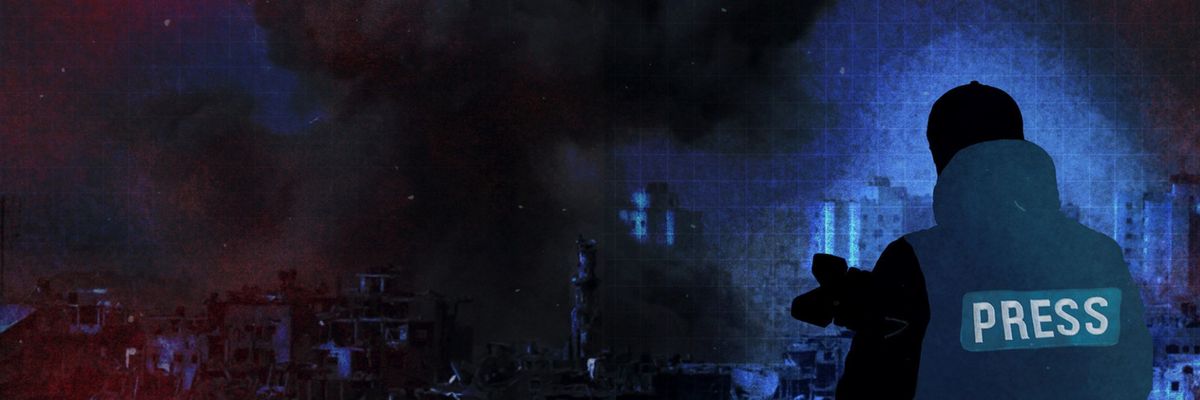
Forbidden Stories and its Gaza Project partners investigated Israel’s killing of journalists in Gaza and elsewhere.
 (Illustration: Forbidden Stories/The Gaza Project)

“This is one of the most flagrant attacks on press freedom that I can remember,” said one campaigner. “The impact on press freedom in Gaza, in the region, and the rest of the world is something we cannot accept.”

With more than 100 media professionals—nearly all of them Palestinian—killed in Gaza since October, a group of 50 reporters from 13 international organizations this week shared the results of a new investigative journalism initiative aimed at exposing the deadly toll Israel’s onslaught has taken on those reporting it to the world.

The Gaza Project—led by the Paris-based nonprofit Forbidden Stories—”analyzed nearly 100 cases of journalists and media workers killed in Gaza, as well as other cases in which members of the press have been allegedly targeted, threatened, or injured since October 7,” when Hamas-led attacks on Israel left more than 1,100 people dead and over 240 others kidnapped.

“Faced with what is being reported as the record number of journalists killed, Forbidden Stories, whose mission is to pursue the work of journalists who are killed because of their work, set out to investigate the targeting of journalists,” the group said

“For four months, Forbidden Stories and its partners investigated the circumstances of their killings, as well as those who have been targeted, threatened, and injured in the West Bank and Gaza,” it added. “These investigations point to a chilling pattern and suggest some journalists may have been targeted even though they were identifiable as press.”

Gaza Project member Committee to Protect Journalists (CPJ) has condemned what it called an “apparent pattern of targeting journalists and their families,” noting cases in which media workers were killed while wearing press insignia and after being threatened by Israeli officials.

“This is one of the most flagrant attacks on press freedom that I can remember,” CPJ program director Carlos Martínez de la Serna said of the ongoing war. “The impact on press freedom in Gaza, in the region, and the rest of the world is something we cannot accept.”

Basel Khair Al-Din, a Palestinian journalist in Gaza who believes he was targeted by a drone strike while wearing a press vest, said, “Whereas this press vest was supposed to identify and protect us, according to international laws, international conventions, and the Geneva Conventions, it is now a threat to us.”

“It’s this vest that almost got us killed, as has happened to so many of our fellow journalists and media workers,” he added.

Groups like Human Rights Watch (HRW) and Amnesty International have called for official investigations into Israeli killing of journalists including an October 13 attack that killed 37-year-old Lebanese Reuters videographer Issam Abdallah and wounded half a dozen other journalists who were covering cross-border clashes between Israeli troops and Hezbollah fighters in southern Lebanon.

Dylan Collins, an American deputy editor at Al Jazeera English, was wounded while administering first aid to Christina Assi, an Italian Agence-France Presse journalist whose legs were blown off in the attack.

Reuters determined that an Israeli tank crew “fired two shells in quick succession” at the journalists, who HRW said were “clearly identifiable as members of the media, and had been stationary for at least 75 minutes.” HRW “found no evidence of a military target near the journalists’ location.”

Amnesty International, meanwhile, asserted that the Israel Defense Forces (IDF) strike was “likely a direct attack on civilians that must be investigated as a war crime.”

Asa Kasher, the lead author of the IDF’s Code of Ethics, told Forbidden Stories that “no member of the press should have been killed under normal circumstances of hostilities in Gaza.”

“It shouldn’t happen, even a single one,” he added. “It’s illegal. It’s unethical. The person who does it should be brought to court.”

Israel’s alleged deliberate targeting of journalists is part of the evidence presented in a South Africa-led genocide case against Israel being reviewed by the International Court of Justice in The Hague.

Separately, the chief prosecutor at the International Criminal Court (ICC), also located in the Dutch city, is seeking arrest warrants for Israeli Prime Minister Benjamin Netanyahu, Israeli Defense Minister Yoav Gallant, and three Hamas leaders for alleged war crimes and crimes against humanity including extermination and forced starvation in the case of the Israelis and extermination, rape, and torture in the case of Hamas.

The international press freedom group Reporters Without Borders last month filed a third ICC complaint alleging “war crimes against journalists in Gaza.”

According to Palestinian and international officials, at least 37,718 Palestinians—mostly women and children—have been killed during Israel’s 264-day assault on Gaza, which has also left more than 86,300 people wounded and 11,000 others missing and feared dead and buried beneath the rubble of hundreds of thousands of homes and other bombed-out buildings.

Around 90% of Gaza’s 2.3 million people have also been forcibly displaced, and the Israeli siege on Gaza has caused widespread—and deadly—starvation and what the head of the United Nations food agency called a “full-blown famine” in northern parts of the strip.

Original article by BRETT WILKINS republished from Common Dreams under a CC licence.

Zionist Keir Starmes is quoted "I support Zionism without qualification." He's asked whether that means that he supports Zionism under all circumstances, whatever Zionists do.
Zionist Keir Starmes is quoted “I support Zionism without qualification.” He’s asked whether that means that he supports Zionism under all circumstances, whatever Zionists do.

Continue ReadingThe Gaza Project Exposes Israel’s ‘Chilling Pattern’ of Killing Journalists