Original article by Ramzy Baroud republished from Common Dreams under Creative Commons (CC BY-NC-ND 3.0).
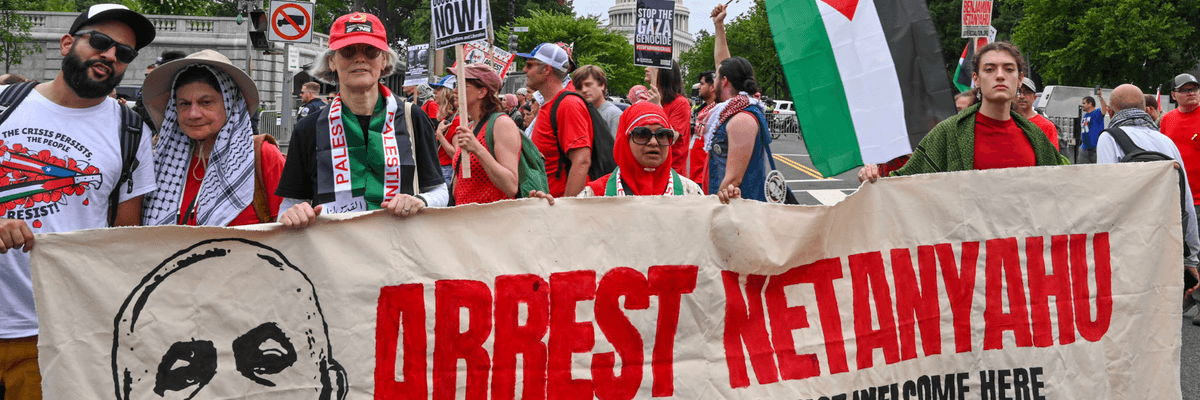
Growing support for Palestine means that more U.S. voters will base their future political decisions on how the U.S. engages with Israel and its disregard for Palestinian rights.
It is crucial for any American administration to recognize that, regardless of political agendas, the views of the American public regarding the situation in Palestine and Israel are undergoing a significant shift. A critical mass of opinion is rapidly forming, and this change is becoming undeniable.
Paradoxically, while Islamophobia continues to rise across the U.S., sentiments supporting Palestinians and opposing Israeli occupation are steadily increasing.
In theory, this means that the pro-Israeli media’s success in linking Israel’s actions against the Palestinian people to the so-called “war on terror”—a narrative that has demonized Islam and Muslims for many years—is faltering.
Palestine may not be the sole measure by which the Trump administration will be judged, nor the only factor shaping future voting patterns. Yet, it is undoubtedly a crucial test.
Americans are increasingly viewing the situation in Palestine as a human rights issue, and one that is deeply relevant to domestic politics. A recent Gallup poll underscores this shift.
The poll, released on March 6, was conducted between February 3 and 16. It found that American support for Israel is at its lowest point in 25 years, while sympathy for Palestinians has reached its highest level. Having 46% of Americans supporting Israel and 33% supporting Palestinians would have seemed inconceivable in the past, when the plight of Palestine and its people was largely overlooked by the general public.
Even more remarkable is that this shift continues to gain momentum, despite the fact that mainstream media and American politicians have been more biased than ever, promoting a dehumanizing discourse of Palestinians and unprecedented, uncritical support for Israel.
While the growing shift in favor of Palestine—particularly the genocide in Gaza, which played a role in influencing political outcomes in several states during the last presidential election—had gone largely unnoticed by the Biden administration, it’s clear that the dissatisfaction with the government’s position remains unchanged.
The previous administration approved significant military aid to Israel, topping $17.9 billion in the first year alone, enabling its genocidal war in Gaza, resulting in over 160,000 casualties over a span of 15 months.
Yet, this blatant disregard for Palestinian lives and rights persisted under the new administration of President Donald Trump, who appointed some of the most staunchly anti-Palestinian, pro-Israel figures to key positions in his government.
Trump did this despite making repeated, though often contradictory, promises to end the war and resolve the Israeli-Palestinian conflict.
Instead, the U.S. president approved the release of a shipment of heavy MK-84 bombs and passed a nearly $3 billion arms sale to Israel.
Trump also introduced a new U.S. policy that solely focused on “taking ownership” of Gaza and displacing its population. Although this position was inconsistently articulated, Trump ultimately, on March 14, seemed to reverse it altogether. This left many wondering whether U.S. foreign policy was truly independent or simply a reflection of Israel’s influence and its Washington lobby.
Unlike Biden, whose support for Israel has been consistent, Trump’s stance has been confusing and contradictory. The U.S. news portal Axios reported on March 5 that talks between the U.S., led by Adam Boehler, and Hamas had taken place in Doha. In an interview with CNN four days later, Boehler made the striking statement that U.S. and Israeli foreign policies should be seen as separate. “We’re the United States. We’re not an agent of Israel,” he said.
However, as analysts began mulling over this unprecedented language, it was soon revealed that Boehler was removed from his position, and the traditional, unwavering support for Israel quickly returned.
As U.S. policymakers continue to swing between their unwavering commitment to Israel and the “America first” rhetoric, they must keep in mind the following.
First, the American public is increasingly aware of events in Palestine, so masking Israel’s violations of Palestinian rights under the guise of “Israel’s right to defend itself” no longer suffices.
Second, U.S. and Israeli interests are not identical: The U.S. seeks geopolitical dominance followed by stabilization and so-called “containment,” while Israel thrives on provocations, destabilization, and long-lasting conflicts.
Third, Palestine has become a domestic issue in the U.S., and the debate on Palestine and Israel is no longer one-sided. Growing support for Palestine means that more U.S. voters will base their future political decisions on how the U.S. engages with Israel and its disregard for Palestinian rights.
Fourth, crackdowns on dissent, arrests of activists, and funding cuts will only deepen the polarization around this issue, rather than fostering an open, informed, and productive debate about a matter of great importance to millions of Americans. Such actions are quickly eroding the reputation of the U.S. as a democratic state and undermining confidence in its commitment to a peaceful resolution of the conflict.
Palestine may not be the sole measure by which the Trump administration will be judged, nor the only factor shaping future voting patterns. Yet, it is undoubtedly a crucial test. If the contradictions persist, and the U.S. continues to provide unwavering military support for Israel, Palestine could become the defining issue that contributes to the unraveling of U.S. foreign policy, not only in the Middle East but around the world.
It is not too late for this trajectory to shift, or for some degree of balance to emerge. The lives of millions are at stake.
Original article by Ramzy Baroud republished from Common Dreams under Creative Commons (CC BY-NC-ND 3.0).


- The Older Generation of Politicians Can’t Stop the American Intifada
- 5 Things a Year of Israeli Genocide in Gaza Has Taught Us About Palestine and the World
- The Gaza War Won’t End by Imposing a “Solution” on Palestinians
- Israel-Palestine: What Could Be a Nonviolent Path Forward for Ending Oppression?
- Trump Proves He’s Still No Friend of Gaza
- US Corporate Media Complicit in Demonizing Pro-Palestinian Protesters

