U.S. Department of Energy Secretary Chris Wright handpicked the five contrarian scientists who authored a controversial new climate report.Tom Williams/CQ-Roll Call, Inc via Getty Images
Researchers say DOE report cherry-picks data to downplay threat of greenhouse gases
The last assessment of the state of climate science from the United Nations’s Intergovernmental Panel on Climate Change (IPCC), published in its final form 2 years ago, was a monumental effort, with 721 volunteer scientists synthesizing all available published research. Yesterday, the Department of Energy (DOE) released its own climate assessment, as part of a campaign by the U.S. Environmental Protection Agency (EPA) to overturn its landmark endangerment finding from 2009, which found that burning fossil fuels endangers public health and established carbon dioxide as a pollutant EPA could regulate. But the DOE report—called A Critical Review of Impacts of Greenhouse Gas Emissions on the U.S. Climate—had fewer authors than IPCC’s: just five.
Handpicked by DOE Secretary Chris Wright, a fossil fuel entrepreneur, the authors are well known to climate scientists. Although the members of this Climate Working Group all hold scientific doctorates, they hold contrarian views on climate science that are out of step with the mainstream. The report, assembled in months, argues that some of the warming attributed to fossil fuel burning is instead driven by natural cycles or variability in the Sun, and that sea level rise has not been accelerating. Climate researchers say the authors cherry-picked evidence and highlighted uncertainties to achieve the net effect of downplaying the impacts of climate change. “This shows how far we have sunk,” says Naomi Oreskes, a historian of science at Harvard University. “Climate denial is now the official policy of the U.S. government.”
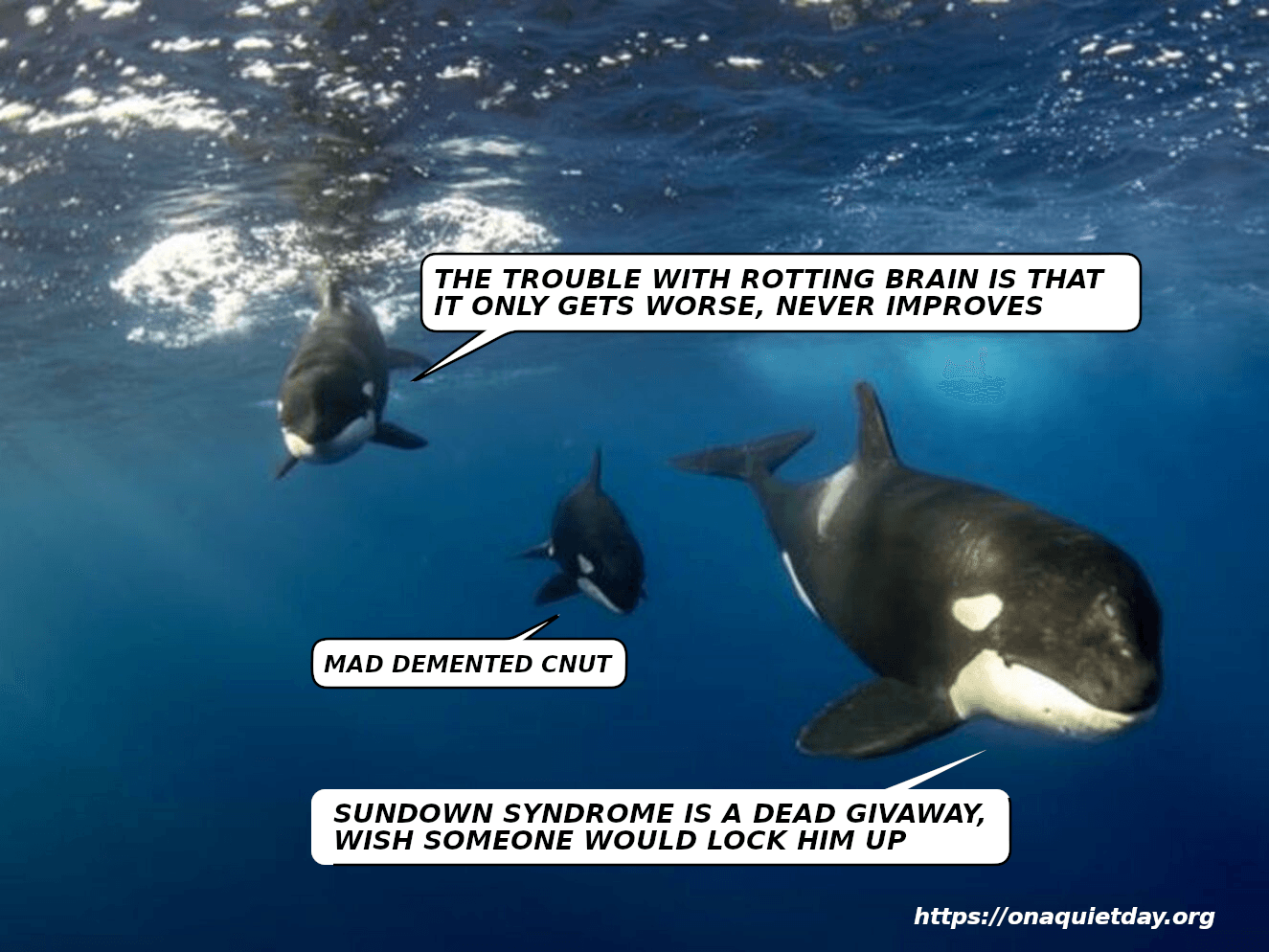
Donald Trump urges you to be a Climate Science denier like him. He says that he makes millions and millions for destroying the planet, Burn, Baby, Burn and Flood, Baby, Flood.Elon Musk urges you to be a Fascist like him, says that you can ignore facts and reality then.Orcas discuss Donald Trump and the killer apes’ concept of democracy. Front Orca warns that Trump is crashing his country’s economy and that everything he does he does for the fantastically wealthy.
The climate crisis is no longer a future threat — it’s a terminal diagnosis, and the only moral response now is to act like everything depends on us, because it does.
Francisco Goya – The Third of May 1808 (1814), A scream against institutional violence and helplessness.
There comes a point in your life when the facts won’t let you look away. You feel it before you know it: something is terribly wrong, and we are running out of time.
So let’s begin with something simple. How do you know something is true?
Take the example of cancer. If you feel a lump or have symptoms, you don’t just ask your mate what they think. You go to a doctor. And not just any doctor — you want a specialist. Someone who’s legally obliged to tell you the truth, however hard it is to hear. You want the tests, the scan, the data. And above all, you want a number: “What’s the likelihood I have it?” Because that number changes everything.
You don’t want vague reassurances. You want the truth. If the doctor says there’s a 50% chance, your life changes in that moment. You go into action. You start making decisions — fast. Because the alternative is death. And no one can run from that.
It’s this same clarity, this same objectivity, that we need to bring to the climate crisis. Because the truth is — and I mean this literally — the planet has cancer. It is spreading. It is terminal. And it is going to kill us if we don’t act, immediately.
This isn’t ideology. It’s not politics. It’s not “just your opinion.” It is physical reality. And just like cancer, it doesn’t care what you believe.
In 1989, NASA scientist James Hansen warned the UN that if we didn’t slash emissions, society would collapse. That was 35 years ago. In 2025, global temperatures have now risen to 1.6°C above pre-industrial levels. And the rate of warming is accelerating. For most of the 20th century, the rise was around 0.18°C per decade. In the last ten years, it’s more than doubled to 0.37°C per decade. We’re now on course to hit 2°C around 2035 — and that’s being optimistic.
But what does that number mean?
A landmark peer-reviewed paper, “The Future of the Human Niche,” published by Tim Lenton and colleagues, makes it brutally clear: at 2°C of warming, around 1 billion people will no longer be able to live where they currently do. That’s 25% of the Earth’s surface becoming uninhabitable. One billion refugees — in just a few years.
To put that into context: there were 50 million refugees after the Second World War. That was the worst war in human history. What’s coming is twenty times worse.
And that figure — one billion — only covers the effects of extreme heat. It doesn’t include what happens when rising sea levels drown coastal cities, when droughts kill crops, when wildfires consume whole regions, when freshwater disappears. The truth is, climate collapse is not just an environmental issue. It is a full-system breakdown. It affects food, health, housing, energy, migration, and war — all at the same time.
Still think this is just about polar bears?
If you’re still not convinced, don’t take it from me. Take it from the insurance industry. In 2024, the British actuarial society — a group of people whose job it is to measure risk for a living — released a report projecting that at 2°C of warming, we’ll see 2 billion deaths. At 3°C? 4 billion. That’s half the population of the Earth.
And this is not worst-case modelling. This is their baseline. This is what the people who insure your life, your business, your pension, believe is most likely to happen if we stay on our current course.
It gets worse. Because climate breakdown isn’t a one-off crisis — it triggers runaway feedback loops. Ice melts and reduces the planet’s ability to reflect sunlight, which makes it heat up faster. Permafrost thaws and releases methane, a greenhouse gas 80 times more potent than CO₂. Forests burn and release carbon. Soils lose their ability to absorb emissions. Everything begins to feed on itself. Even if we stopped all human emissions tomorrow, these systems may continue warming the planet — potentially beyond the point of recovery.
Most tipping points are estimated to be triggered between 1°C and 2°C. We are already at 1.6°C. We are now in the danger zone. There is no longer a buffer. There is no margin of error. This is happening in real time.
So what do we do?
Well, the answer is no different from the cancer patient. Two things: stop making it worse, and start trying to repair the damage. That means ending fossil fuel emissions as fast as humanly possible. That means scaling up emergency carbon removal. That means mobilising everything we’ve got.
Will it work? We don’t know. But what we do know is this: if we do nothing, billions will die. And not in some abstract future. In our lifetimes. In the lifetimes of our children.
This is not a problem for “someone else to solve.” This is your responsibility, your emergency, your world.
Edward Burtynsky – Manufactured Landscapes, a pyre waiting to burn.
And if you think you still have a choice — let me be blunt: you don’t. If your actions or inactions contribute to this collapse, you don’t just destroy your own future. You destroy the lives of everyone around you. You condemn entire generations to hell on Earth because you couldn’t face the truth.
It’s not just foolish. It’s not just selfish. It’s evil.
Let me speak personally for a moment. I’ve met hundreds of people who, after hearing this reality, decided to act. Ordinary people. Teachers, nurses, students, grandparents. They quit their jobs. They faced arrest. Some went to prison. Not because they were heroes. But because they understood this one, simple thing: if we don’t fight, we die. If we don’t rise up, we burn.
You can’t half-commit to this. You can’t give a little donation, feel a bit guilty, and move on. Once you’ve heard the truth, you are accountable. And the only question left is what you’re going to do about it.
So this is your moment. This is the turning point. If you’ve read this far, you already know. You know what’s coming. You know the scale of the crisis. You know the failure of our leaders.
You also know this: we are not powerless. There are millions of us waking up. Rising up. Organising. We are building the resistance that history will remember.
Join us.
Because history is watching. And your children will ask what you did. And one day, in the final hours of your life, you will ask yourself the same question.
Don’t wait for the flood. Don’t wait for the fire. We have no choice but to act. And act we will.
This was meant to be Roger Hallam’s climate briefing for the Rev21 Convention. But prison authorities blocked it. They’ve now banned him from posting on social media altogether.
To keep up with Roger’s work and the revolutionary movement he helped build, follow Rev21 across platforms:
Roger’s release has once again been delayed — originally expected in March, then May, and now postponed indefinitely. First, his designated home was deemed “unsuitable” for rehabilitation because someone associated with Just Stop Oil was present. Then, following press coverage that included the name of his probation officer (quoted directly in the piece), Roger was placed on a high-risk list — supposedly due to the psychological impact on staff. That probation officer has since been replaced, but the new officer has refused to respond to legal communications from Roger’s team.
It now appears that prison staff are refusing to meet with Roger directly, citing the “risk” he poses to them. His lawyers have written to the prison, but there is no legal requirement for them to respond within a set timeframe, leaving him in a state of limbo.
At the same time, Roger’s ability to contribute to public work has been severely restricted. Prison authorities have blocked over 20,000 words of his writing, and his input into the Convention and our social media efforts has been censored. Despite this, Roger continues to engage with projects through prison phone and email, where possible. He remains deeply committed to the cause and continues to support our work with unwavering clarity and determination.
Donald Trump urges you to be a Climate Science denier like him. He says that he makes millions and millions for destroying the planet, Burn, Baby, Burn and Flood, Baby, Flood.Nigel Farage urges you to ignore facts and reality and be a climate science denier like him. He says that Reform UK has received millions and millions from the fossil fuel industry to promote climate denial and destroy the planet.Orcas discuss how Trump was re-elected and him being an insane, xenophobic Fascist.
A view of flames and giant smoke is seen over the sky as a fire erupted at the natural gas Moss Landing Power Plant in Moss Landing of Monterey Bay, California, United States on January 17, 2025. (Photo: Tayfun Coskun/Anadolu via Getty Images)
Scientists said that atmospheric carbon dioxide concentrations peaked above 430 parts per million for the first time in perhaps 30 million years.
The concentration of carbon dioxide in the atmosphere peaked above 430 parts per million in 2025—the highest it has been in millions of years—according to data released by the National Oceanic and Atmospheric Administration and Scripps Institution of Oceanography at the University of California, San Diego on Thursday.
The news was overshadowed by the explosive feud between U.S. President Donald Trump and his erstwhile backer Elon Musk, but climate activist Bill McKibben argued that it was ultimately more consequential.
“In the long run, this is actually going to be the important news of the day—CO2 in the atmosphere passes another grim milestone,” McKibben wrote on social media.
In the long run, this is actually going to be the important news of the day–co2 in the atmosphere passes another grim milestone
Carbon dioxide has been accumulating in the atmosphere due primarily to the human burning of fossil fuels, as well as by the clearing of forests and other natural carbon sinks. There, it acts as a greenhouse gas, trapping heat from the Earth, and is the primary gas responsible for the rise of global temperatures by approximately 1.1°C from the 1850 -1900 average. This warming has already had a host of dramatic impacts, from extreme weather events to sea-level rise to polar ice melt, and scientists warn these impacts will only accelerate under current energy policies, which put the world on track for around 3°C of warming by 2100.
The last time that atmospheric CO2 concentrations topped 430 ppm was most likely more than 30 million years ago, Ralph Keeling, who directs the Scripps CO2 Program, told NBC News.
“It’s changing so fast,” he said. “If humans had evolved in such a high-CO2 world, there would probably be places where we wouldn’t be living now. We probably could have adapted to such a world, but we built our society and a civilization around yesterday’s climate.”
“While largely symbolic, passing 430 ppm should be a wake-up call.”
Scripps and National Oceanic and Atmospheric Administration both measure carbon dioxide levels from NOAA’s Mauna Loa Observatory in Hawaii, where Charles Keeling began taking measurements in 1958. As CO2 levels rise over time, they also follow a seasonal cycle—peaking in May before falling in the Northern Hemisphere summer and rising again in the fall.
This May, Scripps Oceanography calculated an average of 430.2 ppm for 2025, which is 3.5 ppm over the average for May 2024. NOAA’s Global Monitoring Laboratory, meanwhile, calculated a monthly average of 430.5 ppm, a 3.6 ppm jump from the year before and the second-steepest yearly climb since 1958.
“Another year, another record,” Keeling said in a statement. “It’s sad.”
JUST IN: Atmospheric carbon dioxide (CO2) concentrations have peaked for the year at 430.5 ppm.📈 This is 3.6 ppm higher than last year and the second largest May-May increase in the 67-year Mauna Loa record. In 2023, the CO2 peaked at 424 ppm. 🔗: https://t.co/adhNurvOtEpic.twitter.com/t1VUSCeKgU
The news comes two months after Mauna Loa daily measurements surpassed 430 ppm for the first time in March, which Plymouth Marine Laboratory professor Helen Findlay called “extremely disappointing and worrying.”
“While largely symbolic, passing 430 ppm should be a wake-up call, especially given the accelerated response we are seeing of glaciers and ice sheets to current warming,” Dr. James Kirkham, chief scientist of the Ambition on Melting Ice coalition of governments, said at the time.
“This upward trajectory is a direct result of continued fossil fuel use, likely exacerbated by emissions from extreme wildfires last year, methane leaks from fossil fuel extraction and possibly greater permafrost emissions, alongside decreased ability of very warm oceans to absorb CO2,” Kirkham said.
The monthly record also comes a little more than a week after a United Nations report warned that there was a small chance global temperatures could surpass 2°C in at least 1 of the next 5 years, only a decade after world leaders pledged in the Paris agreement to keep global temperatures “well-below” that level.
“Carbon emissions are still rising, and the atmosphere is going to keep heating further until greenhouse gas concentrations stabilize,” Matt Kean, who chairs Australia’s Climate Change Authority, wrote in response to the Scripps and NOAA figures. “What sort of climate do we want to leave our children and those who come after them?”
Orcas discuss Donald Trump and the killer apes’ concept of democracy. Front Orca warns that Trump is crashing his country’s economy and that everything he does he does for the fantastically wealthy.Neo-Fascist Climate Science Denier Donald Trump says Burn, Baby, Burn.Elon Musk urges you to be a Fascist like him, says that you can ignore facts and reality then.
Federal subsidies to the oil and gas sector totalled $74.6 billion over five years, Environmental Defence found. Credit: David Niddrie / Flickr (CC BY NC 2.0)
Amid trade war talk of expanding Canadian energy infrastructure, a new report reveals that direct Canadian subsidies to the fossil fuel and petrochemical sectors reached nearly $30 billion in 2024.
For comparison’s sake, Canada spent between $38 billion and $39 billion on defense in 2024.
“Oil and gas companies – emboldened by their influence over President Trump – are exploiting the current economic uncertainty to call on governments to double down on fossil fuels,” Julia Levin, associate director of national climate with nonprofit group Environmental Defence, which put out the report, said in a statement.
Levin notes that oil and gas companies have been vocal in their demand that politicians work to expand pipelines and related projects, and seek new export markets for Canadian fossil fuels. Meanwhile, Canadian taxpayers, who fund the companies’ subsidies, face the expensive consequences of climate change and related disasters.
In recent weeks, the chief executives of Canada’s major oil and gas companies — including Suncor, Cenovus, Enbridge, and Imperial — signed an open letter to the leaders of four of Canada’s major political parties. In it, they demand federal party leaders to eliminate regulations, emissions caps, tanker bans on the West Coast, and carbon levees on major emitters.
The open letter was endorsed by prominent Canadian conservatives, including Conservative Party leader Pierre Poilievre. Alberta Premier Danielle Smith recently repeated many of the same industry talking points in defending her taxpayer-funded trip to attend a controversial PragerU fundraiser where she shared a stage with far-right influencer Ben Shapiro.
Last month, Liberal leader Mark Carney indicated his interest in building new east-west pipelines, ostensibly to reduce dependence on foreign imports and develop new trade opportunities.
“This push ignores the fact that fossil fuels come at a high price — not just at the pump, but through rising costs of groceries, worsening health outcomes, damage to property and huge government handouts,” said Levin in the statement.
“It also ignores the rapid energy transition towards renewable energy that is happening globally.”
Among Environmental Defence’s principal findings is that the Canadian government spent $29.6 billion on the fossil fuel sector in 2024, which is nearly $6 billion more than what it would cost to build interprovincial grid connection infrastructure. Recent research from the International Institute for Sustainable Development suggests that a national electrical grid could lower electricity costs nationwide, create hundreds of thousands of new clean tech jobs, stabilize electricity costs, improve Canadians’ health, and provide Canada with the energy security currently threatened by the Trump trade war.
The Trans Mountain project has received $21 billion in government financing. Credit: Sally T. Buck / Flickr (CC BC NC ND 2.0)
Canada’s direct subsidies includes approximately $21 billion in financing for the Trans Mountain Pipeline, $7.5 billion from Export Development Canada (which included money for LNG and carbon capture, and financing for Canadian companies and companies and governments seeking to buy Canadian products), and another $700 million for LNG infrastructure.
Big Oil regularly promotes LNG and carbon capture as potential solutions for the climate crisis, though these arguments have been thoroughly debunked. LNG advocates in Canada often characterize it as a “bridge fuel” that could be used to help developing nations transition away from coal. Recent research indicates that the world’s two largest coal users — India and China — are in fact transitioning directly to renewable energy systems like solar and wind.
Moreover, LNG is a deadly fossil fuel that also happens to be resource intensive to produce, and often results in large volumes of methane emissions. Methane is estimated to be 80 times more potent a greenhouse gas than carbon dioxide. As for carbon capture, recent research from the Institute for Energy Economics and Financial Analysis poured cold water on Canada’s premier industry-driven carbon capture project — Pathways Alliance — determining that it is not financially viable and is unlikely to provide any environmental benefit. This determination is consistent with expert analyses of other carbon capture projects, both in Canada and globally.
Canada Has Given Away $74.6 Billion in Subsidies
Environmental Defence estimates Canada spent $2.4 billion on carbon capture projects in 2024, more than in previous years.
The group’s report also determined that federal subsidies to the oil and gas sector over the last five years amounted to $74.6 billion. Their analysis of what constitutes federal fossil fuel funding includes direct grants, tax breaks, loans, and loan guarantees from the government of Canada and some federal agencies (such as Export Development Canada).
Despite oil industry claims that fossil fuel companies are investing in climate solutions (claims that have led the federal government to introduce anti-greenwashing legislation), Environmental Defence found that none of Canada’s four largest industry companies reported investments in climate initiatives or emissions reductions as part of their capital spending.
The report has also reveals that pollution created by oil and gas companies reached an estimated $53 billion in 2024. This includes increased health costs, property damage from extreme weather events, as well as decreased agricultural productivity, a consequence of changing weather patterns.
“The calls for a new oil pipeline pose real risks to Canadian taxpayers,” said Levin in an email to DeSmog, noting not only that global demand for oil is set to peak in the next four years and then significantly decline, but that oil demand is already showing signs of plateauing in major energy markets like China.
“No company is willing to bet its own money on what is guaranteed to quickly become a massive stranded asset,” said Levin. “Instead, oil and gas companies want taxpayers to pay the price for new fossil fuel infrastructure as their wealthy shareholders reap the rewards.”
Levin is particularly critical of the under reported fact that federal subsidies to the fossil fuel sector have deepened Canada’s economic vulnerability.
“The Canadian public is already on the hook for the new Trans Mountain Pipeline — to the tune of somewhere around $30 to $40 billion and rising. And the project has done nothing to reduce our dependence on the United States, with nearly half its oil still flowing south of the border,” she said.
Orcas discuss how Trump was re-elected and him being an insane, xenophobic Fascist.
Donald Trump is repeating the same mistakes of short-lived former UK Prime Minister Liz Truss. It’s not a few uber-rich individuals that maintain economic health, concentrating wealth is unhealthy. The rich wouldn’t be rich if they were willing to spend their money. It is the poor that are forced to spend to survive, they have no choice. Making the poor poorer to make a tiny minority richer is counter-productive as markets globally are showing.
Additionally, Trump is a sullen, arrogant bigot unwilling to recognise the overwhelming urgency of climate action. Even marine mammals recognise this.
Elon Musk urges you to be a Fascist like him, says that you can ignore facts and reality then.