People using a ticket machine at Waterloo train station in London
THE government was urged to ditch “parasitic” private contracts today after it emerged that regulated train fares in England could soar by 5.8 per cent next year.
This year fares went up 4.6 per cent — one point higher than last July’s retail prices index (RPI).
…
The government is set to renationalise all train operators by 2027 and integrate them into Great British Railways, a new public body which will also oversee rail infrastructure.
However GBR will continue to lease rolling stock, carriages and locomotives, from private firms. Outsourced contracts, such as those for cleaning staff, are also set to remain.
A spokesperson for rail union RMT said: “Our analysis shows that £720 million is extracted each year from our railways through rolling stock leasing, outsourcing and subcontracting.
“Eliminating that profiteering would allow fares to be cut by 6.5 per cent.
“The government has an opportunity under GBR to remove these parasitic contracts that drain resources from the network and instead offer real value for money for passengers through public ownership.”
Chancellor of the Exchequer Rachel Reeves arrives to meet students on the carpentry course during a visit to Bury College in Greater Manchester, March 20, 2025
…
Fourteen years of Tory rule have cut services to the bone. The notion that “efficiency savings” can slice off further billions without worsening already degraded services is absurd.
Ironically, the cuts are intended to fund increased military spending — though if there is a department renowned for waste it is the Ministry of Defence. The MoD is repeatedly excoriated by the public accounts committee for the huge sums squandered on projects that end up delayed by years or not delivered at all.
Current Defence Secretary John Healey, when in the shadow cabinet, published a report identifying billions it had overspent on projects and billions more paid for cancelled contracts with its often extortionate suppliers. The report noted that the MoD had even been fined £32.6 million by the Treasury for its “poor accounting practices.” Yet it is this department which is having more billions thrown its way.
As for extortionate suppliers, the evidence is plain that besides tying institutions from hospitals to schools into contracts forcing them to repay PFI debts worth multiples of the original loans, many such agreements also tie them into inflexible and costly servicing contracts.
Outsourcing services is massively inefficient, yet remains the norm, despite Reeves’s one-time promise to deliver “the biggest wave of insourcing in a generation.”
As the Prison Officers Association (POA) points out of outsourced prison maintenance, we end up paying through the nose for “crumbling cells, compromised safety and rodent-infested jails.”
“We do not for one minute accept that the privatised model of prison maintenance is more cost effective than insourcing … it is completely delusional to claim it provides best value for the taxpayer,” POA general secretary Steve Gillan observes.
Clearly value for money is not Reeves’s priority — corporate profits are, including at the Treasury’s expense.
Keir Starmer commits to play the caretaker role for Capitalism through the “hard times”.Keir Starmer explains the moral case for cutting disability benefits. He says work will set you free.
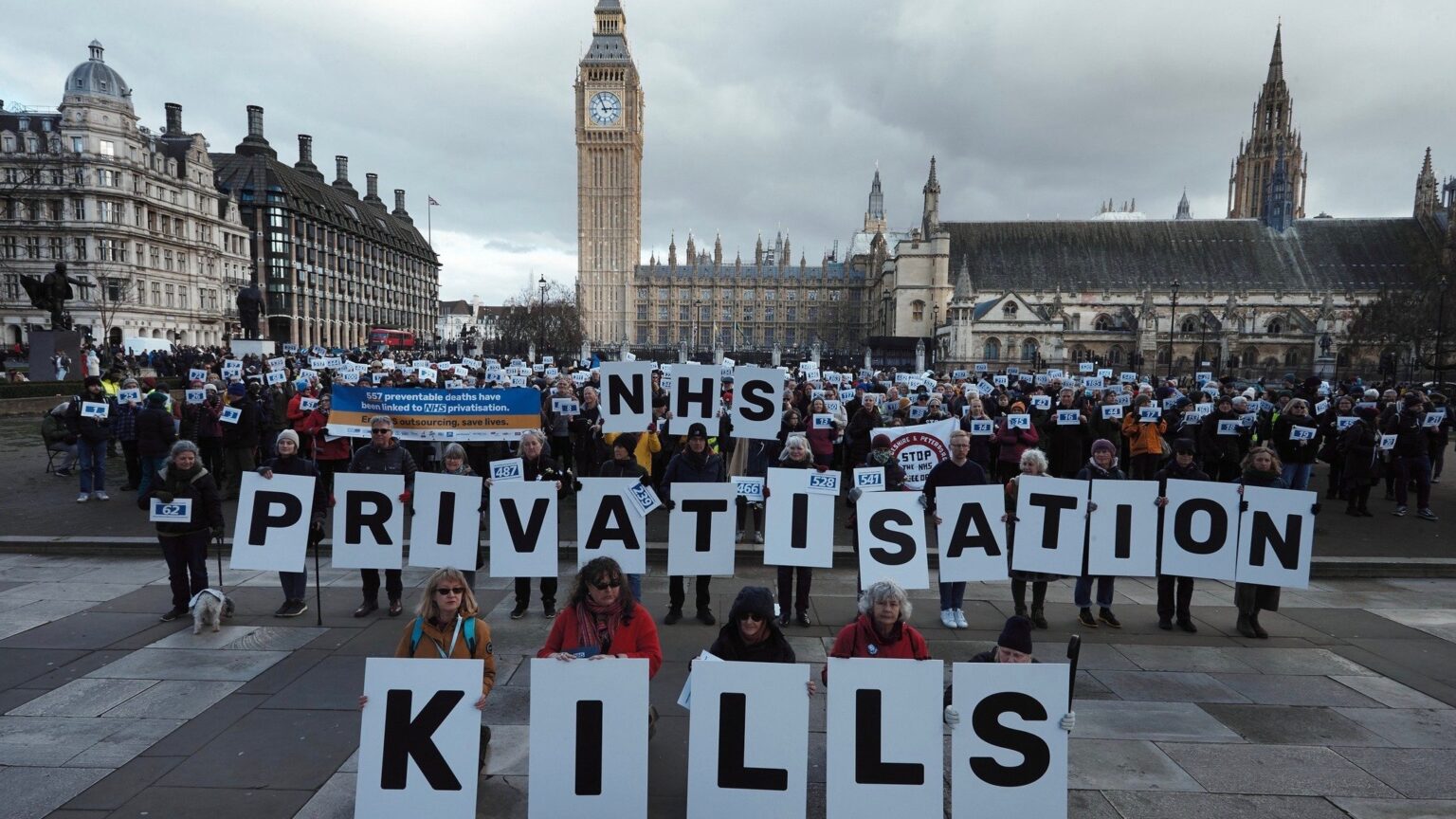
Protest against privatization of the NHS in the UK, February 25, 2023. (Photo: We Own It)
The UK Labour government is considering increasing the role of private healthcare providers, weakening NHS capacities
The Labour Party is considering a major expansion of the private sector’s involvement in the National Health Service (NHS) as it attempts to reduce waiting lists in the United Kingdom. Recently, the Independent Healthcare Providers Network (IHPN) wrote to Keir Starmer’s government, stating that private providers are ready to spend £1 billion to accommodate more NHS patients—if the government guarantees them long-term work.
While the offer has been welcomed by officials from the Department of Health, health activists have raised alarms over the plan. The We Own It campaign warned that a resurgence of the Private Finance Initiative (PFI) policy, as essentially proposed by the private sector, would lead to higher debt, staffing shortages, and diminished NHS training capacities.
This wouldn’t be the first time private capital has been welcomed by a Labour administration. When Tony Blair was Prime Minister, PFI entrusted the private sector with financing the construction of hospitals to fill gaps in the NHS network. The NHS would then pay back the costs of building such infrastructure—with interest—over the course of 25 years or more, eventually becoming the owner.
However, earlier reports indicated that while the NHS gained £13 billion in assets through PFI, it also ended up with £80 billion in debt. This meant that until at least 2022, some NHS trusts spent more on servicing debt to the private sector than on medical supplies.
There is no indication that the current government would introduce stronger safeguards when implementing a new phase of the initiative, dubbed PFI 2.0. If anything, the situation might worsen. While the previous round of PFI left some infrastructure for the public sector, PFI 2.0 foresees nothing of the sort. The additional capacities would be entirely private, with the only public involvement being the money paid to them.
“PFI 2.0 would not only drastically expand private provision in the health service, it will also dramatically increase how much is sucked out of the NHS in profits,” We Own It suggested in its analysis. Currently, private companies siphon £10 million weekly from the NHS. Guaranteeing even more private contracts would add to that burden, leaving fewer funds to invest in the NHS’s own capacities.
Labour fails to grasp importance of publicly-owned NHS
According to a recent inquiry, these capacities are in dire need of strengthening, as health activists have claimed for decades. The inquiry indicated that years of austerity have left a deep mark on the NHS, and it was this—not staff inefficiency—that led to the crisis. Unfortunately, the inquiry failed to underline the importance of breaking ties with the private sector and keeping the NHS publicly-owned, according to the group Keep Our NHS Public.
Even if it did, it is highly likely that Health Secretary Wes Streeting would not understand the importance of such a strategy. Speaking at a party conference in September, Streeting expressed enthusiasm about “reform,” a code word used by governments for “anything but public investment in public capacities.”
“Reform or die. We choose reform,” the Health Secretary said. His approach has left activists understandably worried that the government is sticking to a vague health reform agenda instead of making material commitments to protect the NHS.
Rather than pursuing a shift from “analog to digital,” Keep Our NHS Public argued, the government should pledge to move away from underfunding, fragmentation, and outsourcing. As health workers and their trade unions have raised multiple times, a true strategy to protect the NHS must also include a commitment to improving working conditions and ensuring fair salaries.
If the private sector’s role is expanded, this would not be a realistic option. “The private sector does not have its own staff,” We Own It warned. “They steal staff, trained at huge public expense, from the NHS.”
Further involvement of the private sector would also reduce the NHS’s capacity to train new staff, the group stated. The procedures usually handled by the private sector are often critical for the hands-on experience needed by medical trainees. With fewer procedures of this kind being performed in NHS hospitals, these learning opportunities would disappear, condemning new generations of health workers to lower-quality education and undermine patient care.
“If PFI 1.0 was one of the nails in the coffin of the NHS as we know it, PFI 2.0 is the true end of our NHS as a public service that works for patients, not profit,” We Own It warned.
People’s Health Dispatch is a fortnightly bulletin published by thePeople’s Health Movement and Peoples Dispatch. For more articles and to subscribe to People’s Health Dispatch, clickhere.

 People using a ticket machine at Waterloo train station in London