‘No Safe Place Left’ as Israel Moves to Ethnically Cleanse Nearly 1 Million Gazans

Spread the love

Original article by Brett Wilkins republished from Common Dreams under Creative Commons (CC BY-NC-ND 3.0).
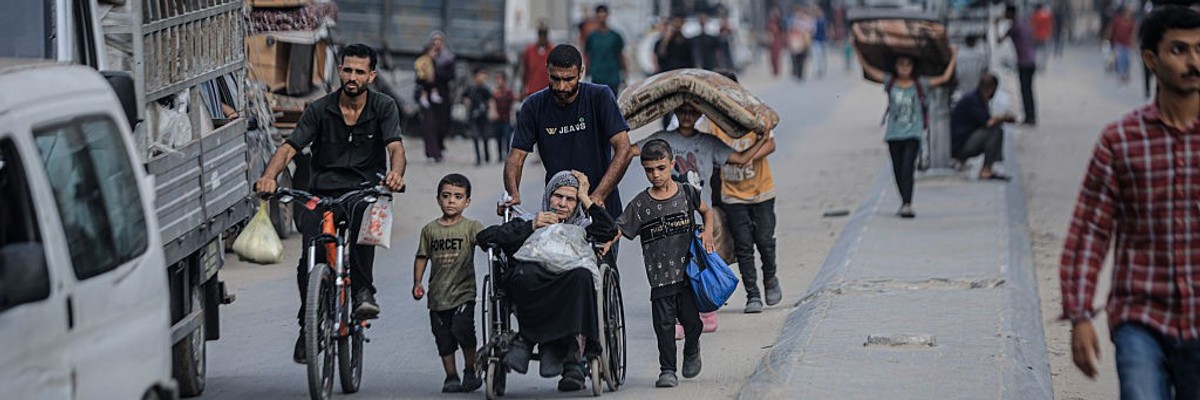
Palestinians flee with their belongings amid Israel’s ethnic cleansing of Gaza City’s Zeitoun neighborhood on August 12, 2025.  (Photo by Ahmed Jihad Ibrahim Al-arini/Anadolu via Getty Images)

“This is the latest chapter in the genocide that Israel is committing in Gaza and part of a broader campaign of ethnic cleansing engulfing the entire Gaza Strip,” said Oxfam International.

Israel’s US-backed campaign to ethnically cleanse Palestinians from Gaza City has left nearly 1 million people—half of them starved by design—with nowhere to seek refuge, United Nations agencies and other humanitarian groups warned Wednesday.

“We are witnessing a dangerous escalation in Gaza City, where Israeli forces have stepped up their operations and ordered everyone to move south. This comes two weeks after famine was confirmed in the city and surrounding areas,” said the UN Humanitarian Country Team (HCT), a strategic forum of UN agency heads and over 200 nongovernmental organizations (NGOs).

“While Israeli authorities have unilaterally declared an area in the south as ‘humanitarian,’ it has not taken effective steps to ensure the safety of those forced to move there and neither the size nor scale of services provided is fit to support those already there, let alone new arrivals,” HCT continued.

“Nearly 1 million people are now left with no safe or viable options—neither the north nor the south offers safety,” HCT added.

One elderly woman caring for an injured 8-year-old girl who is one of tens of thousands of children orphaned by Israeli attacks told Amnesty International Wednesday that “she’s all that I have left, and I have tried everything I can to protect her.”

“We have been displaced twice just in the last week,” the woman added. “We don’t have the means to go to the south, and we are tired of being forced to relive this ordeal all over again.”

An elderly disabled woman living in a makeshift refugee camp in southern Gaza City told Amnesty that “we were displaced from Sheikh Radwan three weeks ago; my son had to carry me on his shoulders because I have no wheelchair and no transportation could reach our area.”

“Now we are ordered to evacuate again. Where do we go?” she asked. “To secure transportation to the south, you have to pay close to 4,000 shekels ($1,200) and to buy a tent, you have to pay at least 3,000 shekels and we don’t know if we’ll find any land to pitch our tent on.”

“We had already spent all our savings to survive this war, looking for food and basics,” the woman added. “Every day is like the war is starting all over again, only far worse, but we are totally depleted, we have no will or strength to carry on.”

Photos showing hundreds of thousands of Palestinians—including some with donkey-drawn carts—slowly streaming southward from Gaza City evoked images from the Nakba, when more than 750,000 Arabs were ethnically cleansed from Palestine by Zionist terror militias during the establishment of modern Israel.

The World Health Organization (WHO), a UN body, warned Wednesday that “starvation and malnutrition in Gaza are at the highest levels ever since the conflict began almost two years ago,” and that “deliberate blocking and delay of large-scale food, health, and humanitarian aid has cost many lives.”

“After 22 months of relentless conflict, over half a million people in the Gaza Strip are facing catastrophic conditions characterized by starvation, destitution, and death,” the agency added. “Another 1.07 million people (54%) are in ‘emergency’ (IPC Phase 4), and 396,000 people (20%) are in ‘crisis’ (IPC Phase 3).”

WHO also cited overall casualties in Gaza—now approaching at least 65,000 deaths, mostly women and children—and 164,000 injuries, according to the Gaza Health Ministry (GHM)—and noted that “as of September 5, 2025, there have been 2,339 reported fatalities among aid-seekers near militarized distribution sites and along convoy routes since May 27.”

Oxfam International—a coalition of over 20 independent NGOs focused on alleviating poverty—echoed the UN experts, asserting that “Israel’s intent to displace around 1 million civilians, half of whom are living in famine, is impossible and illegal.”

“Displacement orders, on leaflets thrown from the sky, or posted on social media, signal grave next steps, a scene all too familiar in Gaza where every order has preceded new waves of destruction and mass casualties,” Oxfam said. “This is the latest chapter in the genocide that Israel is committing in Gaza and part of a broader campaign of ethnic cleansing engulfing the entire Gaza Strip, where nothing and no one has been spared.”

Heba Morayef, regional director for the Middle East and North Africa at Amnesty International, said Wednesday that Israel’s mass displacement order for Gaza City residents “is cruel, unlawful, and further compounds the genocidal conditions of life that Israel is inflicting on Palestinians.”

“Gaza City… is now facing complete obliteration,” Morayef added. “It is evident that Israel is determined in pursuing its goal to physically destroy Palestinians in the Gaza Strip. It is unconscionable that states with leverage over Israel continue to provide it with arms and diplomatic support to destroy Palestinian lives.”

Operation Gideon’s Chariots 2—Israel’s plan to ”conquer, cleanse, and stay” in Gaza and “annihilate everything” there—as Israeli Finance Minister Bezalel Smotrich recently put it—has ramped up in recent days, with intensified Israeli air and artillery strikes and ground troops pushing deeper into Gaza City.

According to GHM, at least 72 Palestinians were killed and a minimum of 356 others were wounded by Israeli forces across Gaza on Thursday, including children and infants. At least 53 of the victims were killed in Gaza City. Israeli strikes reportedly targeted homes, tents housing refugees, and aid distribution points.

Additionally, GHM said that seven Palestinians including a child died from starvation over the past 24 hours, bringing the total number of famine-related deaths in Gaza to at least 411, 142 of them children.

Original article by Brett Wilkins republished from Common Dreams under Creative Commons (CC BY-NC-ND 3.0).

Experiencing issues with this image not appearing. I suspect because it's so critical of Zionist Keir Starmer's support of and complicity in Israel's genocides.
Genocide denier and Current UK Prime Minister Keir Starmer is quoted that he supports Zionism without qualification. He also confirms that UK air force support has been essential in Israel’s mass-murdering genocide. Includes URLs https://www.declassifieduk.org/keir-starmers-100-spy-flights-over-gaza-in-support-of-israel/ and https://youtu.be/O74hZCKKdpA
Continue Reading‘No Safe Place Left’ as Israel Moves to Ethnically Cleanse Nearly 1 Million Gazans

How global inequality hinders climate action

Spread the love
Leaders from around the globe are meeting in Davos. Michael Derrer Fuchs/Shutterstock

Susan Ann Samuel, University of Leeds

World leaders have gathered for the World Economic Forum annual meeting in Davos, Switzerland. One of their main goals is to align their responses to geopolitical shocks such as floods and wildfires that hamper trade, investment and more.

The meeting also supposedly aims to find ways to stimulate economic growth to improve living standards, foster a just and inclusive energy transition, achieve security and cooperation amidst conflicts, and accelerate the economic response to an “intelligent age” of AI.

But, a new report from Oxfam International, published on the first day of the meeting in Davos, highlights how global inequality is more rampant than ever. The report, written by a team of policy campaigners and inequality research advisers outlines how billionaire wealth rose sharply in 2024 worldwide, with the pace of the increase three times faster than in 2023.

The World Economic Forum lists extreme weather as one of the top global risks. But, as world leaders convene in Davos, the high-profile anti-climate stances of some of them stand in stark opposition to any meaningful progress for climate action.

The Oxfam report highlights the exploitation involved in creating and sustaining wealth and outlines how, as inequalities deepen, vulnerable communities are disproportionately affected. The most vulnerable – overwhelmingly women, people of colour, Indigenous groups and low-wage workers – are caught in a cycle of insufficient wages, limited services and minimal political influence.

The report also highlights how wealth inequality is often intertwined with historical processes of extraction — both within countries (for example, through weak labour protections that lowers wages) and between countries (through trade, finance, and resource exploitation).

The climate connection

Other research has also shown how inequality is deeply interwoven with climate breakdown. Each crisis exacerbates the other. Historically, the richest nations – and within them, the wealthiest people – have contributed the most to greenhouse gas emissions.

Meanwhile, lower-income countries that bear little responsibility for global heating suffer the most. These countries, already burdened by debt and systemic inequality, have fewer resources to protect communities from extreme weather, crop failures and infrastructure damage. This makes day-to-day survival a struggle for billions.

When climate change exacerbates existing inequalities, marginalised communities are denied basic human rights. For instance, droughts reduce crop yields and deplete water sources, so more people — often women and children — have to ration supplies or go without. This directly infringes on their rights to food, safe drinking water and sanitation.

In these ways, without climate action, the warming planet threatens to widen inequalities by affecting the poorest people most severely. A 2020 World Bank report estimated that an additional 68 to 135 million people could be pushed into poverty by 2030 because of climate change. French researchers identified that climate change also slows down the economic catch-up of poorer countries.

The reality on the ground is bleak. Floods in Pakistan displaced thousands and affected more than 33 million people in 2023. That’s ten times more than the total population of Los Angeles where, when the recent wildfires struck, 170,000 people had to be evacuated.

Around the world, climate movements continue. Law suits that demand climate action are transforming governance. High-level negotiations like the UN’s annual climate summit carry on seeking progress, although the processes could be improved to accelerate change.

What can Davos do? World leaders need to look at how wealth and power can be redistributed (reparations for climate damages is one way to do this) and low-income, climate-vulnerable nations can be better represented in global decision-making.

Without this kind of change, there’s a risk climate action will perpetuate the same structural imbalances that first enabled environmental exploitation. Only by tackling both climate injustice and economic inequality together can the world prevent further climate disasters and ensure a more equitable future.


Don’t have time to read about climate change as much as you’d like?
Get a weekly roundup in your inbox instead. Every Wednesday, The Conversation’s environment editor writes Imagine, a short email that goes a little deeper into just one climate issue. Join the 40,000+ readers who’ve subscribed so far.


Susan Ann Samuel, PhD Candidate, School of Politics and International Studies, University of Leeds

This article is republished from The Conversation under a Creative Commons license. Read the original article.

Continue ReadingHow global inequality hinders climate action

‘Unacceptable’: Campaigners Decry Climate Finance Failures as COP29 Enters Final Hours

Spread the love

Original article by Eloise Goldsmith republished from Common Dreams under Creative Commons (CC BY-NC-ND 3.0).

Activists demonstrate against industrial agriculture and agribusiness lobbyists on day eight at the UNFCCC COP29 Climate Conference on November 19, 2024 in Baku, Azerbaijan. (Photo by Sean Gallup/Getty Images)

“By the end of the UN climate talks, we must see at least a trillion dollars in public finance on the table,” said one campaigner.

As the clock winds down at the UN climate summit taking place in Baku, Azerbaijan, green groups are sounding the alarm Thursday following the release of a draft climate finance deal that they say falls short of what’s needed to support climate-vulnerable countries and adequately address the planetary crisis.

“The clock is ticking. COP29 is now down to the wire,” said UN Secretary-General António Guterres on Thursday, just a day before the two-week conference is set to conclude.

Finance has been a major focus of this year’s summit. Under the 20125 Paris Agreement, countries are supposed to come up with a “new collective quantified goal”—or NCQG in COP jargon—that will govern how much money from rich countries will be transferred to developing countries in order to help the latter cut their emissions and adapt to climate change.

No equivalent climate finance arrangement has been agreed to before, though countries at the summit broadly agree that richer countries, who are responsible for much of historic CO2 emissions, should help poorer and more climate-vulnerable nations deal with natural disasters and their transition to green energy.

The draft text that dropped early Thursday, however, was received poorly.

Oxfam International’s climate justice lead, Safa’ Al Jayoussi, said “COP29 must do more than simply repeat the same threadbare promises. Rich countries have spent decades now stalling and blocking genuine progress on climate finance. This has left the Global South suffering the most catastrophic consequences of a climate crisis they did not create. The draft text scandalously misses the crucial element of declaring a clear public commitment to a new climate finance goal.”

Instead of specifying how much annually should be funneled towards developing countries via climate finance, the NCQG draft text displayed “X” in place of any actual figures or monetary commitments.

Oscar Soria, a director at the Common Initiative think tank, told the Guardian: “The negotiating placeholder ‘X’ for climate finance is a testament of the ineptitude from rich nations and emerging economies that are failing to find a workable solution for everyone.”

“By the end of the UN climate talks, we must see at least a trillion dollars in public finance on the table,” added Andreas Sieber, 350.org associate director of policy and campaigns. Economists told the summit attendees last week that developing countries need at least $1 trillion annually by 2030 to deal with climate change.

A specific and shared concern from campaigners was the draft text’s inclusion of carbon market schemes as a way “to scale up” climate finance. While the draft promotes “high-integrity voluntary carbon markets” and other “instruments that mobilize new sources of climate finance and private finance” as part of the equation, critics have long warned that these market-based approaches are nothing but false solutions designed to benefit corporate investors, wealthier nations, and the fossil fuel industry itself.

“Labelling carbon credits as climate finance—which they are unreservedly not—should be axed from the text or risk creating a dangerous escape route for polluters. The same goes for explicitly allowing investments in fossil fuel infrastructure. This is fundamentally incompatible with the goals of the Paris Agreement,” said Laurie van der Burg, Oil Change International’s global public finance manager, in response to the draft text.

While Article 6 of the Paris Agreement allows for the international transfer of carbon credits, groups warned the changes in the COP29 draft would dramatically strengthen the foothold of such schemes.

“Shockingly, COP29 is set to agree to carbon markets that are even worse than the voluntary carbon markets,” said Kirtana Chandrasekaran, a climate campaigner with Friends of the Earth International. “We know these markets have failed. They are riddled with fraud and they do not reduce emissions or provide finance. Communities everywhere and, in fact, the planet itself is on the line.”

Without addressing these concerns, advocates of a meaningful deal at the conference say COP29 is headed for failure.

As 350.org‘s Sieber argued, paying the “historic debt that rich countries owe will enable all nations to take action on climate at home and meet the collective goal agreed last year at COP28—to triple renewable energy, and transition away from fossil fuels. Right now, we only see cowardice and a void in leadership, ignoring the undeniable science that we can’t keep polluting our planet with dirty oil, gas and coal.”

“The time to course correct is now—the European Union and other rich countries must stop playing poker with the planet and humankind’s future at stake,” Sieber added. “It’s time to put their cards on the table and commit real, transformative funding—no more excuses, no more delays, it’s time.”

Original article by Eloise Goldsmith republished from Common Dreams under Creative Commons (CC BY-NC-ND 3.0).

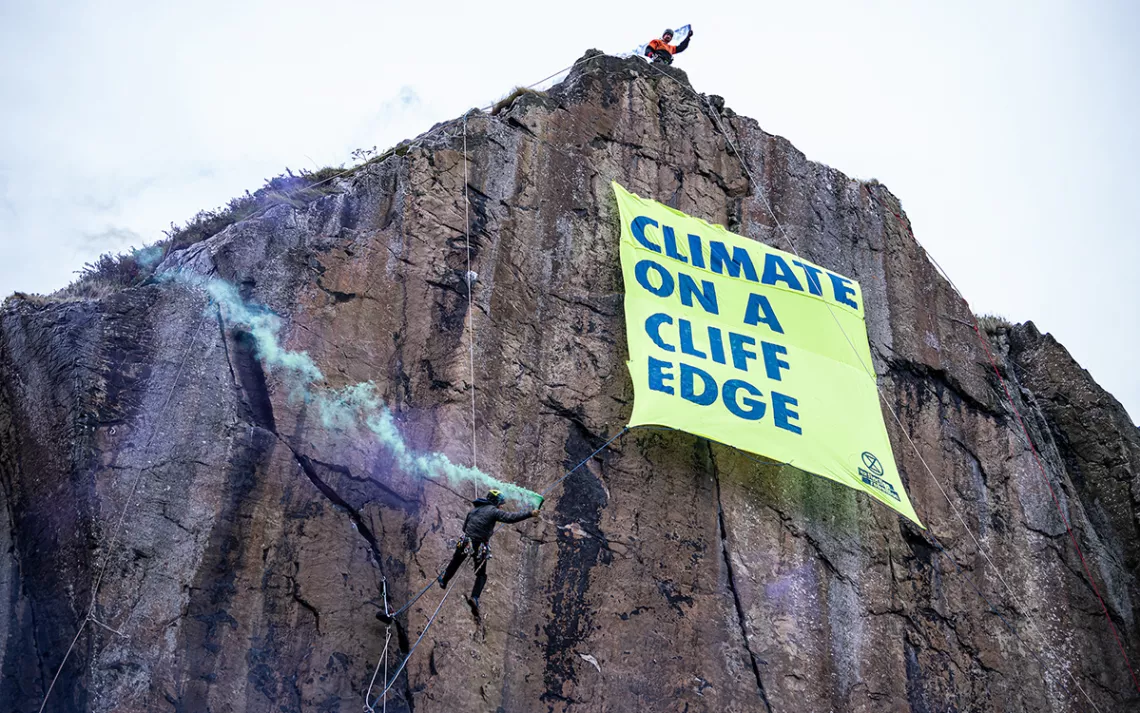
Experienced climbers scale a rock face near the historic Dumbarton castle in Glasgow, releasing a banner that reads “Climate on a Cliff Edge.” One activist, dressed as a globe, symbolically looms near the edge, while another plays the bagpipes on the shores below. | Photo courtesy of Extinction Rebellion and Mark Richards
Orcas comment on killer apes destroying the planet by continuing to burn fossil fuels. Second version, corrected text.
Continue Reading‘Unacceptable’: Campaigners Decry Climate Finance Failures as COP29 Enters Final Hours

‘Devastating Blow to Humanity’: Barred From Gaza by Israel, Health Workers Cry Out for Help

Spread the love

Original article by Jon Queally republished from Common Dreams under Creative Commons (CC BY-NC-ND 3.0). 

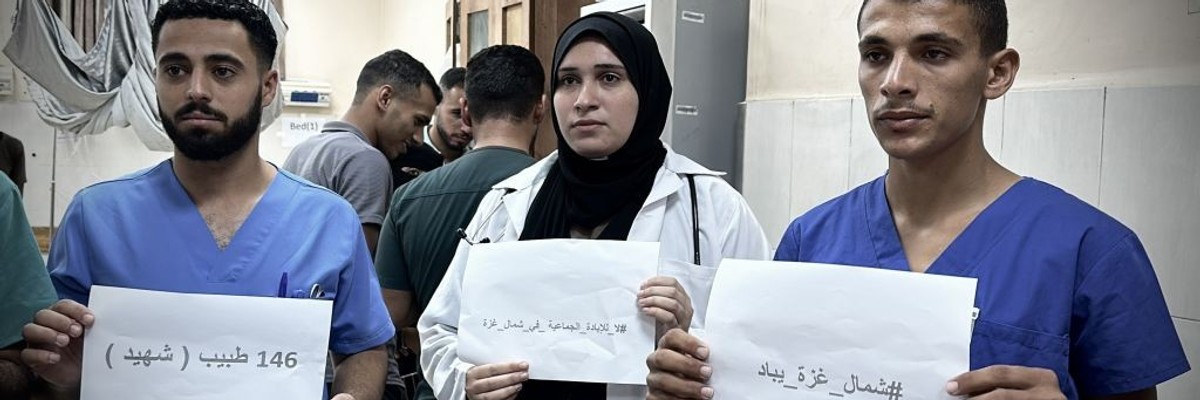
Health workers, holding banners and placards, gather at the Nasser Hospital to protest Israeli army’s attacks on northern Gaza and the prevention of the entry of necessary equipment and supplies to the besieged hospitals in Khan Yunis, Gaza on October 19, 2024.  (Photo by Doaa Albaz/Anadolu via Getty Images)

As the situation inside Gaza is increasingly described as “indescribable,” medical NGOs blocked from providing care to Palestinians trapped inside besieged territory demand world leaders to stop turning ‘blind eye’ to Israeli war crimes and violations of humanitarian law.

As more Israeli bombing of the Jabalia refugee camp in northern Gaza killed dozens of people Saturday, health workers from both inside and out of the besieged territory are again pleading with world leaders to bring an end to the indiscriminate attacks and imposed humanitarian crisis that witnesses on the ground increasingly say there are no words to describe.

At al Nasser Hospital in Khan Yunis and elsewhere in Gaza, doctors and other medical staff on Saturday staged protests and held press conferences to call attention to the ongoing attacks in northern areas, including the latest targeting of Jabalia in which reporting indicated anywhere from 33 to over 50 people—including civilian men, women, and children—were killed.

“The world is watching, and history will judge us by how we respond to this grave injustice. I call upon each and everyone one of you to join this fight for the preservation of our shared humanity.” —Dr. Khaled Saleh, FAJR Scientific

Al-Jazeera reports that hospitals, which have repeatedly been bombed by Israel over the last year, were not immune from this latest round:

Three partially functioning hospitals treating severely wounded patients and sheltering thousands of displaced Palestinian civilians in northern Gaza are now out of service after coming under intense Israeli fire, a Gaza health official told Al Jazeera, as the siege on Jabalia enters its third week, with at least 33 more people killed in the northern area.

Israeli forces bombed al-Awda Hospital in Jabalia early on Saturday, and have also shelled Kamal Adwan and the Indonesian hospitals in Beit Lahiya over the past few hours, Al Jazeera correspondents have reported.

Saturday’s attacks come days after Israel barred at least six medical service NGOs from continuing their life-saving work in Gaza. According to the Washington Post:

Two of those medical NGOs, Glia and the Palestinian American Medical Association (PAMA), confirmed to The Washington Post that they were notified by the WHO this week about the bans. Both groups have worked in Gaza for years preceding the war.

“WHO is concerned about the impact of these denials on Gaza’s strained healthcare system,” the organization said Thursday in a statement. It added that international emergency medical teams (EMTs) deployed to Gaza are essential to keeping the system operational, as only 17 of the enclave’s 36 hospitals remain functionaland “healthcare needs far exceed the system’s capacity.”

Dr. Khaled Saleh, chair of FAJR Scientific, which provides surgical expertise and trauma specialists to war-torn regions and was another of the groups notified by the WHO that it had been barred from entering Gaza, said in a statement that the move by the Israeli government filled him with “deep sadness and concern for the current state of our global family, questioning our shared humanity and ethics.”

Blocked from providing aid to people in dire need, Saleh called on people worldwide to push for an end to Israel’s blocking of vital medical aid and those seeking to provide it.

“This is a devastating blow to humanity, representing a level of destruction that we have not witnessed since World War II, yet our world leaders turn a blind eye,” he said.

“As a member of the global community,” Saleh continued, “I implore all of you who value compassion, ethics, and the sanctity of human life to stand with us and raise your voices against this unconscionable decision. Together, we must advocate for the voiceless and demand restoration of the fundamental right to access to medical care.”

Israel’s ban on the medical NGOs comes after a string of healthcare professionals who spent time in the Gaza strip have gone public with what they witnessed on the ground, telling tales of unspeakable horror and trying to shake the world out of its complacency on what experts say is a genocide in motion being carried out by Israeli forces.

https://twitter.com/ryangrim/status/1847415481340158265?ref_src=twsrc%5Etfw%7Ctwcamp%5Etweetembed%7Ctwterm%5E1847415481340158265%7Ctwgr%5Ea9ba79d1e9ff243bed5fc4882543079cfea6dc4e%7Ctwcon%5Es1_c10&ref_url=https%3A%2F%2Fwww.commondreams.org%2Fnews%2Fgaza-health-workers

Earlier this week, the UN humanitarian office, OCHA, said that Israel’s continued blocking of food and medical supplies to Jabalia and other ares in the northern was “having life-threatening impacts” for the people there.

OCHA spokesperson Farhan Haq said the OCHA was calling on Israeli authorities “to allowed safe, sustained and unimpeded access to Jabalia and all areas of the north where people are in desperate need of assistance.”

In a post on Friday, Oxfam International mourned the killing of Dr. Ahmad Al-Najar and midwife Laila Jneid, both of whom worked with Juzoor, “killed by Israeli airstrikes on Jabalia,” the group said. “They were providing lifesaving health care in Gaza. Attacking aid workers is a war crime.” Oxfam repeated its demand for a “cease-fire now” and said healthcare workers should never be a target.

In a dispatch on Friday, Dr. Taghreed Al-Imawi, Juzoor staff and an OBGYN doctor at Kamal Adwan Hospital in northern Gaza, described the untenable situation on the ground.

“The situation is beyond horrific and is very difficult and indescribable,” said Al-Imawi. “Dead people, severed body parts and injured people everywhere. We are receiving emergency calls from all the areas of the north. Ambulances are not able to reach the injured. We have seen more than 23 pregnant women among the injured coming to the hospital since last week, wounded either by shrapnel or gunfire, suffering from fractures. Some were in a critical condition. Kamal Adwan Hospital and other semi-operational hospitals have received displacement orders but there is no way to evacuate in any case.”

“The pediatrics section is closed as it is full of injured people,” Al-Imawi added, “the surgery section is full of injured people, even the reception, the hospital has been shelled several times and targeted by snipers, people are terrified to come to the hospital now.”

Having recently returned from a field mission in Gaza, pediatric nurse Becky Platt, working through Save the Children—who posted her testimony Saturday—described a situation on the ground that was “like nothing I’ve seen before.”

Platt said the horrific situation is “both in terms of healthcare need and just in terms of the whole humanitarian context—seeing homes and landscapes completely devastated and seeing just the absolute level of human suffering and need as absolutely mind blowing.”

https://twitter.com/i/status/1847518629484478816

“No child should have to be in pain,” she said. “And it just feels like your hands are tied when you can’t do what you know that you could do easily at home or in another context. I think that when it really hits. It’s just—it’s just not fair. It’s not okay that we’ve got children with devastating injuries who don’t have access to pain relief.”

For his part, Dr. Saleh of FAJR Scientific, said it was up to everyone in the world to make their voices heard.

“The world is watching,” he said, “and history will judge us by how we respond to this grave injustice. I call upon each and everyone one of you to join this fight for the preservation of our shared humanity.”

Original article by Jon Queally republished from Common Dreams under reative Commons (CC BY-NC-ND 3.0). 

Continue Reading‘Devastating Blow to Humanity’: Barred From Gaza by Israel, Health Workers Cry Out for Help

Analysis Details How Israel’s Gaza Siege ‘Is Driving a Humanitarian Disaster’

Spread the love

Original article by Brett Wilkins republished from Common Dreams under Creative Commons (CC BY-NC-ND 3.0). 

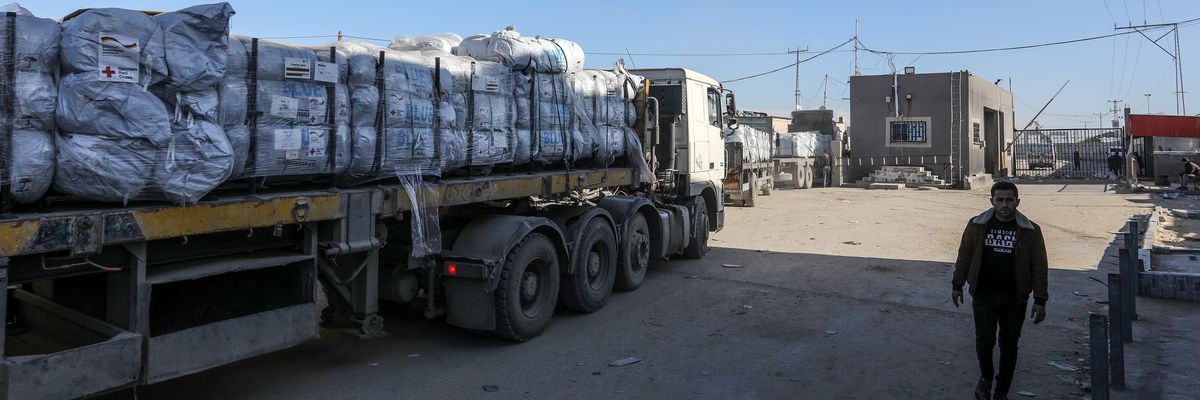
Trucks carrying aid supplies to Gaza are seen at the Karem Abu Salem border crossing on February 17, 2024. (Photo: Abed Rahim Khatib/Anadolu via Getty Images)

“Over 11 months, we have reached shocking levels of conflict, displacement, disease, and hunger,” said one campaigner.

Israel’s “complete siege” of the Gaza Strip “is driving a humanitarian disaster,” with 83% of required food aid failing to enter the embattled enclave, where the entire population is facing hunger and disease and almost half a million Palestinians are at risk of starvation, an analysis published Monday revealed.starvation,

The analysis by 15 international aid organizations noted that a record-low average of just 69 aid trucks are entering the Gaza Strip each day, compared with an already insufficient 500 daily truckloads a year ago. Additionally, the groups said that “only 17 out of Gaza’s 36 hospitals remain partially functional, and “critical infrastructure such as water networks, sanitation facilities, and bread mills” have been destroyed.

“While Israeli military attacks on Gaza intensify, lifesaving food, medicine, medical supplies, fuel, and tents have been systematically blocked from entering for almost a year,” the aid groups—which include ActionAid, American Friends Service Committee, CARE International, Christian Aid, Islamic Aid, Oxfam International, and Save the Children—said in a statement.

The publication highlights numerous ways that “lifesaving aid is systematically obstructed on a daily basis” in Gaza.

“These include the denial of safety, with more than 40,000 Palestinians and nearly 300 aid workers killed since last October; the sharp tightening of a 17-year blockade to a full siege, which prevents aid from entering Gaza; delays and denials which restrict the movement of aid around Gaza; tightly restrictive and unpredictable control of imports; the destruction of public infrastructure such as schools and hospitals; and the displacement of civilians and humanitarian workers,” the analysis’ authors wrote.

Zenab, a 33-year-old Palestinian woman pregnant with her second child, said that her pregnancy “has been the hardest time of my life.”

“It was also hard to get the medication I needed,” she continued. Sometimes I had to walk for hours to different pharmacies, hospitals, and health centers to see if anyone had my medication available. For me as a pregnant woman, there has been hardly any healthcare support, no proper hygiene and sanitation, and no suitable mattress to sleep on.”

“I was suffering from complications during my pregnancy,” Zenab added. “We didn’t have enough water to drink, and had hardly any food. The doctors again told me that my pregnancy was in danger.”

Among the report’s key findings:

  • 83% of required food aid doesn’t make it into Gaza, up from 34% in 2023;
  • An estimated 50,000 children aged between 6-59 months urgently require treatment for malnutrition by the end of the year;
  • 65% of the insulin required and half of the required blood supply are not available in Gaza;
  • Availability of hygiene items has dropped to 15% of the amount available in September 2023, with 1 million women now going without the hygiene supplies they need;
  • Only around 1,500 hospital beds in Gaza remain operational, compared to around 3,500 beds in 2023 which was already well below sufficient to meet the needs of a population of more than 2 million people; and
  • 1.87 million people are in need of shelter with at least 60% of homes destroyed or damaged as of January, yet tents for around just 25,000 people have entered Gaza since May 2024.

“There is a shortage of all humanitarian items. We are overwhelmed [with] these needs and [these] urgent requirements,” said Amjad Al Shawa, director of the Palestinian NGOs Network. “People [are] starving due to the shortage of aid. One hundred percent of the population depends on humanitarian aid.”

The authors of the analysis—which was released ahead of this week’s United Nations General Assembly in New York—are demanding that Israel secure an immediate and lasting cease-fire. They are also calling for an arms embargo on Israel and Israeli compliance with the recent International Court of Justice (ICJ) advisory opinion, which found that the occupation of Palestine is an illegal form of apartheid that must end immediately. Israel is on trial for genocide in a separate ICJ case.

“The situation was intolerable long before last October’s escalation and is beyond catastrophic now.”

“The situation was intolerable long before last October’s escalation and is beyond catastrophic now,” CARE International West Bank and Gaza country director Jolien Veldwijik said in a statement. “Over 11 months, we have reached shocking levels of conflict, displacement, disease, and hunger.”

That includes dozens of children who have died due to malnutrition, dehydration, and lack of adequate medical care.

“Aid is still not getting in, and humanitarian workers are risking their lives to do their jobs while attacks and violations of international law intensify,” Veldwijik added. “Aid, which is urgently required for 2.2 million people at risk of dying in the coming weeks and months, should never be politicized. We demand an immediate and sustained cease-fire, and the free flow of humanitarian aid into and throughout Gaza.”

Original article by Brett Wilkins republished from Common Dreams under Creative Commons (CC BY-NC-ND 3.0). 
Continue ReadingAnalysis Details How Israel’s Gaza Siege ‘Is Driving a Humanitarian Disaster’