Argentina’s president visits Israel to open embassy in Jerusalem

Spread the love

This work by Middle East Monitor is licensed under a Creative Commons Attribution-NonCommercial-ShareAlike 4.0 International License

President of Argentina Javier Milei in Buenos Aires, Argentina, on March 1, 2025. [Luciano Gonzalez – Anadolu Agency]

Argentine President Javier Milei arrived in Israel on Sunday for an official visit during which he is set to open his country’s embassy in Jerusalem, Israeli media reported, Anadolu reports.

Milei met with Prime Minister Benjamin Netanyahu on Sunday evening, and the two men delivered joint statements after their talks, The Times of Israel news portal reported.

They also signed memorandums of understanding on security and artificial intelligence, the outlet said.

During his visit, Milei will open his country’s embassy to Israel in Jerusalem, the newspaper added.

The trip marks Milei’s third visit to Israel since he took office in December 2023. He is scheduled to return to Argentina on Tuesday afternoon.

Milei first announced plans to move the embassy from Tel Aviv to Jerusalem during a visit to Israel in February 2024 and reiterated in November that the new mission was to be inaugurated in the spring.

More than 1,000 Tel Aviv homes left uninhabitable by Iran war: Mayor

Currently, only a handful of countries maintain embassies in Jerusalem, including the US, Kosovo, Honduras, Guatemala, Papua New Guinea, and Paraguay.

Most countries have refused to move their embassies to Jerusalem, viewing such an act as tacit recognition of Israel’s unilateral claim to the city as its capital.

The Palestinians regard East Jerusalem as the capital of their future state, based on international resolutions that do not recognize Israel’s occupation of the city in 1967 or its annexation in 1980.

This work by Middle East Monitor is licensed under a Creative Commons Attribution-NonCommercial-ShareAlike 4.0 International License

Donald Trump calls for help from NATO allies in securing the Straight of Hormuz despite saying on 7 March 2026 that they don't need people to join wars after they've already won. He's challenged with the claim that he lies as much as the IDF.
Donald Trump calls for help from NATO allies in securing the Straight of Hormuz despite saying on 7 March 2026 that they don’t need people to join wars after they’ve already won. He’s challenged with the claim that he lies as much as the IDF.
Keir Starmer explains that UK is actively supporting Israel's genocidal expansion and repeats his previous quotation that he supports Zionism "without qualification". Keir Starmer said “I said it loud and clear – and meant it – that I support Zionism without qualification.” here: https://www.jewishnews.co.uk/keir-starmer-interview-i-will-work-to-eradicate-antisemitism-from-day-one/
Keir Starmer explains that UK is actively supporting Israel’s genocidal expansion and repeats his previous quotation that he supports Zionism “without qualification”. Keir Starmer said “I said it loud and clear – and meant it – that I support Zionism without qualification.” here: https://www.jewishnews.co.uk/keir-starmer-interview-i-will-work-to-eradicate-antisemitism-from-day-one/
Donald Trump sings and dances, says that it's fun to kill everyone ...
Donald Trump sings and dances, says that it’s fun to kill everyone …
Continue ReadingArgentina’s president visits Israel to open embassy in Jerusalem

Twenty years after “No to the FTAA”, Latin American movements reaffirm their anti-imperialist commitment

Spread the love

Original article by Pablo Meriguet republished from peoples dispatch under a Creative Commons Attribution-ShareAlike 4.0 (CC BY-SA) license.

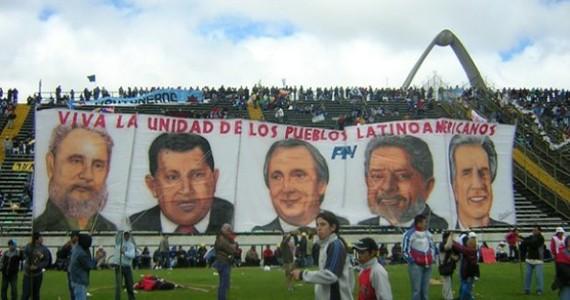
In 2005, in the city of Mar del Plata, the presidents of the brother countries of the Americas, Lula da Silva, Hugo Chávez, Evo Morales, and Néstor Kirchner stood firm against the United States. Photo: X

The meeting in Mar del Plata paid tribute to the moment when several Latin American presidents defeated the US attempt to establish a regional free trade agreement.

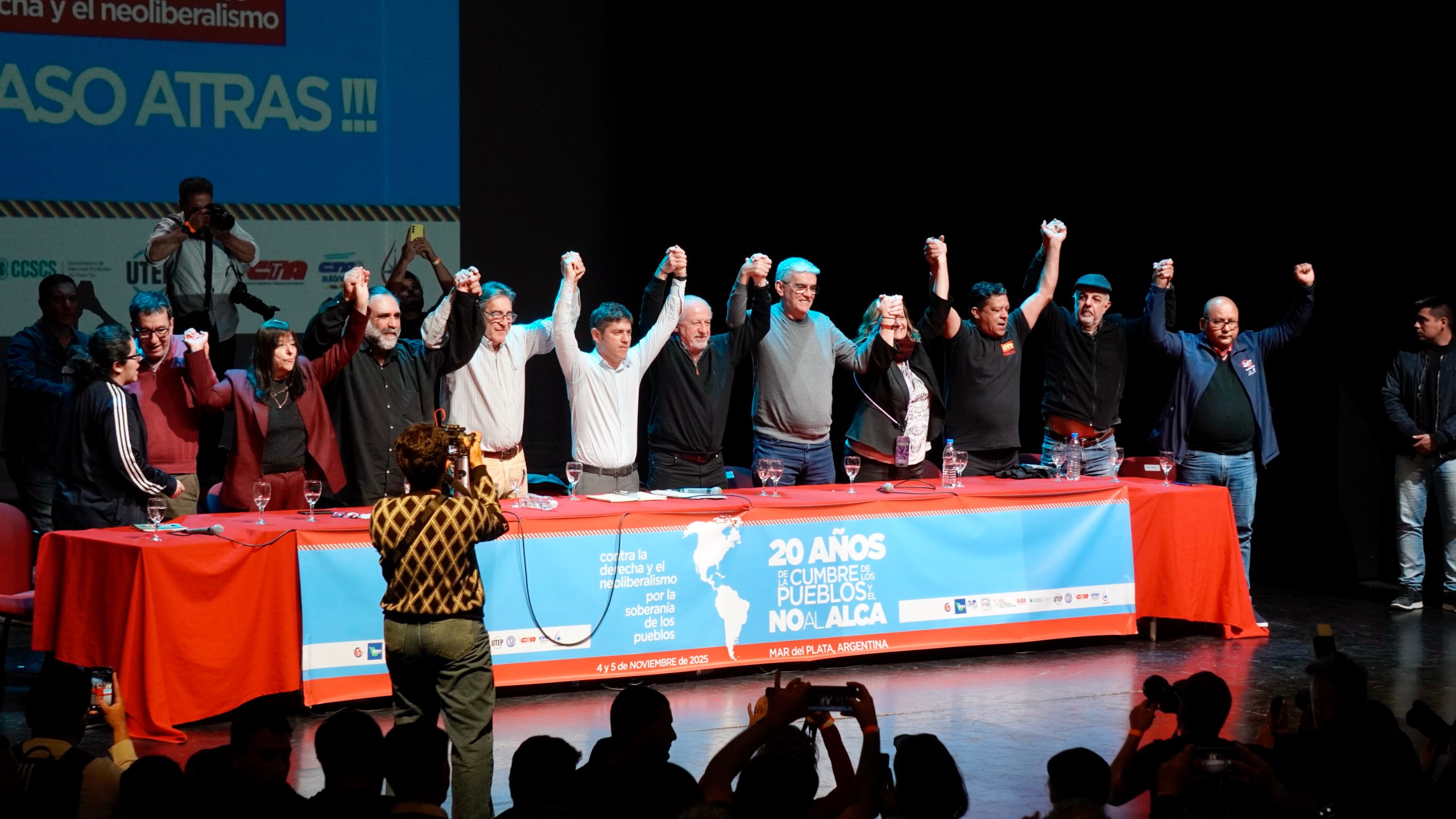
In the same place where the regional free trade project was “buried” two decades ago, 150 delegates from various social movements in Brazil, Uruguay, Bolivia, Cuba, Mexico, Portugal, Haiti, Palestine, Chile, Nicaragua, Peru, and Paraguay gathered to reaffirm the anti-imperialist spirit that led to the regional rejection of the FTAA project, they say.

“The world faces greater levels of inequality, injustice, and authoritarianism, with a growing concentration of financial and technological power that deepens poverty and limits the autonomy of countries in the Global South,” the delegates said in the event’s final declaration.

The meeting was also attended by the governor of Buenos Aires, Axel Kicillof, who stated that the rejection of the FTAA in 2005 was a “new declaration of independence” for Latin American countries. “The rejection of the FTAA was a victory for Latin American sovereignty, voiced by a group of presidents with enormous courage, represented in our country by Néstor Kirchner. Twenty years after that historic milestone, we have a responsibility to continue building unity, because there is no possibility of development for our countries outside the framework of regional integration. We cannot afford not to have a project on behalf of our people, because Argentina and the countries of Latin America are not anyone’s backyard,” Kicillof wrote in X.

Peoples Summit No al ALCA
Delegates from dozens of Latin American countries reaffirm the anti-imperialist spirit of the “No to the FTAA” summit in 2005.

For his part, the Secretary of Foreign Affairs of the Argentine Workers’ Central Union (CTA), Adolfo Aguirre, stated: “In this very place, in front of the President of the United States, George W. Bush, and before the eyes of the whole world, our peoples, workers, together with leaders such as Néstor Kirchner, Hugo Chávez, and Luiz Inácio Lula da Silva, marked a turning point. We said no to surrender, no to dependence, no to the model that wanted to turn our America into the backyard of economic power.”

Twenty years ago, the anti-imperialist slogan was born

Twenty years ago in Argentina, several political leaders from the Latin American left gathered at a People’s Summit, whose fundamental slogan was the rejection of the Free Trade Area of the Americas (FTAA), an initiative promoted, among others, by the George W. Bush administration. The FTAA sought to significantly reduce customs barriers between American countries.

According to popular and left-wing forces in Latin America and the Caribbean, the agreement would have promoted a regional market in which the United States would have had an enormous advantage over other countries and which, in the long run, would have led to the destruction of the still immature regional industry to benefit the interests of large US companies.

However, the economic and geopolitical project did not prosper due to fierce and coordinated opposition from several Latin American presidents, including Néstor Kirchner (Argentina), Hugo Chávez (Venezuela), and Luiz Inácio Lula da Silva (Brazil), among others. The political maneuver took place in Mar del Plata, during the Summit of the Americas, where Bush and his entourage suffered a severe setback. Thus, the proposal that had been in the works and planned since 1994 in Miami and was definitively defeated.

The Summit of the Americas is considered by several experts to be a turning point in the geopolitical relations of the American continent. New progressive and pro-sovereignty processes joined those of Argentina, Brazil, and Venezuela, giving rise to an attempt at regional integration that to this day is pushed by progressivism and boycotted by Washington’s neoliberal allies.

While the summit was taking place, thousands of people from left-wing and progressive movements and political parties gathered at a parallel conference with the slogan “No to the FTAA,” which was eventually attended by several political leaders. Among them, Hugo Chávez made a statement in his speech that would go down in history: “ALCA (FTAA in Spanish), al carajo! (FTAA, go to hell!)”.

A historic event

The region has undoubtedly changed its political composition. The seemingly unstoppable rise of progressive governments is now fragmented due to the emergence of new right-wing and neoliberal projects, such as those of Javier Milei in Argentina and Daniel Noboa in Ecuador, and the recent victory of the Bolivian right after more than 20 years of left-wing governments, among others.

However, in several countries, progressivism managed to regain government, as in the case of Lula da Silva himself, or managed to remain in power, as in the case of the United Socialist Party of Venezuela. Also, in other countries such as Colombia with Gustavo Petro and Mexico with Andrés Manuel López Obrador and Claudia Sheinbaum, progressive governments took office for the first time in their recent history.

In this sense, the dispute over governments in Latin America remains open, and much of the structure of that dispute can be found in what happened in Mar del Plata 20 years ago, where one regional project was buried and another was established, for almost a decade, as the model for regional integration around a position that, although it had its clear limits, always declared itself sovereign and independent.

Original article by Pablo Meriguet republished from peoples dispatch under a Creative Commons Attribution-ShareAlike 4.0 (CC BY-SA) license.

Continue ReadingTwenty years after “No to the FTAA”, Latin American movements reaffirm their anti-imperialist commitment

South America on fire

Spread the love

Original article by Pablo Meriguet republished from peoples dispatch under a Creative Commons Attribution-ShareAlike 4.0 (CC BY-SA) license.

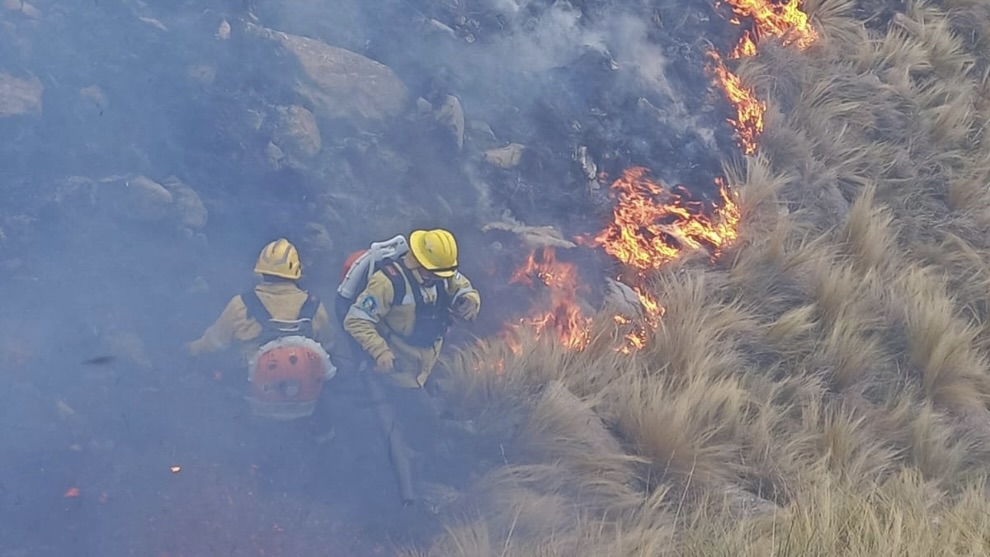
Fires in Córdoba, Argentina have been raging for the past month. Photo: Córdoba Government

More than 300,000 fires have been reported so far in 2024 across South America. The blazes have displaced hundreds and killed several. The causes of this tragedy must be sought in deep geopolitical injustices.

South America is facing one of the most serious environmental crises in recent decades. In the last two months, there has been a dramatic increase in the outbreak of forest fires that have devastated thousands of square kilometers across Colombia, Ecuador, Brazil, Perú, Paraguay, Bolivia, and Argentina. The impacts of the blazes are exponential, not only seen in the direct destruction to the forests and wildlife and surrounding communities, but in many countries the dangerous smoke has traveled far beyond the site of the fire.

The tragedy of fires in South American countries

So far in 2024, more than 300,000 fires have been registered across South America.

In Brazil, the number of fires in southern Brazil (Pantanal and the Amazon) have increased by 92% compared to last year. In the whole country, more than 170,000 have been registered so far and more than 11 million hectares have been lost in this year so far. The fires have required massive state investments in order to alleviate the destruction. In the State of São Paulo alone, more than 15,000 people from the civil guard, firefighters and others have been mobilized to try to put out the fires.

In the El Chaco area, encompassing Bolivia and Paraguay, fires continue to consume thousands of hectares. More than 60,000 fires have been reported in Bolivia this year, with the regions of Rio Blanco and Palestina, in the east of the country, being the most affected and hundreds of people were evacuated. President Luis Arce has declared a national state of emergency to better address the environmental catastrophe. For now, Chile and Venezuela have offered assistance to Bolivia, which has not been able to quell the flames on its own.

In Córdoba, Argentina, fire continues to destroy millions of plants and animals despite the efforts of almost 1,000 firefighters who are trying to extinguish the flames. The strong winds in the central region of the country have made it even more difficult for hundreds of firefighters to extinguish the two large fires. In several cities in Córdoba, hundreds of people were urgently evacuated due to the threat of the flames.

In Colombia, more than 31 forest fires devastated 10,000 hectares of forest. The most affected region is the southwest encompassing the departments of Tolima, Valle del Cauca, and Huila. In these places, Petro’s government ordered the deployment of military troops to help in the rescue tasks and to alleviate the fires. Over a dozen fires are still raging in the country that threaten the lives of hundreds of people.

In Peru, the serious fires have already claimed the lives of over 20 people and experts estimate that it will take about 500 years for Peru’s ecosystems to recover from the latest fires. More than 49 active fires have reported by the National Emergency Operations Center, and are mainly located in Tumbes, Ayacucho, Amazonas, Cuzco, San Martin, and Cajamarca. The army has also been deployed in these areas, which are suffering from the ongoing forest fires.

Some underlying causes of fires 

The eruption of fires across the region and the widespread devastation to the continent’s flora and fauna has once again brought many to ask why these fires are breaking out. In some cases, the fires are literally sparked by “human intervention”, yet even in these cases, they could not have reached large proportions if it were not for the generalized state of drought in the region, as well as the high temperatures.

According to experts, the leading cause behind the fires is the climate change-induced drought in the region. The lack of rainfall is devastating in an ecosystem that especially requires water during certain periods of the year to subsist. Most of the environmental changes that have occurred worldwide due to global warming are due in particular to large companies that devastate ecosystems, and developed countries, which consume most of the world’s goods and generate most of the world’s CO2 emissions and waste.

In this case, the South American region, rich in flora and fauna (and therefore one of the most fragile areas), is one of the most affected by the economic inequality and production imbalance between developed and developing countries, with many countries on the continent producing overwhelmingly raw materials for export.

The production of monoculture crops for agro-export business in many regions of the continent often requires the destruction of native plants to clear land. The vast forests of the continent are also often taken advantage of by large timber companies whose felling of trees also desertifies vast areas of land. The extraction of minerals by multinational mining companies also requires large amounts of water for processing and has severe impacts on the surrounding region also because of the chemicals used in the process.

In addition, it must be taken into account that the fires, already a product of global warming, release thousands of tons of additional CO2 into the environment, which worsens global warming. It is a vicious circle that endangers not only the affected regions but also the existence of all species on Earth.

For now, South American states are quite simply not prepared to face these challenges, especially because many of them have decided to reduce the size of the state, further liberalize the economy by allowing large companies to do whatever they want in rural areas and with their countries’ natural resources, and defund various emergency and rescue groups such as firefighters and forest rangers. The drought is also preventing hydroelectric plants from producing the energy needed to supply its citizens. In addition, wildfire emergencies are not being adequately addressed by firefighting groups that often do not have adequate funding to hire more recruits and acquire better equipment. This is without taking into account the millions of animals (many of them endangered) that are dying every day in the flames, or that have to flee their natural habitat without the certainty that they will be able to survive in a new environment.

Climate change has long ceased to be a theoretical hypothesis. Old speculations about the consequences of a radically unjust world now take the form of flares that can be seen for hundreds of kilometers (only a blind man does not see them); developed countries pollute poor countries and in doing so are destroying the natural wealth of the people, which, in many ways, is all they have. Climate change in South America (this environmental projection of colonialism) is killing people and devastating life and is today a hell that seems to have no end.

Original article by Pablo Meriguet republished from peoples dispatch under a Creative Commons Attribution-ShareAlike 4.0 (CC BY-SA) license.

Continue ReadingSouth America on fire