Milei’s government represses retirees’ march with extreme force

Spread the love

Original article by Pablo Meriguet republished from peoples dispatch under a Creative Commons Attribution-ShareAlike 4.0 (CC BY-SA) license.
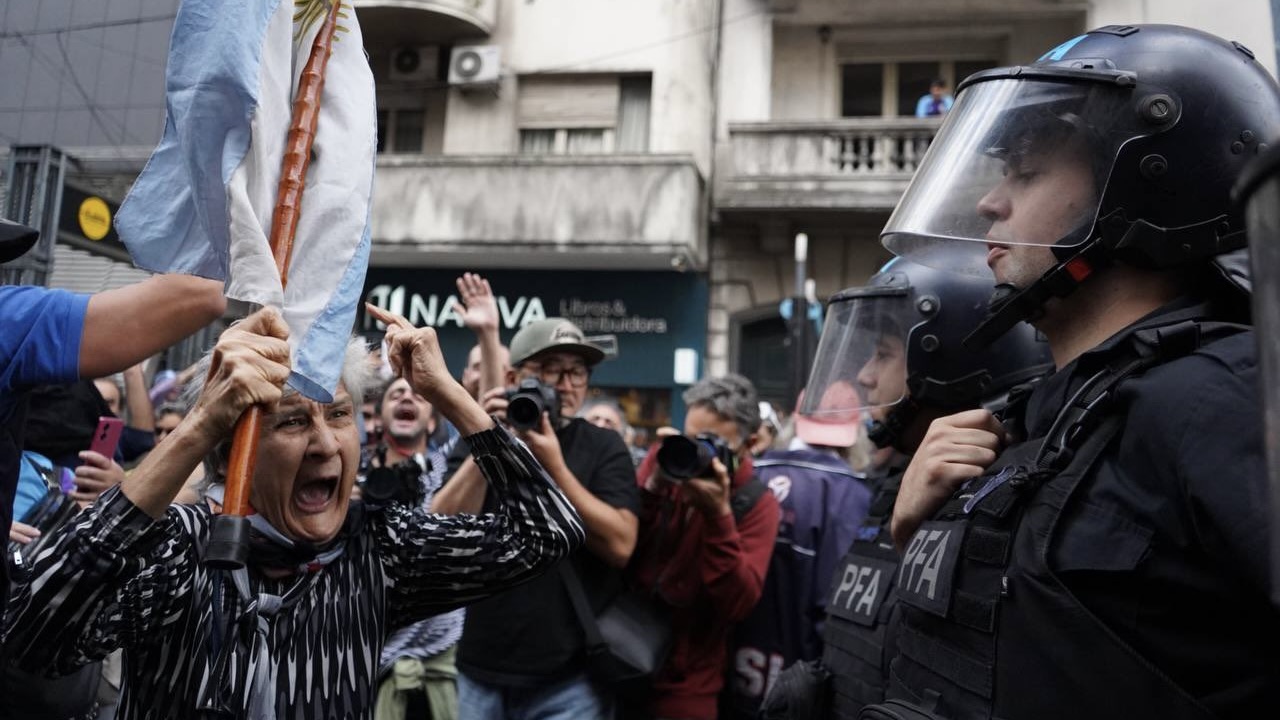
Interaction between a pensioner and a cop in Buenos Aires on March 12. Photo: Argentina Humana / X

More than a hundred people were arrested and dozens were injured in the police repression. Movements and press organizations have called for the resignation of the Secretary of Security, Patricia Bullrich.

On March 12, Javier Milei’s right-wing government brutally repressed a demonstration of retirees and their supporters, including fan clubs of football teams, demanding better living conditions. The Buenos Aires Police reported that at least 124 people were arrested in the protests outside Congress. For its part, the Emergency Medical Attention System (SAME) reported that, at the end of the day of protests, 46 people were injured.

Early on March 13, a judge in Buenos Aires, Karina Andrade, ruled to free 114 of the detainees arguing that the constitutional rights to protest, to manifest in democracy, and free speech, had been put at risk. She added that elderly people are “one of the most vulnerable sectors of our country” and they are protected.

Retirees demand to live with dignity

For the past several months, retirees have been protesting every Wednesday to demand an improvement in their living conditions. Thanks to Milei’s neoliberal adjustments, their quality of life has drastically declined.

According to data from the Ombudsman’s Office for the Elderly, a pensioner needs at least 1,200,523 pesos (USD 1,066) per month to cover their basic expenses. However, the minimum pension in February was 343,086 pesos (USD 321), including a bonus of 70,000 pesos (USD 65). The glaring gap between the cost of living and the income of pensioners has been the key motivating factor driving adults of 70-90 years old to take to the streets every week and risk brutal repression from Milei’s right-wing government.

According to Florencia Abreju, an Argentine journalist, “The cuts to medicines, the reduction of medical assistance, and the excessive increase of basic services have aggravated the situation even more. Why always with the retirees? The answer is clear: Milei’s government destroys the rights of all, starting with the weakest.”

Repression was ordered by Milei’s government

This Wednesday was not the first time that the Minister of Security Patricia Bullrich had ordered repression, but the level of force used by the police was certainly more extreme. Tear gas, rubber bullets, water cannons, pepper spray, blows with batons, etc., were some of the means of repression used by the Argentine police to confront the demonstrators, who were mostly retirees.

Pensioner dousing his face with milk after being tear gassed. Photo: Argentina Humana / X

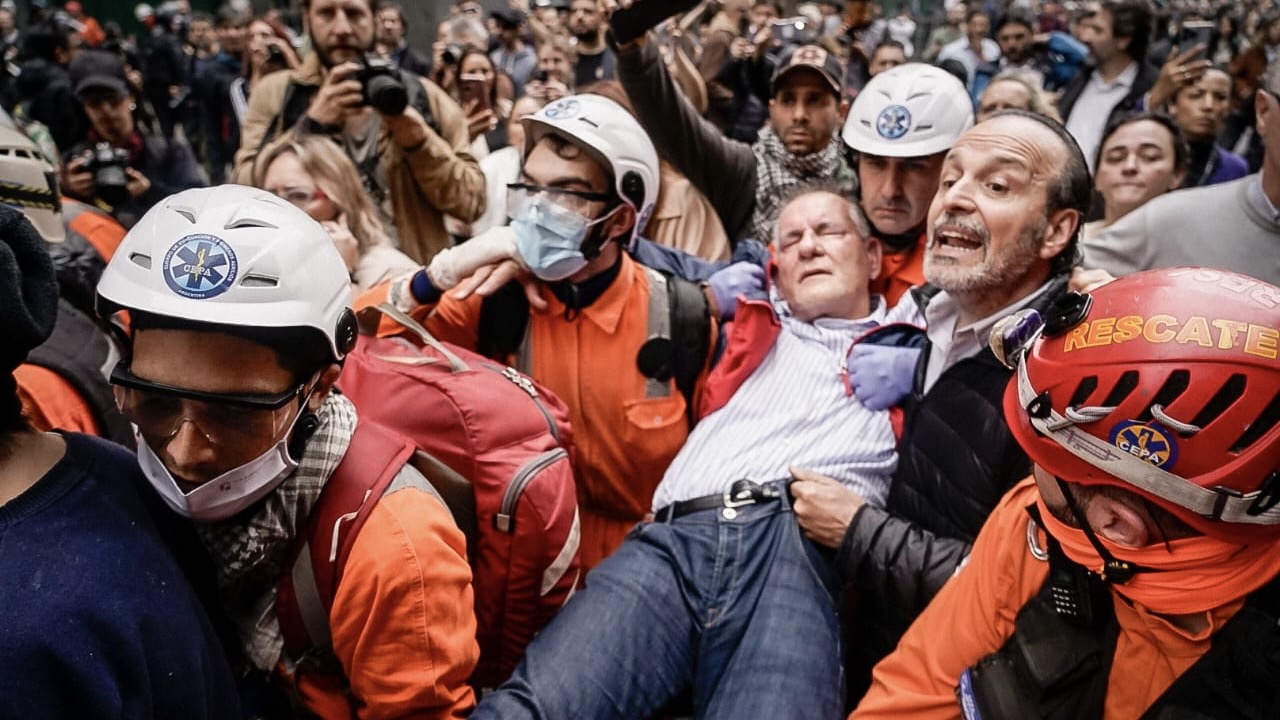
One of the victims is photographer Pablo Grillo, who suffered a serious head injury while taking pictures of the protest and the repression. As seen in a video, the police fired a tear gas bomb at him which directly impacted his head, causing a severe wound that kept him on the verge of death at the Ramos Mejía hospital in Buenos Aires.

The Executive justified the widespread repression of the protests by citing the participation of several fan organizations of various Argentine soccer clubs, such as Chacaritas, Boca Juniors, River Plate, and Rosario Central, among others. According to Bullrich, the members of the so-called “barras bravas” are dangerous groups and this justified the forceful response of the National Police, even though several of the injured and detained do not belong to such groups. On her X account, the Security Secretary wrote “Our forces are deployed to enforce the protocol: traffic is not cut and the barras bravas, on the sidewalk.”

However, for Florencia Abreju, this type of rhetoric seeks to discredit the legitimate claims of the protesters. “The most alarming thing is that the government, through Bullrich and her officials, justified the repression and stigmatized the protesters… This discourse seeks to criminalize social protest and delegitimize the demands of people who take to the streets to defend their rights. The stigmatization of militancy and fierce repression are tools typical of an authoritarian government that is willing to do anything to stay in power.”

Several journalists demand Bullrich’s resignation

In response to the repression ordered by the Secretary of Security and in solidarity with the injured journalist, several journalists have begun calling for Patricia Bullrich’s resignation. The Association of Graphic Reporters of Argentina expressed in a communiqué “Institutional violence and impunity for crimes committed by the security forces have increased…Today [we demand] that the President [Milei] immediately remove [Patricia Bullrich] and place her and her subordinates at the disposal of the justice system. Otherwise, we make him morally, politically, and criminally complicit in the crimes committed by his [Security] Secretary.”

“They shot a colleague in the Congress…Tomorrow all the journalists in Argentina must be asking for the resignation of whoever ordered the shooting of the colleague,” said a journalist on the Crónica TV Show as images of the repression flashed on the screen.

For now, Milei shows no signs of backing down from his internal security policy of openly and forcefully repressing demonstrators opposing his neoliberal agenda. In this regard, Abreju points out “Repression, stigmatization, and authoritarian discourse are signs of a government that is in decline but does not hesitate to resort to excessive force to impose its agenda through terror. It is time to be alert and united in the face of this subjugation of rights. What is at stake is not only the future of retirees but democracy and the future of the nation. Today, as never before, it is necessary to defend what has been conquered and repudiate the systematic violence that seeks to install fear in the people with an already known recipe.”

Original article by Pablo Meriguet republished from peoples dispatch under a Creative Commons Attribution-ShareAlike 4.0 (CC BY-SA) license.
Continue ReadingMilei’s government represses retirees’ march with extreme force

Argentine organizations reject attempts by Milei to silence dissent with fear

Spread the love

Original article by Pablo Meriguet republished from peoples dispatch under a Creative Commons Attribution-ShareAlike 4.0 (CC BY-SA) license.
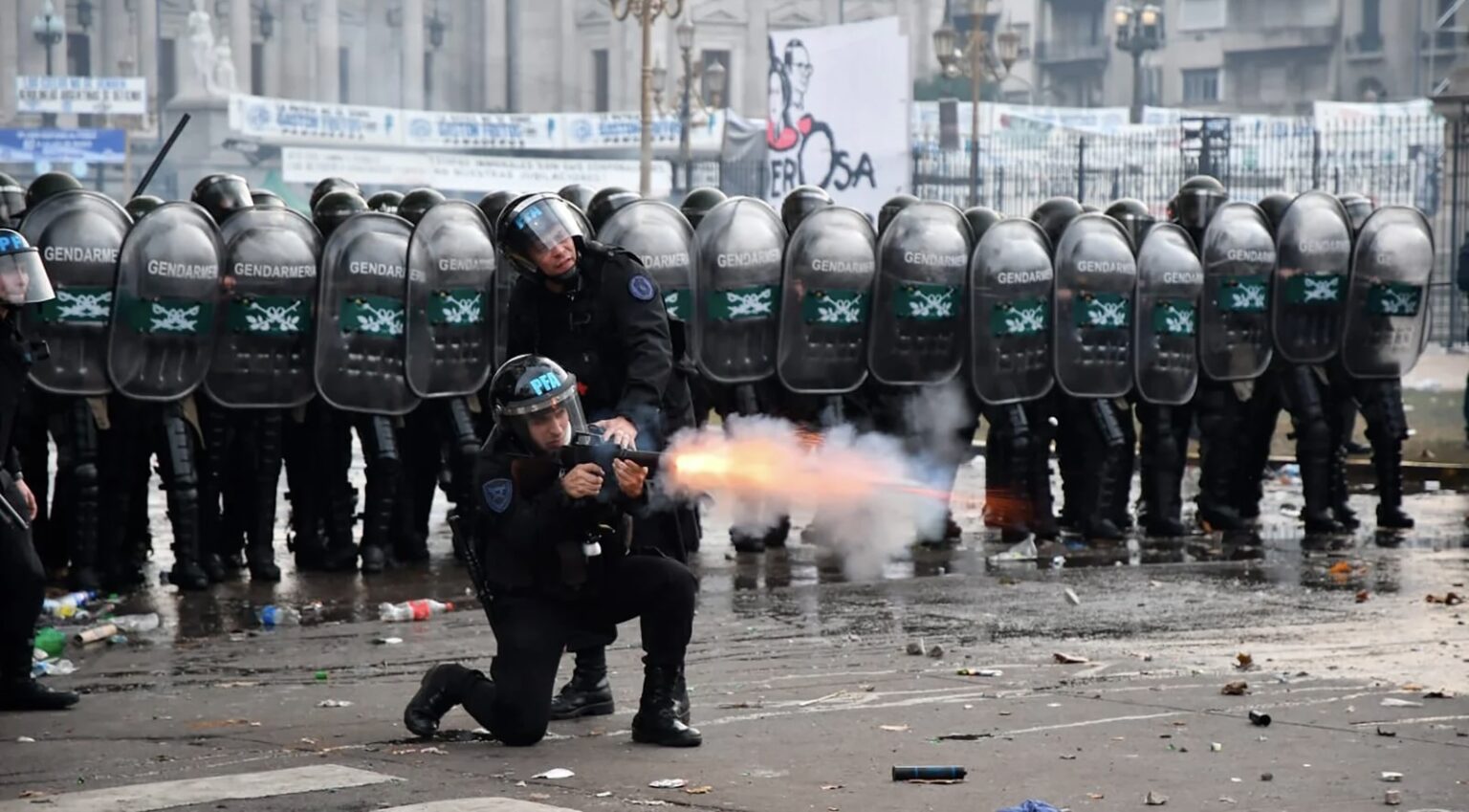
Police in Argentina brutally repressed a mobilization against Milei’s controversial economic reforms. Photo: UP Diputados

Over 30 people were detained in Buenos Aires during the brutal repression of the protests against Milei’s economic reform law

Last week, the Argentine Senate debated the bill called “Law for Bases and Starting Points for the Freedom of Argentines” (Ley Bases), a set of economic and political reforms proposed by the far-right government of Javier Milei. While the Executive sought the necessary votes in the Senate to pass the law, thousands of demonstrators gathered around the legislature to demand that the law be shelved.

The protests were called by several social organizations and trade unions, including the country’s largest trade union confederations, the General Confederation of Labor (CGT), the Argentine Workers’ Central Union, and the Argentine Workers’ Central Union (Autonomous).

The action of the police, under the orders of the Minister of Security, Patricia Bullrich, was excessive and brutal. Even lawmakers were not spared the violent repression. Peronist legislators, Eduardo Valdés, Carlos Castagnetto, Leopoldo Moreau, Juan Manuel Pedrini, Carolina Yutrovic and Luis Basterra, denounced that they were beaten by the security forces. In addition, several detainees told press that “they were stripped naked and that pepper spray was thrown at them”.

Martin Dirroco, a worker detained during the protests, recounted: “We were in Congress and we began to feel the tear gas, our throats began to burn and we began to leave. We heard more and more shots fired; we could see the repression. […] Suddenly a lot of people started to come, we tried to leave and seven motorcycles appeared. The one on the back of the motorcycle was pointing a gun at us. They got off the motorcycle and told us to stay still. They shooted and shouted ‘everybody against the wall’. They started pushing and shoving, holding me and throwing me to the ground. […] We had to sleep in a courtyard with handcuffs on”.

On Wednesday, June 12, 33 people were arrested, with many held for several days. Carlos Lopez, a left Argentine political leader, told Peoples Dispatch that as of today there are still five people detained on alleged charges of “public intimidation” and “arson”. Lopez comments that some people were even arrested 15 blocks from the Senate, far away from the events for which they are accused. “They are trying to sow terror from the government, the State, so that the population feels fear and shuts its mouth”. In addition, López continues, the detainees did not have adequate access to water and food; some spent more than 15 hours in a police patrol car and many could not speak to their lawyers: “There was intimidation, torture and threats […] We ask for everyone’s solidarity so that this type of action does not happen again,” said López.

Police launching tear gas canisters at protesters on Wednesday June 12 in Buenos Aires. Photo: Somos Telam

The President’s Office celebrated the approval of the law and called the demonstrators “terrorists”: “Starting from 38 deputies and 7 senators, with terrorist groups attacking the Congress, having to deploy the Security Forces in defense of democracy, with the political caste resisting and operating until the last moment, and having to resort to the tie-breaker of the Vice President of the Nation, Victoria Villarruel, tonight’s is a triumph of the Argentine people and the first step towards the recovery of our greatness, having approved the most ambitious legislative reform of the last forty years.”

Several human rights organizations, such as the Grandmothers and Mothers of the Plaza de Mayo, the Permanent Assembly for Human Rights, the Relatives of the Disappeared and Detained for Political Reasons, among others, called for a demonstration on Tuesday June 18 to demand the release of the 16 people that were still detained (including several students and professors) accused of “terrorism”. During a press conference, various relatives of the detainees denounced the injustice of the accusations against the prisoners and affirmed that they are not terrorists and demanded their immediate release.

Milei’s “Ley Bases”

At the end of the debate last Wednesday, the law was approved thanks to the vote of Vice President Victoria Villarruel, who broke the tie. The controversial law must be approved a second time in the Chamber of Deputies.

The reforms of the “Ley Bases” propose a paradoxical transformation of the functioning of the Argentine State. At the same time that they seek to diminish the State’s capacity to control the economy, they strengthen the President’s political power to make economic and political decisions, which will no longer have to be approved by the legislative branch. In other words, the intention is to build a weaker but more agile State to execute President Milei’s neoliberal plan.

One of the most controversial changes is the creation of the “Incentive Regime for Large Investments” (RIGI, for its initials in Spanish). The purpose of this regime is to reduce the State’s control over large companies that invest more than USD 200 million in the country. The government promises these big companies a reduction in taxes, privileges in the project approval process, and protection of capital from state control for 30 years. RIGI seeks, among other things, the exploitation of natural resources by major companies.

According to the “Ley Bases”, the President may have “extraordinary powers” for one year if he declares a public emergency in the economic, financial, and energy fields. In this sense, Milei would have several powers that currently only the Legislative has. To achieve its approval in the Senate, the Executive committed itself not to interfere with 15 public agencies, such as the National Service of Food, Health and Quality (SENASA), the National Bank of Genetic Data (which has information on those who disappeared during the last dictatorship), among other institutions. However, the government will be able to legislate through expeditious decrees, which implies, in general, the first great legislative victory for its political project.

In addition, the “Ley Bases” authorizes the privatization of Intercargo, a state-owned company dedicated to provide services to air travel companies, and Energía Argentina S.A., which is in charge of the extraction and exploration of hydrocarbon deposits, their transportation, and storage. Although Milei wanted to privatize more than 40 public companies, the negotiations forced him to limit his aspirations. Nevertheless, Milei’s major project in this regard seems to be aimed, at first, at the privatization of the mining, energy and fuel sectors.

Finally, the “Ley Bases” seeks to make a discreet, although controversial, labor reform, as it proposes, among other things, to eliminate penalties for companies that use informal workers, which is currently sanctioned by law.

While the Executive celebrates its neoliberal legislative victory, the families of the prisoners continue to pressure the justice system to free the detainees and drop the serious charges that could mean several years in prison.

Original article by Pablo Meriguet republished from peoples dispatch under a Creative Commons Attribution-ShareAlike 4.0 (CC BY-SA) license.

Continue ReadingArgentine organizations reject attempts by Milei to silence dissent with fear

Milei Couples ‘Total Crackdown’ on Protest With Economic Shocks in Argentina

Spread the love

Original article by Julia Conley at Common Dreams shared under Creative Commons (CC BY-NC-ND 3.0).

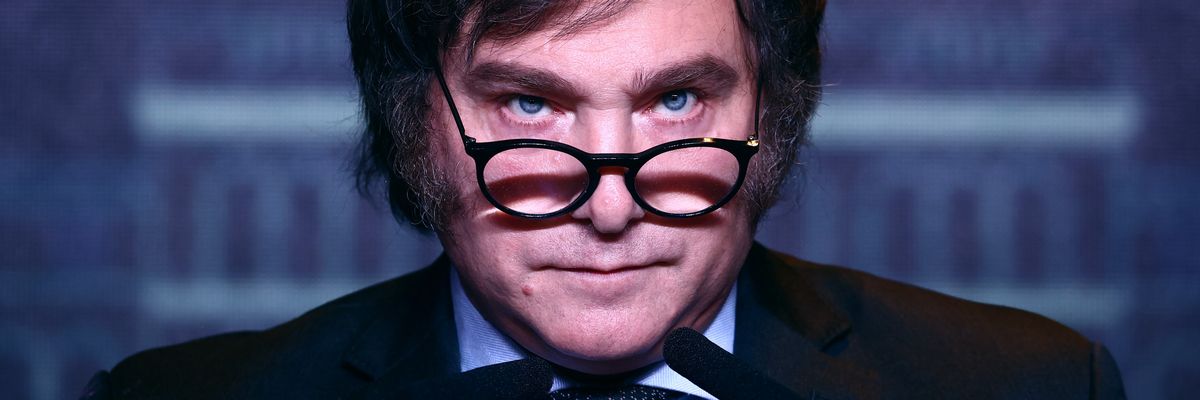
Argentinian President Javier Milei looks on after the polls close in the presidential runoff election on November 19, 2023 in Buenos Aires, Argentina. (Photo: Tomas Cuesta/Getty Images)

“Protest is elemental to Argentine social and political life, so it’s not difficult to imagine how this ends,” said one journalist.

As the human impact of Argentinian President Javier Milei’s “shock treatment” to the South American country’s economy became increasingly clear with rising prices on Thursday, Security Minister Patricia Bullrich announced what one journalist said were doubtlessly “preemptive” new controls on protests to discourage a struggling population from speaking out.

Bullrich said four security forces—the Federal Police, the Gendarmerie, the Naval Prefecture, and the Airport Security Police—will work together to stop protests that block streets and suggested the protocol is aimed only at ensuring “that people can live in peace” without demonstrators blocking traffic.

But as Progressive International co-general coordinator David Adler and others noted, the measures also include calls for armed forces to break labor strikes, create a national registry of people who organize protests, and sanctions against parents who bring their children to demonstrations.

The new package amounts to “a total crackdown on Argentine civil society,” Adler said.

https://twitter.com/davidrkadler/status/1735666098127733129?ref_src=twsrc%5Etfw%7Ctwcamp%5Etweetembed%7Ctwterm%5E1735666098127733129%7Ctwgr%5Edc4c076d58c4fd3232ae472103691fce93a38f1a%7Ctwcon%5Es1_c10&ref_url=https%3A%2F%2Fwww.commondreams.org%2Fnews%2Fmilei

Bullrich’s announcement came days after Milei, a far-right libertarian economist who has called the climate crisis “a socialist lie” and has been compared to former U.S. President Donald Trump, announced in the first weeks of his presidency an economic “shock treatment” package including a devaluation of the peso by 50%, from 400 pesos to the U.S. dollar to 820 pesos.

The administration also said it would cut public spending by closing some government ministries, increasing retirements ordered by decree, reducing energy and transportation subsidies, and freezing public works, with further “profound” measures expected in the future.

Milei claimed that with the spending cuts, government revenues will ultimately increase by 2.2 points, helping to confront an economic crisis in which annual inflation exceeds 160%, the country has a trade deficit of $43 billion, and $45 billion is owed to the International Monetary Fund (IMF).

But as Milei’s “open heart surgery of the economy,” as El País called the package, took hold, prices of some goods and services rose by 100% and some commuters worried that they will no longer to be able to afford their daily commutes it transit agencies are forced to raise prices due to lost subsidies.

“If [the bus fare] goes up, my salary will be spent on transport,” Julia González, who takes three buses and a train to her job in downtown Buenos Aires, toldThe Associated Press.

About 40% of Argentinians live below the poverty line and more than 9% are destitute, reported El País, with incomes insufficient to buy food.

Economist Juan Manuel Telechea told the outlet that monthly inflation could reach 30-40% due to the devaluation and that social aid will be “highly insufficient.”

Presidential spokesperson Manuel Adorni said of the economy Wednesday that Milei “found a patient in intensive care about to die,” but one trade unionist told El País the president is “exaggerating the inherited crisis situation to justify inadmissible measures, which will increase poverty levels in Argentina above 50% in a matter of days.”

“The mega-devaluation that is being carried out is a matter of concern because it may devolve into hyperinflation,” Pato Laterra, an economist at the National University of La Plata, told the newspaper.

Mark Weisbrot, co-director of the Center for Economic and Policy Research, said last month that Argentina’s current economic crisis is the result of right-wing former President Mauricio Macri’s administration, which took out the largest loan ever from the IMF and pushed the economy into a recession, with poverty and inflation rising by 50% or more.

“But a crazed, economically suicidal approach would only make things worse—and as Argentina has experienced, things can get a lot worse,” said Weisbrot. “Milei displays a callous disregard for most people’s living standards, values, and well-being, as well as a commitment to widely discredited economic policies, that is unprecedented.”

Jacob Sugarman of the Buenos Aires Heraldsaid Wednesday that it remains to be seen “how long Argentine society is willing to tolerate this kind of pain” and suggested that Bullrich’s announcement of a crackdown on dissent is likely to further anger the public.

“Protest is elemental to Argentine social and political life, so it’s not difficult to imagine how this ends,” said Sugarman, “especially with Bullrich announcing that the government will use federal forces including the National Military Police to break picket lines.”

Original article by Julia Conley at Common Dreams shared under Creative Commons (CC BY-NC-ND 3.0).

Continue ReadingMilei Couples ‘Total Crackdown’ on Protest With Economic Shocks in Argentina