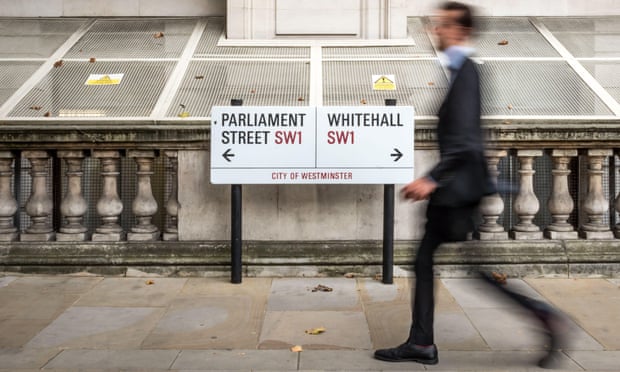
Wednesday’s spring statement has been overshadowed by where the cuts are due to fall, with some departments asked to model cuts of up to 11%. Photograph: pxl.store/Alamy
‘You can’t cut your way to growth,’ says PCS head as Reeves confirms move to cut administrative costs by 15% by 2030
Rachel Reeves’s planned cuts of £2bn to government departments will hit frontline services from jobcentres to HMRC phone lines and efforts to cut the asylum backlog, a union has said.
On Sunday the chancellor confirmed plans to seek a 15% reduction in admin costs across Whitehall, amounting to about £2bn a year, by the end of the decade. She said this would also result in about 10,000 job losses in the civil service, although this was not a target.
As she prepares to give her spring statement on Wednesday, Reeves is under pressure to balance the books in line with her fiscal rules, meaning some departments are in line for spending cuts to avoid more tax rises or higher borrowing.
But the Public and Commercial Services Union (PCS) warned her that there would be consequences for public services after 15 years of underfunding by the Tories.
Fran Heathcote, the general secretary of the PCS, said: “You hear that every day from the public, that they wait too long on the phone when they try to make tax payments, jobseekers rushed through the system in just 10 minutes because there aren’t enough staff to see them, victims of crime waiting until 2027 to have their cases heard in the courts as well as the backlog in the asylum system which results in additional hotel costs.
“The impact of making cuts will not only disadvantage our members but the public we serve and the services they rely on. We’ve heard this before under Gordon Brown when cuts were made to backroom staff and [the] consequences of that were chaos.”
Keir Starmer, Angela Rayner and Rachel Reeves wear the uniform of the rich and powerful. They have all had clothes bought for them by multi-millionaire Labour donor Lord Alli. CORRECTION: It appears that Rachel Reeves clothing was provided by Juliet Rosenfeld.Keir Starmer confirms that he’s proud to be a red Tory continuing austerity and targeting poor and disabled scum.
Keir Starmer says pensioners can freeze to death and poor children can starve and be condemned to failure and misery all their lives.
…
So-called austerity is best understood as a massive transfer of wealth — from public to private, from the many to the few, as the fortunes of the super-rich ballooned while Britain endured the longest wage squeeze since the Napoleonic wars.
This is a grotesquely unequal country in which big banks and energy giants post the largest profits in their history, in which the richest 1 per cent own more than the poorer 70 per cent of the population put together, in which millions rely on foodbanks while the number of billionaires increased by a fifth during the Covid crisis alone.
When Reeves gives with one hand and takes away with the other — as PCS leader Fran Heathcote notes she does by offering a 1.7 per cent increase in departmental spending, while setting a 2 per cent savings target for those same departments — she cites pressure on the public finances that could be relieved easily through higher corporation tax, a financial transactions tax or a wealth tax. As Unite’s Sharon Graham notes, a 1 per cent tax on the richest 1 per cent would raise £25 billion, filling the so-called “black hole” in the budget at a stroke.
It is a choice to echo Tory hysteria over benefit fraud, when the amount lost to this is less than goes unclaimed in social security payments people are entitled to. Giving the Department for Work & Pensions power to remove money directly from bank accounts will likely increase non-take-up of benefits by people who need them but understandably fear their personal finances being exposed in this way.
And it’s a choice to hike the cost of a bus ticket by 50 per cent while maintaining a fuel duty freeze — when governments across Europe are making public transport cheaper because it is essential to reduce greenhouse gas emissions.
‘If arms company bosses and Britain’s political elite won’t impose an arms embargo, we, the workers, will enforce it from below’
This May Day, over 1,000 workers across Britain have mobilised to blockade four sites involved in the supply of arms to Israel, in a response to calls from Palestinian trade unions.
In solidarity with Palestinian workers as the onslaught on Gaza reaches its 208th day, trade unionists in Britain have blocked entry to the UK Department of Business and Trade in London and three BAE Israeli arms factories in Scotland, Wales and Lancashire to protest the government’s refusal to suspend the sale of UK arms to Israel.
BAE Systems has been targeted as the UK’s leading military goods manufacturer which profits from arming Israel, while workers have blocked the UK Trade Department in support of civil servants who have expressed fears that they could be complicit in war crimes in Gaza if Israel is found to have broken international law.
Civil servants’ union PCS is considering bringing legal action to prevent their members being forced to carry out potentially unlawful acts, after staff requested to “cease work immediately” on arms export licences to Israel.
Canada, the Netherlands, Japan, Spain and Belgium have suspended the sale of arms to Israel, while the British government continues to refuse. It comes as a legal challenge over the British government’s role in allowing weapons to be sent to Israel has been given the go-ahead to be heard in the High Court later this year.
WHITEHALL cleaners, security guards and support staff are to strike for five days after being offered a below-inflation pay rise.
They are angry to have been offered just a 3.5 per cent rise by outsourced contractor ISS when inflation is running at 6.8 per cent, the Public and Commercial Services (PCS) union said.
Nearly 100 PCS members at the Department for Energy Security & Net Zero, Department for Business & Trade and Department for Science, Innovation & Technology are set to take action from September 4 to 8.
PCS general secretary Mark Serwotka said: “It’s obscene that ISS can afford to pay board members £988,000 — a rise of 8.9 per cent from last year — yet claim they can’t afford to pay cleaners a fair rise.
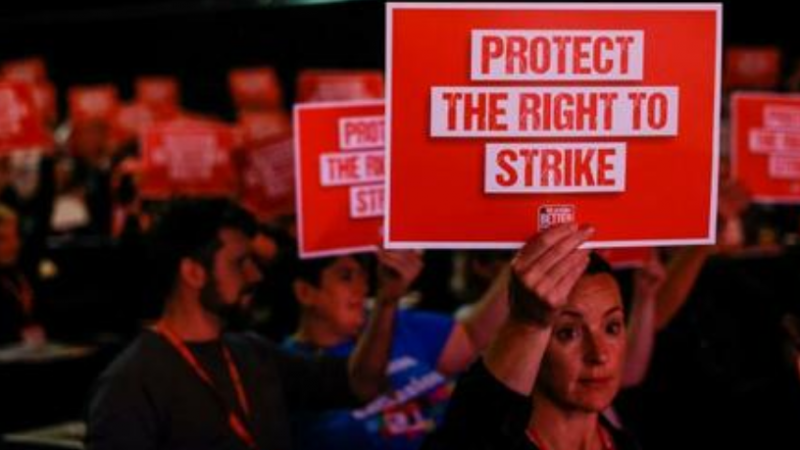
The Trades Union Congress (TUC) has organised an emergency protest on Monday 22nd May for 6.00pm outside Parliament Square, as it fights to protect the right to strike which is under attack from the Tory government.
Mick Lynch from the RMT, Matt Wrack from the FBU and Kevin Courtney will be speaking at the rally, with Unison, USDAW and the PCS union all showing their support.
The government’s strikes bill, which will empower employers to sue unions and sack staff in crucial sectors if minimum service levels aren’t maintained, has been slammed as an attack on the fundamental right to strike and as a draconian piece of legislation. The Bill essentially means that when workers lawfully vote to strike in health, education, fire, transport, border security and nuclear decommissioning, they could be forced to attend work – and sacked if they don’t comply.
The TUC said in a press statement: “We can’t afford to lose the right to strike. But multi-millionaire Tory politicians are attacking our right to strike for better pay and fair treatment at work.
Former Chancellor Kwasi Kwarteng has once more refused to apologise for his disastrous mini-budget which caused financial turmoil and which eventually led to him being sacked and Liz Truss being forced out of office.
Kwarteng, whose mini-budget resulted in chaos on the financial markets, the pound hitting an all-time low against the dollar and mortgage rates soaring, said he was ‘not in the business of forgiveness’.
“I’m not going to apologise,” he told Channel 4 News.
Former Tory MP and now Reform UK party member Ann Widdecombe has been widely condemned for her ‘out of touch’ and appalling comments on families struggling to make ends meet during the cost of living crisis.
Widdecombe was asked on BBC 2’s Politics Live programme about the cost of living crisis and what advice she would give to viewers who could not even afford the basics.
Jo Coburn asked the former Tory MP: “What do you say to those viewers who literally can’t afford to pay even for some of the basics – if they’ve gone up the way that cheese sandwich has, with all its ingredients?”
“Well, then you don’t do the cheese sandwich,” Widdecombe replied.
Her comments were immediately condemned by fellow panellist Rachel Cunliffe who said: “We’re talking about absolute basics and staples. We’re talking about own-brand pasta, we’re talking about bread, we’re talking about families who can’t afford to feed their children.
‘The First Past the Post system hands more power to the establishment than MPs or people.’
The Mayor of Greater Manchester, Andy Burnham, has set out the reasons for why the Labour Party should back a change to the voting system in favour of proportional representation (PR), despite party leader Keir Starmer saying that voting reform will not be a priority should Labour win power.
Although the Labour Party conference last year overwhelmingly backed a motion calling on the party to embrace a proportional electoral system, the leadership has made clear that it would not do as the motion says.
Since then, at the Progressive Britain conference last week, Starmer made clear that voting reform would not be among the priorities should Labour win power.
Burnham however has urged the party to adopt PR, saying that the current first-past-the-post voting system hands more power to the establishment than MPs or people and changing the system to proportional representation would mean “every vote would matter”.
Carla Denyer claims Greens are the strongest party on democratic reform
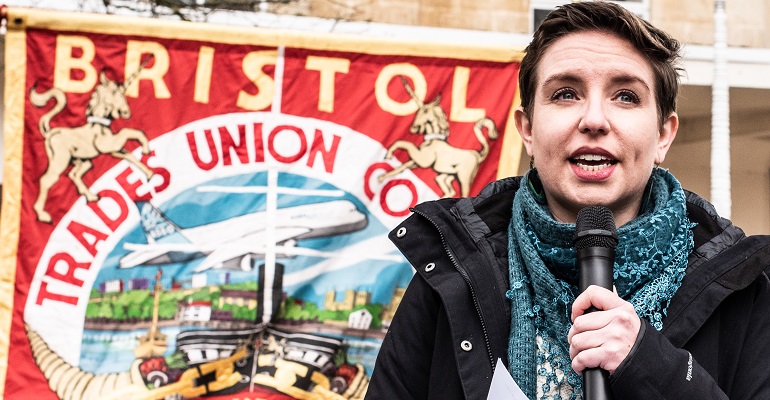
Carla Denyer, Cost of Living Crisis, Bristol, 2 April 2022
The Green Party has slammed the Tories for dragging democracy in the UK in a dangerous direction.
Speaking at an event last night, co-leader of the Green Party of England and Wales, Carla Denyer, laid out how the Tory’s have assaulted our democracy – and how the Greens would solve it.
Denyer discussed how to restore public faith in politics and argued that the Greens were the strongest party on democratic reform.
…
The Greens have said they would apply proportional representation for all elections to all levels of government, along with bringing the voting age down to 16.
They would introduce devolution, mirroring systems in Europe by giving more power to local and regional government and Scottish, Welsh and Northern Irish Parliament. They would also introduce an elected upper house to replace hereditary power in the House of Lord and set up a Citizen’s Convention.
Introducing a fairer system of state funding for political parties, which would hope to eliminate the dependence of large private donations and strengthen transparency on political lobbying and donations. One in four people believe that party donors have the most influence on government decisions, according to Unlock Democracy.
Denyer also accused the media of preventing democratic conversations through its bias towards certain political parties.