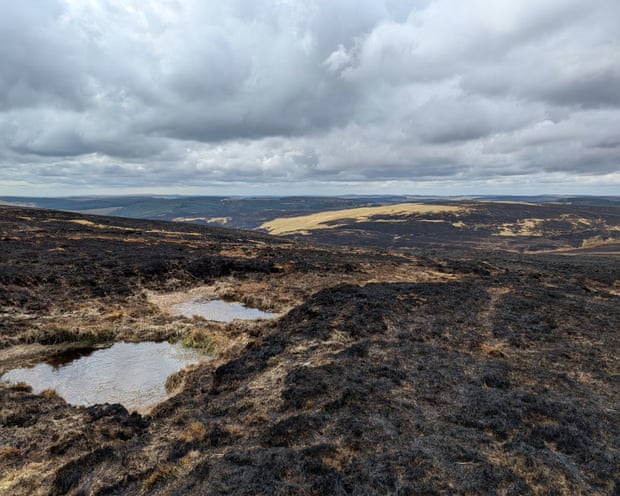
The effects of a huge wildfire on Abergwesyn Common, mid Wales. Habitats for many species such as reptiles and birds were destroyed. Photograph: Chris Smith/National Trust
National Trust says these are ‘alarm signals we cannot ignore’ as climate breakdown puts pressure on wildlife
Extremes of weather have pushed nature to its limits in 2025, putting wildlife, plants and landscapes under severe pressure, an annual audit of flora and fauna has concluded.
The National Trust, which provides a snapshot of how the weather is hitting wildlife every Christmas, described it as a rollercoaster of conditions that tested nature’s resilience like never before in modern times.
Ben McCarthy, the head of nature conservation at the charity, said: “Heat, drought and fire are the defining headlines of 2025.
“Extremes in weather is nothing new, but the compounded impact of several drought years in a short period – 2018, 2022 and now 2025 – is putting untold strain on habitats and making life even more difficult for wildlife. These are alarm signals we cannot ignore, and we need to work faster, smarter and in a more joined-up way.”
Donald Trump urges you to be a Climate Science denier like him. He says that he makes millions and millions for destroying the planet, Burn, Baby, Burn and Flood, Baby, Flood.Nigel Farage urges you to ignore facts and reality and be a climate science denier like him and his Deputy Richard Tice. He says that Reform UK has received £Millions and £Millions from the fossil fuel industry to promote climate denial and destroy the planet.Elon Musk urges you to be a Fascist like him, says that you can ignore facts and reality then.
Burned trees from the Palisades Fire and dust blown by winds seen from Will Rogers State Park in the Pacific Palisades neighborhood in Los Angeles, California on Jan. 15, 2025. Apu Gomes / Getty Images
Our planet’s plants and soils reached the peak of their ability to absorb carbon dioxide in 2008, and their sequestration rate has been falling ever since, according to a new analysis by a father-and-son team in the United Kingdom.
At first, the added carbon led to warmer temperatures, vegetation growth and a longer growing season. Once a tipping point was reached, however, the combination of heat stress, wildfires, drought, flooding, storms and the spread of new diseases and pests led to a reduction in the amount of carbon plants can soak up.
“The rate of natural sequestration of CO2 from the atmosphere by the terrestrial biosphere peaked in 2008. Atmospheric concentrations will rise more rapidly than previously, in proportion to annual CO2 emissions, as natural sequestration is now declining by 0.25% per year,” the authors of the study wrote. “This effect will accelerate climate change and emphasises the close connection between the climate and nature emergencies. Effort is urgently required to rebuild global biodiversity and to recover its ecosystem services, including natural sequestration.”
Once the tipping point was reached, the chances of unchecked climate breakdown became more likely, reported The Guardian.
Former Chief Executive of the Scottish Environment Protection Agency James Curran, with help from his son Sam, took a detailed look at the world’s changing carbon concentration levels. Their analysis revealed that, since 2008, plants have been absorbing an average of 0.25 percent less carbon dioxide each year.
“The findings are very stark. Emissions now need to fall by 0.3% per year, just to stand still. That’s a tall order since they typically increase by 1.2% per year,” James Curran said, as The Guardian reported.
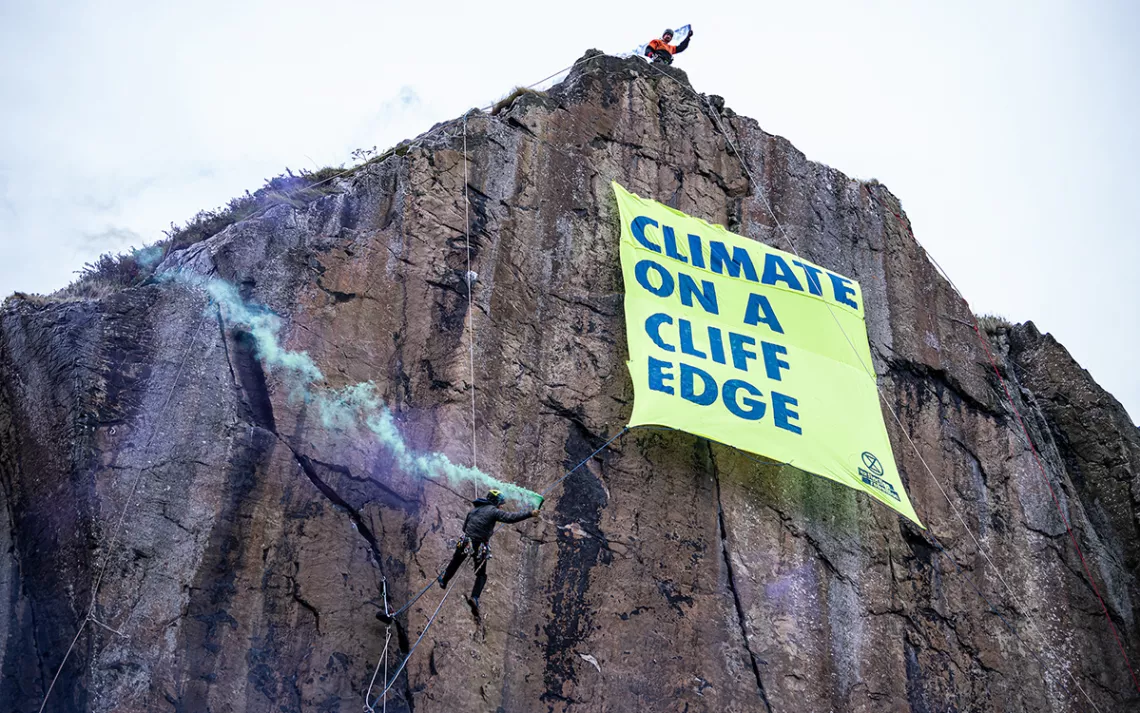
Experienced climbers scale a rock face near the historic Dumbarton castle in Glasgow, releasing a banner that reads “Climate on a Cliff Edge.” One activist, dressed as a globe, symbolically looms near the edge, while another plays the bagpipes on the shores below. | Photo courtesy of Extinction Rebellion and Mark RichardsNeo-Fascist Climate Science Denier Donald Trump says Burn, Baby, Burn.