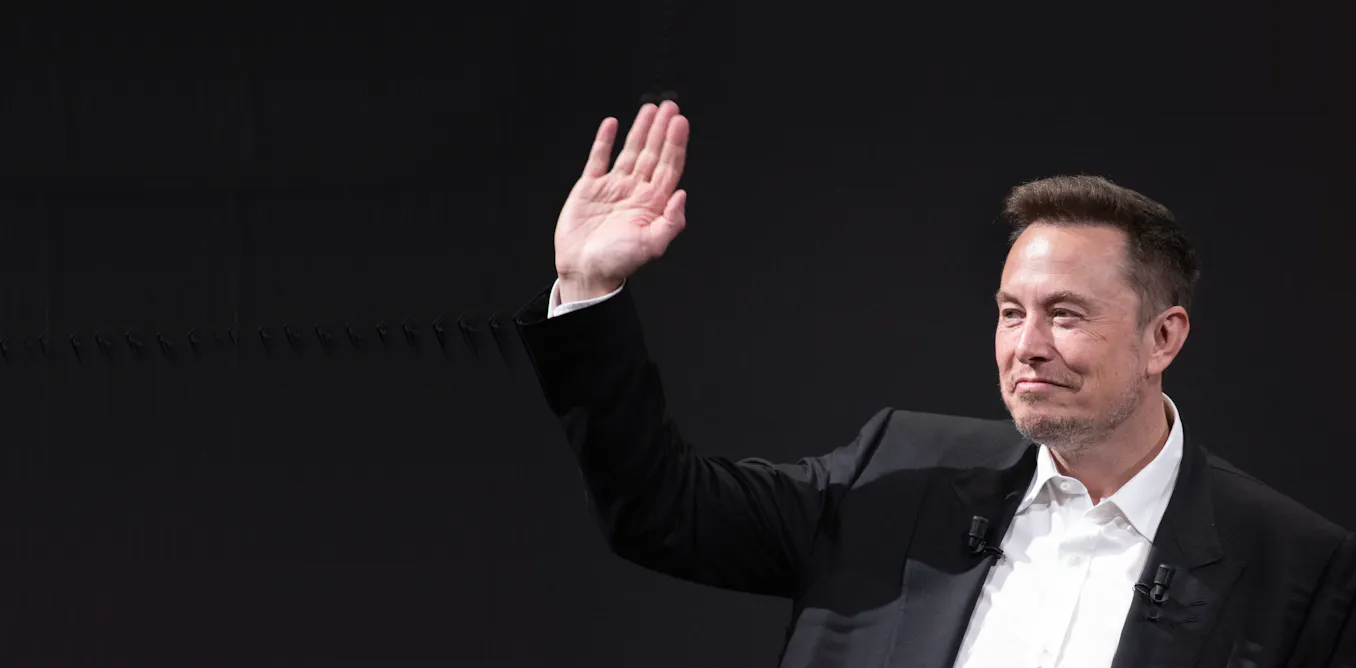
Tech billionaire Elon Musk is on track to become the world’s first trillionaire. It’s a sign markets aren’t working

Spread the love
FredericLegrand/Shutterstock

Richard Denniss, Crawford School of Public Policy, Australian National University

Apparently, the world is about to get its first trillionaire.

A report from the business intelligence agency Informa Connect says, at his present rate of wealth accumulation, tech billionaire Elon Musk is on track to be the world’s first trillionaire, three years from now.

At the moment Musk is said to be worth US$195 billion (A$293 billion), but if his wealth continues growing at the recent rate of 110% per year, he will hit US$1.195 trillion in 2027.

The next trillionaire after Musk should be Indian mining magnate Gautam Adani, followed by Nvidia chief Jensen Huang and Indonesian mining mogul Prajogo Pangestu, all of whom are on track to hit the milestone in 2028.

The nearly 1 billion human beings who don’t yet have electricity connected to their homes will doubtless be looking on with interest as the tech bros and mining bosses vie to crack 13 digits.

Before examining how it is that someone could ever make a trillion-dollar fortune, and what it might mean for the world for so much of the world’s wealth to be held in the hands of one person, it is important to first try to comprehend how big a trillion actually is.

One trillion seconds last 31,000 years

A million is a big number: it is 1,000 thousands. If you managed to retire with that many dollars in superannuation, you would have saved up more than 90% of your fellow retirees.

One billion is 1,000 millions. It takes 12 days for a million seconds to pass, but 31 years for a billion seconds to tick over.

That means a trillion seconds would equal 31,000 years.

If you had $1 trillion and did no more than stick it in the bank where it earned 4% interest per year you would get $40 billion per year in interest.

No one needs $1 trillion, and it is hard to see how anyone could spend it as fast as it grew, which raises important questions about how societies, economies and democracies will be able to function if and when governments allow trillionaires to emerge.

For mortals, a trillion is hard to justify

The palace at Versaille could have cost $300 billion in today’s dollars. WikimediaCommons, CC BY-NC-SA

France’s King Louis XIV spent today’s equivalent of US$200 billion-300 billion building his palace at Versailles, and it was by no means his only palace.

Pyramids and sphinxes didn’t come cheap either, but these sorts of expenditures were seen as needed for beings selected by gods and not entirely mortal.

For mortals, some believe that the entire population benefits when a small minority controls most of the resources on the basis that it builds incentives.

Just as peasants spent millennia awaiting their reward in the afterlife while their rulers enjoyed heaven on earth, in modern economies we are told wealth and prosperity will trickle down to us eventually if we keep working hard.

Unfortunately for most of us, despite the wealth of the richest 200 Australians growing from A$40.6 billion to $625 billion over the past 20 years, neither the Australian economy nor the wages of ordinary Australians are soaring.

High profits are meant to be temporary

Incentives can and do play an important role in our economy.

In the so-called “free market” envisaged by 18th-century economist Adam Smith, if my new farming technique or silicon chip is so good that everyone wants one, it is considered only fair that I get an initial reward.

But after a while, everyone else will be free to compete with me by selling similar goods and in turn stopping me from getting an extraordinary ongoing reward.

The problem is that some markets aren’t free and don’t work properly. It is no accident that the world’s biggest fortunes are held by those who have monopoly rights to sell natural resources or technologies that are protected by patents or systems that lock in users.

That’s bad news for those still waiting patiently for wealth to trickle down or to be spread more evenly.

Technofeudalism keeps profits growing

In his latest book former Greek finance minister Yannis Varoufakis describes the world we now live in as one of technofeudalism in which online platforms have the ongoing opportunity to exploit workers, consumers and producers in ways Smith could not have imagined.

Having created digital platforms where the price of entry is handing over your personal details and preferences, modern tech titans use a new form of alchemy to convert data into knowledge that allows them to keep you on their platform and exploit you or advertisers or suppliers in the belief that you won’t leave.

And while there are physical limits to how big a car factory or fast-food chain can grow, there are almost no physical limits on how much money tech platforms can make by selling ads they didn’t make for products they didn’t make to consumers they know nearly everything about.

Restraining profits is pro-market

It isn’t anti-capitalist to want those profits competed away, it’s pro-market.

When the United States broke up J.D. Rockerfeller’s oil monopoly in the early 20th century, the oil industry prospered rather than vanished. consumers and the businesses that had dealt with Rockerfeller were better off, and so was the economy as a whole.

Democracies have, for now, the power to use taxes and regulations to redistribute the enormous benefits flowing to the new class of billionaires (and soon trillionaires) from the sale of scarce resources and the creation of platforms that keep us trapped.

Whether and how we use that power is up to us, but we mightn’t have it for long. The more the new class of billionaires and trillionaires becomes entrenched, the more it will be able to use the political system to protect their interests rather than those of mere mortals.

Richard Denniss, Adjunct Professor, Crawford School of Public Policy, Australian National University

This article is republished from The Conversation under a Creative Commons license. Read the original article.

Continue ReadingTech billionaire Elon Musk is on track to become the world’s first trillionaire. It’s a sign markets aren’t working

Murdoch to Musk: how global media power has shifted from the moguls to the big tech bros

Spread the love
The Conversation, Mary Altaffer/AAP, Frederic Legrand/Shutterstock

Matthew Ricketson, Deakin University and Andrew Dodd, The University of Melbourne

Until recently, Elon Musk was just a wildly successful electric car tycoon and space pioneer. Sure, he was erratic and outspoken, but his global influence was contained and seemingly under control.

But add the ownership of just one media platform, in the form of Twitter – now X – and the maverick has become a mogul, and the baton of the world’s biggest media bully has passed to a new player.

What we can gauge from watching Musk’s stewardship of X is that he’s unlike former media moguls, making him potentially even more dangerous. He operates under his own rules, often beyond the reach of regulators. He has demonstrated he has no regard for those who try to rein him in.

Under the old regime, press barons, from William Randolph Hearst to Rupert Murdoch, at least pretended they were committed to truth-telling journalism. Never mind that they were simultaneously deploying intimidation and bullying to achieve their commercial and political ends.

Musk has no need, or desire, for such pretence because he’s not required to cloak anything he says in even a wafer-thin veil of journalism. Instead, his driving rationale is free speech, which is often code for don’t dare get in my way.

This means we are in new territory, but it doesn’t mean what went before it is irrelevant.

A big bucket of the proverbial

If you want a comprehensive, up-to-date primer on the behaviour of media moguls over the past century-plus, Eric Beecher has just provided it in his book The Men Who Killed the News.

Alongside accounts of people like Hearst in the United States and Lord Northcliffe in the United Kingdom, Beecher quotes the notorious example of what happened to John Major, the UK prime minister between 1990 and 1997, who baulked at following Murdoch’s resistance to strengthening ties with the European Union.

In a conversation between Major and Kelvin MacKenzie, editor of Murdoch’s best-selling English tabloid newspaper, The Sun, the prime minister was bluntly told: “Well John, let me put it this way. I’ve got a large bucket of shit lying on my desk and tomorrow morning I’m going to pour it all over your head.”

MacKenzie might have thought he was speaking truth to power, but in reality he was doing Murdoch’s bidding, and actually using his master’s voice, as Beecher confirms by recounting an anecdote from early in Murdoch’s career in Australia.

In the 1960s, when Murdoch owned The Sunday Times in Perth, he met Lang Hancock (father of Gina Rinehart) to discuss potentially buying some mineral prospects together in Western Australia. The state government was opposed to the planned deal.

Beecher cites Hancock’s biographer, Robert Duffield, who claimed Murdoch asked the mining magnate, “If I can get a certain politician to negotiate, will you sell me a piece of the cake?” Hancock said yes. Later that night, Murdoch called again to say the deal had been done. How, asked an incredulous Hancock. Murdoch replied: “Simple […] I told him: look you can have a headline a day or a bucket of shit every day. What’s it to be?”

Between Murdoch in the 1960s and MacKenzie in the 1990s came Mario Puzo’s The Godfather with Don Corleone, aided by Luca Brasi holding a gun to a rival’s head, saying “either his brains or his signature would be on the contract”.

Former British Prime Minister John Major fell foul of Rupert Murdoch – and paid the price. Lynne Sladky/AP/AAP

Changing the rules of the game

Media moguls use metaphorical bullets. Those relatively few people who do resist them, like Major, get the proverbial poured over their government. Headlines in The Sun following the Conservatives’ win in the 1992 election included: “Pigmy PM”, “Not up to the job” and “1,001 reasons why you are such a plonker John”.

If media moguls since Hearst and Northcliffe have tap-danced between producing journalism and pursuing their commercial and political aims, they have at least done the former, and some of it has been very good.

The leaders of the social media behemoths, by contrast, don’t claim any fourth estate role. If anything, they seem to hold journalism with tongs as far from their face as possible.

They do possess enormous wealth though. Apple, Microsoft, Google and Meta, formerly known as Facebook, are in the top ten companies globally by market capitalisation. By comparison, News Corporation’s market capitalisation now ranks at 1,173 in the world.

Regulating the online environment may be difficult, as Australia discovered this year when it tried, and failed, to stop X hosting footage of the Wakeley Church stabbing attacks. But limiting transnational media platforms can be done, according to Robert Reich, a former Secretary of Labor in Bill Clinton’s government.

Despite some early wins through Australia’s News Media Bargaining Code, big tech companies habitually resist regulation. They have used their substantial influence to stymie it wherever and whenever nation-states have sought to introduce it.

Meta’s founder and chief executive, Mark Zuckerberg, has been known to go rogue, as he demonstrated in February 2021 when he protested against the bargaining code by unilaterally closing Facebook sites that carried news. Generally, though, his strategy has been to deploy standard public relations and lobbying methods.

But his rival Musk uses his social media platform, X, like a wrecking ball.

Musk is just about the first thing the average X user sees in their feed, whether they want to or not. He gives everyone the benefit of his thoughts, not to mention his thought bubbles. He proclaims himself a free-speech absolutist, but most of his pronouncements lean hard to the right, providing little space for alternative views.

Some of his tweets have been inflammatory, such as him linking to an article promoting a conspiracy theory about the savage attack on Paul Pelosi, husband of the former US Speaker, Nancy Pelosi, or his tweet that “Civil war is inevitable” following riots that erupted recently in the UK.

As the BBC reported, the riots occurred after the fatal stabbing of three girls in Southport. “The subsequent unrest in towns and cities across England and in parts of Northern Ireland has been fuelled by misinformation online, the far-right and anti-immigration sentiment.”

Nor does Musk bother with niceties when people disagree with him. Late last year, advertisers considered boycotting X because they believed some of Musk’s posts were anti-Semitic. He told them during a live interview to “Go fuck yourself”.

He has welcomed Donald Trump, the Republican Party’s presidential nominee, back onto X after Trump’s account was frozen over his comments surrounding the January 6 2021 attack on the capitol. Since then both men have floated the idea of governing together if Trump wins a second term.

Is the world better off with tech bros like Musk who demand unlimited freedom and assert their influence brazenly, or old-style media moguls who spin fine-sounding rhetoric about freedom of the press and exert influence under the cover of journalism?

That’s a question for our times that we should probably begin grappling with.

Matthew Ricketson, Professor of Communication, Deakin University and Andrew Dodd, Director of the Centre for Advancing Journalism, The University of Melbourne

This article is republished from The Conversation under a Creative Commons license. Read the original article.

Continue ReadingMurdoch to Musk: how global media power has shifted from the moguls to the big tech bros