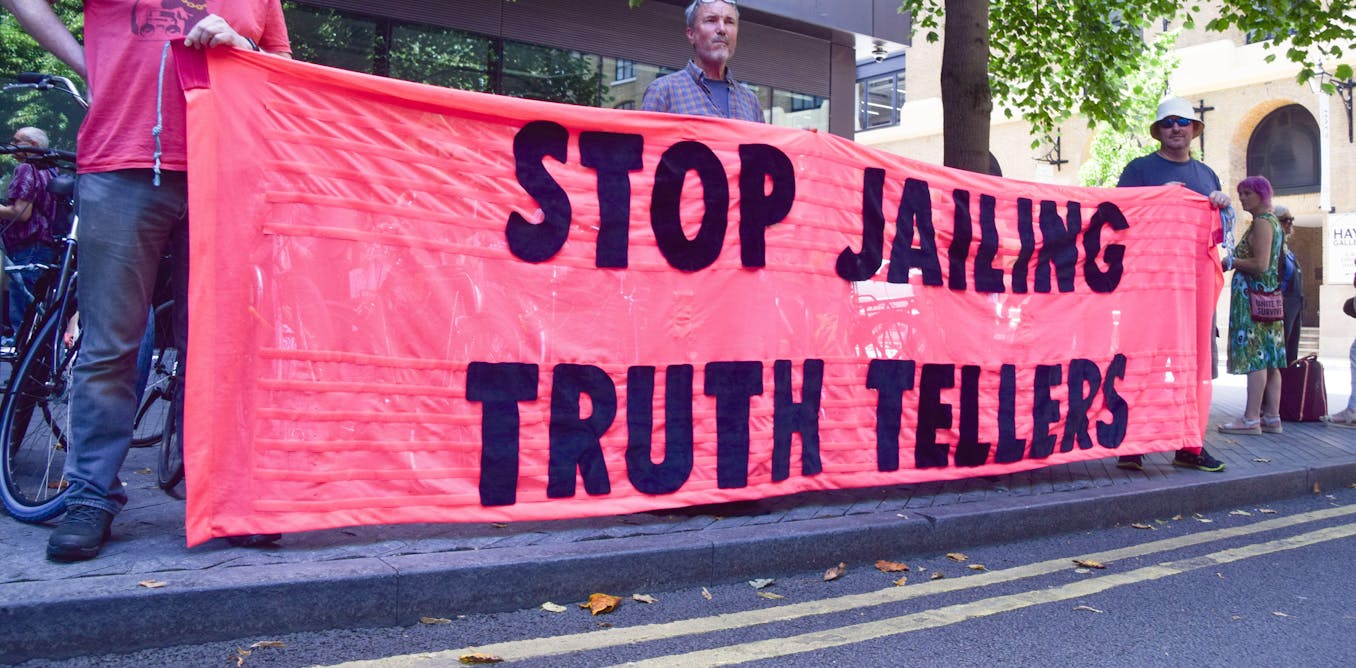
The unnecessarily violent police intervention at a Quaker place of worship is a PR disaster and will only serve to deepen the chasm between them and the public. SYMON HILL reports
THE police raid on a Quaker place of worship last week was not about preventing crime or arresting criminals. It was an attempt to intimidate peaceful protesters. It will not succeed.
At about 7.15pm on Thursday March 27, at least 20 police officers broke down the door of Westminster Quaker Meeting House in St Martin’s Lane in London. They could have just rung the doorbell.
The police, some armed with tasers, charged into a room where the non-violent protest group Youth Demand were holding a welcome talk. Women in their late teens and early twenties were grabbed and handcuffed behind their backs.
They swarmed through the rest of the building, entering every room, including one that had been hired by a life drawing class and even a room where a private counselling session was taking place.
This horrific incident was made possible by the draconian anti-protest laws introduced by the previous Tory government and maintained by their Labour successors. The police reportedly used the Police, Crime, Sentencing and Courts Act as they arrested six women. The youngest was 18.
When the Act was passed in 2022, we were told that the police would use it only in extreme situations. That promise is now as broken as Westminster Meeting House’s door.
In their media statement, the Metropolitan Police said that Youth Demand are planning civil disobedience in London. In recent years there has been a noticeable increase in campaigners being arrested for things they are only talking about doing. Even so, this went further.
This Youth Demand gathering was a welcome talk. It was a public event, open to people who had never even considered engaging in civil disobedience before. The police arrested other Youth Demand members in London and Exeter on the same day.
The police’s thuggery seems designed to intimidate Youth Demand from going ahead with their plans for April. The police may hope that the publicity around the raid will deter others from joining in.
Typically, the police have seriously underestimated the determination of people whose rights are denied.
Lengthy prison sentences have been imposed on five Just Stop Oil activists for coordinating direct action on the M25, the main ring road around London. For a non-violent protest, there is no equivalent in modern times.
The five years for Roger Hallam and four years for the remaining four: Daniel Shaw, Louise Lancaster, Cressida Gethin and Lucia Whittaker de Abreu, have been widely condemned as grossly disproportionate. According to one snap poll, 61% of the public consider the sentences too harsh.
But nobody should be surprised: these sentences are a logical outcome of Britain’s authoritarian turn against protest over the past five years.
Protest in England and Wales was previously dealt with by the courts according to what we call Hoffmann’s Bargain. This meant protesters should accept their guilt in court, but their conscientiousness – along with the wider importance of disruptive protest to democracy – would be rewarded with lenient sentences.
This changed with the prosecution of the Stansted 15, who were charged and found guilty of terrorist-related offences for stopping a deportation flight in 2017. The 15 were sentenced to community service, fines, and for some, short suspended prison sentences. On appeal, the Court of Appeal threw out the charges in 2021, but at the same time hardened the general approach of the courts to protest, confirming that a key defence (known as necessity) was not available to protest defendants in court.
Making it harder for activists to defend themselves
Since then, three things have happened. First, other potential defences that protesters could rely on, including lawful excuse, have been systematically restricted by the Court of Appeal.
Second, the Crown Prosecution Service (CPS) has sought where possible to bring more serious charges against protesters than used to be the case. In this they have been encouraged by new legislation brought in by the last government, notably the Police, Crime, Sentencing and Courts Act (2022) and the Public Order Act (2023).
Third, judges have typically sought to control and reduce the time that defendants have in court to explain their motives to the jury, because – without a defence in law – the defendants’ arguments are, in legal terms, not relevant.
We saw each of these dynamics in the Just Stop Oil “Conspiracy 5” trial. Before 2018, public nuisance itself was barely used for protest offences, but the CPS now regularly brings this charge against peaceful protesters. But the charge of a conspiracy to cause public nuisance, which these five defendants faced, is a further escalation as it treats protest movements as a criminal enterprise, and does not allow a lawful excuse defence. As a consequence, the stakes are higher and the outcomes more serious.
In court, the defendants were unable to argue that they had a lawful excuse for their action (Hallam repeatedly tried to argue this in court, and was repeatedly shut down by the trial judge). Finally, although the defendants did manage to explain their motives to the jury, the jury had no opportunity to find them not guilty in law. Although juries still have the power to find defendants not guilty by making a moral rather than a legal decision, this is much harder and rarer.
The result is that the first part of Hoffmann’s Bargain is being abandoned. With no recourse to a defence in law, protest defendants are now regularly being found guilty. But the second part of the bargain, leniency at sentencing, is increasingly being forgotten.
A new benchmark
In April 2023, Just Stop Oil activists Morgan Trowland and Marcus Decker were sentenced to three years and two years seven months in prison respectively after being convicted of public nuisance for disrupting the Dartford Crossing, a large bridge over the Thames to the east of London. Upheld by the Court of Appeal, these sentences have now become a benchmark.
In the Conspiracy 5 case, the trial judge explicitly cited this benchmark as the basis for the sentences he imposed, and any appeal against them will have to reckon with the Court of Appeal’s determination that they are fair.
This case brings into sharp focus two very contrasting visions of what a trial is, and what the criminal law is for. The courts are effectively treating protest trials as a legal flowchart, with a strict distinction between what is and what is not relevant on the shortest route to a verdict.
But defendants often see the courts as a place where they can make urgent arguments about moral values and social justice. Rather than a public nuisance, they consider their actions a public service. By not allowing defendants to account for their actions properly, the courts create an artificial separation between law and politics, and diminish the democratic agency of juries.
By imposing prison sentences on non-violent protesters, they impose authoritarian responses to pressing social problems.
Keir Starmer confirms that his government is cnutier than Suella Braverman on killing the right to protest.Orcas comment on killer apes destroying the planet by continuing to burn fossil fuels.
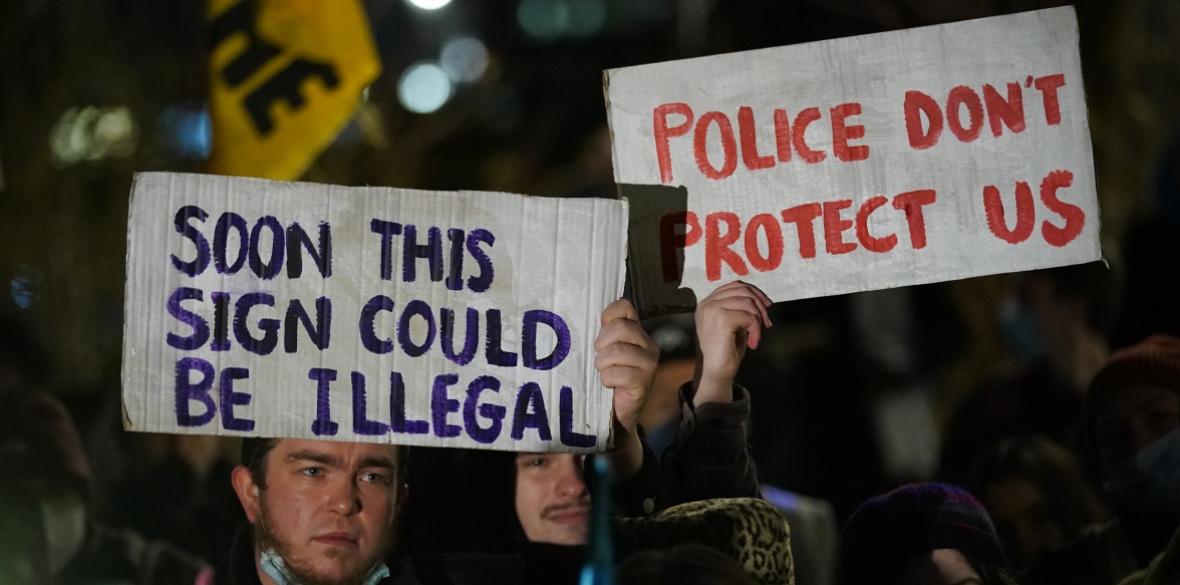
Demonstrators take part in a ‘Kill The Bill’ protest against The Police, Crime, Sentencing and Courts Bill, on College Green, Westminster, January 17, 2022
RIGHTS advocates have launched a campaign to overturn Tory legislation attacking the right to protest.
Liberty, formerly the National Council for Civil Liberties has condemned the government’s Police, Crime, Sentencing & Courts Act 2022 and the Public Order Act 2023 as part of a clear pattern in which the right to strike and the right to vote had also been attacked.
It has launched an online petition and is gathering signatures for a letter to Home Secretary James Cleverly calling on him to scrap the legislation.
Liberty director Akiko Hart said: “No matter where we live, our backgrounds, or who we vote for, we all want people in power to listen to our concerns and work to build a brighter future for us and our loved ones.
“But this government is clamping down on the ways we speak up on important issues. Most recently it has given the police dangerously broad powers to crack down on protests and arrest demonstrators.”
Ms Hart said Britain’s leaders are “criminalising protesters to hide from their own failings.”
“This is part of a clear pattern of shutting down the ways we can all hold them accountable for their actions,” she said.
“They have also created laws that stop workers from striking and block countless people from voting.”
Boris Johnson confirms his thumbs up from Rupert Murdoch
Our investigation reveals secretive funding sources for think tanks that boast of influencing the government
Influential right-wing UK think tanks with close access to ministers have received millions in ‘dark money’ donations from the US, openDemocracy can reveal.
The TaxPayers’ Alliance, the Institute of Economic Affairs (IEA), Policy Exchange, the Adam Smith Institute and the Legatum Institute have raised $9m from American donors since 2012. Of this, at least $6m has been channelled to the UK, according to tax returns filed with US authorities – representing 11% of the think tanks’ total UK receipts, with the figure reaching 23% for the Adam Smith Institute.
In that time, all five have steadily increased their connections in the heart of government. Between them, they have secured more than 100 meetings with ministers and more than a dozen of their former staff have joined Boris Johnson’s government as special advisers.
Representatives from right-wing think tanks – many of whom are headquartered at 55 Tufton Street in central London – frequently appear in British media and have been credited with pushing the Tories further to the right on Brexit and the economy.
As openDemocracy revealed yesterday, ExxonMobil gave Policy Exchange $30,000 in 2017. The think tank went on to recommend the creation of a new anti-protest law targeting the likes of Extinction Rebellion, which became the Police, Crime, Sentencing and Courts Act 2022.
None of these think tanks disclose their UK donors. With the exception of the Adam Smith Institute, none provide any information about the identity of donors to their US fundraising arms.
But an investigation by openDemocracy has identified dozens of the groups’ US funders by analysing more than 100 publicly available tax filings.
The Scottish National Party MP Alyn Smith said that the findings showed that the UK’s lobbying laws were not tough enough.
“He who pays the piper calls the tune,” he told openDemocracy. “We urgently need to rewrite the laws governing this sort of sock puppet funding so that we can see who speaks for who.”
Last month, Smith asked an IEA representative who funded the think tank on BBC’s flagship question time show.
Among the US-organisations who have donated to UK think tanks are oil companies and several of the top funders of climate change denial in the US.
The think tanks’ US arms received $5.4m from 18 donors who have also separately donated a combined $584m towards a vast network of organisations promoting climate denial in the US between 2003 to 2018, according to research from climate scientists.
The John Templeton Foundation, founded by the late billionaire American-British investor, has donated almost $2m to the US arms of the Adam Smith Institute and the IEA. Researchers claim that the John Templeton Foundation has a “history of funding what could be seen as anti-science activities and groups (particularly concerning climate-change and stem-cell research)”.
The National Philanthropic Trust, a multi-billion-dollar fund that does not disclose its own donors, has given almost $2m to the IEA, Policy Exchange, TaxPayers’ Alliance and the Legatum Institute’s US fundraisers. The trust has donated $22m to climate denial organisations, one of which described it as a “vehicle” for funnelling anonymous donations from the fossil fuel industry.
The Sarah Scaife Foundation, founded by the billionaire heir to an oil and banking fortune, has given $350,000 to the Adam Smith Institute and the Legatum Institute. The foundation is one of the biggest funders of climate denial in the US, contributing more than $120m to 50 organisations promoting climate denial since 2012. Last month, openDemocracy revealed that the foundation, which has $30m in shares in fossil fuel companies, gave $210,525 to a UK climate sceptic group.
Policy Exchange, the influential conservative think tank, published a report in 2019 – two years after taking money from ExxonMobil – claiming that Extinction Rebellion were “extremists” and calling for the government to introduce new laws to crack down on the climate protest group.
New anti-protest laws passed under the Police, Crime, Sentencing and Courts Act last month appear to have been directly inspired by the report. The Home Office did not deny that it considered the recommendations when approached for comment.
The American Friends of the IEA also received a $50,000 donation from ExxonMobil in 2004, while the main UK branch of the IEA has received donations from BP every year since 1967.
The Legatum Institute has received $154,000 from the Charles Koch Foundation in 2018 and 2019. The foundation was set up by the American billionaire co-owner of Koch Industries, one the biggest fossil fuel companies in the US.
Andy Rowell, co-author of “A Quiet Word: Lobbying, Crony Capitalism and Broken Politics in Britain”, told openDemocracy: “For years, there have been calls for think tanks, who are so often joined at the hip with government, to be transparent and disclose who funds them.
“The fact that so much dark money is behind these groups, and much of it is linked to climate denial groups, is a political scandal that can’t be allowed to continue, especially given our climate emergency.”
In all, US donors account for more than a tenth of the overall income of the IEA, Policy Exchange, Adam Smith Institute and TaxPayers’ Alliance.
Anti-green lobbying
While all the think tanks say they do not dispute the science on climate change, many are campaigning to increase the UK’s dependency on fossil fuels and deregulate energy markets in response to the cost of living crisis.
The TaxPayers’ Alliance, Adam Smith Institute and the IEA have all called for the UK’s ban on fracking to be overturned. In April, the government agreed to review the moratorium it had imposed in 2019, when scientists deemed fracking unsafe. The U-turn came after concerted pressure from anti-net zero Tory MPs and lobby groups.
The IEA has also called for the government to approve the opening of a new coal mine in Cumbria, while the TaxPayers’ Alliance has called for the government to scrap green energy bill levies. Tory MP Ben Bradley has cited the TaxPayers’ Alliance in Parliament while claiming that levies will exacerbate the cost of living crisis.
Environmental groups say cutting the levies, which are used to invest in energy efficiency measures and renewable energy, would be self-defeating and merely delay the UK’s longer-term transition away from fossil fuels.
Johnson’s think tank cabinet
Right-wing think tanks like the IEA have come to play an increasingly influential role in shaping British politics, despite the lack of transparency around their funding.
The IEA has boasted that 14 members of Boris Johnson’s cabinet – including the home secretary Priti Patel, the foreign secretary Liz Truss and the business secretary Kwasi Kwarteng, are “alumni of IEA initiatives”.
Ministers have recorded 26 meetings with the think tank since 2012, but there may be additional, undeclared private meetings. In 2020, Truss, who was then the secretary of state for trade, failed to declare two meetings with the IEA, arguing that they were made in a personal capacity.
Mark Littlewood, the director of the IEA, has boasted of securing access to ministers and MPs for his corporate clients, including BP, telling an undercover reporter in 2018 that he was in “the Brexit influencing game”.
Others like Policy Exchange, which was co-founded by the ‘levelling up’ secretary Michael Gove, can claim to have had some of their policy ideas taken up by the government.
Gove’s recently announced plan to allow residents to vote on whether to allow developments on their street was first proposed by Policy Exchange last year. Campaigners said the plan will not help increase the supply of affordable housing.
Several of the think tanks were accused by a whistleblower of coordinating with one another to advocate for a hard break from the European Union following the referendum vote.
Shamir Sanni, a former pro-Brexit campaigner who worked for TaxPayers’ Alliance before going public with his claims, alleged that the organisation regularly met with the IEA, the Adam Smith Institute to agree on a common line on issues relating to Brexit.
Sanni subsequently won an unfair dismissal case against the TaxPayers’ Alliance. The organisations he identified have all denied they act as lobbyists or coordinate.