Original article by Stephen Prager republished from Common Dreams under Creative Commons (CC BY-NC-ND 3.0).
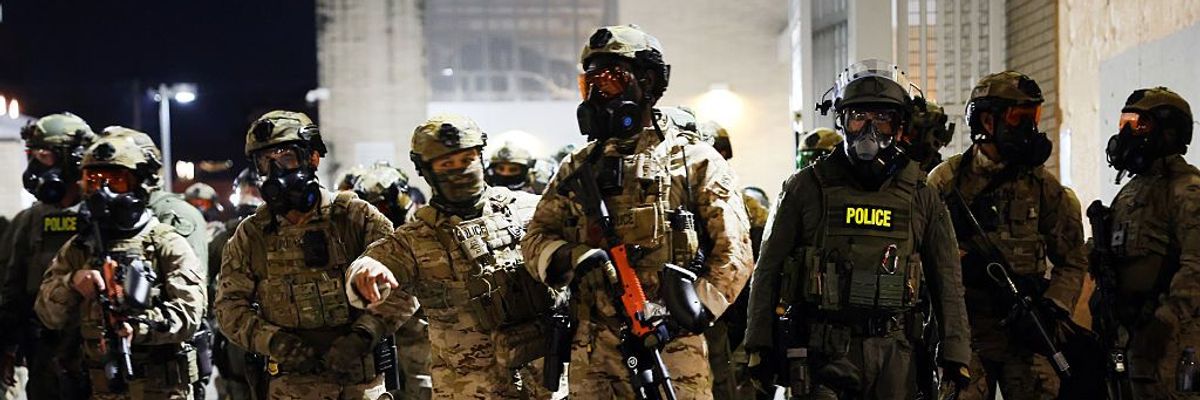
The incident comes as immigrants’ rights advocates warn ICE’s tactics in US cities are growing increasingly violent.
Amid report after report of increasingly aggressive tactics used by federal immigration enforcement, a pair of Portland medical workers say that an agent threatened to shoot them as they tried to transport an injured protester last week.
According to publicly archived dispatch records reported by Willamette Week, an ambulance crew was attempting to transport a protester with a broken or dislocated collarbone from an Immigration and Customs Enforcement (ICE) facility in southern Portland on October 5.
The facility has been a flashpoint in recent weeks as the site of several small but persistent protests, which the Trump administration has attempted to characterize as violent provocations by “antifa” in order to justify its deployment of military troops.
After entering through the facility’s front gate around 9:19, the two medics were able to load the patient into the ambulance without issue. But at 9:40, the driver reported to dispatch that “we are still not being allowed to leave by ICE officers.”
Confidential incident reports filed by each of the two medics, and obtained by WW, describe in more detail what was happening at the scene.
Each of the drivers’ separate reports says the agents had demanded to ride along in the ambulance en route to the hospital. The driver replied that without arrest paperwork, they were not permitted to ride along. Agents continued to insist that the vehicle would not be allowed to leave until an officer was permitted to accompany them.
“I repeated again,” the driver said in their report, “that no officer is permitted to ride in the ambulance and that they can meet us at the hospital and that we needed to be let out of the facility. Officers then began walking away from me whenever I spoke. At that point, a group of 5-8 civilian-dressed men walked into the garage and just stared at me. No identification on any of them. I walked back to the ambulance and got into the driver’s seat. I flipped the emergency lights on and put the car into drive. I inched forward slowly out of the garage.”
A man described as being in civilian clothes and a neck-wrap then stepped in front of the vehicle and ordered the ambulance not to leave, according to the report. As more agents amassed about 15 feet in front of the vehicle, the driver assumed they were preparing to escort the ambulance off the property and continued to slowly inch the vehicle forward. But agents continued to obstruct the ambulance’s path. As of 9:39, a dispatch report said there were “50-60 fed agents completely blocking the road.”
At this point, the crew member in the passenger’s seat exited the vehicle to attempt to reason with the officers. After putting the vehicle into park, the driver began to exit as well. They said that as they opened the side door, “I looked up and suddenly the entire group of officers… were crowded around the open car door, some of them leaning forward towards me, inches from my face.”
The driver recalls that an agent “pointed his finger at me in a threatening manner and began viciously yelling in my face, stating, ‘DON’T YOU EVER DO THAT AGAIN, I WILL SHOOT YOU, I WILL ARREST YOU RIGHT NOW.” The vehicle had rolled forward slightly after the driver put it in park, apparently leading the agents to believe the medics were attempting to hit them.
“I was still in such shock,” the driver later wrote, “that they were not only accusing me of such a thing, but crowding and cornering me in the seat, pointing and screaming at me, threatening to shoot and arrest me, and not allowing the ambulance to leave the scene. This was no longer a safe scene, and in that moment, I realized that the scene had not actually been safe the entire time that they were blocking us from exiting, and that we were essentially trapped.”
The ambulance was finally allowed to leave after being delayed for more than 20 minutes. An unmarked vehicle followed the ambulance to the hospital, where several men in civilian dress exited and walked in.
The incident reports provide the latest account of what Portland city officials described to WW as a pattern in which “federal agents have in several cases needlessly intensified situations that might have easily remained far more calm.”
Over the same weekend, peaceful demonstrators and journalists were ambushed with pepper spray, flash-bang grenades, and rubber bullets without clear provocation. In one viral incident earlier that week, a demonstrator who danced at protests in an inflatable frog costume had pepper spray shot directly into his air intake vent by an officer as he attempted to help a fellow protester who was injured.
The reports come as experts say ICE has been intensifying its tactics around the country, which have been captured in several videos taken by bystanders.
One video in Hyattsville, Maryland, shows an officer who dropped his gun while pinning a man to the ground, before picking it up and pointing it towards onlookers.
In another video from Alamosa, Colorado, agents were filmed hopping out of a car and immediately pointing their weapons at a young couple whom they’d boxed in at an intersection. As the woman in the car shouted that the driver’s 1-month-old baby was riding in the back seat, an officer in a Customs and Border Protection (CBP) hat used his baton to smash open the car’s driver’s side window, spilling glass into the vehicle.
Another video from the Chicago area, where President Donald Trump has surged ICE as part of “Operation Midway Blitz,” shows agents firing pepper spray upon a pastor who was speaking outside a facility.
And a recent photo shows a masked agent in the passenger’s seat of an unmarked van pointing a weapon at a woman who was attempting to film him from the neighboring car.
On October 4, CBP agents in Chicago shot a woman, 30-year-old Marimar Martinez, whom they similarly claimed had provoked them by ramming them with her car. Body camera footage would not only contradict this claim, but show that the agents had in fact plowed into Martinez’s vehicle after one of them shouted “Do something, bitch.”
Prosecutors said Martinez had a licensed gun in her car. But her attorneys say she did not brandish the weapon, and she was not charged with any weapons-related offense. She was the second person shot by immigration agents in the area in less than a month—the other was also unarmed.
In the meantime, the Trump administration has attempted to describe peaceful demonstrations against ICE’s behavior as acts of “terrorism,” with deputy White House chief of staff Stephen Miller calling those in Portland “an organized terrorist attack on the federal government and its officers.”
Fred Tsao, senior policy counsel at the Illinois Coalition for Immigrant and Refugee Rights, told NPR that the latest spate of attacks by federal agents “are just the tip of the iceberg.”
“This administration,” he said, “overall seems more interested in heightening the tensions instead of trying to ramp them down.”
Original article by Stephen Prager republished from Common Dreams under Creative Commons (CC BY-NC-ND 3.0).


 A detail of a Police officer