‘Very Fabric of Life’ at Risk Without Urgent Action to End Fossil Fuel Era

Spread the love

Original article by Jessica Corbett republished from Common Dreams under Creative Commons (CC BY-NC-ND 3.0).
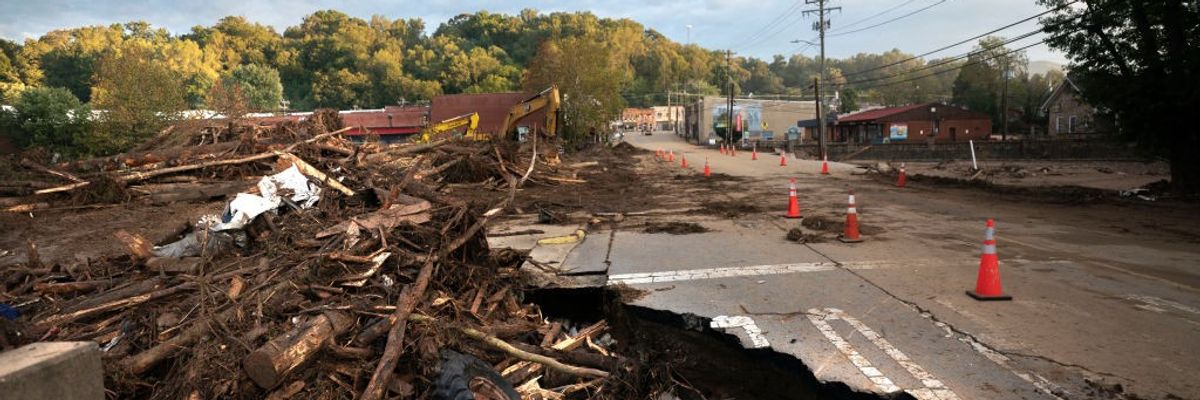
Flood damage is shown at a bridge across Mill Creek in the aftermath of Hurricane Helene on September 30, 2024 in Old Fort, North Carolina.
 (Photo: Sean Rayford/Getty Images)

“We are on the brink of an irreversible climate disaster. This is a global emergency beyond any doubt.”

As Hurricane Milton barreled toward Florida’s Gulf Coast, demonstrating the dangers of global warming, international scientists on Tuesday published a terrifying annual analysis that highlights the need to swiftly phase out planet-heating fossil fuels.

“Our aim in the present article is to communicate directly to researchers, policymakers, and the public,” the coalition wrote in BioScience. “As scientists and academics, we feel it is our moral duty and that of our institutions to alert humanity to the growing threats that we face as clearly as possible and to show leadership in addressing them.”

“We are on the brink of an irreversible climate disaster. This is a global emergency beyond any doubt. Much of the very fabric of life on Earth is imperiled. We are stepping into a critical and unpredictable new phase of the climate crisis,” warned the 14 experts from Australia, Brazil, China, Denmark, Germany, Switzerland, the United Kingdom, and the United States.

Their latest edition, “The 2024 State of the Climate Report: Perilous Times on Planet Earth,” shows that 25 of the 35 “planetary vital signs” the team uses to track the climate emergency are at record extremes. They include U.S.-heat related mortality, fossil fuel subsidies, coal and oil consumption, carbon dioxide equivalent emissions, per capita meat consumption, global tree cover loss due to fires, ocean acidity and heat content change, glacier thickness change, and ice mass change in Antarctica and Greenland.

“Ecological overshoot, taking more than the Earth can safely give, has pushed the planet into climatic conditions more threatening than anything witnessed even by our prehistoric relatives.”

The report emphasizes that “human-caused carbon dioxide emissions and other greenhouse gases are the primary drivers of climate change. As of 2022, global fossil fuel combustion and industrial processes account for approximately 90% of these emissions, whereas land-use change, primarily deforestation, accounts for approximately 10%.”

“For many years, scientists, including a group of more than 15,000, have sounded the alarm about the impending dangers of climate change driven by increasing greenhouse gas emissions and ecosystem change,” the publication notes. “For half a century, global warming has been correctly predicted even before it was observed—and not only by independent academic scientists but also by fossil fuel companies.”

“Despite these warnings, we are still moving in the wrong direction; fossil fuel emissions have increased to an all-time high, the three hottest days ever occurred in July of 2024, and current policies have us on track for approximately 2.7°C peak warming by 2100,” the article adds. “Tragically, we are failing to avoid serious impacts, and we can now only hope to limit the extent of the damage. We are witnessing the grim reality of the forecasts as climate impacts escalate, bringing forth scenes of unprecedented disasters around the world and human and nonhuman suffering.”

Oregon State University professor William Ripple, who led the team with Christopher Wolf of Terrestrial Ecosystems Research Associates, said in a Tuesday statement that “ecological overshoot, taking more than the Earth can safely give, has pushed the planet into climatic conditions more threatening than anything witnessed even by our prehistoric relatives.”

“We’re already in the midst of abrupt climate upheaval,” Ripple stressed. “For example, Hurricane Helene caused more than 200 deaths in the southeastern United States and massive flooding in a North Carolina mountain area thought to be a safe haven from climate change.”

“Since the publication of our 2023 report, multiple climate-related disasters have taken place, including a series of heatwaves across Asia that killed more than a thousand people and led to temperatures reaching 122°F in parts of India,” he continued. “Climate change has already displaced millions of people, with the potential to displace hundreds of millions or even billions. That would likely lead to greater geopolitical instability, possibly even partial societal collapse.”

To avoid that dark future, the article argues, “we need bold, transformative change: drastically reducing overconsumption and waste, especially by the affluent, stabilizing and gradually reducing the human population through empowering education and rights for girls and women, reforming food production systems to support more plant-based eating, and adopting an ecological and post-growth economics framework that ensures social justice.”

The assessment—whose authors include Michael Mann of the University of Pennsylvania, Naomi Oreskes of Harvard University, and Stefan Rahmstorf and Johan Rockström of the Potsdam Institute for Climate Impact Research—comes just over a month away from the next United Nations Climate Change Conference, COP29, which is scheduled for November 11-22 in Azerbaijan.

Pointing to previous summits, Wolf said Tuesday that “despite six reports from the International Panel on Climate Change, hundreds of other reports, tens of thousands of scientific papers, and 28 annual meetings of the U.N.’s Conference of the Parties, the world has made very little headway on climate change.”

“Humanity’s future depends on creativity, moral fiber, and perseverance,” he warned. “If future generations are to inherit the world they deserve, decisive action is needed, and fast.”

Original article by Jessica Corbett republished from Common Dreams under Creative Commons (CC BY-NC-ND 3.0).

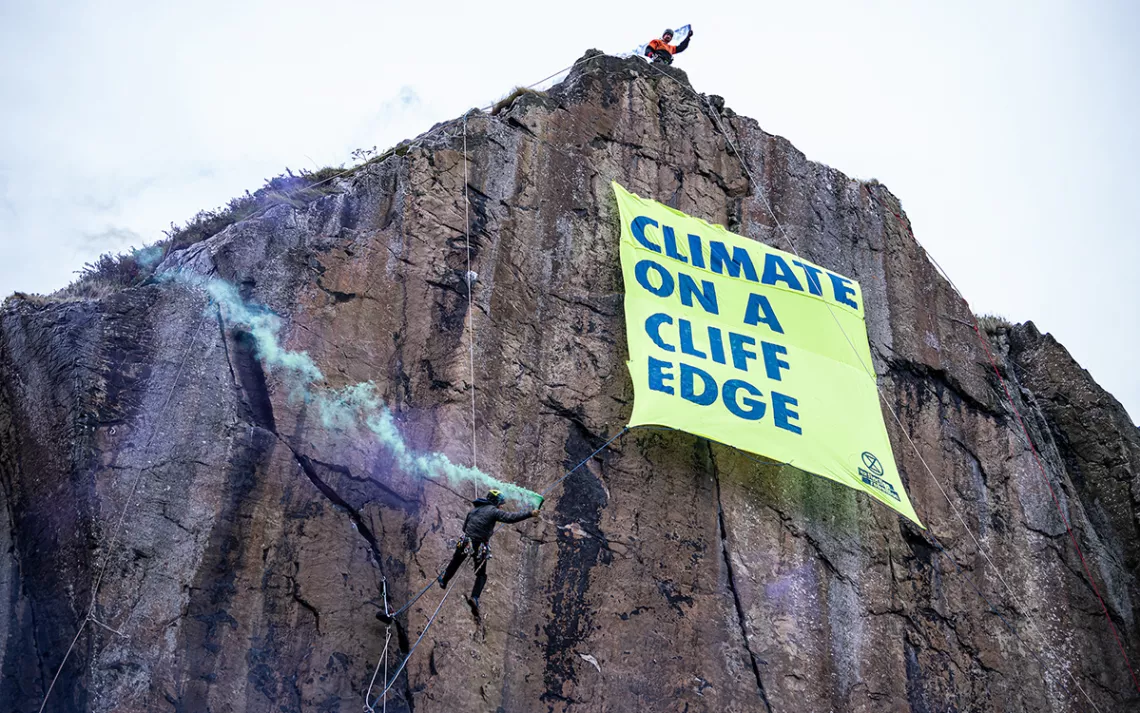
Experienced climbers scale a rock face near the historic Dumbarton castle in Glasgow, releasing a banner that reads “Climate on a Cliff Edge.” One activist, dressed as a globe, symbolically looms near the edge, while another plays the bagpipes on the shores below. | Photo courtesy of Extinction Rebellion and Mark Richards
Continue Reading‘Very Fabric of Life’ at Risk Without Urgent Action to End Fossil Fuel Era

‘Red Alert’ as 7th of 9 Planetary Boundaries On Verge of Being Breached: Report

Spread the love

Original article by Edward Carver republished from Common Dreams under Creative Commons (CC BY-NC-ND 3.0). 

A diver checks the coral reefs of the Society Islands in French Polynesia in 2019. (Photo: Alexis Rosenfeld/Getty Images).

“Our updated diagnosis shows that vital organs of the Earth system are weakening, leading to… rising risks of crossing tipping points.”

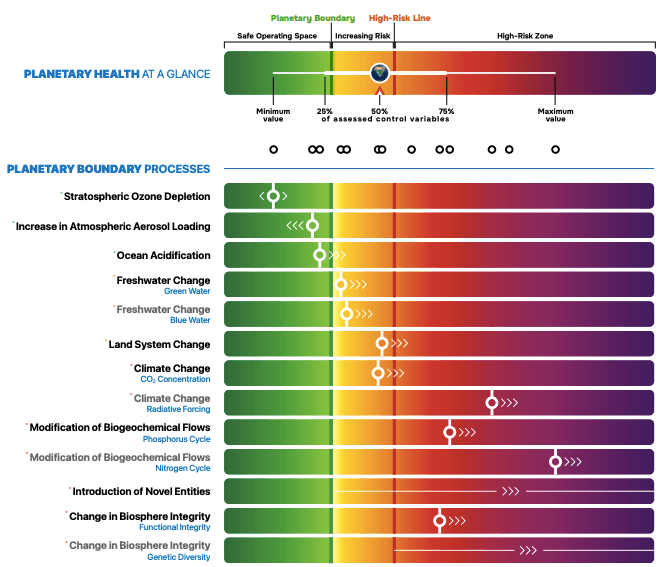
Six of nine planetary boundaries have already been transgressed, and a seventh, for ocean acidification, is on the verge of being breached, according to a major report released Monday.

The 96-page report, produced by the Potsdam Institute for Climate Impact Research (PIK), is the first in a planned series of annual “planetary health checks.”

The authors found that safe planetary boundaries had already been crossed for the climate, freshwater, land use, biogeochemical flows, novel entities, and biosphere integrity—in keeping with a study in Science Advances last year. They found a “clear trend towards further transgression”—moving deeper into the danger zone, where irreversible tipping points are more likely to be triggered—in each of the six categories.

“Our updated diagnosis shows that vital organs of the Earth system are weakening, leading to a loss of resilience and rising risks of crossing tipping points,” Levke Caesar, a PIK climate physicist lead author of the report, said in a statement that announced a “red alert.”

The health check also showed that ocean acidification, a seventh category, has reached a dangerous precipice, putting the foundations of the marine food web at risk. Ocean acidification, which can threaten coral reefs and phytoplankton populations, is caused by the buildup of carbon dioxide from burning fossil fuels and other human activities.

Caesar said a “safe operating space” threshold for acidification could be crossed in the next few years.

“Looking at the current evolution, I’d say it’s really, really difficult to prevent that [boundary] crossing,” she toldMongabay.

A graphic shows the status of nine environmental categories, four of which have been broken down into two control variables. Image from Planetary Health Check 2024. Design by Globaïa.

PIK director Johan Rockström, a co-author of the new report, helped develop planetary boundary research in the late 2000s. In a seminal 2009 paper in Nature, he and his co-authors found that three of the nine boundaries had already been crossed. That number has gradually gone up based on a series of studies over the last decade.

The planet boundary framework, which is often connected to the degrowth movement, emphasizes that the categories are interconnected.

“The interconnectedness of [planetary boundary] processes means that addressing one issue, such as limiting global warming to 1.5°C, requires tackling all of them collectively,” the new report says.

Boris Sakschewski, a climate scientist who, along with Caesar, is a lead author of the report said that, “We know that all planetary boundary processes act together and each one needs protection to protect the whole system.”

The consequences of continued ocean acidification, which is primarily measured by aragonite saturation, would be severe, the report warns.

Ocean acidification is approaching a critical threshold, with significant declines in surface aragonite saturation, particularly in high-latitude regions like the Arctic and Southern Ocean. These areas are vital for the marine carbon pump and global nutrient cycles, which support marine productivity, biodiversity, and global fisheries. The growing acidification poses an increasing threat to marine ecosystems, especially those reliant on calcium carbonate for shell formation.

Some researchers believe that the ocean acidification threshold has already been crossed, especially given regional variability, with cooler polar waters absorbing more carbon dioxide, causing a faster drop in pH levels.

The report was written with a general audience in mind and is not peer-reviewed, though it’s based on peer-reviewed studies, the authors said.

The final pages of the report present solutions, especially agricultural. A radical overhaul of the global food system, heavily dependent on fertilizer and other harmful inputs, will be necessary to reverse the disturbing trends documented in the report, the authors wrote.

“Sometimes overlooked compared to the impacts of energy production and consumption—particularly the use of fossil fuels—the food systems we depend on are among the largest drivers of environmental degradation. The global food system is the single largest driver behind the transgression of multiple planetary boundaries,” the report says.

Original article by Edward Carver republished from Common Dreams under Creative Commons (CC BY-NC-ND 3.0). 

Continue Reading‘Red Alert’ as 7th of 9 Planetary Boundaries On Verge of Being Breached: Report

Climate Crisis to Cost Global Economy $38 Trillion a Year by 2050

Spread the love

Original article by OLIVIA ROSANE republished from Common Dreams under Creative Commons (CC BY-NC-ND 3.0). 

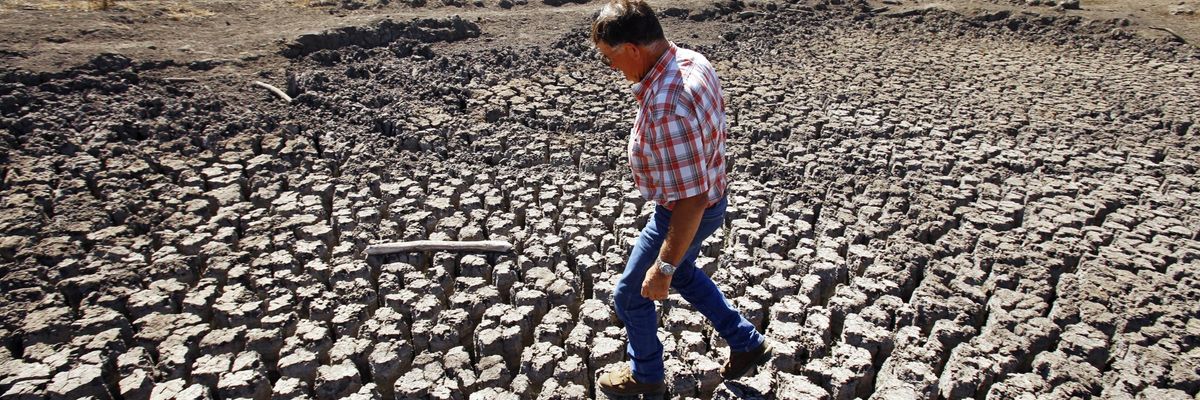
Rancher Jon Pedotti walks on the cracked remains of a parched lake bed of his 1,561-acre ranch located along San Simeon Creek in the Santa Lucia Mountain foothills of Cambria, California during a drought on October 1, 2014. (Photo: Al Seib/Los Angeles Times via Getty Images)

“This clearly shows that protecting our climate is much cheaper than not doing so, and that is without even considering noneconomic impacts such as loss of life or biodiversity,” a new study’s lead author said.

The climate crisis will shrink the average global income 19% in the next 26 years compared to what it would have been without global heating caused primarily by the burning of fossil fuels, a study published in Nature Wednesday has found.

The researchers, from the Potsdam Institute for Climate Impact Research (PIK), said that economic shrinkage was largely locked in by mid-century by existing climate change, but that actions taken to reduce emissions now could determine whether income losses hold steady at around 20% or triple through the second half of the century.

“These near-term damages are a result of our past emissions,” study lead author and PIK scientist Leonie Wenz said in a statement. “We will need more adaptation efforts if we want to avoid at least some of them. And we have to cut down our emissions drastically and immediately—if not, economic losses will become even bigger in the second half of the century, amounting to up to 60% on global average by 2100.”

“I am used to my work not having a nice societal outcome, but I was surprised by how big the damages were.”

Put in dollar terms, the climate crisis will take a yearly $38 trillion chunk out of the global economy in damages by 2050, the study authors found.

“That seems like… a lot,” writer and climate advocate Bill McKibben wrote in response to the findings. “The entire world economy at the moment is about $100 trillion a year; the federal budget is about $6 trillion a year.”

This means that the costs of inaction have already exceeded the costs of limiting global heating to 2°C by six times, the study authors said. However, limiting warming to 2°C can still significantly reduce economic losses through 2100.

“This clearly shows that protecting our climate is much cheaper than not doing so, and that is without even considering noneconomic impacts such as loss of life or biodiversity,” Wenz said.

The damages predicted by the study were more than twice those of similar analyses because the researchers looked beyond national temperature data to also incorporate the impacts of extreme weather and rainfall on more than 1,600 subnational regions over a 40-year period, The Guardian explained.

“Strong income reductions are projected for the majority of regions, including North America and Europe, with South Asia and Africa being most strongly affected,” PIK scientist and first author Maximilian Kotz said in a statement. “These are caused by the impact of climate change on various aspects that are relevant for economic growth such as agricultural yields, labor productivity, or infrastructure.”

However, Wenz told the paper that the paper’s projected reduction was likely a “lower bound” because the study still doesn’t include climate impacts such as heatwaves, tropical storms, sea-level rise, and harms to human health.

Unlike previous studies, the research predicted economic losses for most wealthier countries in the Global North, with the U.S. and German economies shrinking by 11% by mid-century, France’s by 13%, and the U.K.’s by 7%. However, the countries set to suffer the most are countries closer to the equator that have lower incomes already and have historically done much less to contribute to the climate crisis. Iraq, for example, could see incomes drop by 30%, Botswana 25%, and Brazil 21%.

“Our study highlights the considerable inequity of climate impacts: We find damages almost everywhere, but countries in the tropics will suffer the most because they are already warmer,” study co-author Anders Levermann, who leads Research Department Complexity Science at PIK, said in a statement. “Further temperature increases will therefore be most harmful there. The countries least responsible for climate change, are predicted to suffer income loss that is 60% greater than the higher-income countries and 40% greater than higher-emission countries. They are also the ones with the least resources to adapt to its impacts.”

Wenz told The Guardian that the results were “devastating.”

“I am used to my work not having a nice societal outcome, but I was surprised by how big the damages were. The inequality dimension was really shocking,” Wenz said.

Levermann said the paper presented society with a clear choice:

It is on us to decide: Structural change towards a renewable energy system is needed for our security and will save us money. Staying on the path we are currently on, will lead to catastrophic consequences. The temperature of the planet can only be stabilized if we stop burning oil, gas, and coal.

McKibben, meanwhile, argued that the findings should persuade major companies to embrace climate action for self-interested reasons. He noted that most corporate emissions come from how company money is invested by banks, particularly in the continued exploitation of fossil fuel resources.

“If Amazon and Apple and Microsoft wanted to avoid a world where, by century’s end, people had 60% less money to spend on buying whatever phones and software and weird junk (doubtless weirder by then) they plan on selling, then they should be putting pressure on their banks to stop making the problem worse. They should also be unleashing their lobbying teams to demand climate action from Congress,” McKibben wrote.

“These people are supposed to care about money, and for once it would help us if they actually did,” he continued. “Stop putting out ads about how green your products are—start making this system you dominate actually work.”

Original article by OLIVIA ROSANE republished from Common Dreams under Creative Commons (CC BY-NC-ND 3.0). 

Continue ReadingClimate Crisis to Cost Global Economy $38 Trillion a Year by 2050