ARGENTINA’S far-right President Javier Milei has cut more than 63,000 public-sector jobs since coming to power two years ago, it was reported on Monday.
The structural adjustment programme put in place by Mr Milei between December 2023 and December 2025 slashed 63,234 public-sector jobs, according to the Centre for Political Economy of Argentina (Cepa).
A report by the organisation said the cuts of 18.4 per cent amounted to almost 80 jobs lost per day.
Director Heran Letcher described the cuts “as the deepest in recent decades.”
…
Mr Milei’s administration has prioritised the reduction of public spending, shrinking the state and the so-called liberalisation of the Argentinian economy.
The president promised to carry out these cuts to secure financial support from the US government and bodies such as the World Bank and the International Monetary Fund.
Observers have warned that the cuts directly affect the operational capacity of the state and the provision of public services, as well as adding to rising unemployment and growing poverty across Argentina.
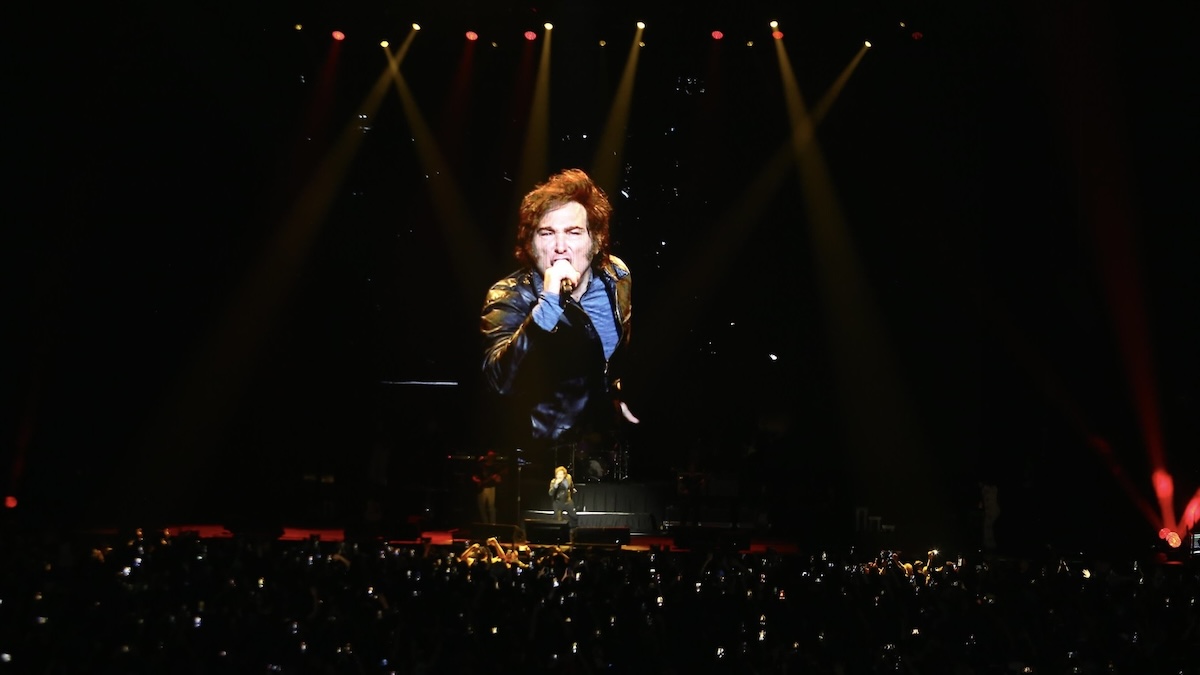
Argentina President Javier Milei. Photo: Javier Milei / X
In this article, we review some of the general trends and attitudes of Milei’s government two years into his term.
Thousands of Argentines endured high temperatures as they took to the streets on December 18 to protest the labor reform of Javier Milei’s far-right government. The call to action by the General Confederation of Labor (CGT) was supported by several trade unions, which claimed that the measure seeks to destroy workers’ rights to benefit big business: “This reform will only deepen poverty, social exclusion, and job insecurity. We will not give up our fight for decent work,” the CGT said in a statement.
The government has justified the measure by citing an alleged need to modernize labor relations: “The text also incorporates specific incentives for the formalization of employment, new rules for the platform economy, more efficient employer contribution schemes, and mechanisms that reduce litigation, providing the system with greater predictability and long-term stability.”
However, organized workers claim that this is a labor flexibility project that aligns with President Milei’s neoliberal agenda. Cristian Jerónimo, leader of the CTE, said: “[The labor reform] does nothing to benefit the world of work; it is written in favor of Argentina’s large corporations and does not favor small and medium-sized enterprises.”
But for the protesters, this reform comes as no surprise. Long before becoming president, Milei announced that it was imperative to reform the entire structure of the Argentine state in order to put it on the “path to freedom,” which means neoliberalizing the economy, reducing state participation in the economy to a minimum, strengthening the apparatus of repression, and aligning the South American country geopolitically with Washington’s interests. In short, to return to the path of the Washington Consensus.
After the day of mass mobilization, the government announced that the debate on the reform would be postponed until February, an initial sign that Milei is feeling the pressure of the popular demonstrations. Yet, after two years in office, Milei has done everything possible to push forward his neoliberal agenda even amid many rounds of mass demonstrations. A series of laws, executive decrees, and international diplomatic engagements have been the clearest signs of the path taken by the right-wing libertarian leader who governs a country that, despite his promises, is once again returning to the path of economic crisis and political instability.
Economy: fiscal adjustment and social tension
In line with neoliberal orthodoxy, Milei has implemented a series of fiscal adjustments to eliminate the deficit, even though this has been at the expense of the material stability of the most disadvantaged sectors, who have taken to the streets to protest against cuts in health, education, and other areas that the Argentine state now refuses to cover in full or adjust in line with the current economic reality. Students, teachers, researchers, and university workers have also taken to the streets consistently, demanding improvements in higher education funding, funding for science and health research, and defending free and public education.
Repression of mass protests, ordered by Security Minister Patricia Bullrich, has been severe. Hundreds have been arrested and injured, including Pablo Grillo, a journalist who was nearly killed when a tear gas canister struck him in the head.
Nevertheless, Milei did not slow down. The elimination of subsidies, wage freezes, and widespread privatization of public companies generated the long-awaited fiscal surplus in more than a decade. Year-on-year inflation, which stood at around 211% at the end of 2023, was reduced to 3% at some point in 2025.
Despite this, several analysts have stated that the 2.3% increase in inflation in October 2025 reflects the shortcomings of a neoliberal model in sustaining a long-term surplus.
Furthermore, it is important to remember that this year, Donald Trump’s administration bailed out Argentina with a record payment of more than USD 20 billion, in addition to the IMF’s generous granting of USD 20 billion to Argentina.
In other words, the surplus that the executive branch promotes as its great economic success has been achieved thanks to enormous support from its international allies, who demand neoliberal macroeconomic change not only in Argentina but throughout the region. This, of course, comes at a price that Argentines will have to pay for decades to come. Argentina has the largest IMF debt in the world. Its debt of more than USD 64 billion is “the price of freedom.”
Politics: reduction of the state and open confrontation
Following his economic model, Milei’s government has pushed radical downsizing. More than 10 ministries and 200 government departments were eliminated in one fell swoop. This meant the dismissal of almost 50,000 people who suddenly found themselves thrown into unemployment and precarity.
These decisions were made abruptly and aggressively, political attitudes that the president has adopted as part of his communication strategy. Bypassing parliamentary approval whenever possible, Milei always sought to govern unilaterally whenever possible.
But Milei has also achieved significant legislative victories. At the beginning of his administration, he had the support of only 39 deputies and six senators; however, he managed to pass several laws, such as the Bases Law (which allowed for the radical privatization of the Argentine state) and tax reforms.
He achieved this thanks to the support of the PRO, a right-wing party led by former president Mauricio Macri, and certain dissident Peronists. The formation of the so-called “May Pact,” a major agreement between Argentina’s right-wing parties and governors, allowed him to negotiate and agree on several reforms desired by right-wing libertarianism.
This pact prevented an increase in pensions for the elderly, who have regularly protested to demand more money to buy medicine and food, which are now major obstacles in their lives. Despite this, the Pact has not budged and continues with its neoliberal drift.
Political and judicial scandals
Milei’s administration has also been marked by several scandals. Very early on, he began a dispute with Victoria Villarruel, his vice president, whom he accused of playing into the hands of his political enemies.
He was also involved in the “$LIBRA” scandal, in which he is accused of being part of an international fraud scheme related to the sale of cryptocurrencies. A parliamentary commission concluded that Milei did use his position as president to promote the scam, which caused millions in losses to investors around the world.
But the event that probably had the greatest impact on Milei’s popularity involved his sister. Karina Milei, who serves as Secretary to the President, is accused of participating in a bribery ring that operated through the National Disability Agency (ANDIS). Many saw the emergence of this scandal as the reason for his resounding defeat in the Buenos Aires Province elections on October 26.
Despite this, Milei managed to recover and his party, La Libertad Avanza (LLA), won the next legislative elections and increased its number of seats in the legislature. His strategy was the usual one: accusing Peronism of destroying Argentina and presenting himself as the only one capable of saving the country. However, this messianic communication strategy has begun to be questioned precisely because of the corruption and fraud scandals that have plagued his government.
Alignment with Washington
Milei has made a significant shift in the country’s foreign policy. Argentina’s vote against the UN resolution condemning the US economic and trade blockade of Cuba reflects an important change. Historically, Argentina has maintained a diplomatic position against any act of imperialism due to its claim over the Malvinas Islands, which, despite being off its coast, are governed by the United Kingdom. The dispute has escalated to military levels despite repeated claims by the Argentine authorities.
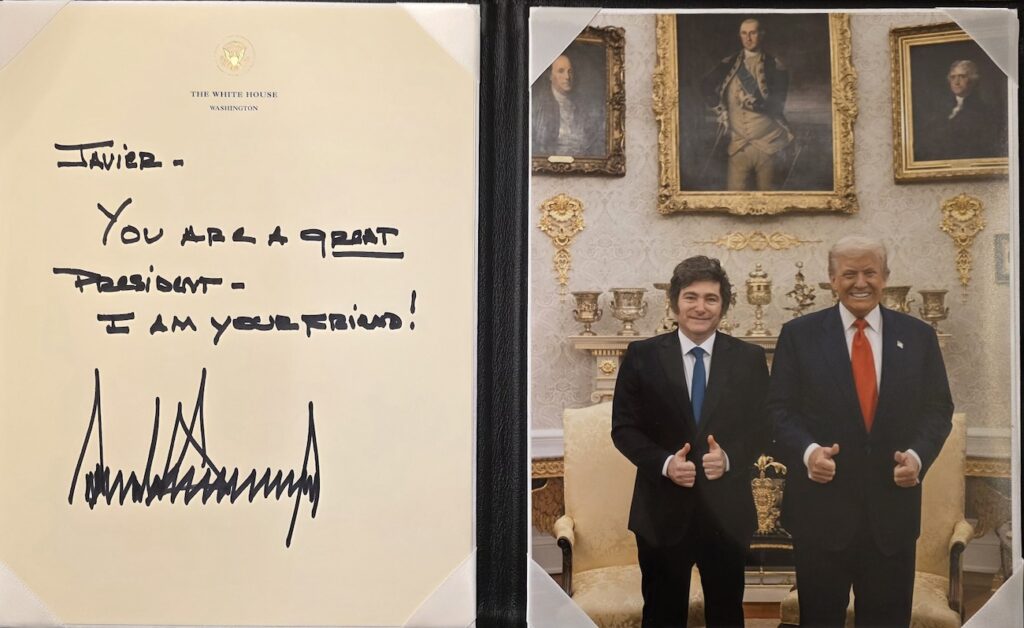
Donald Trump-signed photo of him and Javier Milei. Photo: Javier Milei / X
But the change is much more than nominal. Argentina has become the Trump administration’s greatest ally in South America. Milei has praised Trump’s personality, and Trump has publicly supported him, like when, in the last legislative elections, he suggested an end to cooperation between Buenos Aires and Washington if Milei lost. In response, the Argentine president has repeatedly declared his loyalty to Trump’s geopolitical project and has supported all of his initiatives both within and outside the region.
In this way, Milei has become a sort of archetype for the leaders of the new Latin American right. With radical fiscal adjustment at the expense of the most impoverished sectors, open confrontation with their opponents, and an international policy fully aligned with Washington (which has initiated a new chapter of the Monroe Doctrine), far-right governments are beginning to gain ground in the region: Kast in Chile, Paz in Bolivia, etc., are examples of an ideological and geopolitical shift in the region that is impossible to understand without the figure of Javier Milei.
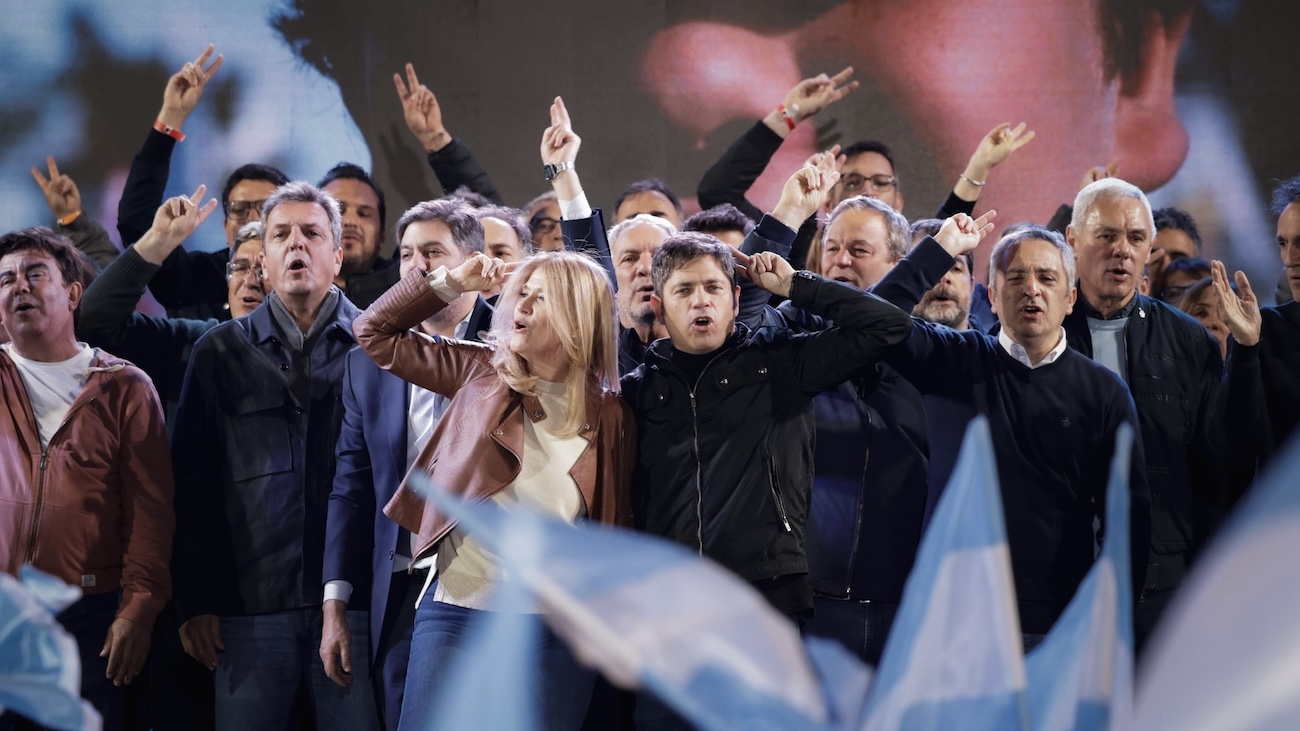
Axel Kicillof and other Peronist leaders in Buenos Aires celebrating their victory on Sunday, September 7. Photo: Fuerza Patria / X
Despite the president taking a front-line role in the election campaign and predicting victory for his party (“Buenos Aires will be painted purple,” Milei claimed), the figures speak for themselves. Voter turnout is estimated at almost 61%.
On September 7, 2025, the province of Buenos Aires dealt a crushing defeat to the right-wing libertarian project of President Javier Milei, who, after learning the results of the provincial elections, said: “Today we have suffered a clear defeat and we must accept it.”
The people of Buenos Aires province, which accounts for 38% of the country’s population, elected senators, deputies, and delegates of their municipalities. Peronism decided to join forces and form a large anti-Milei alliance called Fuerza Patria (Homeland Force), which, according to official data, obtained almost 47% of the valid votes. Meanwhile, La Libertad Avanza, Milei’s party that allied itself with the PRO (the party of former president Mauricio Macri), reached almost 34%. In third and fourth place were the centrist SOMOS and the Left Front, respectively, which each obtained almost 5%. The rest of the votes were divided among the other contenders.
In other words, Peronism won by more than 13 points over the far right, allowing it to take six of the eight electoral districts. La Libertad Avanza only managed to win the fifth and sixth districts. In addition, Peronism swept the municipal elections, winning 95 of the 135 municipalities in the province.
Milei says he will not back down
Despite the resounding defeat, Milei stated that while the necessary political mistakes must be corrected, he will not back down from his neoliberal project. “We will not back down one millimeter in the government’s policy; we will accelerate the course even more. If we have made political mistakes, we will process them and do better to win in October… We will continue to defend fiscal balance.”
He also took the opportunity to criticize his primary opposition, “They have put all the Peronist apparatus that they have been managing for 40 years into play, and this [result] is the floor for us and the ceiling for them.”
Peronism celebrates
For its part, the main opposition force, Peronism, celebrated the results. Former President Cristina Fernández, who is currently under house arrest, wrote on her X account: “Did you see that, Milei? Trivializing and vandalizing the ‘Never Again’ movement, which represents the darkest and most tragic period in Argentine history, does not come without a price. Neither is laughing at the death and pain of your opponents. But pointing fingers and stigmatizing the disabled, while your sister charges a 3% kickback on their medications, is lethal. And I’d better not even tell you how the rest (of those who still have jobs) are doing. Indebted for food, rent, expenses, or medications, and on top of that, with maxed-out credit cards. Get out of your bubble, brother.”
The Peronist governor of the province of Buenos Aires, Axel Kicillof, said to his supporters after learning the results: “The message from the polls is that you can’t govern for outsiders, for those who have the most. Milei: You have to govern for the people.” Furthermore, looking ahead to future elections, including the presidential election, Kicillof stated: “The elections have shown that there is another way, and today we are beginning to follow it.”
What is the reason for the crisis of ultraliberalism?
There are several elements which can help explain the defeat of Milei and his party on Sunday.
Other interpretations also point to an increasingly difficult management of the economy. The government has implemented a radical neoliberal policy that is in line with the demands of the International Monetary Fund (IMF). This has brought some stability to inflation, but it has also caused enormous social unrest, such as that of retirees who have taken to the streets every week to protest against government cuts to health care and freeze pensions.
In this regard, journalist Federico Rivas Molina wrote in El País: “The economic team is finding it increasingly difficult to maintain the value of the peso against the dollar. To prevent the dollarization of peso portfolios, it first raised rates to 80%, triple the inflation forecast for this year. Then it raised bank reserve requirements to 50% to reduce the amount of pesos in circulation. In the middle of last week, the floating bands it had agreed with the International Monetary Fund and sold dollars from the Treasury. Milei then blamed the turbulence on what he called ‘the kuka risk,’ that is, the fear of a Kirchnerist victory that had investors terrified. With the prophecy fulfilled, the scenario is now much more hostile than it was on Friday.”
Along these lines, Erika Gimenez, a journalist at ARG Medios, told Peoples Dispatch that Milei’s economic plan is not working and the people know it. She explained, “No one feels that their economic situation has improved under Milei’s government; quite the contrary: inflation is rising, salaries are insufficient, pensions for retirees and disabled people are being cut, among other cruel policies implemented by Milei. He is not convincing a sector that previously voted for him.”
She also expressed her opinion that Peronism, which has several internal tendencies (not always compatible), could sustain this alliance in the medium term thanks to the emergence of a figure who can bring together the different internal forces: “I think that Axel Kicillof’s leadership [in Peronism] is indisputable.”
Regarding the immediate future of Milei’s government, Gimenez said that a process of internal crisis is coming: “The figure of his sister is weighing on Milei, and despite this, he is not going to remove her. In addition, some ministers are going to resign or be fired, although it is not known which ones. There is a kind of political instability and instability in the Milei government’s economic project. It is most likely that between now and October, when there will be national legislative elections in which everyone in the country votes, political and economic stability will be at stake.”