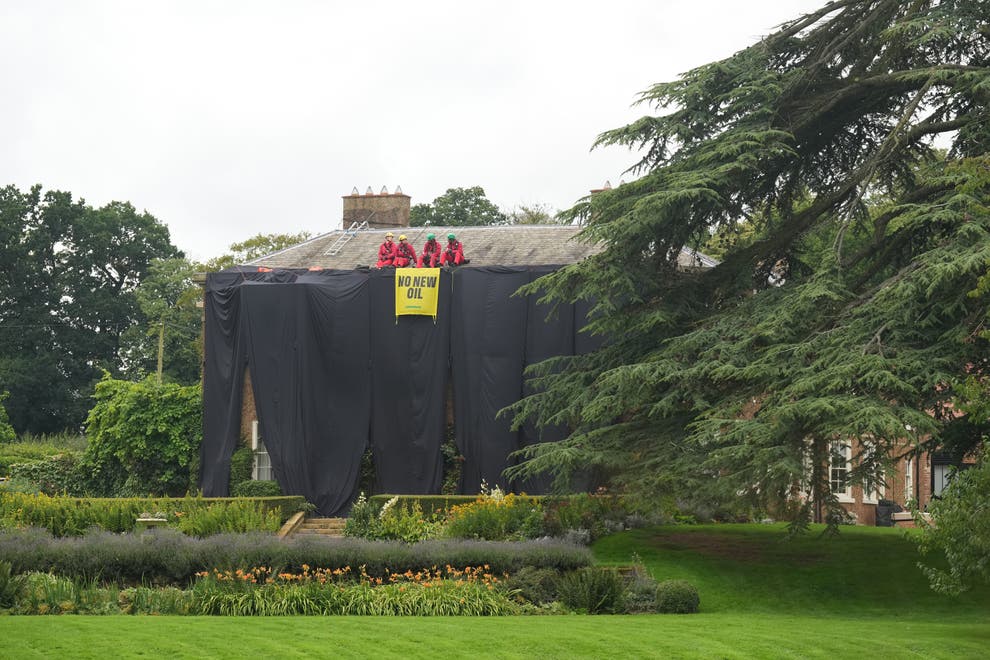
Three people are set to be charged over a protest at Rishi Sunak’s home (Danny Lawson/PA Wire)
Three people will be charged with criminal damage following a Greenpeace protest at Rishi Sunak’s home in North Yorkshire, prosecutors have said.
Mathieu Soete, 38, Amy Rugg-Easey, 33, and Alexandra Wilson, 32, will each be charged with one count of criminal damage over the protest last August in the prime minister’s Richmond constituency, the Crown Prosecution Service said.
Mr Soete, of Hackney, and Ms Rugg-Easey and Ms Wilson, both from Shiremoor in North Tyneside, are due to appear at York Magistrates’ Court on 21 March, according to the CPS.
A fourth suspect is due to answer bail at a later date.
Activists were pictured last year atop the roof of Mr Sunak’s grade II-listed manor house in Kirby Sigston, near Northallerton, which they draped with oil-black fabric in protest over what they called a new fossil fuel drilling “frenzy”.
The prime minister was on holiday in California at the time of the demonstration.
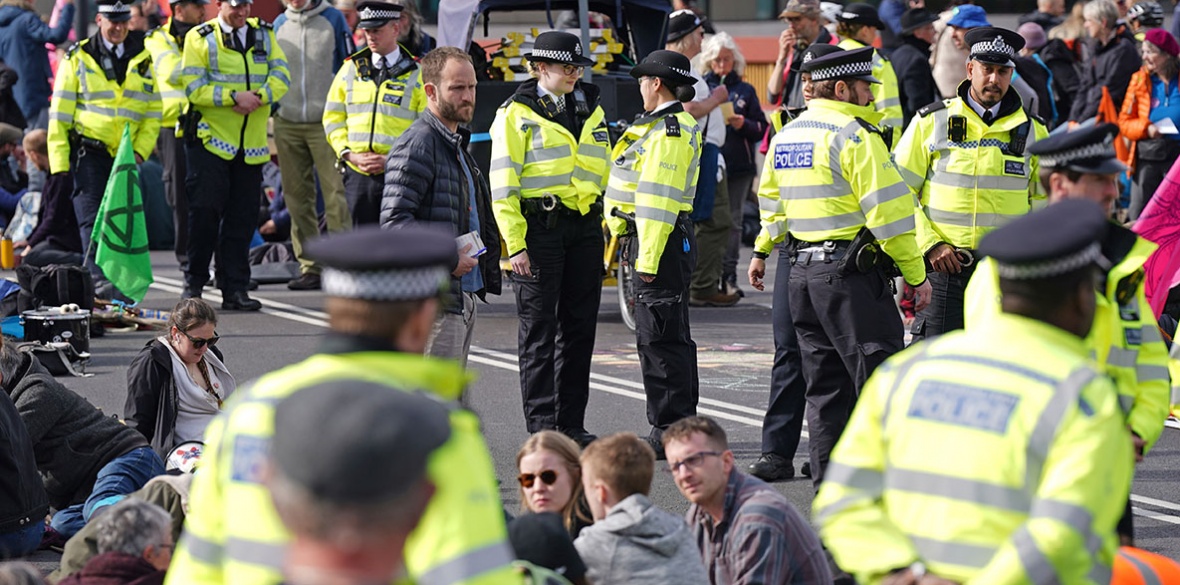
Police during an Extinction Rebellion demonstration blocking Vauxhall Bridge in central London, April 10, 2022
Right to protest comes under fresh attack as Tories unveil new measures and fines
THE right to protest came under fresh attack today as the Tory government unveiled new measures directed at demonstrators.
Rattled by the repeated huge solidarity marches with Palestine in recent months, ministers presented amendments to criminal justice legislation designed to make protesting harder.
Among the acts now to be criminalised are wearing masks at a demonstration, climbing on war memorials or the use of flares or fireworks.
Protesters engaging in any of these activities now risk fines of up to £1,000.
Nor will they any longer be able to use the right to protest as a defence if they cause serious disruption, a change driven by the refusal of a jury to convict anti-racists charged with hauling down the statute of slave trader Edward Colston in Bristol.
…
Leading human rights lawyer and peer Shami Chakrabarti said: … “This is more culture war nonsense from the government while children go hungry and the planet burns.”
…
Suella Braverman, who lost office trying to ban a Gaza ceasefire protest on Armistice Day, has demanded further measures.
These would include giving ministers, rather than the police, the power to ban marches they do not approve of; prohibit the use of particular slogans or phrases and proscribe groups deemed “extremist” even if they are entirely peaceful.
Devoted New York Times readers are likely unaware that a huge protest was held in the nation’s capital on Saturday, January 13, to protest Israel’s wanton slaughter of tens of thousands of Gazan civilians, and to condemn “Genocide” Joe Biden’s weapon shipments and diplomatic backing for Israel. The Times, despite having a huge bureau in Washington, DC, did not mention the event, even over the course of the following week.
Freedom Plaza for the March on Washington for Gaza, January 13, 2024 (CC photo: Elvert Barnes)
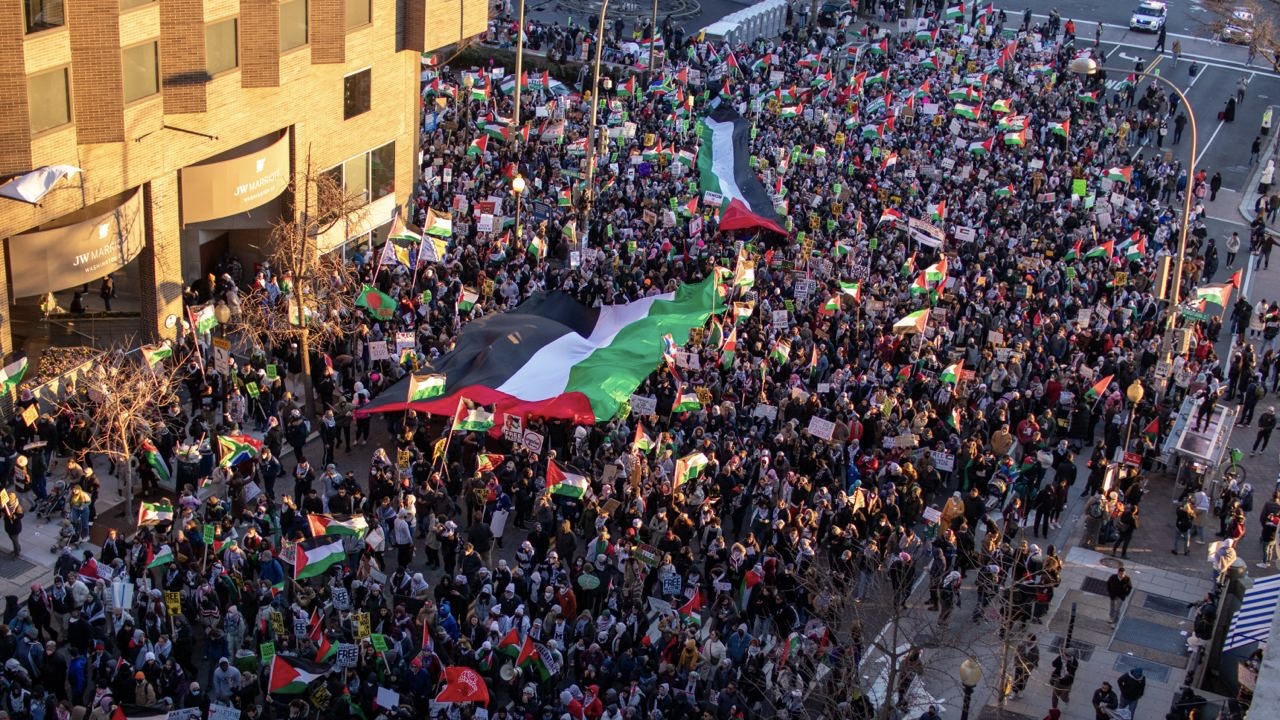
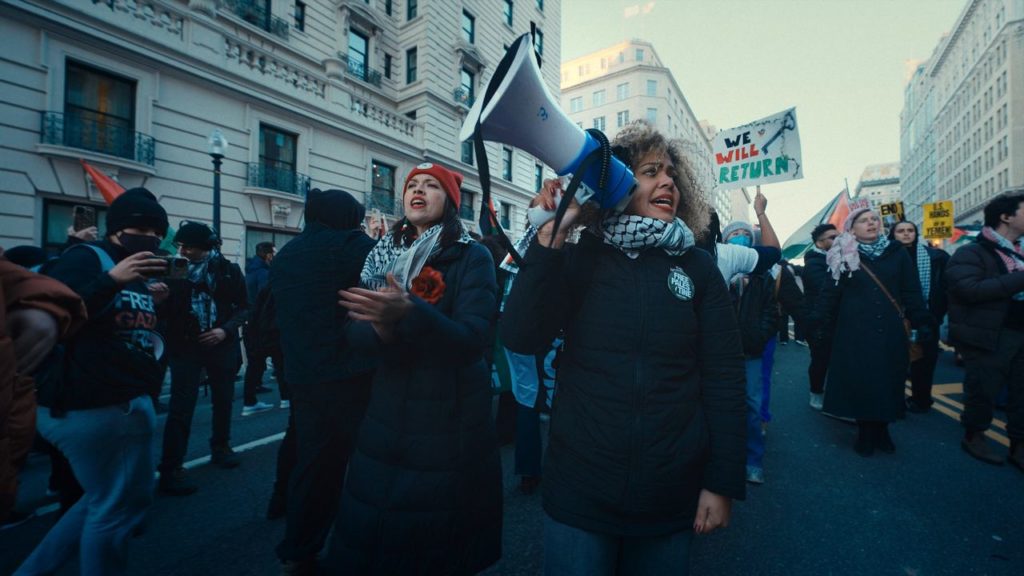
It’s hard to get an independent estimate of the number of people who showed up—Palestinians and Americans of all ages and races, including Jewish Americans, arriving from all parts of the country—because neither the Washington Metro Police nor the National Parks Service provides crowd estimates. What is clear from photo images of Freedom Plaza, a broad 500-foot-long rectangle that can easily accommodate over 100,000, is that there was what Newsweek (1/13/24) called a “massive” demonstration spilling over into adjacent Pershing Park, with still more thousands of protesters continuing to arrive along on Pennsylvania Avenue.
Protester John Reuwer, treasurer and a board member of the organization World Beyond War, is a veteran of many protests, large and small. He attended the January 13 protest, as well as an earlier one on November 4. Reuwer said he attempted to gauge the number of marchers when they began walking out of the plaza towards a planned White House protest. “It took one hour and 40 minutes to clear Freedom Plaza,” he said, guessing that the total protester count was “between 100,000–150,000.” (March organizers claimed to have had 400,000 protesters in DC, though that seems a high estimate to this author, who has attended plenty of protests, dating back to the early Vietnam War actions.)
Newsworthy alliance
Al Jazeera (1/13/24): “Massive rallies have kicked off off in world capitals including London, Paris, Vienna, Berlin, Amman and Washington, DC.”
By size alone, the rally deserved a story in the Times. But this wasn’t just one isolated US demonstration; it was part of a global call for protest against the ongoing assault on Gaza, which by January 13 had killed nearly 24,000, 70% of the victims being women and children. Times editors were surely aware that large anti-Israel, pro-Palestinian demonstrations were occurring around the US and the world (Al Jazeera, 1/13/24).
Even more newsworthy than the number of demonstrators and simultaneous global actions was the reality that this was the second mass action in DC in two months. In both cases, the lead organizers were Palestinian or US Muslim pro-Palestinian organizations.
Also newsworthy was that those two demonstrations both prominently featured activists from Jewish Voice for Peace (Newsweek, 1/13/24), a leftist anti-Zionist organization that claims to have some 400,000 members. This unique sponsorship marks a huge development after the two decades of widespread US Islamophobia that followed the 9/11 attacks, as well as a rare political alliance between US Muslims and anti-Zionist American Jews.
Surely all this deserved an article in the the nation’s leading newspaper.
True to form
John Hess
The Times has a long history of ignoring or minimizing the newsworthiness of anti-war protests. As the late John Hess, a career New York Times journalist, wrote of the paper’s coverage of protest against the Vietnam War in his tell-all book about working for the paper, titled My Times: A Memoir of Dissent (Seven Stories Press, 2003):
The Times’ coverage of the Indochina war, as indeed all its news coverage, may be viewed as a battleground. On the one hand (to employ a favorite Times usage), a handful of reporters did noble work; on the other hand, editors reined them in, toned down reporting on the peace movement, passed up chances to break the news of the My Lai massacre, and followed the basic administration line on peace terms to the bitter end.
Journalist Jeff Cohen, a longtime media critic (and founder of FAIR), says:
The Times has a long-standing bias against activists and protests—especially if the protests are against US foreign policy, and especially if the Times is supportive or apologetic about official policy—which is most of the time. Totally ignoring the January 13 protest, to me, is not unusual. Times coverage has a bias that views politics as happening in the suites (or at election time), but certainly not in the streets. Public protests in which the US president is being labeled a genocide-enabler or mass murderer by unofficial actors—i.e., not elite politicians—are rarely going to make it into the news pages of the Times.
A former Times reporter recalls:
The NYT‘s coverage of protests has long been sporadic, hit and miss. Some editors would say, “Just because people are out there protesting doesn’t necessarily warrant a story. If the underlying subject or controversy is important, then we will cover that—that’s more important than covering the protest.”
This former Times reporter adds:
One annual protest that the Times covers almost religiously is the annual anti-abortion protest on each January anniversary of Roe v. Wade. it was never clear why Times pays so much more attention to that than to many other protests.
Indeed, true to form, the Times (1/19/24), after apparently deciding that the huge January 13 pro-Gaza protest didn’t warrant a story, less than a week later devoted 1,500 words to an annual March for Life anti-abortion rally on the National Mall, said to have been attended by “thousands.”
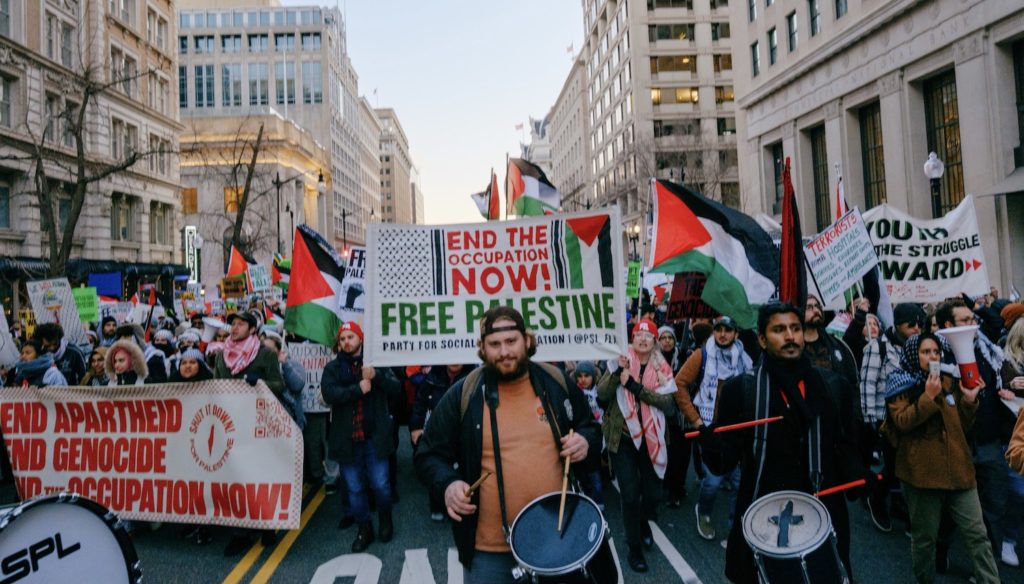
Hundreds of thousands marched in Washington, DC to demand an immediate ceasefire and protest Israel’s ongoing genocide in Gaza
Hundreds of thousands marched in Washington DC to protest Israel’s genocidal war on Gaza. Photo: Adrian Antonioli / ANSWER Coalition
On January 13, a crowd of 400,000 gathered in Washington, DC’s Freedom Plaza to take the Palestine solidarity movement straight to Biden’s doorstep. Hundreds of thousands then marched, holding Palestinian, Yemeni, South African, and Puerto Rican flags, through DC and straight to the gates of the White House.
The mobilization was organized by the American Muslim Task Force on Palestine, which includes American Muslims for Palestine, Council on American-Islamic Relations, Islamic Circle of North America, Muslim American Society, Muslim Student Association-National, Muslim Legal Fund of America, Muslim Ummah of North America, and Young Muslims, and the ANSWER Coalition.
Frustrated with Biden’s support and bankrolling of Israel’s genocide in Gaza, protesters surrounded the President’s residence and chanted “Hands off Yemen!” and “Yemen, Yemen, make us proud, turn this invasion around!” in reference to the US-UK bombing campaign against Yemen in response to the country’s blockade of Israel-bound ships. Protesters also left bloody baby dolls at the gates of the White House to condemn the genocide in Gaza and the over 10,000 children that have been killed to date. As the crowd demonstrated, several snipers were seen on the roof of the White House.
The hundreds of thousands who showed up in DC were joined by millions across the world who participated in a global day of action in solidarity with Palestine to mark nearly 100 days of Israel’s genocide in Gaza. Rallies, strikes, and mass mobilizations were held in major cities of South Africa, Japan, Turkey, the UK, South Korea, Indonesia, Ireland, New Zealand, Ivory Coast, Sweden, Italy, Germany, Austria, Australia, Finland, as well as throughout the United States. Thousands shut down the Port of Oakland in California at 5 am on Saturday morning.
Before marching, the crowd of hundreds of thousands in Freedom Plaza heard from a diverse array of speakers from the US Muslim community and anti-imperialist organizations. “So long as the genocide in Gaza is being funded by this administration,” said Ismahan Abdullahi of the Muslim American Society, “we will not relent in our efforts to demand justice and the liberation of the Palestinian people.”
“Just as South Africa courageously rose to rightfully charge Israel with genocide, we the people of the United States of America will rise and continue these efforts,” she continued.
“You Genocide Joe, you Blinken the butcher, and your Secretary of Defense Lloyd Austin. You will be haunted by the screams of the children in Gaza,” said Taher Herzallah of American Muslims for Palestine, who, like many other speakers, placed the blame for the ongoing Gaza genocide directly onto the United States government. “You will be haunted by the prayers, the agonizing prayers of the elderly and the women of Gaza. And we, this new generation, will be the answer to their prayers.”
Protesters demanded an end to all US funding of Israel. Photo: Wyatt Souers / ANSWER Coalition
2024 is an election year, and Biden, who is running for reelection, has been hounded by Pro-Palestine demonstrators at several campaign events already. Mainstream media outlets openly worry about Biden’s chances in 2024, with the aging President losing key demographics of Democratic Party support such as young people and Arab-Americans.
“Instead of focusing on the American people, our tax money is being used to spread hatred, to spread warfare, to support criminal activity, frankly speaking, to support a genocide,” Mohamed Sabri, who traveled from Chicago to attend the march in DC, told Peoples Dispatch about why he will not be voting for Biden.
As a result of Biden’s unpopularity, third party candidates running for president in 2024 have gained new prominence. Both Jill Stein and Cornel West, running platforms to the left of the ruling Democratic Party, spoke at the March for Gaza.
Peoples Dispatch spoke to presidential and vice presidential candidates Claudia De La Cruz and Karina Garcia, who were on the ground, marching among the crowd of hundreds of thousands, and are running jointly on an explicitly socialist platform. “We know it’s significantly important for any presidential candidate running for the 2024 election to prioritize the freedom, liberation of Palestine. Anyone who does not do that is standing in support of genocide,” said De La Cruz, the presidential candidate for the Party for Socialism and Liberation.
“Democratic politicians, they like to pay a lot of lip service during the year, especially around domestic issues, and they never want to talk about imperialism, which is at the center, it’s the core of all of the problems faced by the entire world,” added Garcia.
The PSL presidential ticket of Claudia de la Cruz and Karina Garcia participating in the March for Gaza in Washington DC. Photo: Craig Birchfield / ANSWER Coalition
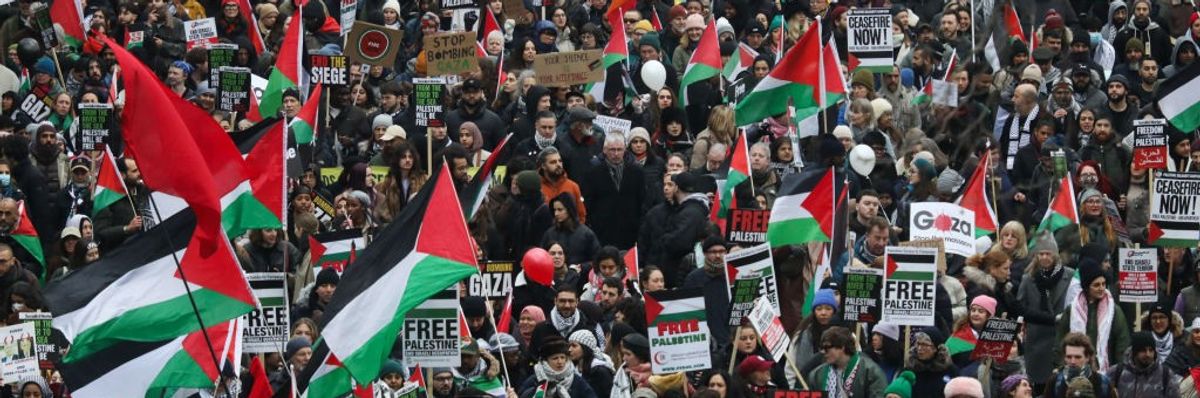
Tens of thousands of people gather to join the Global Day of Action calling for a ceasefire and an end to the war on Gaza on the 13th of January 2024, Central London, United Kingdom. The march and rally coincided with marches all over the World. (Photo by Kristian Buus/In Pictures via Getty Images)
Coordinated actions from DC to London to Jakarta designed to “send a powerful message not just to the Israelis but to the Western powers who are backing them that the public say ‘not in our name.’”
Major coordinated demonstrations took place across the world on Saturday to mark the 100th day of Israel’s bombardment and military assault on the people of the Gaza Strip that have now claimed the lives of nearly 24,000 Palestinians, a large majority of them innocent men, women, and children who had nothing to do with the attacks orchestrated by Hamas on October 7 of last year.
In London, as many as 500,000 people marched on Parliament Square to demand an immediate cease-fire Gaza, condemn their own U.K. government’s support of Israel’s disproportionate and “genocidal” onslaught, and warn against a wider regional war that experts warn is creeping closer by the day.
‘Justice is lacking’: pro-Palestine demonstrators gather in London www.youtube.com
“This Global Day of Action, from Australia through to Asia, Europe and the Americas, is the first coordinated, international movement against the war being waged by Israel on the Palestinian people,” said Gaza Global Day of Action organizers ahead of the demonstration. “It will send a powerful message not just to the Israelis but to the Western powers who are backing them that the public say ‘not in our name.’”
In Dublin, organizers of a march that saw more than 100,000 march through city streets called it the largest rally for Palestinian rights in Irish history.
So proud of this today – one of biggest protests in Ireland in recent years Tens of thousands march in Massive solidarity protest today in Dublin with Gaza#CeasefireNOW#palestine🇵🇸 pic.twitter.com/rOusYmzsfR
The crowd was filled with Palestinian flags, posters calling for an “End to the Gaza genocide” as well as makeshift washing lines, with baby clothes hanging from it, representing the many young lives lost in the conflict.
At the front of the march, four people held mock corpses in bloody body bags to represent the growing number of civilian casualties.
In the United States, tens of thousands marched in Washington, D.C. to denounce the Israeli onslaught—which has claimed over 23,000 lives, including more than 10,000 children—as well as their own government’s complicity in the carnage. President Joe Biden was on the tip of many demonstrators’ tongues and polls in the U.S. have shown very little support across the political spectrum for how he is handling the situation.
Jake and Ida Braford, a young couple from Richmond, Virginia, who brought their two small children to the protest, told the Associated Press the situation in Gaza has made them unsure of their support for Biden come this year’s election.
“We’re pretty disheartened,” Ida told the news agency. “Seeing what is happening in Gaza, and the government’s actions makes me wonder what is our vote worth?”
Following the march, demonstrators left a pile of bloodied baby dolls, including severe parts, in a pile outside the White House as a message to Biden. “The blood of the over 10,000 murdered children in Gaza is on his hands,” said CodePink co-founder Jodie Evans.
Meanwhile, in Indonesia, thousands gathered outside the U.S. embassy in Jakarta to condemn the ongoing “genocide” in Gaza perpetrated by Israel with the backing of the U.S. government and other Western allies.
Global day of action: Demonstration at US embassy in Jakarta urges ceasefire in Gaza www.youtube.com
Large protests were also held in Kuala Lumpur, Malaysia as well as in the South African cities of Cape Town and Johannesburg. On Thursday, a delegation from South Africa presented its case charging Israel with genocide before the International Court of Justice (ICJ) in The Hague.
“We are here today to be part of the global day of action that will see demonstrations planned in more than 66 cities and at least 36 countries,” said a statement released by the organizers in Cape Town. “Today’s rally will be part of a united front of global voices, calling unconditionally for an immediate and permanent ceasefire.”
Cities in Israel were not among those holding large-scale demonstrations against the government’s ongoing military campaign in Gaza. One application by Israelis for a rally in Haifa to denounce the onslaught was rejected.
As Haaretzreported: “The commander of the police’s Coastal District, Maj. Gen. Daniel Levy, explained that the refusal to grant the permit was over “real concerns about a serious disruption to public order,” adding that there was a high likelihood that violence would break out between demonstrators and people opposing the demonstration.”