Heavy rain and floods affect millions in Pakistan, over 650 killed since late June

Spread the love

Original article by Abdul Rahman republished from peoples dispatch under a Creative Commons Attribution-ShareAlike 4.0 (CC BY-SA) license.
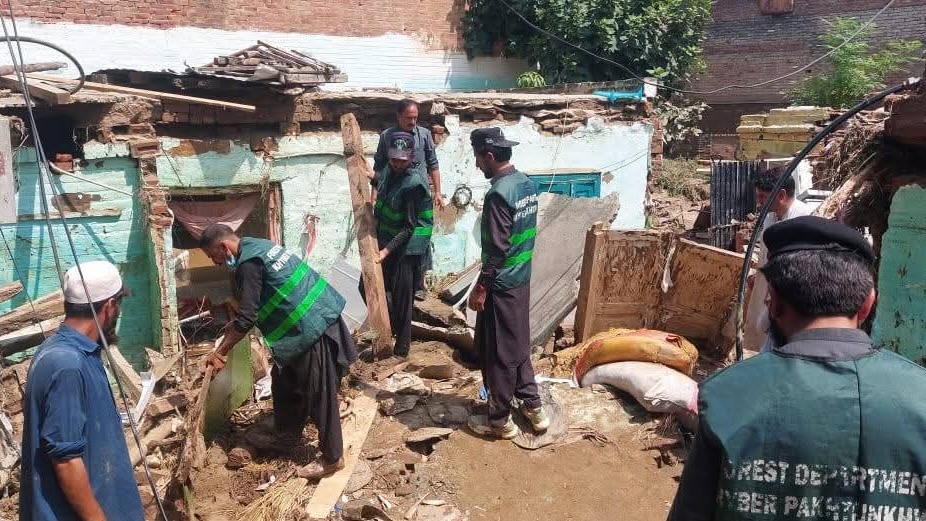
The Lower Swat Forest Division team of the Forest Department is engaged in rescue and relief activities in the flood-affected areas of Mingora, KP. Photo: Pir MusavirPTI/X

Pakistan has witnessed frequent heavy rains and floods in recent times causing massive human and material loss claimed to be the result of human-induced global changes in the climate

Pakistan is yet again facing heavy casualties and massive destruction due to unusual heavy rains and floods across the country this year. According to the country’s National Disaster Management Authority (NDMA), more than 650 people have been killed and over 900 others have been injured in rain-related incidents across the country since June 26.

The flash floods in mostly the northeastern parts of the country have also displaced hundreds of thousands with scores still reported missing.

It is estimated that Pakistan has already received 50% more rain this year in comparison to last year. The country’s meteorological department has warned that the current spell of heavy rains is expected to last until August 19 with three more spells of heavy rains through September after that.

The upcoming spells may cause massive flooding in the areas along the Indus river in the coming days, Pakistani authorities have warned.

Though death and destruction from the floods have been recorded across all the provinces of Pakistan, including the capital Islamabad, the northeastern Khyber Pukhtunkhwa (KP), and Gilgit-Baltistan have been hit the hardest.

Last week, huge flash floods washed away villages and communication networks at various places in the hilly region of KP and Gilgit-Baltistan. Heavy rains and cloud bursts have destroyed roads, railway lines, schools, hospitals, and other essential civilian infrastructure in KP, Gilgit-Baltistan, and other parts of Pakistan.

Buner in KP, which witnessed a cloud burst last week, has been the hardest-hit district, amassing more than half of all deaths recorded in the province with scores of people still missing.

According to the NDMA, KP recorded the highest number of people killed at 390, followed by Punjab, Pakistan’s largest province, which has recorded 164 deaths. Even the drier regions such as Balochistan have recorded over a dozen deaths due to the heavy rain and flash flooding.

Fresh heavy rains on Monday have made the relief and rescue operations difficult, particularly in the most affected regions in the hills.

Effects of climate change

Residents in Pakistan’s hilly areas who lost their houses in the flash floods say there were no early warnings of the heavy rains which multiplied the loss of lives and property.

Inam Haider Malik, head of the NDMA, claimed in a press conference in Islamabad on Sunday that it is difficult to predict cloud bursts and flash floods and warned that at least three more spells of heavy rain in the coming days may cause flooding in the lower areas in Pakistan. He emphasized that the “scale of loss is part of the climate change impacts”.

Pakistan’s chief meteorologist Zaheer Babar also claimed that the unusually heavy rains are a result of climate change. However, he also underlined that the impact of erratic rain is multiplied due to haphazard construction near the river valleys and unscientific disposal of waste in the river beds, Geo Tv quoted Babar saying.

“The situation in Khyber Pukhtunkhwa and Gilgit Baltistan is devastating. We are in the midst of a climate emergency,” claimed Ammar Ali Jan, leader of the Haqooq-e-Khalq Party (HKP). In his posts on X, Ammar also demanded “Pakistan should receive climate reparations, including debt relief” as it is a victim of “fossil-fuel driven model of Western development.”

Taimur Rahman, leader of the Mazdoor Kisan Party (MKP), underlined the failure of the Pakistani state to treat all its citizens equally, resulting in disproportionate losses to the poor during such floods.

Taimur claimed that the government in the country uses most of its resources on developing flood preventive mechanisms around richer localities while ignoring the needs of the majority of people.

Pakistan has faced repeated floods in the last few years with an increase in the overall rainfall during the monsoon season in particular. In 2022, in a similar situation, floods killed over 1,700 across Pakistan and affected over 33 million people, badly impacting the peoples livelihoods and the overall economy of the country as it tried to recover from the effects of COVID-19. The floods also destroyed crops, intensifying the overall food insecurity in the country.

Original article by Abdul Rahman republished from peoples dispatch under a Creative Commons Attribution-ShareAlike 4.0 (CC BY-SA) license.

Donald Trump urges you to be a Climate Science denier like him. He says that he makes millions and millions for destroying the planet, Burn, Baby, Burn and Flood, Baby, Flood.
Nigel Farage urges you to ignore facts and reality and be a climate science denier like him. He says that Reform UK has received millions and millions from the fossil fuel industry to promote climate denial and destroy the planet.
Continue ReadingHeavy rain and floods affect millions in Pakistan, over 650 killed since late June

Record levels of pollution endanger millions of lives in Pakistan

Spread the love

Original article by Abdul Rahman republished from peoples dispatch under a Creative Commons Attribution-ShareAlike 4.0 (CC BY-SA) license.
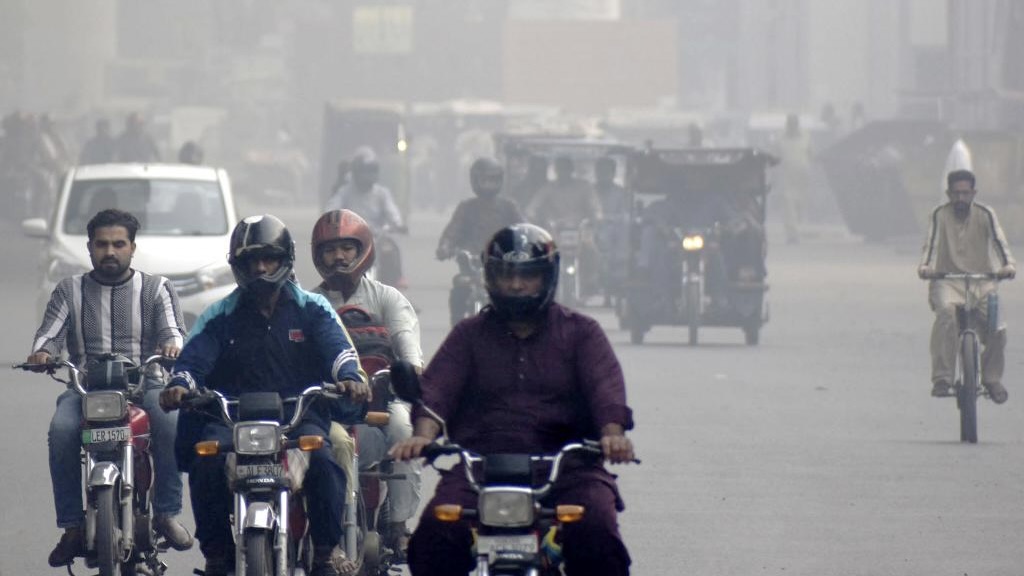
Pollution in Lahore last year. Photo: Xinhua

Left activists in the country blame the government’s reluctance to act against big polluters despite its impact on the most of the people who are risking their health to pursue their livelihoods.

A thick layer of toxic smog has covered the atmosphere of Pakistan’s Punjab province for the last two weeks, making its air hazardous for millions of people in cities such as Lahore and Multan.

Lahore, the capital of Punjab and the second largest city of Pakistan has emerged as the world’s most polluted city with its AQI hitting above 1,000 for several days this week. The AQI on Wednesday was recorded at 815. Other cities in the Punjab province, such as Multan, Bahawalpur and Faisalabad too recorded an average AQI above 400 in the same period.

An AQI above 300 is considered hazardous for human living.

The high level of pollutants (PM 2.5) in the air has forced the Pakistani authorities to shut down schools and colleges until November 17 and public parks until November 18. It has also issued orders to shut the shops and commercial activities early asking citizens to minimize venturing out and to wear masks.

The number of people reporting respiratory issues have reached nearly 70,000 daily in the province according to the Associated Press.

Prolonged exposure to smog leads to a large number of health problems such as irritation in the eyes, respiratory issues among others. Every year millions of people die due to air pollution.

According to the World Health Organization (WHO) “fine particles matter (PM 2.5) can penetrate [the human body] through the lungs” and blood streams causing major damages to human organs and can cause lung cancer, asthma, stroke and other diseases. Such exposure among children can affect their growth both physically and psychologically and can have lifelong effects.

Smog has become a regular feature in Pakistan’s Punjab province in recent years due to rising pollution caused by the high number of vehicles, increasing urbanization with a high density population, and an increase in polluting industries and agricultural activities.

According to Marriyum Aurangzeb, a senior minister in the Punjab government, Lahore endured 275 days of unhealthy AQI levels over the past one year with average temperature rising by 2.3 degree celsius.

Failure of the state

Punjab is Pakistan’s largest province with over 117 million people. The government led by Mariyum Nawaz of Pakistan Muslim League (PML) has been accused of taking inadequate measures to control the situation. In the name of fighting against polluters it has only targeted farmers and brick kilns and has been reluctant to hold larger and more powerful polluters such as big industries and the transport sector, Dawn reported.

According to the Punjab government’s own study, unfit vehicles apparently are the primary polluters (around 43%) in the province but the government has failed to curb their movement.

Ammar Ali Jan, head of the Haqooq-e-Khalq Party (HKP) has been consistently raising the issue of smog which makes the atmosphere “unfit for human survival.” Noting that in this inhuman condition only the rich who can afford to buy air purifiers can survive terming the government’s inactivity to provide relief to the people as a “criminal and insane” policy of “privatization of clean air.”

High pollution disrupts normal life for all sections of the population. However, it disproportionately affects the working class population as they are unable to follow the protection measures such as staying at home and wearing masks given the nature of their livelihoods.

In a recent tweet he also said that “climate catastrophe in Punjab is a result of a development model that turned our cities into concrete jungles.” He accused the Maryum Nawaz government for remaining “hopelessly non serious about confronting the challenge” and instead favoring big polluters such as “land mafia,” and “car/oil companies” in the state.

In light of the government’s lack of response, various left and progressive student organizations in the country called for a protest in front of the Punjab provincial assembly on Thursday, November 14. They demanded urgent action to fight climate change and the smog problem in the country.

Original article by Abdul Rahman republished from peoples dispatch under a Creative Commons Attribution-ShareAlike 4.0 (CC BY-SA) license.

Continue ReadingRecord levels of pollution endanger millions of lives in Pakistan