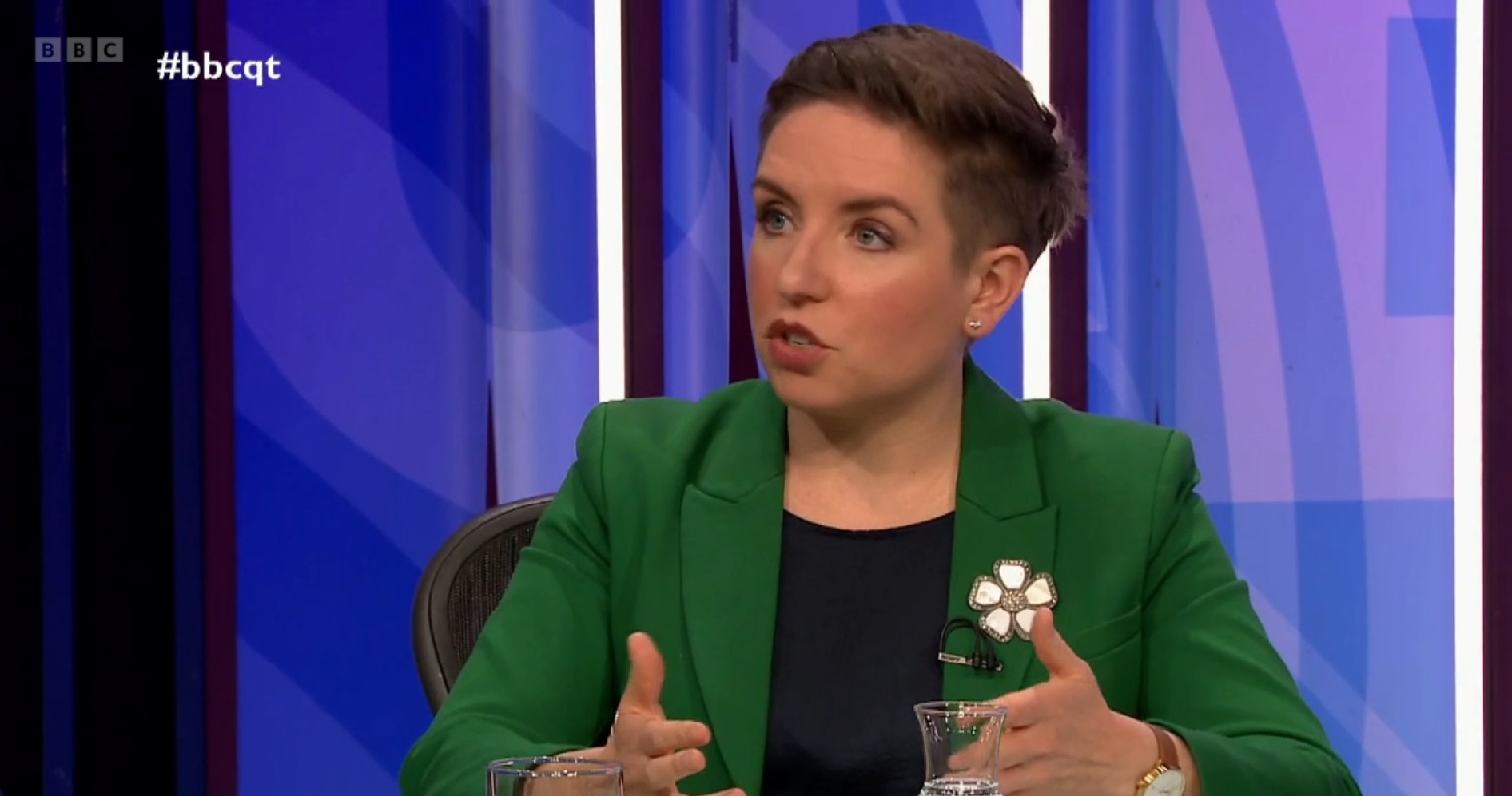
Green Party’s Bristol Central MP Carla Denyer on BBC Question Time.
Reacting to President Trump’s threats towards Greenland, Green MP Carla Denyer said
“Buoyed up by his imperialistic adventures in Venezuela, where he trampled over international law, Trump is now eyeing up Greenland.
“A year of pandering to the President has had no restraining effect whatsoever. It is time for Keir Starmer and government ministers to show some backbone.
“They must make clear that the UK will not tolerate an attack on Greenland and that they will stand up for international law and state sovereignty. Not selectively, but wherever such violations take place and whoever is committing them – whether that be Putin in Ukraine, Netanyahu in Gaza, or Trump in Venezuela, and now potentially in Greenland.
“The Green Party will always reject “might is right” authoritarianism, where military power is used to trump sovereignty and the rule of law. Diplomacy, cooperation and peacebuilding efforts must be strengthened.”
The Kremlin fired a new intermediate-range ballistic missile at Ukraine on Thursday in response to Kyiv’s use this week of American and British missiles capable of striking deeper into Russia, President Vladimir Putin said.
In a televised address to the country, the Russian president warned that U.S. air defense systems would be powerless to stop the new missile, which he said flies at ten times the speed of sound and which he called the Oreshnik — Russian for hazelnut tree. He also said it could be used to attack any Ukrainian ally whose missiles are used to attack Russia.
“We believe that we have the right to use our weapons against military facilities of the countries that allow to use their weapons against our facilities,” Putin said in his first comments since President Joe Biden gave Ukraine the green light this month to use U.S. ATACMS missiles to strike at limited targets inside Russia.
Pentagon deputy press secretary Sabrina Singh confirmed that Russia’s missile was a new, experimental type of intermediate range missile based on it’s RS-26 Rubezh intercontinental ballistic missile.
“This was new type of lethal capability that was deployed on the battlefield, so that was certainly of concern,” Singh said, noting that the missile could carry either conventional or nuclear warheads. The U.S. was notified ahead of the launch through nuclear risk reduction channels, she said.
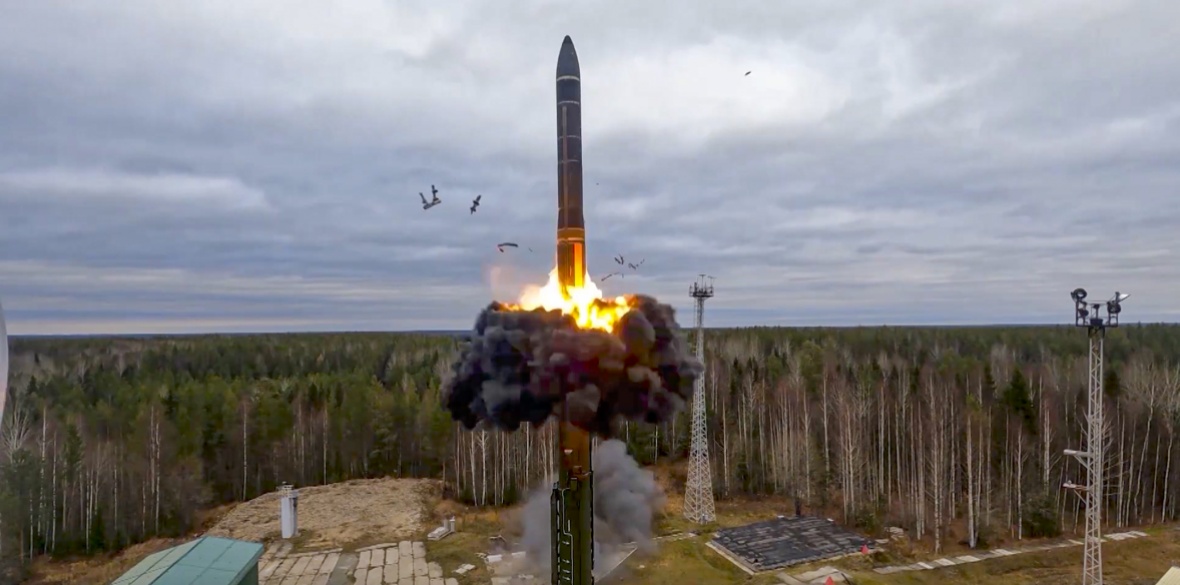
In this photo taken from video released by Russian Defense Ministry Press Service on October 26, 2022, a Yars intercontinental ballistic missile is test-fired as part of Russia’s nuclear drills from a launch site in Plesetsk, northwestern RussiaPhoto: Russian Defense Ministry Press Service via AP
The threshold for Russia’s use of nuclear weapons was formally lowered by President Vladimir Putin today. [19 Nov 2024]
This followed a decision by US President Joe Biden to let Ukraine strike targets inside Russian territory with longer-range missiles supplied by Washington.
The updated doctrine says an attack against Russia by a non-nuclear-armed power with the “participation or support of a nuclear power” will be seen as their “joint attack on the Russian Federation.”
It warns that any massive aerial attack on Russia could trigger a nuclear response but avoids any firm commitment and mentions the “uncertainty of scale, time and place of possible use of nuclear deterrent.”
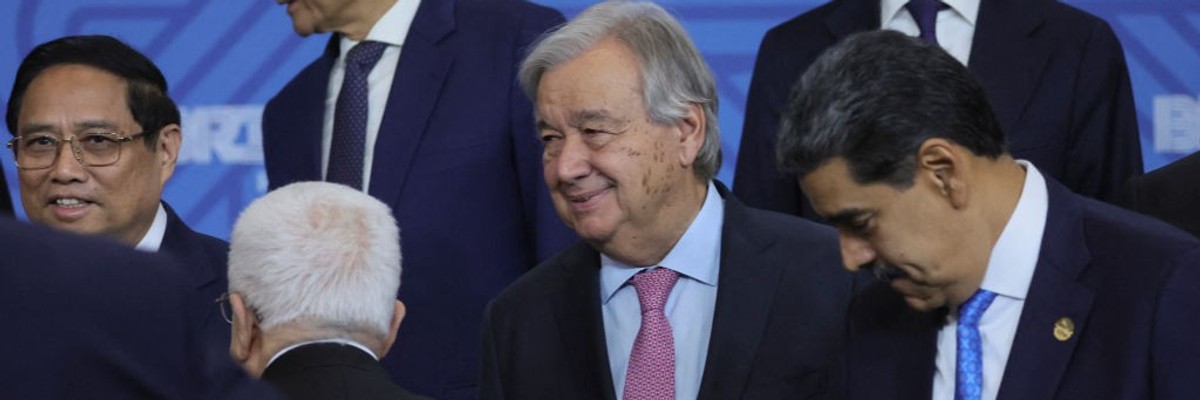
United Nations Secretary-General Antonio Guterres, center, stands with other dignitaries at the BRICS Plus conference in Kazan, Russia, on October 24. 2024. (Photo: Maxim Shipenkov/POOL/AFP via Getty Images)
“We need peace in Ukraine,” U.N. Secretary General Antonio Guterres said, speaking before Russian President Vladimir Putin.
United Nations Secretary-General Antonio Guterres, speaking in Russia on Thursday, called for peace in Ukraine and “across the board” as wars also rage in Gaza, Lebanon, and Sudan.
Guterres spoke before Russian President Vladimir Putin and other leaders from “BRICS Plus” countries gathering in Kazan, a city roughly 500 miles east of Moscow.
“Across the board, we need peace,” Guterres said.
“We need peace in Ukraine,” he added. “A just peace in line with the U.N. Charter, international law, and U.N. General Assembly resolutions.”
After the speech, Guterres renewed his call for a cease-fire in Lebanon and Gaza.
“We need a cease-fire in Lebanon—as we need a cease-fire in Gaza and the immediate release of all hostages,” he wrote on social media. “Escalation after escalation is leading to the unimaginable for the people of the region.”
We need a ceasefire in Lebanon – as we need a ceasefire in Gaza and the immediate release of all hostages.
Escalation after escalation is leading to the unimaginable for the people of the region. pic.twitter.com/YhwLkSbXzV
Putin presided over the closing ceremonies of the BRICS conference on Thursday, saying the group provided a counterbalance to the “perverse methods” of the West. Brazil, Russia, India, and China formed the group in the 2000s, with South Africa joining in 2010; BRICS recently expanded to include a number of other developing countries.
The conference drew the largest gathering of international diplomats into Russia since Putin’s forces invaded Ukraine in February 2022, escalating a conflict that had begun in 2014.
Ukraine’s foreign ministry criticized Guterres for attending the conference and noted that he did not attend Ukraine’s global peace summit in Switzerland in June.
“This is a wrong choice that does not advance the cause of peace,” according to the ministry’s social media account. “It only damages the U.N.’s reputation.”
Guterres has repeatedly called for a cease-fire in Gaza in the last year. The Israeli government declared him persona non grata earlier this month, barring him from entering the country on the grounds that he had not strongly condemned an Iranian barrage of missiles into Israel—an accusation Guterres denied, saying he did forcefully condemn the Iranian attack.
For U.N. Day, celebrated annually on October 24, Guterres issued a video statement calling for the world’s nations to keep the “beacon of hope” that is the U.N. “shining.”
The U.N. has had only limited success in stopping or slowing the wars in Ukraine, Gaza, Lebanon, and Sudan, which are among many dozens of conflicts across the world and have brought mass death and destruction.
The total number of Ukrainians and Russians who’ve died since February 2022 has reached roughly one million, The Wall Street Journalreported last month.
In Gaza, more than 42,000 people have been killed by Israeli forces in roughly the last year, following the Hamas-led October 7 attack that killed about 1,200 Israelis. More than 2,500 people have been killed by Israeli forces in Lebanon over the same period, including 1,900 in the escalation that’s occurred in the last five weeks, according to Lebanon’s health ministry. Dozens of Israelis have also died in that conflict.
A U.N. official said last month that the death toll in Sudan, which has been ravaged by civil war since April 2023, is at least 20,000 and could be much higher. The country is facing the prospect of a large-scale famine, with Save the Children on Tuesday raising the alarm that conditions there are worsening.
A photograph from the battle of Kohima, in north-east India, during World War II
We have long struggled for black and Asian Allied soldiers to be properly acknowledged in Europe’s commemorations — but now a worse travesty is upon us, as Russia’s crucial role is purged from the record, writes ROGER McKENZIE
…
President Putin took part in the commemoration of the 60th D-Day anniversary in 2004 and again, 10 years later, for the 70th anniversary — but he was not invited to this one.
The USSR, of which Russia was a key part, lost around 25 million people in the fight against Nazi Germany. But even this until recently undisputed fact is now under challenge.
In fact, the Red Army caused 80 per cent of all WWII German military losses and themselves lost 30 times more people than Britain, France and the US combined.
The Red Army’s defeat of the Nazis at Stalingrad is cited by many experts as being the decisive turning point in World War II. Between 150,000 and 250,000 Germans are estimated to have died at Stalingrad.
For Nazis, Stalingrad was not the battle that exacted the highest death toll, but the psychological impact of the battle was immense and was decisive in winning the war. It occupied and depleted massive Nazi resources which paved the way for the eventual Allied victory.
Over half a million Soviet soldiers and civilians died in the Battle of Stalingrad, among them numerous civilians. But that clearly was not enough to be invited.
Ukraine’s President Volodymyr Zelensky, on the other hand, was in attendance — as he always seems to be at pretty much anything. I now expect to see Zelensky at any event where a photo opportunity exists but the fact that he is invited to a commemoration of an event about the defeat of the Nazis is particularly insulting given the number of Nazis in his own forces and his applause in Canada last year for a veteran of a Waffen SS brigade that fought in Ukraine.
But the Russians are not the only ones that have been deliberately written out of history. The role of black people of African or Asian descent has continually been discarded.
…
More than 134,000 travelled from other colonies, including some 10,000 from the Caribbean to help defeat the Nazis. Only when casualties began to mount during the war were black people enlisted to join the fighting or become part of the Merchant Navy.
But there was no suspension in the standing orders of racism. Caribbean men joining the Merchant Navy were paid around one-third of the wages that white sailors were paid.
…
Around two and a half million fighters came from India to support the war effort. About the same time as the D-Day landing Indian, Gurkha and African soldiers fought the historic but little talked about — at least in Britain or the US — battles in Kohima, in north-east India.
These battles fought alongside British soldiers were among some of the toughest in the war and helped to turn the tide against the Japanese. Not for nothing did many of the troops who fought in battles in India and what is now Myanmar during the war call themselves “the Forgotten Army.”
I think they are probably wrong. I don’t think they were forgotten. I believe they were ignored because much of the fighting was carried out by black people. The Battle of Kohima and Imphal was the bloodiest of World War II in India, and it cost Japan many of its most elite fighters.
None of this seems to matter though to those that continue to hide the contribution made by people of African and Asian origin to the victory over the Nazis. We know the erasure of the role of the Red Army in World War II is being carried out for a different purpose.
The leaders of the Western powers can’t bring themselves to acknowledge the massive sacrifice of the Soviet people lest it demonstrate the skill and bravery of its soldiers and the refusal to be defeated by the seemingly invincible Nazis.
It is also part of the inexorable lurch towards a conflict with Russia as Nato ramps up the warmongering rhetoric that could lead to World War III and the catastrophic nuclear destruction of the planet.
Western powers seem far more willing to associate themselves with the Nazis surrounding the leadership of Ukraine and to hobnob with the likes of fascist-inspired Italian leader Giorgia Meloni.
I wonder how fast they will move for a photo opportunity should the far-right Marine Le Pen win the National Assembly election later this month or the next French presidential vote.
They say that history is written by the winners. Well, it seems not all the winners count. This means we must all call out the continued drive to rewrite history.