Even Once Reluctant Scholars Now Agree on Israel’s Gaza Assault: It’s a Genocide
Original article by Julia Conley republished from Common Dreams under Creative Commons (CC BY-NC-ND 3.0).
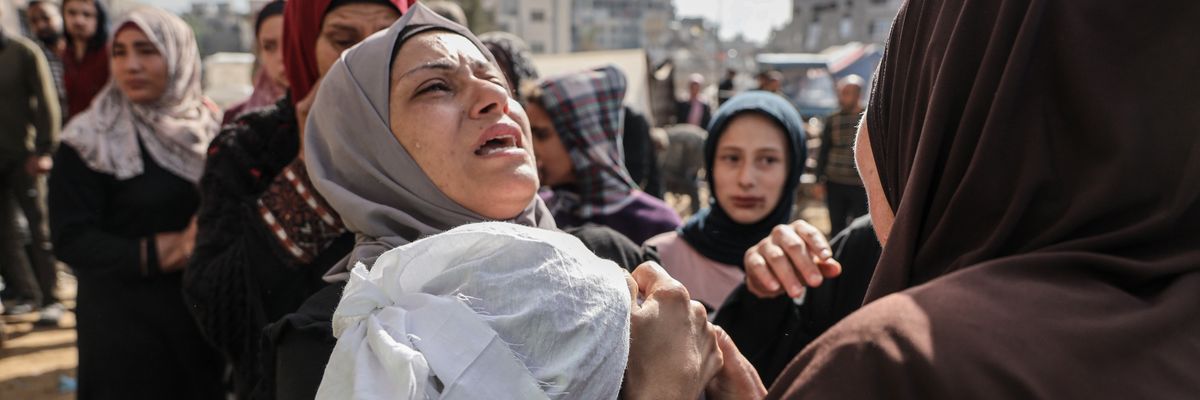
“Can I name someone whose work I respect who doesn’t consider it genocide?” said one researcher. “No.”
Only a tiny number of progressive Democratic lawmakers in the U.S. have used the word “genocide” to describe Israel’s relentless bombardment of Gaza, and the U.S. public divided, with less than 40% of Americans saying last year that the term described the Israel Defense Forces’ bombing of hospitals, schools, refugee camps, and other civilian infrastructure.
But for seven leading international experts on genocide, the question is not controversial—even for those who previously rejected the label.
The seven experts were interviewed Wednesday by NRC, a newspaper in the Netherlands, and were unequivocal: Not only have they all come to believe—some earlier than others—that Israel is committing genocide against Palestinians in Gaza, but the vast majority of their peers in academia concur.
“Can I name someone whose work I respect who doesn’t consider it genocide?” said Raz Segal, an Israeli genocide researcher at Stockton University in New Jersey. “No.”
Uğur Ümit Üngör, a professor at the University of Amsterdam and the NIOD Institute for War, Holocaust, and Genocide Studies, added, “I don’t know them.”
The interview was published the day before Nakba Day, the 77th anniversary of Palestinians’ forced expulsion from their lands when Israel was established, and as the death toll in Gaza reached 53,010. At least 15,000 of those killed have been children, NRC reported.
When it comes to defining the last 19 months in Gaza as a genocide, reported the newspaper, “even cautious voices have changed.”
Israeli scholar Shmuel Lederman of Open University of Israel “opposed the genocide label” until Prime Minister Benjamin Netanyahu’s government flouted the International Court of Justice’s January 2024 order to prevent genocide by allowing emergency aid into Gaza and halting top officials “incendiary language on Palestinians.” Israeli leaders have called Palestinians “human animals” and “Amalek“—an ancient enemy in the Hebrew Bible who Israelites were commanded to exterminate.
Lederman also began to see his government as genocidal after the Israel Defense Forces seized control of the Rafah crossing last year, cutting off the only humanitarian aid route as international experts warned famine was imminent, and as analysts warned the true death toll in Gaza could ultimately be close to 200,000.
“For me personally, the combination of this and the continued destruction of Gaza made the turn from harsh criticism of the crimes Israel is committing in Gaza and warnings that we are getting close to that place, to the perception that the cumulative effect of what Israel is doing in Gaza is genocidal in every sense,” said Lederman on the social media platform X on Thursday. “I think the second half of 2024 is the point at which a consensus emerged among genocide researchers (as well as the human rights community) that this was genocide. Those who may have still had doubts—I estimate that they have dissipated following Israel’s actions since the cease-fire was broken.”
Since March, when Israel reimposed a total blockade on humanitarian aid and broke a temporary cease-fire, nearly 3,000 Palestinians have been killed in bombings, and nearly 250,000 people are now facing “extreme deprivation of food,” according to the Integrated Food Security Phase Classification.
Melanie O’Brien, president of the International Association of Genocide Scholars, told NRC that Israel’s deliberate blockade on “food, water, shelter, and sanitation” convinced her the Netanyahu government was carrying out a genocide, while Segal pointed to “openly genocidal statements” by Israeli leaders.
“But for all it is about the sum of what would apply separately as ‘ordinary’ war crimes,” NRC reported. “The picture as a whole makes it a genocide. That is how the term is meant, says [British professor Martin] Shaw: ‘holistic.'”
“Apart from social debate, genocide is also the subject of science,” reads the article. “And that field of research, genocide studies, does not see it as a yes/no question, but as a process. Not a light switch, but a ‘dimmer,’ in the words of professor of Holocaust and genocide studies Uğur Ümit Üngör.”
NRC noted that the Western media and political debates have been consumed with “misunderstandings and simplifications.”
Those who continue defending Israel’s actions insist that “it is a military war to destroy Hamas, there is no clear eradication plan, not all Gazans have been killed, it does not look like the Holocaust, the judge has not yet ruled.”
As historian Rutger Bregman said on X Thursday, the scholars interviews by NRC make clear: “Genocide is a process, it’s not a binary switch. And it’s not about matching the Holocaust.”
Segal, who is Jewish, told NRC that he is “regularly accused of antisemitism” for speaking out against Israel.
“A German authority in the field that wants to remain anonymous calls the subject ‘poisoned’ in his country,” reported NRC. “You are, he says, called directly [antisemitic] if you mention ‘possible genocide.’ If these acts are subjected to a country other than Israel, he says, all Germans would immediately sound the alarm and speak of genocidal violence, as happened with the Russian massacre in the Ukrainian city of Botzja. But now, he says, it remains silent.”
Dirk Moses, editor-in-chief of the Journal of Genocide Research, said that portions of the field of research are “in crisis” if experts don’t “combat the artificial distinction between [genocide] and military targets” and continue to defend Israel’s actions.
“Then parts of the field of research are actually dead,” he said. “Not only conceptually incoherent, but complicit.”
Original article by Julia Conley republished from Common Dreams under Creative Commons (CC BY-NC-ND 3.0).

- 800+ Legal Scholars Say Israel May Be Perpetrating ‘Crime of Genocide’ in Gaza
- ‘Most Thorough Legal Analysis’ Yet Concludes Israel Committing Genocide in Gaza
- It’s Not Complicated: Israel is Committing Genocide in Gaza
- Who accuses Israel of committing genocide in Gaza? | Gaza News …
- Israel committing genocide in Gaza, says EU’s former top diplomat …



 A Yemeni soldier inspects the damage reportedly caused by U.S. airstrikes in Sanaa, Yemen, April 27, 2025