Limiting jury trials will harm minority ethnic victims and defendants, research shows
Spread the love

Tara Lai Quinlan, University of Birmingham and Katharina Karcher, University of Birmingham

The right to trial by jury dates back to at least the 12th century. The government’s proposals to limit it in England and Wales, many argue, run counter to the UK’s core democratic principles. And as others have pointed out, scrapping jury trials for some crimes is unlikely to solve the massive backlog in the crown courts.

Our research suggests that there is another reason why it is a bad idea to scrap jury trials. They can play a vital role in reducing racial discrimination in the criminal justice system.

The proposals laid out by justice secretary David Lammy would have a disproportionately negative impact on people of colour – both defendants and victims – for whom jury trials give a glimmer of hope in a criminal justice system where “ethnic minorities (excluding white minorities) appear to be over-represented”.

Government data repeatedly shows black, Asian and minority ethnic defendants are less likely to plead guilty than white defendants, and more likely to take their cases to trial. Lammy’s own 2017 review of racial inequality in the justice system suggests this is driven by a perception that the plea-bargaining process is unfair to defendants of colour, and that only a jury of peers will give them a fair trial.

Once black defendants choose a jury trial, research shows they are “more likely … to obtain acquittals or reductions in charges as a result”, compared to black defendants who plead guilty without opting for a trial.

A jury of 12 people brings a broader array of diverse perspectives and opinions which enhance the quality of discussions in deliberations, particularly in cases involving an ethnic minority defendant. Defendants should have their fate decided by people who might better understand their experiences, backgrounds and motivations.

Lammy’s 2017 review emphasised the importance of juries in making the criminal justice system more legitimate, particularly for people of colour: “Juries deliberate as a group through open discussion. This both deters and exposes prejudice or unintended bias: judgements must be justified to others.”

Sentencing is also disproportionate for defendants of colour when compared to white defendants, following both jury trials and plea agreements. Research has found that explicit or implicit judicial biases – whether judges stereotype the defendant, how they interpret sentencing recommendations from prosecutors and defence counsel, or how they apply aggravating and mitigating factors – may all contribute to these disparities.

Empirical evidence from other jurisdictions shows that more diverse juries are fairer to black defendants. Indeed, studies repeatedly show that all-white juries much more readily convict black defendants. Juries with even one black member are less likely to do so.

The UK’s Contempt of Court Act limits this type of research with live juries. But there is enough evidence from other jurisdictions to suggest that retaining juries, and ensuring those juries are diverse, is essential for protecting the fair trial rights of people of colour generally, and black people in particular.

Justice for victims

Jury trials are also essential for black victims and their families. Since 2022, we have worked with the family and friends of Dea-John Reid, a 14-year-old black boy who was racially abused and chased through the streets of Birmingham by a group of white boys and men who fatally stabbed him in broad daylight.

In their 2022 trial, the perpetrators were acquitted of racially aggravated murder, with only the principal offender found guilty of manslaughter by a jury of one Asian and 11 white members. Dea-John’s family felt that the lack of diversity on the jury, which did not have a single black member, could have meant they were less likely to see Dea-John as a worthy victim. Research shows that black men and boys are stereotyped as suspects – even when they are victims of crime.

Since 2022, we have worked with the family’s campaign, which supports retaining jury trials, but wants them to be more ethnically diverse, particularly in cases involving black victims. Our research has documented the campaign and is addressing critical gaps in UK research on jury diversity.

Diversity in the judiciary

Lammy’s proposals for reform include expanding the use of bench trials. This means that more cases would be heard by a single judge alone.

The judiciary in England and Wales is neither sufficiently diverse nor representative of the population. While black, Asian or minority ethnic people make up around 22% of the population, as of 2025, they make up only 11% of all court judges.

Lammy’s proposal also goes against what the public wants. In 2024, we surveyed 1,000 members of the public, 75% of whom stated explicitly that they believed the UK should have jury trials.

While most of our respondents believed that jury trials were fair (51%) and trustworthy (60%), they also felt strongly that more diverse juries were fairer (61%). Around half of people (51%) believed juries should look like the communities they serve. We found that for people of colour, taking part in jury service was viewed as even more important than for white respondents.

When it comes to perceptions of fairness and trust in the courts, we found important racial differences. Our research found that people of colour trust judges and the courts at lower rates than white people. People of colour in our survey were also more likely than white people to believe that judges treat them more unfairly compared to white people. And most of our respondents believed that more diversity in the judiciary is needed.

If Lammy remains committed to reducing inequality in the criminal justice system for people of colour, rather than reducing jury trials, he should be increasing them, and the diversity on them, to ensure justice for all.

Tara Lai Quinlan, Associate Professor in Law and Criminal Justice, University of Birmingham and Katharina Karcher, Senior Lecturer, Department of Modern Languages, University of Birmingham

This article is republished from The Conversation under a Creative Commons license. Read the original article.
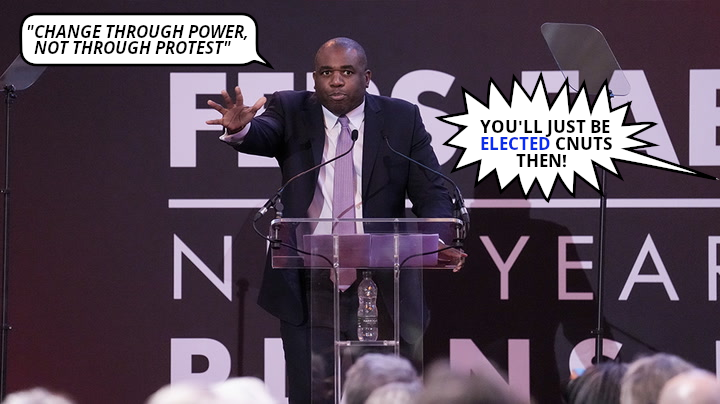
UK Labour Party Foreign Secretary David Lammy repeatedly heckled at a speech to the Fabian Society over his and the Labour Party's support for and complicity in Israel's genocide of Gaza.
UK Labour Party Foreign Secretary David Lammy repeatedly heckled at a speech to the Fabian Society over his and the Labour Party’s support for and complicity in Israel’s genocide of Gaza.

Richard Tice refuses to condemn Reform mayoral candidate’s comments about David Lammy

Continue ReadingLimiting jury trials will harm minority ethnic victims and defendants, research shows

AFL-CIO: The fights for climate justice and racial justice are intertwined

Spread the love

Original article by Blake Skylar [good name] republished from People’s World under http://creativecommons.org/licenses/by-nc-nd/3.0/us/.

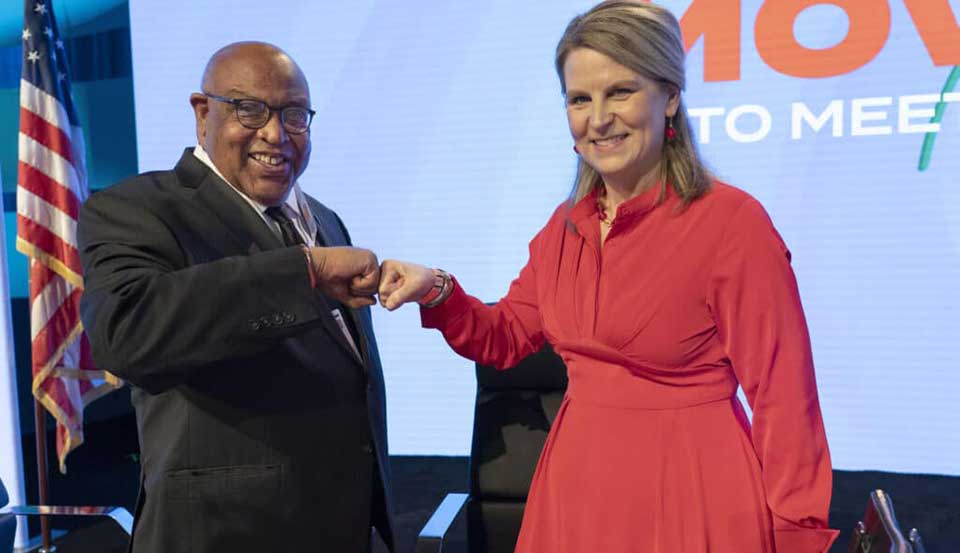
Fred Redmond and Liz Shuler. Jay Mallin/iatse.net

WASHINGTON – Global warming, in itself, affects everyone but in a world where discrimination along lines of race and class is rampant, it falls hardest on those who are most oppressed, the poor, working-class, and non-white people here at home and around the world. Rather than solve the problem, fossil fuel interests would sooner put blinders on the eyes of those who bear the brunt of global warming’s effects and on everyone else.

On Earth Day, Apr. 22, and in the days since then, the AFL-CIO is reminding the world that on the contrary, the eyes of the working class, the poor, and minorities are wide open, and they are fighting back.

“Thinking about movements coming together in the same room today made me think of Dr. King and what he said,” remarked AFL-CIO Secretary-Treasurer Fred Redmond, the highest-ranking African-American leader in the labor movement. “During his days, a term like environmental justice didn’t really exist, but he understood how interconnected these challenges were. Structural racism, economic injustice, and underinvestment in Black and brown communities. He told us in 1967 that the cities were gasping in polluted air and enduring contaminated water. What’s equally important is that he knew the solution, how important it was to stand together in solidarity. Organized labor can be one of the most powerful interests to do away with this evil that confronts our nation that we refer to as discrimination.

“The same forces that are against [equality] are also anti-labor. We are evolving, and so many of our 60 affiliated unions are prioritizing issues that we never would have imagined years ago. Yet even as we take on as a labor movement these new issues, we are still guided by the old values that helped define the labor and civil rights movements for years.

“Just a few generations ago, this movement lifted families into the middle class, especially many black workers who had migrated from down south. It provided those newly migrated Black Southerners access to well-paying jobs and upward mobility in our economy.”

“There is a long history of important collaboration between labor and the fight for racial justice,” said Professor Carlton Waterhouse, Director of Environmental and Climate Justice at Howard University School of Law. “When I was a student and first started fighting for the rights of people in need, I was involved in the anti-apartheid efforts at Penn State University. And when we were out on the campus having built a shanty-town, there were labor representatives from local unions who came out to spend time with us, and in doing that, they planted important seeds; the idea that the fight for people is not just one fight, it’s many fights.

Fighting on multiple levels

“And the fight for people means fighting on multiple levels with multiple partners. If we’re going to see success in fighting the climate crisis, it’s only gonna happen if we’re able to see our shared need for collaboration when it’s not always so obvious. Like when labor representatives come to work with students fighting for anti-apartheid. If we’re going to be successful in the fights for racial justice and climate equity, we’re going to have to invest in one another.”

Patrice Willoughby, the Senior Vice President of Global Policy and Impact with the NAACP, highlighted a tool that can be added to the collective arsenal in this battle against global warming. Called the Justice40 Initiative, it’s a move by the Biden administration that aims to ensure that 40 percent of the benefits derived from clean energy and affordable, sustainable housing goes to the most disadvantaged communities. Specifically, this refers to communities that have endured the lion’s share of disinvestment and pollution.

“These investments are catalytically important now,” said Willoughby. “You cannot save the planet unless you uplift the needs of the people.” She added that there are also mechanisms that have to be built to ensure that the initiative is being applied fairly and constructively. “We need to actually have an accounting because many times when these funds go into states it’s up to those states to determine how those funds are used.

“It’s also a matter of equipping the communities, so we’re spending a lot of time with activists and community-based organizations. Many times people read about these things and don’t know how it can affect them, so we’re spending a lot of time in a critically important year in states whose legislatures are voting in ways that are not favorable to the people most affected by greenhouse gas and climate change. So it’s important to link the issues to the power of the ballot and the fact that people have the ability to make change on their own behalf.”

The vulnerability of people in marginalized communities to the havoc of the climate crisis is a situation that the AFL-CIO’s Fred Redmond knows well. “It’s my family’s story,” he said. “They grew up in the Mississippi delta and made that great migration in the 50s and landed in Chicago. It was tough. They worked hard and worked long hours to support their families. We were poor, but that changed when my father got a good job at an aluminum mill in Chicago, with good wages and health care, and had a chance to retire with dignity and respect. Most importantly, he had a voice on the job.

“But even then, union jobs had a legacy of discrimination and bias. Blacks had the hardest jobs and had very few opportunities for advancement. My dad was on the union grievance committee and protested job discrimination and disparate treatment and was committed to making the union more inclusive. When I took a job at the mill after high school he challenged me to have that same commitment.

“That’s my story, and that’s the story of the creation of the Black middle class and the power of holding a union card. Now equity and opportunity are baked into unions, so we recognize the need to connect those values and align our work with our partners in environmental activism. It’s the only way we’ll be able to deliver justice for our communities, and the only way we can move with the speed and urgency that we need in this climate crisis.”

“That’s the unique thing about this,” AFL-CIO President Liz Shuler agreed. “It’s the urgency of the crisis. Many of you know I grew up in Portland, Oregon. When I was a kid in the summer the temperatures were around the 70s and 80s, nobody had air conditioning. Maybe we’d get into the 90s once in a while, but that was a rare day. Fast forward to today, and things have changed. Now it’s not unusual to have temperatures in the 100s for weeks at a time.

“In 2021, one of the most heartbreaking stories I remember was about Sebastian Francisco Perez, a worker from Guatemala who came to the U.S. to support his family. Just months later on a farm in St. Paul, Oregon, the temperature hit 115 degrees. He kept going because that’s what the bosses demanded. His coworkers found him unconscious that afternoon and he died one day after his 38th birthday.

“That story gutted me. These stories are often spun as ‘this is the effect of climate, climate is to blame.’ Yes, but the climate isn’t a person. Greedy corporations are also to blame when they make you work in 115-degree heat without water breaks or shade so they can make even more profit. We are the ones out there building factories and schools when it’s 110 degrees. We are the responders who show up after a hurricane or a flood destroys a community. We’re the ones getting sick on the job, choking on polluted air and toxic water.

“The flip side of that coin is that we as workers, unions, and environmental and civil rights leaders, can bring about the change we are hungry for. We have a historic opportunity with the federal investments of the Biden administration to use clean energy to transform the economy and create good safe union jobs, but we have to get it right. And we won’t buy into this false choice that companies and right-wing politicians give us. It’s not an ‘either-or’. It’s climate and workers, economy and environment, jobs and justice.”

Original article by Blake Skylar [good name] republished from People’s World under http://creativecommons.org/licenses/by-nc-nd/3.0/us/.

Continue ReadingAFL-CIO: The fights for climate justice and racial justice are intertwined