Global South leaders join Victory Day events in Moscow as Europe stays away

Spread the love

Original article by Ana Vračar republished from peoples dispatch under a Creative Commons Attribution-ShareAlike 4.0 (CC BY-SA) license.

Marking the 80th anniversary of Nazi Germany’s defeat, Global South leaders are gathering in Moscow, while EU remains absent
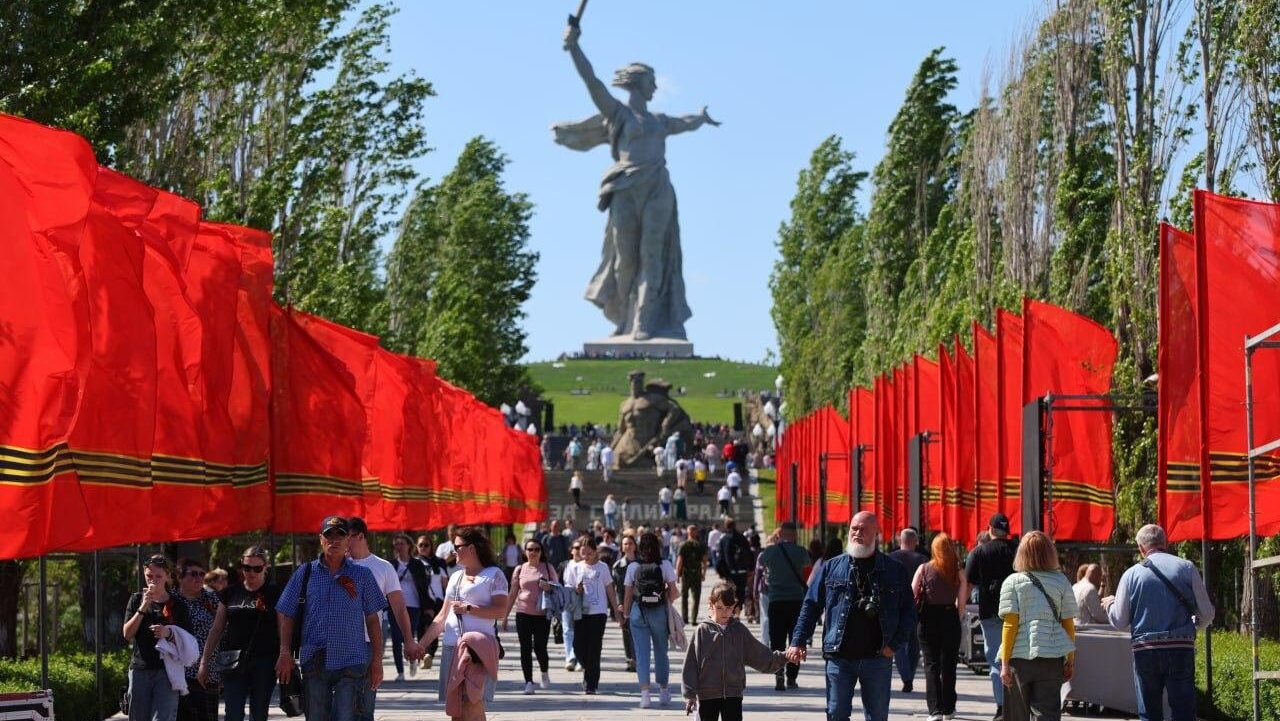
Source: Ministry of Foreign Affairs of Russia/X

Early high-level events marking the 80th anniversary of the defeat of Nazi Germany are underway in Russia, where the traditional Victory Parade on Friday, May 9, will welcome a host of world leaders and other guests to commemorate the Red Army’s role in the liberation of Europe. According to Russian authorities, 29 countries have confirmed their leaders will attend the event, including Brazil, Burkina Faso, China, Cuba, Venezuela, and Vietnam.

Victory Day, falling on May 8 in most of Europe and on May 9 in Russia due to time zone differences, marks the official surrender of Nazi Germany in 1945. Although the date holds deep historical significance for Europe, its political leaders will be largely absent from this year’s events in Moscow. Slovakia is the only EU country to appear on the latest list of attendees, ignoring warnings from the bloc’s High Representative for Foreign Affairs, Kaja Kallas, who implied there would be ‘consequences’ for European officials participating in the event. Her threats mark the latest episode in a long-standing campaign of historical revisionism led by the EU, aimed at minimizing and obscuring the Soviet Union’s role in the liberation of Europe in World War II.

Honoring Red Army’s role in defeating Nazi Germany

In contrast to the EU, Global South leaders attending the events expressed their respect and acknowledged those who fought for liberation. At the beginning of his visit, Venezuelan President Nicolás Maduro stated simply: “It was the Red Army that liberated Europe.” Similarly, Chinese President Xi Jinping emphasized the importance of maintaining an accurate historical perspective on World War II and applying its lessons to the present, particularly when it comes to resisting Western domination.

“Eighty years ago, the forces of justice around the world, including China and the Soviet Union, united in courageous battles against their common foes and defeated the overbearing fascist powers,” Xi wrote in an article for the Russian Gazette. “Eighty years later today, however, unilateralism, hegemonism, bullying, and coercive practices are severely undermining our world.”

Despite efforts by Western governments to demonize the Red Army, many around the world still remember the USSR’s decisive role in the antifascist struggle, the immense sacrifices it made during the war, and the international solidarity it championed. “The peoples of the world have not forgotten who, in 1945, liberated them from Nazi enslavement and destruction,” stated Gennady Zyuganov, leader of the Communist Party of the Russian Federation, ahead of Victory Day.

“Celebrating the 80th anniversary of the great victory over fascism, we must remember the origins of Nazism,” he added. “Imperialism, which gave birth to that plague, is not a thing of the past. It is no coincidence that today our former allies in the anti-Hitler coalition are erasing us from the list of victorious countries.”

Left movements reclaim antifascist legacy for today’s struggles

Although communist groups across Europe circulated statements honoring the Red Army’s role in World War II, some also voiced concern about the context of this year’s central commemoration in Russia – just as much as the revisionism of core EU countries

Read more: Italy marks 80 years since liberation with calls against genocide and militarism

It is in the spirit of reclaiming the resistance, that left and progressive groups across the region are organizing their own events. In Belgium, for example, activists have rallied around long-standing demands to re-establish May 8 as a public holiday. In former Yugoslav countries, actions will affirm the relevance of antifascism today, particularly in connection with solidarity for Palestine and mobilizations against genocide. All these events are not limited to remembrance: they aim to resist efforts to rewrite history in service of the Global North’s current political agenda.

Original article by Ana Vračar republished from peoples dispatch under a Creative Commons Attribution-ShareAlike 4.0 (CC BY-SA) license.
Continue ReadingGlobal South leaders join Victory Day events in Moscow as Europe stays away

European leaders rewrite WWII history on Auschwitz liberation anniversary

Spread the love

Original article by Ana Vračar republished from peoples’ dispatch under a Creative Commons Attribution-ShareAlike 4.0 (CC BY-SA) license.

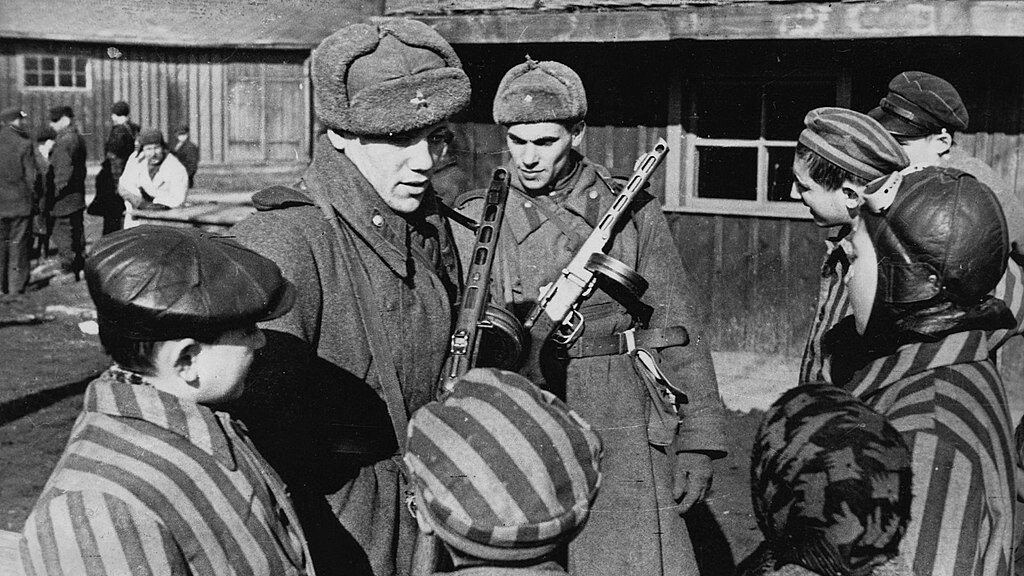
Red Army soldiers with prisoners of Nazi concentration camp, 1945. Source: Wikimedia Commons

As European leaders gathered at Auschwitz to commemorate 80 years since its liberation, they upheld a revisionist narrative that downplays the role of the Red Army in defeating Nazism

On January 27, 1945, soldiers of the Soviet Red Army liberated Auschwitz, the Nazi concentration camp where over one million people—overwhelmingly Jews—were murdered. Eighty years later, European leaders gathered in Poland, now home to the Auschwitz memorial, to hear survivor testimonies and reaffirm the commitment to ensuring such atrocities never happen again.

Yet this year’s commemoration came with a blazing omission. Despite the USSR’s vital role in defeating Nazi Germany and its allies—at the cost of over 20 million Soviets’ lives—there were no representatives of the Russian Federation at Auschwitz. In its pursuit of punishing Russia for the war in Ukraine, the European Union (EU) has virtually erased the Red Army’s contributions from the narrative. Leaders like Ursula von der Leyen and Giorgia Meloni issued statements of remembrance while avoiding any mention of the USSR. Only left politicians dared to talk about the full picture in their messages on the day of remembrance.

Read more: Zagreb’s anti-fascist flame: a decade of liberation celebrations and resistance

These events have to be read as part of a broad revisionist trend spreading through Europe, in which far-right parties, such as Meloni’s Brothers of Italy and France’s National Rally, are using anti-communist tropes to rewrite history. This trend has taken root among mainstream parties as well. Just days before Holocaust remembrance day, the European Parliament adopted a resolution condemning Russia for “exploiting the narrative of the ‘liberation of Europe from Nazism.’” The text of the resolution also criticized the restoration of Lenin’s monuments in Ukraine and called for a “pan-European” memorial for “victims of the 20th century totalitarian regimes,” a vocabulary that aims to equate fascism and communism.

In what can only be described as a severe case of historical amnesia, the parliamentaries proposed a ban on “both Nazi and Soviet communist symbols” across the EU. As some have pointed out, implementing such a ban would complicate commemorations like the one on Monday, given the prominence of Soviet uniforms in archival photographs of liberation.

While the EU is entertaining itself with erasing communism’s role in defeating Nazism in World War II, it seems to have learned extremely little from the Holocaust itself. The first phase of a ceasefire in Gaza had not even begun when Polish authorities announced they would allow Israeli Prime Minister Benjamin Netanyahu to attend the Auschwitz commemoration—despite an International Criminal Court warrant for his arrest on war crimes charges. Though Netanyahu ended up not attending himself, the mere possibility highlights Europe’s willingness to overlook crimes against humanity if committed by its current allies.

“Laying claim to the memory of one genocide in order to justify another genocide is morally and politically unacceptable,” historian Enzo Traverso said in a recent interview with Jacobin, commenting on Europe’s reactions to the genocide in Gaza. “The memory of Auschwitz should be mobilized to impede new genocides, not to justify them.”

Read more: Elon Musk and AfD’s Alice Weidel’s align ahead of elections in Germany

By refusing to acknowledge the full history of Nazism’s defeat in 1945—especially the contributions of the Red Army and communist movements—Europe only fuels the rise of the far-right. Parties like Alternative for Germany (AfD), National Rally and Brothers of Italy may avoid explicit antisemitism in their platforms, but their policies thrive on the same hatred and violence that drove the Holocaust. As these parties gain electoral ground, the slogan “Never again is now” is becoming increasingly difficult to believe.

Original article by Ana Vračar republished from peoples’ dispatch under a Creative Commons Attribution-ShareAlike 4.0 (CC BY-SA) license.
Continue ReadingEuropean leaders rewrite WWII history on Auschwitz liberation anniversary

Morning Star Editorial: Return to the real history and real lessons of the Holocaust

Spread the love

https://morningstaronline.co.uk/article/return-real-history-and-real-lessons-holocaust While the Morning Star’s copyright on this article is respected, I hope that they will excuse me fully quoting it.

Nazi soldiers separate Hungarian Jews on the ramp at Auschwitz-II-Birkenau in German-occupied Poland, May/June 1944, during the final phase of the Holocaust

HOLOCAUST Memorial Day, the anniversary of the liberation of the Nazis’ Auschwitz death camp by the Red Army, is one of the most solemn days in the labour movement calendar.

The industrialised effort to exterminate Europe’s Jews, Roma and Sinti, alongside others the fascists deemed unworthy of life like gay, disabled or mentally ill people, remains the most systematic and calculated genocide in history. It must never be denied or downplayed.

Yet the meaning of Holocaust Memorial Day is increasingly obscured. Partly this is due to the rewriting of history.

Holocaust relativism presents the Nazis’ programme of racist mass murder as just one among many crimes of “totalitarianism,” postulating a false equivalence between Nazi Germany and the country which played the biggest part in its defeat, the Soviet Union.

The result is an equivocation between those who ran the death camps and those who liberated them — something masked in much British media discourse by referring vaguely to Auschwitz’s liberation by “the Allies” rather than the Soviets.

This has already regressed in some quarters into implied support for the Nazis or their local auxiliaries as anti-Russian freedom fighters, as we saw when a Ukrainian Waffen-SS veteran was applauded by MPs in the Canadian parliament, or when Estonia’s Foreign Ministry posted tweets denouncing the 80th anniversary of the Soviet assault on Tallinn, not mentioning the context that Tallinn was under Nazi occupation. Calling out such distortions of history should not, of course, blind us to the manipulation of the memory of the second world war by the present Russian government for its own purposes either.

The removal of context allows the memory of the Holocaust to be deployed cynically by Britain’s rulers too.

The UN resolution establishing Holocaust Memorial Day is clear that its message is a universal one: “The Holocaust, which resulted in the murder of one third of the Jewish people, along with countless members of other minorities, will forever be a warning… of the dangers of hatred, bigotry, racism and prejudice.” It also “condemns without reserve all manifestations of religious intolerance, incitement, harassment or violence against persons or communities based on ethnic origin or religious belief.”

This text calls on us to apply the lessons of the Holocaust to all instances of racist persecution and all genocides.

It is disregarded by a British government which will not call out the Islamophobia of the far-right rioters who attacked mosques last summer, and which has been complicit in an assault on the people of Gaza recognised as a genocide by Amnesty International and Human Rights Watch, and as plausibly amounting to one by the International Court of Justice.

Indeed, the memory of the Holocaust is misused to shield the state of Israel from accountability for its acts of war and ethnic cleansing, and it will be interesting to see which British politicians have the courage to condemn Donald Trump’s call this weekend to “clean out” “probably a million-and-a-half people” from Gaza to facilitate its colonisation by Israel.

So far removed are some self-appointed authorities from the reality of the Holocaust as a product of fascism and war that the Anti-Defamation League, quick to accuse Palestine solidarity campaigners of anti-semitism, could only admit to an “awkward hand gesture” when confronted by evidence of a fascist salute by Trump ally and tech tycoon Elon Musk.

Both anti-semitic and Islamophobic hate crimes are on the rise. Confronting that means returning to the real lessons of the Holocaust, as thousands will do at local trade union and political meetings this week, though our government will not.

That does not mean depoliticising it. The Holocaust was political, emerging from the ideology of fascism. When we say “never again,” we must commit ourselves to anti-fascism — which is sadly once again an urgent political cause.

https://morningstaronline.co.uk/article/return-real-history-and-real-lessons-holocaust While the Morning Star’s copyright on this article is respected, I hope that they will excuse me fully quoting it.

Elon Musk urges you to be a Fascist like him, says that you can ignore facts and reality then.

dizzy: While Musk is correct that Germans should not feel guilt about their ancestors’ actions that’s not reason to erase history, to ignore facts and reality. He is a Neo-Fascist supporting Neo-Fascism.

Elon Musk Expresses Support for Germany’s Far-Right AfD Party—Again

Continue ReadingMorning Star Editorial: Return to the real history and real lessons of the Holocaust

The black, and Red, contribution to Nazi defeat must never be forgotten

Spread the love

Original article at https://morningstaronline.co.uk/article/victory-over-nazis-was-black-and-red

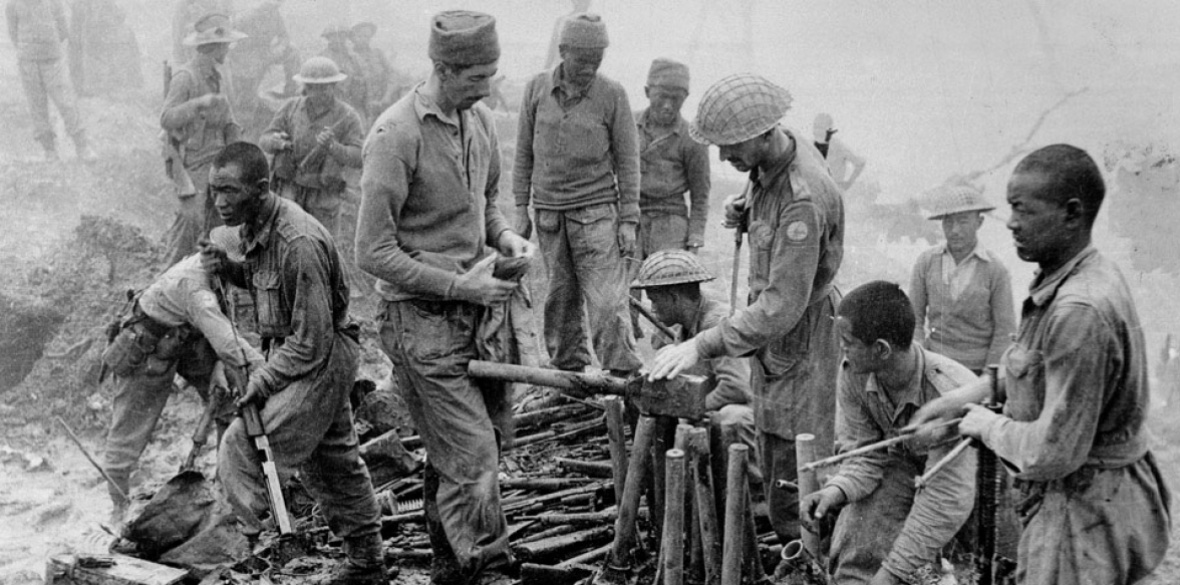
A photograph from the battle of Kohima, in north-east India, during World War II

We have long struggled for black and Asian Allied soldiers to be properly acknowledged in Europe’s commemorations — but now a worse travesty is upon us, as Russia’s crucial role is purged from the record, writes ROGER McKENZIE

President Putin took part in the commemoration of the 60th D-Day anniversary in 2004 and again, 10 years later, for the 70th anniversary — but he was not invited to this one.

The USSR, of which Russia was a key part, lost around 25 million people in the fight against Nazi Germany. But even this until recently undisputed fact is now under challenge.

In fact, the Red Army caused 80 per cent of all WWII German military losses and themselves lost 30 times more people than Britain, France and the US combined.

The Red Army’s defeat of the Nazis at Stalingrad is cited by many experts as being the decisive turning point in World War II. Between 150,000 and 250,000 Germans are estimated to have died at Stalingrad.

For Nazis, Stalingrad was not the battle that exacted the highest death toll, but the psychological impact of the battle was immense and was decisive in winning the war. It occupied and depleted massive Nazi resources which paved the way for the eventual Allied victory.

Over half a million Soviet soldiers and civilians died in the Battle of Stalingrad, among them numerous civilians. But that clearly was not enough to be invited.

Ukraine’s President Volodymyr Zelensky, on the other hand, was in attendance — as he always seems to be at pretty much anything. I now expect to see Zelensky at any event where a photo opportunity exists but the fact that he is invited to a commemoration of an event about the defeat of the Nazis is particularly insulting given the number of Nazis in his own forces and his applause in Canada last year for a veteran of a Waffen SS brigade that fought in Ukraine.

But the Russians are not the only ones that have been deliberately written out of history. The role of black people of African or Asian descent has continually been discarded.


More than 134,000 travelled from other colonies, including some 10,000 from the Caribbean to help defeat the Nazis. Only when casualties began to mount during the war were black people enlisted to join the fighting or become part of the Merchant Navy.

But there was no suspension in the standing orders of racism. Caribbean men joining the Merchant Navy were paid around one-third of the wages that white sailors were paid.

Around two and a half million fighters came from India to support the war effort. About the same time as the D-Day landing Indian, Gurkha and African soldiers fought the historic but little talked about — at least in Britain or the US — battles in Kohima, in north-east India.

These battles fought alongside British soldiers were among some of the toughest in the war and helped to turn the tide against the Japanese. Not for nothing did many of the troops who fought in battles in India and what is now Myanmar during the war call themselves “the Forgotten Army.”

I think they are probably wrong. I don’t think they were forgotten. I believe they were ignored because much of the fighting was carried out by black people. The Battle of Kohima and Imphal was the bloodiest of World War II in India, and it cost Japan many of its most elite fighters.

None of this seems to matter though to those that continue to hide the contribution made by people of African and Asian origin to the victory over the Nazis. We know the erasure of the role of the Red Army in World War II is being carried out for a different purpose.

The leaders of the Western powers can’t bring themselves to acknowledge the massive sacrifice of the Soviet people lest it demonstrate the skill and bravery of its soldiers and the refusal to be defeated by the seemingly invincible Nazis.

It is also part of the inexorable lurch towards a conflict with Russia as Nato ramps up the warmongering rhetoric that could lead to World War III and the catastrophic nuclear destruction of the planet.

Western powers seem far more willing to associate themselves with the Nazis surrounding the leadership of Ukraine and to hobnob with the likes of fascist-inspired Italian leader Giorgia Meloni.

I wonder how fast they will move for a photo opportunity should the far-right Marine Le Pen win the National Assembly election later this month or the next French presidential vote.

They say that history is written by the winners. Well, it seems not all the winners count. This means we must all call out the continued drive to rewrite history.

Original article at https://morningstaronline.co.uk/article/victory-over-nazis-was-black-and-red

Continue ReadingThe black, and Red, contribution to Nazi defeat must never be forgotten