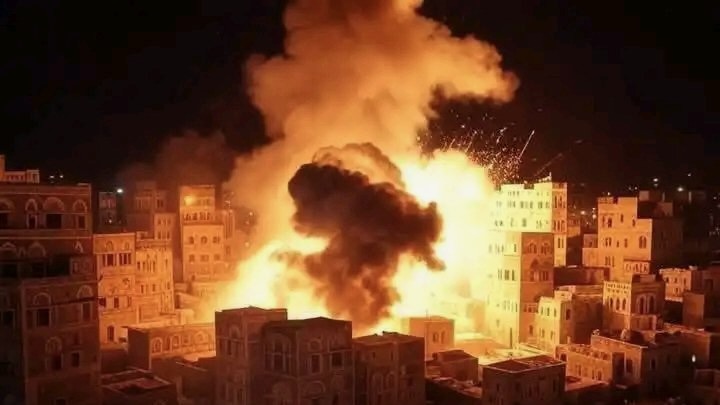
Israel’s Strike on Yemen Newspaper Offices Was ‘Deadliest Global Attack’ on Journalists in 16 Years: Press Freedom Group

Spread the love

Original article by Stephen Prager republished from Common Dreams under Creative Commons (CC BY-NC-ND 3.0). 
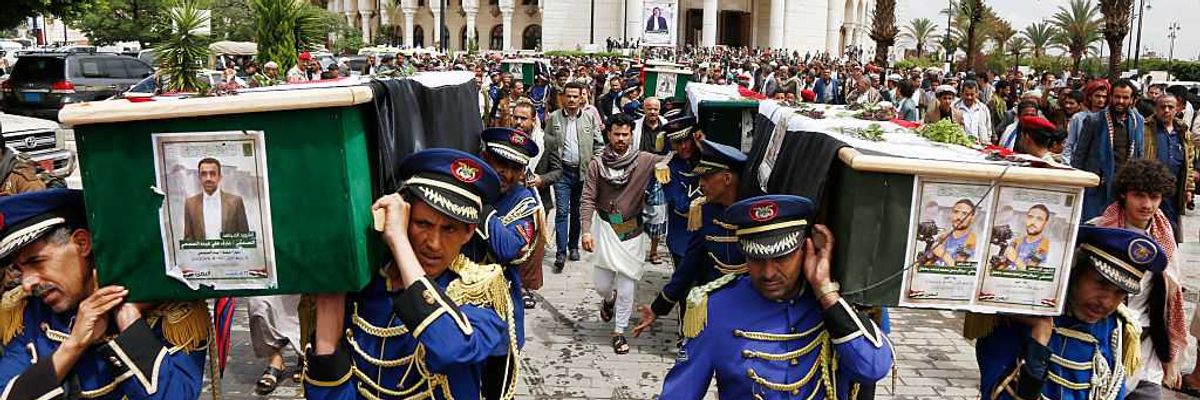
Honor guards carry coffins during a funeral procession of 31 Yemeni journalists killed in Israeli airstrikes on September 16, 2025, in Sana’a, Yemen.
 (Photo by Mohammed Hamoud/Getty Images)

The Committee to Protect Journalists said Israel’s attack on a media complex in Sana’a last week killed 31 journalists.

Israel’s airstrikes on a media complex in Yemen last week resulted in the largest single attack on journalists the world has seen in 16 years, according to the Committee to Protect Journalists.

In a report released Friday, the group said that 31 journalists from two government-run newspapers based in Sana’a were killed in the strikes on September 10, along with four others, including one child.

Nasser Al-Khadri, editor-in-chief of the newspaper 26 September, called the attack on his newsroom an “unprecedented massacre of journalists.”

“It is a brutal and unjustified attack that targeted innocent people whose only crime was working in the media field, armed with nothing but their pens and words,” Al-Khadri told the CPJ.

According to CPJ, it was the second-largest attack on the press they’ve ever recorded, and the worst since 2009, when 32 journalists were massacred as part of a political ambush in the Philippines.

The Israeli government has often defended its attacks on civilian infrastructure by claiming that it houses militants. But in these strikes, the IDF’s media desk acknowledged that it was targeting what it referred to as the “Public Relations Department” for the Houthis, also known as Ansar-Allah.

Shortly after Israel’s genocidal war in Gaza began in 2023, the militant group, which controls large parts of Yemen, began to launch drone and missile strikes against shipping vessels in the Red Sea and directly against Israel in what they have described as an effort to support Palestinians under fire. They have said they will stop these attacks when Israel reaches an agreement with Hamas to end the war in Gaza.

Israel has repeatedly bombed Yemen in recent weeks, including launching a strike on its main airport and large amounts of civilian infrastructure. On the same day it bombed the media complex, it also hit residential areas in Sana’a as well as a medical facility.

In a post on X, the official account for the Israel Defense Forces justified striking the newspapers by saying that they are “responsible for distributing and disseminating propaganda messages in the media, including speeches by Houthi leader Abdul-Malik and statements from spokesman Yahya Saree.” For this reason, Israel described the journalists as “military targets.”

But the CPJ says that “as civilians, journalists are protected under international law, including those working for state-run or armed group-affiliated outlets, unless they take direct part in hostilities.”

Niku Jafarnia, a Bahrain and Yemen researcher for Human Rights Watch, explained in more detail on Monday:

Radio and television facilities are civilian objects and cannot be targeted. They are legitimate targets only if they are used in a way that makes an “effective contribution to military action.” However, civilian broadcasting facilities are not rendered legitimate military targets simply because they are pro-Houthi or anti-Israel, or report on the laws of war violations by one side or the other, as this does not directly contribute to military operations.

Al-Khadri said that Israel’s strikes hit his newsroom around 4:45 pm, right when staff were finishing up the publication of the weekly paper.

Mohammed al-Basha, a Yemen analyst, noted that “Since it is a weekly publication, not a daily one, staff were gathered at the publishing house to prepare for distribution, significantly increasing the number of people present in the compound.”

The CPJ classified the 31 journalists killed in the strike as having been “murdered” by Israel, meaning that they were deliberately targeted specifically for their work. Over the past decade, the group says, 1 in 6 of the world’s murdered journalists have been killed by Israel.

While estimates from different groups vary, Israel’s war in Gaza is considered by far the deadliest conflict in the world for journalists, with more killed than any other conflict in the world combined. In August, the CPJ reported that 192 journalists, nearly all Palestinians, have been killed since October 7, 2023, while other groups put the death toll even higher.

In attacks last month that drew similar worldwide condemnation, Israel conducted what was described as a “double tap” strike on Khan Younis’ Nasser Hospital aimed at killing first responders who arrived after the first strike. Twenty people were killed in total, including rescue workers and at least five journalists.

Not long before, Israel carried out the targeted assassination of Al Jazeera correspondent Anas al-Sharif and five other journalists, claiming without evidence that they were part of “a Hamas terrorist cell.”

“Since October 7, 2023, Israel has emerged as a regional killer of journalists, with repeated incidents in Gaza, Lebanon, Iran, and now Yemen confirming Israel’s longstanding pattern of labeling journalists as terrorists or propagandists to justify their killings,” said CPJ regional program leaderSara Qudah.

“Israel’s September 10 strikes on two newspaper offices in Yemen marks an alarming escalation, extending Israel’s war on journalism far beyond the genocide in Gaza,” Qudah said. “This latest killing spree is not only a grave violation of international law, but also a terrifying warning to journalists across the region: no place is safe.”

Original article by Stephen Prager republished from Common Dreams under Creative Commons (CC BY-NC-ND 3.0). 

Continue ReadingIsrael’s Strike on Yemen Newspaper Offices Was ‘Deadliest Global Attack’ on Journalists in 16 Years: Press Freedom Group

US and UK escalate aggression on Yemen as Signal scandal unfolds

Spread the love

Original article by Aseel Saleh republished from peoples dispatch under a Creative Commons Attribution-ShareAlike 4.0 (CC BY-SA) license.

US aircraft launched 41 airstrikes early Friday morning across Yemen. Photo: Al Manar news

The last couple of weeks saw an unprecedent escalation by the Western coalition against Yemen, after Ansar Allah resumed Red Sea operations in retaliation for Israel’s renewed genocide and aid ban in Gaza.

For nearly two weeks, the US has conducted daily airstrikes on Yemen. The UK also took part in the heavy, non-stop aggression in different areas across Yemen. 

In the early hours of Friday, March 28, US fighter jets hit more than 40 locations in the Arab country including the capital Sana’a, Saada, Marib, Al-Jawf, and Hodeidah governorates. The airstrikes reportedly left several people across the country injured. 

On Thursday, March 27, at least two people were killed and two others wounded in a series of US airstrikes that targeted the Yemeni capital Sana’a.

The aggression was launched one day after the US launched 15 airstrikes on the southern and northeastern regions of Sanaa, in addition to the vicinity of Sanaa International Airport. The US and the UK targeted the Saada governorate in northwestern Yemen with dozens of airstrikes on the same day as well.

The western coalition had already intensified its airstrikes against Yemen for several days before Wednesday, March 26. Dozens of people, including women and children, were reported killed in the fierce aerial campaign. 

US national security exposed after Signal chat on Yemen’s aggression plan leaked 

A huge scandal has rocked the Trump administration after internal national security deliberations related to the US plans to strike Yemen were mistakenly leaked through the Signal messaging application, on Monday, March 24. 

Contents of the Signal chat were published in The Atlantic after its Editor-in-Chief Jeffrey Goldberg was seemingly inadvertently added to the chat by US National Security Advisor Mike Waltz.

Goldberg disclosed the content of the chat, which was considered a huge breach of data security via a story published by The Atlantic. The journalist revealed that he knew that the US was planning to bomb different targets belonging to Ansar Allah across Yemen on March 15, two hours before the first airstrike was launched.  

Goldberg elaborated that he became aware of the plan once the US Secretary of Defense Pete Hesgeth texted him the information at 11:44 am. Goldberg said that “the plan included precise information about weapons packages, targets, and timing.”

The breach has provoked criticism and raised questions about the accountability in Trump’s cabinet as it has not only revealed sensitive details related to military-operations, but also what was perceived as institutional dishonesty inside the Trump administration. 

Downplaying the seriousness of the leak, Trump called the incident a “witch hunt” while speaking to reporters at the Oval Office. The US President instead focused on the success of the US airstrikes in Yemen. The White House also said that the leaked information shared via the commercial messaging application was not classified.

The Democrats slammed the Trump administration calling on the officials involved to resign. Meanwhile, the Republican and Democratic leaders of the Senate Armed Services Committee issued a bipartisan call for an expedited investigation into the breach.

Progressive movements and commentators have noted that amid the scandal, the attacks on Yemen themselves and their legality seem to be an afterthought for the Democrats who have instead focused their criticisms on the security violations of the officials’ communication.

Der Spiegel exposes new data security breach of Trump’s top officials 

While the Trump administration is trying to dismiss the embarrassing scandal, German news website Der Spiegel reported on Thursday, March 27 that it found the contact data of Trump’s most important security advisers via hacked data dumps and commercial providers. 

The leaked data included password details for Mike Waltz, Pete Hegseth, and Director of National Intelligence Tulsi Gabbard, in addition to mobile phone numbers and email addresses. 

The website pointed out that these phone numbers and email addresses are apparently still in use, some of which are linked to accounts on social media networks like Instagram and LinkedIn.

Original article by Aseel Saleh republished from peoples dispatch under a Creative Commons Attribution-ShareAlike 4.0 (CC BY-SA) license.

Continue ReadingUS and UK escalate aggression on Yemen as Signal scandal unfolds

Israel, US, UK launch 1st joint attack on Houthi targets in Yemen

Spread the love

https://www.middleeastmonitor.com/20250110-israel-us-uk-launch-1st-joint-attack-on-houthi-targets-in-yemen

A view of damage to several buildings at Sana’a International Airport following an airstrike carried out by the Israeli army last night in the Houthi-controlled capital of Yemen on December 27, 2024. [Mohammed Hamoud – Anadolu Agency]

Israel, the US and Britain, on Friday, carried out their first coordinated attack on Houthi targets in Yemen, the Israeli Public Broadcasting Corporation reported.

Houthi-affiliated Al-Masirah TV also reported that a series of air strikes targeted the vicinity of the Al-Sabeen Square in the Yemeni capital, Sana’a, Anadolu Agency reports.

The attack coincided with a rally in support of Palestine amid Israel’s 16-month-old continuing genocidal war on Gaza.

Additionally, the Houthis reported six air strikes on the port city of Al-Hudaydah in western Yemen.

The report did not provide additional details on the impact of the strikes.

The escalation came after the Houthis said, on Monday, that they had attacked the US aircraft carrier, “USS Harry Truman” in the northern Red Sea and claimed missile and drone attacks on targets in southern and central Israel.

The Houthis have targeted Israeli cargo ships or ones linked with Tel Aviv in the Red Sea with missiles and drones in a show of support with the Gaza Strip, where over 46,000 people have been killed in Israel’s genocidal war since October 2023.

Since early 2024, a coalition led by the US has been carrying out air strikes that it said target Houthi locations in Yemen in response to the group’s Red Sea attacks, with occasional retaliation from the Houthis.

READ: Houthi leader says British espionage network arrested in Yemen

This work by Middle East Monitor is licensed under a Creative Commons Attribution-NonCommercial-ShareAlike 4.0 International License.

Continue ReadingIsrael, US, UK launch 1st joint attack on Houthi targets in Yemen

Israeli bombers pound Yemen and Gaza as Human Rights Watch accuses Tel Aviv of genocide

Spread the love

https://morningstaronline.co.uk/article/israeli-bombers-pound-yemen-and-gaza-human-rights-watch-accuses-tel-aviv-genocide

Firefighters work at the scene of an Israeli airstrike on the Haziz power station in southern Sanaa, Yemen, December 19, 2024

ISRAELI bombers pounded Yemen’s capital Sana’a and its port Hodeida today, killing at least nine as they sought to break the Houthi forces, which have launched attacks in solidarity with Palestine.

The bombing raids followed a Houthi missile strike against Israel. The military said it targeted infrastructure in Hodeida, another port Salif, and the Ras Isa oil terminal, then took out energy infrastructure in Sana’a.

Targeting civilian energy infrastructure is a war crime.

“After Hamas, Hezbollah and the Assad regime in Syria, the Houthis are almost the last remaining arm of Iran’s axis of evil,” Israeli Prime Minister Benjamin Netanyahu declared.

“Whoever raises a hand against the state of Israel, his hand will be cut off,” Israeli Defence Minister Israel Katz added. “Whoever harms us will be harmed sevenfold.”

https://morningstaronline.co.uk/article/israeli-bombers-pound-yemen-and-gaza-human-rights-watch-accuses-tel-aviv-genocide

Continue ReadingIsraeli bombers pound Yemen and Gaza as Human Rights Watch accuses Tel Aviv of genocide