Is Carbon Capture Just Climate Delusion?

Spread the love

Original article by BASAV SEN | JIM WALSH republished from Common Dreams under Creative Commons (CC BY-NC-ND 3.0).

Officials pose with shovels for a photo opportunity for the groundbreaking ceremony for Oxys Direct Air Capture facility called Stratos in West Texas on Friday, April 28, 2023.  (Photo: Elizabeth Conley/Houston Chronicle via Getty Images)

Direct air capture and similar technologies come with glossy brochures and lofty promises but we must not be fooled. They are a distraction and a scam orchestrated by the fossil fuel industry.

A newly opened facility in Iceland that will remove carbon dioxide from the atmosphere has been heralded as a hopeful turning point in the urgent fight to stop climate catastrophe. In reality, it is further evidence of a new type of techno-optimism that is not quite old-fashioned climate denial, but something you might call climate delusion.

On its face, the technology known as direct air capture (DAC) seems like a plausible, painless solution to the climate crisis: Giant machines pull greenhouse gasses out of the air, and they are either injected underground or integrated into consumer products.

For years, we have been hearing that a massive breakthrough is just around the corner. The clamor grew much louder when the Climeworks facility in Iceland came online. It is the world’s largest DAC facility—and yet is designed to capture just 36,000 tons of CO2 annually—which is, for the sake of comparison, just one percent of the pollution generated by a single coal power plant. There are much larger DAC plans in the works: Occidental Petroleum is part of a group building a facility in Texas that they claim will capture 500,000 tons of CO2 per year.

Handing out free money to polluters is not only broadly unpopular, it is also terrible public policy. Congress must stop the public funding and support for these climate scams.

And while that theoretical capability sounds impressive, it is still less than 0.01 percent of annual U.S. carbon emissions. And these projections become even less impressive when we consider the track record of carbon removal so far. Another recent Occidental project, the Century carbon capture facility, failed to capture more than a third of its capacity before they liquidated this asset.

There is another more fundamental problem with most of these carbon removal technologies: When the captured carbon is used to squeeze out oil from existing wells (a process known as enhanced oil recovery), is it of any climate benefit at all? There is no doubt that Occidental sees direct air capture as a tool to help it continue extracting fossil fuels; when they are touting ‘net zero oil,’ one cannot escape the conclusion that the goal is to greenwash oil extraction as a climate solution.

Breaking ground on the world’s largest DAC facility

www.youtube.com

To hear proponents of DAC explain it, science tells us this technology is a necessity at this stage in the race to stop climate catastrophe. This is misleading; there is a wide range of modeled pathways for slowing down the rate of global temperature increase, and they do not all rely on carbon removal that have not been shown to work.

Even if DAC was shown to be effective, its costs are astronomical. The Intergovernmental Panel on Climate Change (IPCC) estimates that the cost range of early-stage DAC plants is $600-$1,000/ton of carbon dioxide; and operating DAC at a meaningful scale would consume an estimated one-sixth of the world’s energy output.

By promoting the adoption of technologies they insist will eventually work as advertised, fossil fuel giants can delay the transition away from fossil fuels.

Instead of viewing techno fixes like DAC as a necessity, many in the scientific community warn that reliance on DAC is a risky move that could “obstruct near-term emissions reduction efforts.” This is exactly what makes DAC and carbon capture so appealing to major polluters: By promoting the adoption of technologies they insist will eventually work as advertised, fossil fuel giants can delay the transition away from fossil fuels.

Unfortunately, U.S. taxpayers are funding these false climate solutions; billions of dollars in subsidies are available through the Infrastructure Investment and Jobs Act, and similarly lucrative corporate tax credits are a major part of the Inflation Reduction Act. There is ample evidence that this is a poor investment. A 2020 Treasury Department Inspector General investigation found that nearly 90 percent of tax credits claimed for carbon capture operations were done so with no accompanying verification that any carbon was actually being captured.

Instead of taking corrective action, Congress massively expanded these tax credits, making this scam even more lucrative than before. To make matters worse, the IRS will not release information about which companies are benefiting from this billion dollar taxpayer-funded boondoggle.Handing out free money to polluters is not only broadly unpopular, it is also terrible public policy. Congress must stop the public funding and support for these climate scams. Continuing to encourage the expansion of direct air capture will waste precious money and time and perpetuate further harms on communities most affected by fossil fuel pollution.

Original article by BASAV SEN | JIM WALSH republished from Common Dreams under Creative Commons (CC BY-NC-ND 3.0).

UN Chief Calls for Global Ban on Fossil Fuel Advertising

‘Dystopian’: UAE Used Global Climate Summit to Push $100 Billion in New Oil Deals

Climate Groups Call for Rich to Pay More as International Meetings Begin

Continue ReadingIs Carbon Capture Just Climate Delusion?

Carbon Offsets 101: Why We Can’t Offset Our Way Out of the Climate Crisis

Spread the love
The buildings and steaming cooling towers of a coal-fired power plant behind a landscape park in Germany. Frank Bienewald / LightRocket via Getty Images

https://www.ecowatch.com/carbon-offsets-climate-crisis.html

… Carbon offsets are in theory a way to cancel out greenhouse gas emissions by funding an activity that will remove a supposedly equal amount of carbon dioxide from the atmosphere or prevent an equal amount of carbon pollution. They can be purchased by everyone from major companies pursuing net-zero emissions goals to individuals looking to compensate for high-carbon activities like flying. Typically, an institution or individual will purchase a certain amount of carbon credits, with one credit usually standing in for one metric ton of carbon dioxide — or what is typically emitted by driving 2,513 miles in a gas car — removed from the atmosphere. (That’s roughly the distance between San Francisco and Atlanta). Whoever buys the carbon credit is essentially buying the right to count the emissions reduction as theirs even if it’s being performed by a tree-planting or renewable energy project on the other side of the globe.

Quick Facts

  • One carbon credit usually equals one metric ton of carbon dioxide supposedly removed from the atmosphere, or the equivalent of driving 2,513 miles in a gas-powered car.
  • The voluntary carbon market quadrupled in value between 2020 and 2021 to reach nearly $2 billion. 
  • The average tree absorbs 20 pounds of carbon dioxide each year during the first 20 years of its life.
  • Only four percent of carbon offset projects actively remove carbon dioxide from the atmosphere, as opposed to preventing additional emissions. 
  • More than 170 climate, environmental and Indigenous rights groups signed an open letter opposing carbon offsets. 
  • At least 52 percent of carbon-offset generating wind projects in India would have been built anyway.
  • California’s forest carbon offsets program likely overestimated its emissions reductions by at least 80 percent. 
  • A Ryanair program to offer passengers €1 carbon offsets only actually offset the company’s emissions by 0.01 percent. 
  • Sixty-six percent of highly-polluting companies studied relied on carbon offsets to meet their net zero targets.
  • There are only around 500 million hectares of land available for tree-planting carbon offset projects and Shell wants to claim 10 percent of it.

They’re a Scam: One of the main criticisms of carbon offsets is that many projects don’t really do what they say they are going to do, namely, prevent additional emissions. A major ProPublica report published in 2019 reviewed 20 years of forest-preservation-based offset projects and found that “In case after case […] carbon credits hadn’t offset the amount of pollution they were supposed to, or they had brought gains that were quickly reversed or that couldn’t be accurately measured to begin with.” A 2021 study of wind farms in India found that at least 52 percent of the projects used to back offsets would have been constructed regardless and that therefore the selling of the offsets to polluting industries actually increased emissions. Two studies of California’s forest carbon offsets program found that it overestimated its emissions reductions by at least 80 percent. The dubious nature of many carbon-offset projects leads to charges of greenwashing, because fossil fuel or airline companies can use their purchasing of offsets to market themselves as being more sustainable than they really are. For example, a Ryanair program to charge its customers €1 to offset their flight only lowered the company’s emissions by 0.01 percent.

They’re a Distraction From Reducing Emissions: Even if every carbon offset project worked exactly as advertised, however, it wouldn’t be an effective tool for fighting climate change. That’s because the climate crisis is caused by pumping greenhouse gas emissions into the atmosphere and will only be halted if emissions actually stop as well. Yet a 2021 study looking at net-zero pledges from the sectors responsible for 64 percent of greenhouse gas emissions found that 66 percent of them relied on carbon offsets. Oil, gas and mining companies were especially dependent on offsets for their net zero plans. 

What everyone in the climate space can agree on is that the emphasis needs to move away from purchasing offsets and towards actually reducing fossil fuel emissions. At their best, offsets could be a stop-gap measure to fund beneficial projects and counteract emissions that there is not yet a technologically feasible way to reduce directly. At their worst, carbon offsets risk giving polluters an easy way to greenwash their image while continuing business as usual, actually increasing emissions through miscounting and reproducing the injustices underlying the climate crisis. Given that the current system tips more towards the latter than the former, it’s important for governments, companies and individuals to focus on not putting greenhouse gas emissions in the atmosphere in the first place. 

Read the original article https://www.ecowatch.com/carbon-offsets-climate-crisis.html

Continue ReadingCarbon Offsets 101: Why We Can’t Offset Our Way Out of the Climate Crisis

Study Finds Carbon Offset Schemes ‘Significantly Overestimating’ Deforestation Claims

Spread the love

Original article by BRETT WILKINS republished from Common Dreams under Creative Commons (CC BY-NC-ND 3.0). 

“These carbon credits are essentially predicting whether someone will chop down a tree, and selling that prediction,” said one study author. “If you exaggerate or get it wrong, intentionally or not, you are selling hot air.”

Most carbon offset schemes significantly overestimate their impact on reducing deforestation, with many of the carbon credits purchased by polluting corporations amounting to little more than “hot air,” according to a researcher behind a study released Thursday that could portend billions of dollars in losses for speculators.

“Reducing emissions from deforestation and forest degradation (REDD) projects are intended to decrease carbon emissions from forests to offset other carbon emissions and are often claimed as credits to be used in calculating carbon emission budgets,” explains the study, which was published in the journal Science.

However, according to the study:

We examined the effects of 26 such project sites in six countries on three continents using synthetic control methods for causal inference. We found that most projects have not significantly reduced deforestation. For projects that did, reductions were substantially lower than claimed…

Methodologies used to construct deforestation baselines for carbon offset interventions need urgent revisions to correctly attribute reduced deforestation to the projects, thus maintaining both incentives for forest conservation and the integrity of global carbon accounting.

“Carbon credits provide major polluters with some semblance of climate credentials. Yet we can see that claims of saving vast swathes of forest from the chainsaw to balance emissions are overblown,” study co-author Andreas Kontoleon, from the University of Cambridge’s Department of Land Economy, said in a statement.

“These carbon credits are essentially predicting whether someone will chop down a tree, and selling that prediction,” he added. “If you exaggerate or get it wrong, intentionally or not, you are selling hot air.”

Kontoleon added that overestimations of forest preservation have driven an increase in the number of carbon credits on the market, resulting in artificial price suppression.

“Potential buyers benefit from consistently low prices created by the flood of credits,” he said. “It means that companies can tick their net-zero box at the lowest possible cost.”

This could mean that carbon speculators stand to lose billions of dollars in the future as offsets become stranded assets.

“It’s currently a buyer’s market and buyers are, rightly, prioritizing quality. There are over a billion tons of issued but not retired credits in the market—this suggests lots of credits can be written off, and there will remain a large supply for buyers to tap into,” Anton Root, head of research at AlliedOffsets, toldThe Guardian Thursday.

“A correction like that could help to orient the market toward fundamental supply-demand dynamics, which we don’t currently tend to see, and drive up the price for credits that are deemed to be above the quality threshold,” he added.

The new research follows other scientific research and journalistic investigations, including a January study by The GuardianDie Zeit, and SourceMaterial that concluded that over 90% of the rainforest carbon offsets sold by Verra, the nonprofit organization that sets the world’s leading sustainability standard, “are largely worthless and could make global heating worse.”

While some scientists argue that CO2 extraction, either via natural or technological means, is needed in order to meet the goals of the Paris climate agreement, opponents call the technology a “false climate solution.”

Green groups including Extinction Rebellion and Food & Water Watch have for years warned against carbon capture and storage, which critics call a “scam” and “greenwashing.”

“Carbon offset markets are widely discredited,” Food & Water Watch policy director Jim Walsh said earlier this year. “Their only benefit lies in enriching the middlemen charged with selling the lie.”

Despite this, the Biden administration is pushing ahead with a plan to invest $2.5 billion in a pair of major carbon capture and storage projects, which it claims will “significantly reduce carbon dioxide emissions from electricity generation and hard-to-abate industrial operations” as part of the “effort critical to addressing the climate crisis and meeting the president’s goal of a net-zero emissions economy by 2050.”

Original article by BRETT WILKINS republished from Common Dreams under Creative Commons (CC BY-NC-ND 3.0). 

Continue ReadingStudy Finds Carbon Offset Schemes ‘Significantly Overestimating’ Deforestation Claims

‘Climate Scam’: 180+ Groups Tell Biden to Drop Support for Hydrogen

Spread the love

Original article by JAKE JOHNSON republished from Common Dreams under Creative Commons (CC BY-NC-ND 3.0).

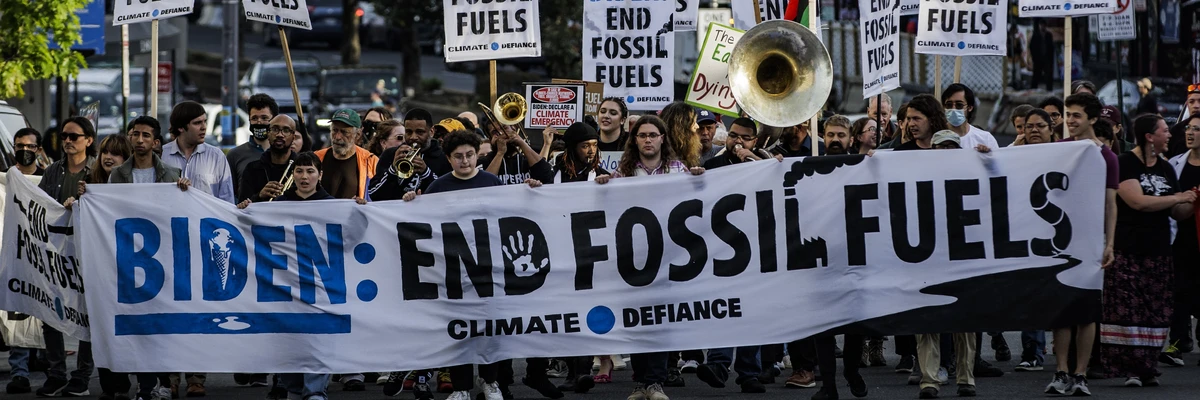
Climate protestors march in Washington DC

“Calling hydrogen clean energy is a scam to prop up the oil and gas industry,” said one campaigner.

More than 95% of hydrogen produced in the United States is made using fossil fuels, but that hasn’t stopped its backers—including industry groups such as the U.S. Chamber of Commerce—from touting the energy source as critical to the fight against climate change.

A diverse coalition of advocacy organizations on Tuesday implored the Biden administration to stop buying into the hype.

In a letter to officials at the U.S. Department of Energy (DOE), more than 180 groups called on the administration to abandon plans to invest in hydrogen projects, warning that “a large-scale buildout of hydrogen infrastructure will further exacerbate the climate crisis and disproportionately harm people of color, low-income communities, and Indigenous peoples.”

Two recently enacted pieces of legislation—the Inflation Reduction Act and a bipartisan infrastructure measure championed by oil industry ally Sen. Joe Manchin (D-W.Va.)—include benefits for the hydrogen industry.

The latter bill authorized the Department of Energy to spend roughly $8 billion on developing Regional Clean Hydrogen Hubs (H2Hubs), drawing outrage from community organizers in Colorado, New Mexico, and other states behind the Western Interstate Hydrogen Hub, a project aimed at expanding U.S. hydrogen production.

“We recognize that the Bipartisan Infrastructure Investment and Jobs Act directs DOE to fund these hubs, but we ask DOE to find a different path and reject this false solution. It’s time for DOE to do the right thing,” the groups wrote in their letter on Tuesday.

The groups behind the letter—including the Center for Biological Diversity and Food & Water Watch—note that hydrogen production generates significant planet-warming emissions.

“Hydrogen lifecycle emissions which use carbon capture and storage are 20% greater than directly burning natural gas or coal, and 60% greater than burning diesel oil, because of the increased fossil fuels required to power it,” the letter states. “The process of producing gray and blue hydrogen is a major source of fugitive methane emissions from flaring, transportation, and other upstream processes—releasing even more potent greenhouse gases and exacerbating atmospheric warming over the next two decades.”

“President Biden can’t claim to be a climate leader while his administration continues to embrace the hydrogen climate scam and other policies that continue to perpetuate fossil fuel production and infrastructure.”

As Nature explained in an editorial warning against “overhyping” hydrogen, “Most hydrogen is currently made by processes—such as steam reformation of natural gas (methane)—that produce large amounts of CO2 as a by-product.”

“Although ‘green’ hydrogen can be made by using electricity from renewable sources to split water molecules,” the outlet added, “this process is costly compared with more conventional production methods.”

Silas Grant, a campaigner with the Center for Biological Diversity, said Tuesday that “calling hydrogen clean energy is a scam to prop up the oil and gas industry.”

“The Biden administration’s plans to expand this dirty energy will only increase oil and gas extraction at a time when the climate emergency demands the opposite,” said Grant. “We need investment in affordable, reliable, community-supported renewable energy like wind and solar.”

The coalition’s letter comes two months after New Mexico-based advocacy organizations urged the Biden administration to reject funding for the Western Interstate Hydrogen Hub, arguing the initiative would “devastate public health, clean air, Indigenous sacred places, and the climate.”

“The climate crisis poses a grave threat to all life on Earth,” the groups wrote in a letter to the U.S. Energy Department. “DOE has the power to help lead a transformation to a more sustainable future. To do so, you must help phase out fossil fuels and reject false solutions like hydrogen.”

But the Biden White House has yet to waver in its support for hydrogen, claiming in a brief last month that “clean hydrogen has the potential to play an important role in decarbonizing the U.S. economy.”

Jim Walsh, policy director at Food & Water Watch, countered Tuesday that investments in hydrogen are “a distraction from real climate action that will cause more pollution, more strain on water resources, and more extraction of climate warming fossil fuels.”

“President Biden can’t claim to be a climate leader while his administration continues to embrace the hydrogen climate scam and other policies that continue to perpetuate fossil fuel production and infrastructure,” Walsh added.

Original article by JAKE JOHNSON republished from Common Dreams under Creative Commons (CC BY-NC-ND 3.0).

Continue Reading‘Climate Scam’: 180+ Groups Tell Biden to Drop Support for Hydrogen