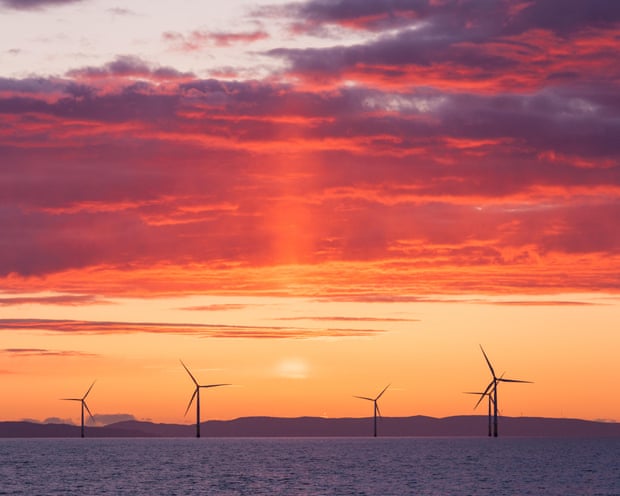
A windfarm off the Cumbrian coast. The crown estate commands hefty option fees from developers to secure areas of the seabed to build windfarms. Photograph: Rob Arnold/Alamy
Environmental group accuses king’s property management company of ‘milking for profit’ its monopoly ownership of seabed
Greenpeace is threatening to sue King Charles’s property management company, accusing it of exploiting its monopoly ownership of the seabed.
The environmental lobby group alleges the crown estate has driven up costs for wind power developers and boosted its own profits, as well as the royal household’s income, due to the “aggressive” way it auctions seabed rights.
The crown estate, as the legal owner of the seabed around England, Wales and Northern Ireland, is responsible for auctioning offshore wind rights. It has benefited from the huge growth in the industry, commanding hefty option fees from renewable energy developers to secure areas of the seabed to build their windfarms.
Will McCallum, co-executive director at Greenpeace UK, said the estate should be “managing the seabed in the interest of the nation and the common good, not as an asset to be milked for profit and outrageous bonuses”.
“We should leave no stone unturned in looking for solutions to lower energy bills that are causing misery to millions of households,” he said.
“The science we need for the ocean we want” – this is the tagline for the UN Ocean Decade (2021-2030), which has just held its first conference in Barcelona, Spain. Marine scientists from around the world, including me, gathered alongside global leaders to chart the progress of this ten-year mission to improve ocean health and marine biodiversity. That includes finding ways to better protect the seabed which we still know relatively little about.
Some areas of sediment on the sea floor hold large stores of carbon. Without greater protection, disturbance from bottom-trawling fishing practices for example, could release some of that stored carbon back into the atmosphere.
I joined discussions in Barcelona that have led to the launch of a new sustainable ocean planning initiative, to be coordinated by Julian Barbière, global coordinator of the Ocean Decade. This aims to encourage commitment to sustainable management of 100% of sea area under a nation’s jurisdiction.
With this in place, there’s scope to reimagine the role of the ocean in our wider climate system and recognise that all marine natural systems sequester and store carbon in their soils and sediments.
I’m here on behalf of the global ocean decade programme for blue carbon – that’s any carbon that is stored in the ocean. This project is one of the UN’s 50 programmes aimed at delivering transformative ocean science solutions for sustainable development, connecting people and our ocean. That’s a big ask.
My work focuses on the extraordinary ability of coastal ecosystems – such as mangroves, salt marshes and seagrass – to sequester or store organic carbon in unusually high densities. Our blue carbon team of international research scientists from more than 20 countries is beginning to define emerging blue carbon ecosystems such as kelp forest and sub-tidal sediments as solutions to manage the climate and biodiversity crises.
The 360 million sq kilometres of ocean and sea floor, from coastal seagrass meadows to the sediment that slowly accumulates within the deepest trenches, are massively overlooked as a precious carbon store. Oceans hold vast stores of carbon – the top metre of the ocean holds an estimated 2.3 trillion metric tonnes.
The seafloor is not a resource to be relentlessly exploited, but a vulnerable repository of global biodiversity and carbon that needs protecting. These highly productive, yet vulnerable, ecosystems have been greatly affected by habitat loss and destructive practices such as deforestation of mangroves for shrimp aquaculture in the relentless development of the world’s coastal zones.
Blue carbon has huge potential to provide ocean-based solutions to help mitigate climate change, and thankfully, at the global scale at least, these losses have slowed in recent years.
The potential for blue carbon to reduce greenhouse gas emissions is relatively modest, but healthy, restored ecosystems have the potential to store an extra 2.96 million tonnes of carbon annually. Certain countries, such as Indonesia, offer huge potential as blue carbon hotspots where the protection and restoration of nature are an opportunity, for both the environment and local communities.
Carbon credits, the means by which additional carbon can become a source of investment income in that community, are gaining much interest. Off the coast of Kenya, the community-based Miko Pamojo project enhances direct benefits to local people from mangrove restoration.
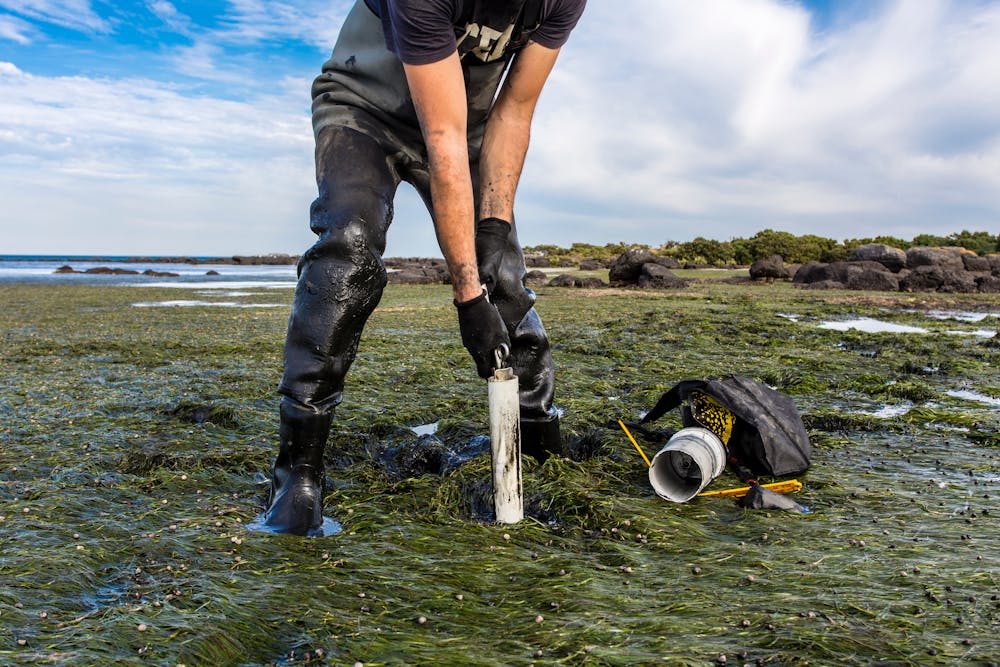
Collecting a sediment core to assess carbon sequestration rates in the sediment of a tidal seagrass bed. I. Noyan Yilmaz/Shutterstock
Blue carbon ecosystems can help countries meet their climate obligations and have been attracting considerable interest. However, if nations want these ecosystems to continue to provide a whole range of services our governments must protect them and, where possible, restore lost habitats.
Most governments have been stubbornly slow to prioritise ocean-based solutions high up on the agenda of global climate negotiations. At this conference, I’ve heard more people, including Unesco’s director general Audrey Azoulay, driving home the need to protect and effectively manage our ocean resources.
Members from the traditional owners of the Great Barrier Reef spoke of “country” from a perspective of a long and sustained human relationship with nature and are intimately connected to the ocean. There is a growing recognition and respect for this indigenous knowledge and our need to integrate that into a sustainable ocean future.
Reimagining the ocean’s role
It makes sense to start by protecting these natural systems that already hold vulnerable stores of carbon – this is sensible risk management.
As nations continue to exploit the marine environment for fishing, fossil fuels and even precious metals which are now being mined from the sea floor in certain places, it is time to rethink the value of these vast natural stores of ocean carbon.
Space science gets way more funding than our oceans, yet vast areas of the global deep ocean remain largely unmapped. “Life below water” is by far the least funded of the UN’s 17 Sustainable Development Goals. That needs to change through a sustained and increased investment in ocean science and greater recognition for the value of our blue economy – defined by the UN as the sustainable use of the ocean’s resources for economic growth, improved livelihoods and jobs.
Stepping back to pause and preserve what already exists in the ocean can help the planet, and us, build resilience and create a healthier and more sustainable marine environment. The seabed forms the foundation for an interconnected ocean ecosystem and acts as an important long-term global sink for carbon that involves the whole ocean and its exchanges with the atmosphere and wider Earth system.
While plans are finally moving in the right direction, there are huge challenges ahead. To paraphrase Cynthia Barzuna, director of ocean action 2030 at the World Resources Institute, “there is no wealthy ocean without a healthy ocean”. The biggest takeaway from the Barcelona conference is that a sustainable ocean future depends on a shared vision that works for all of us and marine life too.
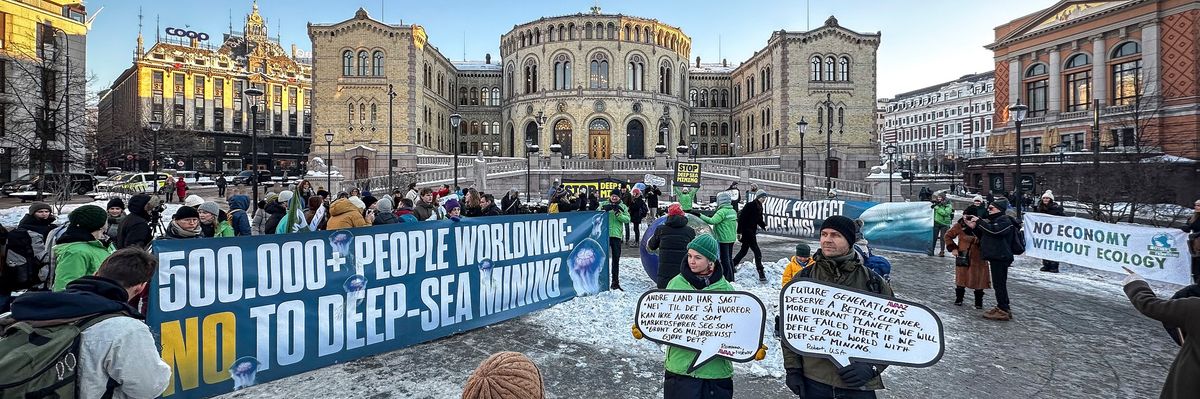
Activists gathered outside the Norwegian parliament in Oslo during a vote to approve deep-sea mining on January 9, 2024. (Photo: Will Rose/Greenpeace)
“This decision is an irrevocable black mark on Norway’s reputation as a responsible ocean state,” said one critic, warning of environmental impacts.
The Norwegian government came under fire from environmentalists and scientists worldwide on Tuesday after moving to become the first country to enable destructive commercial deep-sea mining.
Stortinget, Norway’s parliament, overwhelmingly voted in favor of allowing exploration of the seabed under the country’s Arctic waters for minerals—an outcome widely expected after center-left parties that control the government struck a deal with right-wing parties last month.
“This decision is an irrevocable black mark on Norway’s reputation as a responsible ocean state,” declared Steve Trent, CEO and founder of the U.K.-based Environmental Justice Foundation (EJF), in a statement Tuesday. “Deep-sea mining is a pursuit of minerals we don’t need, with environmental damage that we can’t afford.”
“We can upgrade our economies and get to zero carbon without wrecking the deep ocean in the process.”
“We know so little about the deep ocean, but we know enough to be sure that mining it will wipe out unique wildlife, disturb the world’s largest carbon store, and do nothing to speed the transition to clean economies,” he stressed. “Recent scientific studies in Norwegian waters demonstrate that there will be severe impacts on ocean wildlife if this mining goes ahead.”
Trent continued:
Instead of being the answer to boosting renewable energy, deep-sea mining would be just another form of harmful resource extraction, with steep and needless costs we cannot and should not pay. As the Norwegian government decides to push forward with deep-sea mining, EJF’s latest report reveals that we can upgrade our economies and get to zero carbon without wrecking the deep ocean in the process. New battery technologies are taking off, and there is a ready supply of minerals available now if we improve existing recycling rates. The argument for destroying the deep sea for cobalt and nickel does not withstand scrutiny and Norwegian lawmakers must recognize this.
Chloé Mikolajczak of Europe’s Fossil Free Politics campaign said on social media that “exploration, while different from exploitation, already comes with significant environmental damage. Today, Norway failed the world and failed to protect our future. But the fight can not stop and we’re mobilizing a community of thousands to #StopDeepSeaMining.”
Amanda Louise Helle, who was among the Greenpeace Norway activists protesting outside Stortinget on Tuesday, was similarly determined to continue the battle against deep-sea mining.
“Today our parliament is getting ready to vote in favor of a criminal fate for one of the last safe havens for Arctic marine life,” Helle said ahead of the vote. “Promising to protect the oceans one day and proposing deep-sea mining the next, is next-level hypocrisy. Not only does it risk vulnerable ecosystems in the Arctic, but also Norway’s international reputation.”
“If our politicians are ready to give the Arctic away to greedy companies, then we are more than ready to chase them wherever they plan to deploy their destructive machines,” the campaigner pledged.
#BREAKING: Norway sparks global outrage by approving #DeepSeaMining in the Arctic, endangering the last haven for marine life.
The deep sea is the world's largest carbon reservoir with unique wildlife and important habitats that do not exist anywhere else on Earth. pic.twitter.com/ypA1eO6KB9
Norway’s plan applies to 108,000 square miles of its national waters—”an area bigger than the size of the U.K.,” as the BBC reported Tuesday. “The Norwegian government will not immediately allow companies to start drilling. They will have to submit proposals, including environmental assessments, for a licence which will then be approved on a case-by-case basis by parliament.”
Hundreds of scientists, countries including the U.K., and the European Union have called for a moratorium on deep-sea mining due to environmental concerns. The United Nations-affiliated International Seabed Authority is set to meet later this year to try to finalize global rules about the controversial practice.