MPs question UK Palantir contracts after investigation reveals security concerns

Spread the love

https://www.theguardian.com/technology/2025/dec/22/mps-question-uk-palantir-contracts-security-concerns-investigation

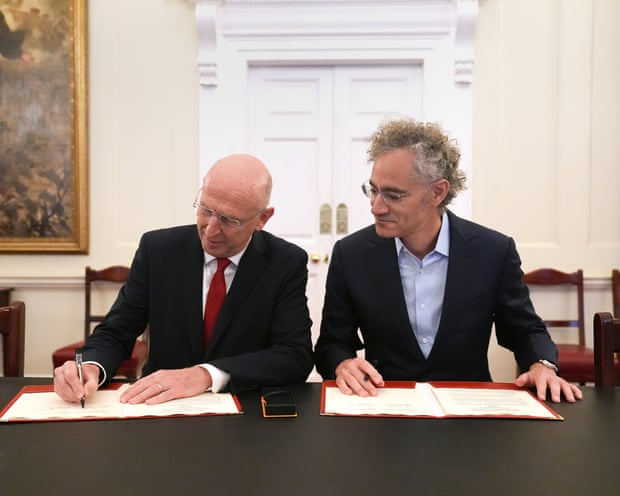
The UK defence secretary, John Healey (left), signs a £1.5bn strategic investment deal in September with Palantir’s chief executive, Alex Karp. Photograph: Lucy North/PA

Journalists find Swiss government rejected company over fears US intelligence might gain access to sensitive data

UK MPs have raised concerns about the government’s contracts with Palantir after an investigation published in Switzerland highlighted allegations about the suitability and security of its products.

The investigation by the Zurich-based research collective WAV and the Swiss online magazine Republik details Palantir’s efforts, over the course of seven years, to sell its products to Swiss federal agencies.

Palantir is a US company that provides software to integrate and analyse data scattered across different systems, such as in the health service. It also provides artificial intelligence-enabled military targeting systems.

The investigation cites an expert report, internal to the Swiss army, that assessed Palantir’s status as a US company meant there was a possibility sensitive data shared with it could be accessed by the US government and intelligence services.

British MPs have voiced concerns over the US data company in light of the report.

“Palantir … is an organisation that the British government, in terms of the NHS, in terms of contracts, should stay very far away from … I think the Swiss army is right to be suspicious,” said the Labour MP Clive Lewis.

The government “needs to undertake transparent due diligence” on the conduct of Palantir and other big tech companies, said Rachael Maskell, the MP for York Central.

https://www.theguardian.com/technology/2025/dec/22/mps-question-uk-palantir-contracts-security-concerns-investigation

Continue ReadingMPs question UK Palantir contracts after investigation reveals security concerns

‘If government cared about security, it would end child poverty and pursue peace’

Spread the love

https://morningstaronline.co.uk/article/if-government-cared-about-security-it-would-end-child-poverty-and-pursue-peace

 Prime Minister Sir Keir Starmer speaks during a visit to BAE Systems in Govan, Glasgow, to launch the Strategic Defence Review, June 2, 2025

Anti-war campaigners warn Britain is on course to become more militaristic as Starmer unveils massive programme of new arms spending

BRITAIN is on course to become a militaristic society with a war economy as Prime Minister Sir Keir Starmer unveiled his government’s strategic defence review today.

Sir Keir pledged that Britain is becoming a “battle-ready, armour-clad nation with the strongest alliances and the most advanced capabilities, equipped for the decades to come.”

And he unveiled a massive programme of new arms spending, setting the military budget to soar to 3 per cent of GDP over the next 10 years.

Arms monopolies shares soared on the news of the spending boost, which will come at the expense of welfare and overseas aid, with tax rises also possible.

Equally chilling was Sir Keir’s claim that society must be put on a war footing. “Every part of society, every citizen of this country has a role to play,” he said.

Sir Keir stressed that Britain was prepared for conflict. “We are moving to war-fighting readiness as the central purpose of our armed forces,” he said, with Nato the central commitment.

His plans were rejected by veteran left Labour MP Diane Abbott, who said: “It is not true that more military spending will boost the economy.

“It is a terrible waste when public services and our basic infrastructure need funds. It is a scandal when welfare is being cut.”

And former Labour leader Jeremy Corbyn argued: “If the government cared about people’s security, it would reverse cruel cuts, end child poverty and pursue an agenda for peace. Let’s fund welfare, not warfare.”

https://morningstaronline.co.uk/article/if-government-cared-about-security-it-would-end-child-poverty-and-pursue-peace

UK Labour Party government ministers Keir Starmer, Angela Rayner and Rachel Reeves explain that they are partners complicit in Israel's Gaza genocide. The UK has provided Israel with arms, military and air force support. They explain that they don't do gas chambers but do do forced marches, starvation, destroy hospitals, mass-murders of journalists and healthcare workers.
UK Labour Party government ministers Keir Starmer, Angela Rayner and Rachel Reeves explain that they are partners complicit in Israel’s Gaza genocide. The UK has provided Israel with arms, military and air force support. They explain that they don’t do gas chambers but do do forced marches, starvation, destroy hospitals, mass-murders of journalists and healthcare workers.
Elon Musk urges you to be a Fascist like him, says that you can ignore facts and reality then.
Continue Reading‘If government cared about security, it would end child poverty and pursue peace’

Gaza Humanitarian Foundation’s head resigns, says he ‘will not compromise on principles’

Spread the love

This work by Middle East Monitor is licensed under a Creative Commons Attribution-NonCommercial-ShareAlike 4.0 International License.

Jake Wood, seen in 2021, the CEO of the Gaza Humanitarian Foundation. [Photo by Astrid Stawiarz/Getty Images]

Jake Wood, the CEO of the Gaza Humanitarian Foundation, has announced his resignation, saying current conditions make it impossible to deliver aid to Gaza without violating basic humanitarian principles—something he refuses to do.

In his resignation statement, Wood said that the current circumstances make it impossible to deliver humanitarian aid without compromising “the humanitarian principles of humanity, neutrality, impartiality, and independence, which I will not abandon.” 

Wood also called on Israel to “significantly expand the provision of aid into Gaza through all mechanisms” while also urging “all stakeholders to continue to explore innovative new methods for the delivery of aid, without delay, diversion, or discrimination.”

READ: Israeli army controls 77% of Gaza: Media office

He stressed that the only path to a lasting solution lies in the release of all hostages held by Hamas, a ceasefire, and a clear roadmap toward peace, security, and dignity for everyone in the region.

Not much is known about the “Gaza Humanitarian Foundation,” which is supported by Washington and Tel Aviv and whose headquarters have been registered since February in Geneva, but the United States supported this foundation without revealing whether it contributes to it directly.

Jake Wood, the founder and outgoing CEO, is a former US Marine sniper who served in Iraq and Afghanistan. He has expressed support for Israel on social media platforms in the past.

Israel continues its policy of systematic starvation against around 2.4 million Palestinians in Gaza by closing border crossings to aid convoys, which have been stuck at the borders since 2 March. This has pushed the territory into a state of famine and has led to the deaths of many.

In recent days, the Israeli military has intensified its operations in both the northern and southern parts of the Gaza Strip, announcing a new ground offensive.

READ: UN food agency calls for ‘sustained, daily’ flow of aid to stave off starvation in Gaza

This work by Middle East Monitor is licensed under a Creative Commons Attribution-NonCommercial-ShareAlike 4.0 International License.

UK Labour Party government ministers Keir Starmer, Angela Rayner and Rachel Reeves explain that they are partners complicit in Israel's Gaza genocide. The UK has provided Israel with arms, military and air force support. They explain that they don't do gas chambers but do do forced marches, starvation, destroy hospitals, mass-murders of journalists and healthcare workers.
UK Labour Party government ministers Keir Starmer, Angela Rayner and Rachel Reeves explain that they are partners complicit in Israel’s Gaza genocide. The UK has provided Israel with arms, military and air force support. They explain that they don’t do gas chambers but do do forced marches, starvation, destroy hospitals, mass-murders of journalists and healthcare workers.
Experiencing issues with this image not appearing. I suspect because it's so critical of Zionist Keir Starmer's support of and complicity in Israel's genocides.
Genocide denier and Current UK Prime Minister Keir Starmer is quoted that he supports Zionism without qualification. He also confirms that UK air force support has been essential in Israel’s mass-murdering genocide. Includes URLs https://www.declassifieduk.org/keir-starmers-100-spy-flights-over-gaza-in-support-of-israel/ and https://youtu.be/O74hZCKKdpA
UK Conservative Party leader Kemi Badenoch explains her reality that the Earth is flat, the Moon is made of cheese and that she was born from Unicorn horn dust
UK Conservative Party leader Kemi ‘‘not a genocide’‘ Badenoch explains her reality that the Earth is flat, the Moon is made of cheese and that she was born from
Unicorn horn dust
Continue ReadingGaza Humanitarian Foundation’s head resigns, says he ‘will not compromise on principles’

‘Energy security’ is being used to justify more fossil fuels – but this will only make us less secure

Spread the love

corlaffra / shutterstock

Freddie Daley, University of Sussex and Peter Newell, University of Sussex

The UK government is about to host a summit with the International Energy Agency (IEA) on the future of energy security. It does so as the world grapples with war, geopolitical realignments and trade barriers, against a backdrop of accelerating climate upheavals. One of the expected outcomes of this summit is a new, agreed definition of what constitutes energy security in the 21st century.

Common understandings of energy security have focused on making supplies reliable and affordable, with less attention paid to ensuring sources of energy are sustainable and less volatile over the medium- and long-term. This neglect compromises our collective security.

The IEA’s 31 member countries and 13 associates include most of the world’s most powerful states. Its influence means that this new definition of energy security will be used to inform government policies and investment decisions around the world. Given the cost of energy infrastructure, and the lengthy time it takes to build these projects, this definition is set to shape our future, economically and climatically.

But there is a very real risk that this definition will open the door to further investments into fossil fuel production under the guise of energy security.

Annotated world map
International Energy Agency (IEA) member and ‘association member’ countries. IEA, CC BY-SA

After Russia invaded Ukraine, governments rushed to cut their reliance on Russian fossil fuels. This caused major disruptions as prices spiked and millions were pushed into energy poverty.

Europe alone spent an extra €517–€831 billion (£444–£713 billion) on energy in 2021 and 2022, even though some imports from Russia continued through so-called “shadow fleets”. Some argued that high fossil fuel prices only embolden leaders like Putin and help fund their conflicts.

Governments responded with “energy nativism”, as they sought to secure as much energy as possible for their citizens at whatever cost. This typically meant boosting renewables and bulk buying oil and gas. In the UK’s case, it also meant the previous government issuing hundreds of new licenses to drill for oil and gas to “increase energy security” – licenses the current government says it will honour).

Shipments of liquified natural gas (LNG) were also redirected from poorer countries like Pakistan and Bangladesh towards the highest bidders in Europe and Asia. This raises the question of who exactly is becoming more energy secure and at what cost.

Meanwhile, large fossil fuel exporters like Qatar, the US and Australia ramped up production. A US official even referred to its gas exports as “molecules of freedom”. Australia has exported so much natural gas it may have to buy its own gas back from Japan at market price.

The sheer volume of investment in new oil and gas infrastructure like offshore rigs or LNG terminals, combined with long build times, has locked in higher fossil fuel production and pushed emissions to record levels. This poses significant risks for both exporters and importers, especially as future demand is uncertain and energy markets remain volatile.

Fossil fuels remain dominant

More fundamentally, continued reliance on fossil fuels is making humanity less secure. The vast majority of emissions still come from burning coal, oil or gas. Preventing climate catastrophe therefore requires us to phase out fossil fuels as fast as possible – with wealthy nations leading the charge. In their place, we’ll have to generate energy from renewable sources that do not replicate the volatility of globally traded fossil fuels.

Yet despite some progressive policies, fossil fuels remain dominant across the global economy. Investment in oil and gas today is almost double the level it must fall below if the world is to reach net zero by 2050, according to the IEA’s own modelling.

The pursuit of energy security has boosted renewables, but adding additional clean energy isn’t enough – it must ultimately displace fossil fuels entirely. This will require a whole-economy shift. That means cutting production of fossil fuels while also reducing demand, stabilising prices and building out clean energy fast enough to support the electrification of transport, industry and heating.

But supply chains for batteries, solar panels and other key technologies are vulnerable. Delays and shortages could mean electricity prices spike, sparking social unrest. This is yet another risk of getting energy security wrong: if inflationary pressures drive the immiseration of the general public, governments and their energy plans will be short lived.

The definition of energy security that comes out of the IEA summit should reflect the fact we’re now in a world of constant crises. True energy security means charting a path towards a world that is more socially, economically and environmentally secure. This means developing a well-managed global plan to phase out fossil fuels.

Freddie Daley, Research Associate, Centre for Global Political Economy, University of Sussex and Peter Newell, Professor of International Relations, University of Sussex

This article is republished from The Conversation under a Creative Commons license. Read the original article.

Continue Reading‘Energy security’ is being used to justify more fossil fuels – but this will only make us less secure

Wiz Acquisition Puts Israeli Intelligence In Charge of Your Google Data

Spread the love

Original article by Alan Macleod republished from MPN under a Creative Commons Attribution-NonCommercial-ShareAlike 3.0 International License.

Google recently announced it would acquire Israeli-American cloud security firm Wiz for $32 billion. The price tag — 65 times Wiz’s annual revenue — has raised eyebrows and further solidified the close relationship between Google and the Israeli military.

In its press release, the Silicon Valley giant claimed that the purchase will “vastly improve how security is designed, operated and automated—providing an end-to-end security platform for customers, of all types and sizes, in the AI era.”

Yet it has also raised fears about the security of user data, particularly of those who oppose Israeli actions against its neighbors, given Unit 8200’s long history of using tech to spy on opponents, gather intelligence, and use that knowledge for extortion and blackmail.

Israel’s Global Spy Network

Wiz was established only five years ago, and all four co-founders — Yinon Costica, Assaf Rappaport, Ami Luttwak, and Roy Reznik — were leaders in Israel’s elite military intelligence unit, Unit 8200. Like many Israeli tech companies, Wiz is a direct outgrowth of the military intelligence outfit. A recent study found that almost fifty of its current employees are Unit 8200 veterans.

“That experience showed me the impact you can make when you combine great talent with amazing technology,” Rappaport said of his time in the military.

Former Unit 8200 agents, working hand-in-glove with the Israeli national security state, have gone on to produce many of the world’s most infamous malware and hacking tools.

Perhaps the most well-known of these is Pegasus, spyware used by governments around the world to surveil and harass political opponents. These include India, Kazakhstan, the UAE, and Saudi Arabia, the latter of which used the tool to spy on Washington Post journalist Jamal Khashoggi before he was assassinated by Saudi agents in Türkiye.

In total, more than 50,000 journalists, human rights defenders, diplomats, business leaders and politicians are known to have been secretly surveilled. That includes heads of state such as French President Emmanuel Macron, Pakistani Prime Minister Imran Khan and Iraqi President Barham Salih. All Pegasus sales had to be approved by the Israeli government, which reportedly had access to the data Pegasus’ foreign customers were accruing.

Unit 8200 also spies on Americans. Whistleblower Edward Snowden revealed that the National Security Agency regularly shared the data and communications of U.S. citizens with the Israeli intelligence group. “I think that’s amazing…It’s one of the biggest abuses we’ve seen,” he said.

For the Israeli government, the utility of these private spying firms filled with former IDF intelligence figures is that it allows it some measure of plausible deniability when confronted with spying attacks. As Haaretz explained: “Who owns [these spying companies] isn’t clear, but their employees aren’t soldiers. Consequently, they may solve the army’s problem, even if the solution they provide is imperfect.”

Today, former Unit 8200 agents not only create much of the world’s spyware, but also the security features that claim to protect against unwanted surveillance. A MintPress investigation found that three of the six largest VPN companies in the world are owned and controlled by an Israeli company co-founded by a Unit 8200 veteran.

Exposed: How Israeli Spies Control Your VPN

How Unit 8200 Controls Palestinians

It is in Palestine, however, that Unit 8200 has been most active. The unit serves as the centerpiece of Israel’s hi-tech repressive state apparatus. Using gigantic amounts of data compiled on Palestinians by tracking their every move through facial recognition cameras, monitoring their calls, messages, emails and personal data, Unit 8200 has created a digital dragnet that it uses to snoop on, harass, and suppress Palestinians.

It compiles dossiers on virtually every Gaza resident, including their medical history, sex lives, and search histories, so that this information can be used for extortion or blackmail later. If, for example, an individual is cheating on their spouse, desperately needs a medical operation, or is secretly homosexual, this can be used as leverage to turn civilians into informants and spies for Israel.

One former Unit 8200 operative said that as part of his training, he was assigned to memorize different Arabic words for “gay” so that he could listen for them in phone conversations he was eavesdropping on.

Unit 8200 is also reportedly behind the even more controversial Project Lavender, a giant, AI-generated kill list of tens of thousands of Gazans that the IDF uses to target the densely populated strip’s civilian population.

Palestanian workers cross the Eyal checkpoint into Israel under the watchful eye of IDF cameras, January 10, 2021. Keren Manor | Activestills

Every Gazan (including children) is assigned a score of 1-100, based on their perceived proximity to Hamas. A wide range of characteristics will increase an individual’s score, including living or working in the same building or being in a WhatsApp group with a known or suspected Hamas member.

If a person’s number reaches a certain threshold, they are automatically added to a Unit 8200 kill list. This, one IDF commander explained, solved Israel’s perennial targeting “human bottleneck,” allowing them to carry out tens of thousands of strikes into Gaza during the first few weeks of the post-October 7 attack alone.

Unit 8200 is also widely reported to have carried out the Lebanon Pager Attack, exploding thousands of electronic devices at the same time, killing dozens and injuring thousands more. The operation was widely described, even by former CIA director Leon Panetta, as an act of terrorism.

This long history of violence, skulduggery, and spying raises troubling questions about whether a corporation founded and staffed by dozens of individuals from such an organization can be trusted with billions of users’ private and personal data.

Google’s Ties to Israeli Intelligence

Google’s purchase of Wiz deepens its already close ties to Unit 8200. In 2013, the tech giant acquired Waze, an online maps service founded by three Unit 8200 veterans, for $1.3 billion. It has also directly hired dozens of former spooks and spies to fill its ranks; a 2022 MintPress News investigation found at least 99 former Unit 8200 agents working at the Silicon Valley behemoth.

Among these figures is Gavriel Goidel, Head of Strategy and Operations for Google Research. Goidel joined Google in 2022 after a six-year career in military intelligence, during which he rose to become Head of Learning at Unit 8200. There, he led a large team of operatives who sifted through intelligence data to “understand patterns of hostile activists,” according to his own account.

Google is far from an outlier when it comes to hiring former Israeli spies to carry out its operations. Facebook, Microsoft, and Amazon have all hired a significant number of ex-Unit 8200 agents. Even TikTok, supposedly a hotbed of anti-Semitism, employs a considerable number of ex-spooks. Perhaps most surprisingly, a number of top U.S. media outlets, including CNN and Axios, have recruited former Unit 8200 spies and analysts to write and produce America’s news about the Middle East.

Revealed: The Israeli Spies Writing America’s News

Google has invested heavily in Israel, first opening offices there in 2006. Longtime CEO Eric Schmidt is known to be a vocal supporter of the controversial state. In a 2012 meeting with Prime Minister Benjamin Netanyahu, he declared that “the decision to invest in Israel was one of the best that Google has ever made.”

But the Wiz deal is undoubtedly the company’s biggest Israeli investment yet. The all-cash acquisition represents a massive injection of money into Israel’s flailing and war-weary economy, equivalent to 0.6% of the country’s GDP. The money, the Israeli press excitedly reports, will allow the government to continue without enacting major austerity measures, reduce the nation’s deficit, and enable Israel to continue on a wartime footing for longer. As such, it represents a move critics say amounts to a financial intervention on behalf of Israel. Moreover, it also sends a message to the rest of the business world to invest in the country, boosting investor sentiment at a time when it is most needed.

The size of the deal also surprised many. The price is similar to that of the sale of JPMorgan Chase and Wells Fargo in 2008, Visa Europe in 2017, and Twitter in 2022. Yet Wiz is a new and relatively unknown company, raising questions about its valuation.

Ultimately, though, these considerations are secondary to the main issue that such a group will now be charged with providing security for the data of billions of users worldwide. Given Unit 8200’s role in monitoring and targeting the Palestinian population, many will be wondering if, going forward, Google products are at all safe to use.

Feature photo | Illustration by MintPress News

Alan MacLeod is Senior Staff Writer for MintPress News. After completing his PhD in 2017 he published two books: Bad News From Venezuela: Twenty Years of Fake News and Misreporting and Propaganda in the Information Age: Still Manufacturing Consent, as well as a number of academic articles. He has also contributed to FAIR.orgThe GuardianSalonThe GrayzoneJacobin Magazine, and Common Dreams.

Original article by Alan Macleod republished from MPN under a Creative Commons Attribution-NonCommercial-ShareAlike 3.0 International License.

Continue ReadingWiz Acquisition Puts Israeli Intelligence In Charge of Your Google Data