Thames Water has been crippled by huge debts. Photograph: Sam Oaksey/Alamy
Lenders say a ‘full return to legal, regulatory and environmental compliance’ under new rescue plan would not be completed until at least 2035-2040
Thames Water may not fully comply with rules on pollution of England’s waterways for as long as 15 years, according to a new plan by creditors who are scrambling to avoid the utility being forced into government administration.
The creditors who in effect own Thames Water have said they will commit to paying fines for pollution, as well as writing off more of their loans and investing more in the company, in new proposals published on Thursday.
However, the creditors also said that “a full return to legal, regulatory and environmental compliance” under their plan would not be completed until at least the 2035-2040 period, raising the prospect of sewage levels above legal limits in some places for at least a decade. They will argue for further leniency on fines from the regulator, Ofwat, during that period, and that it will be impossible for the company to make upgrades across London and south-east England more quickly because of the scale of the work needed after years of neglect.
The group of financial institutions, under the new London & Valley Water holding company, has been locked in talks with Ofwat since May over acceptable terms for the hugely complex restructuring of Britain’s biggest water company.
Thames Water has been crippled by huge debts built up over two decades by owners who have been criticised for paying out dividends without investing enough in its leaking pipes and malfunctioning treatment works. That contributed to widespread public outrage over the level of sewage in Britain’s rivers and seas.
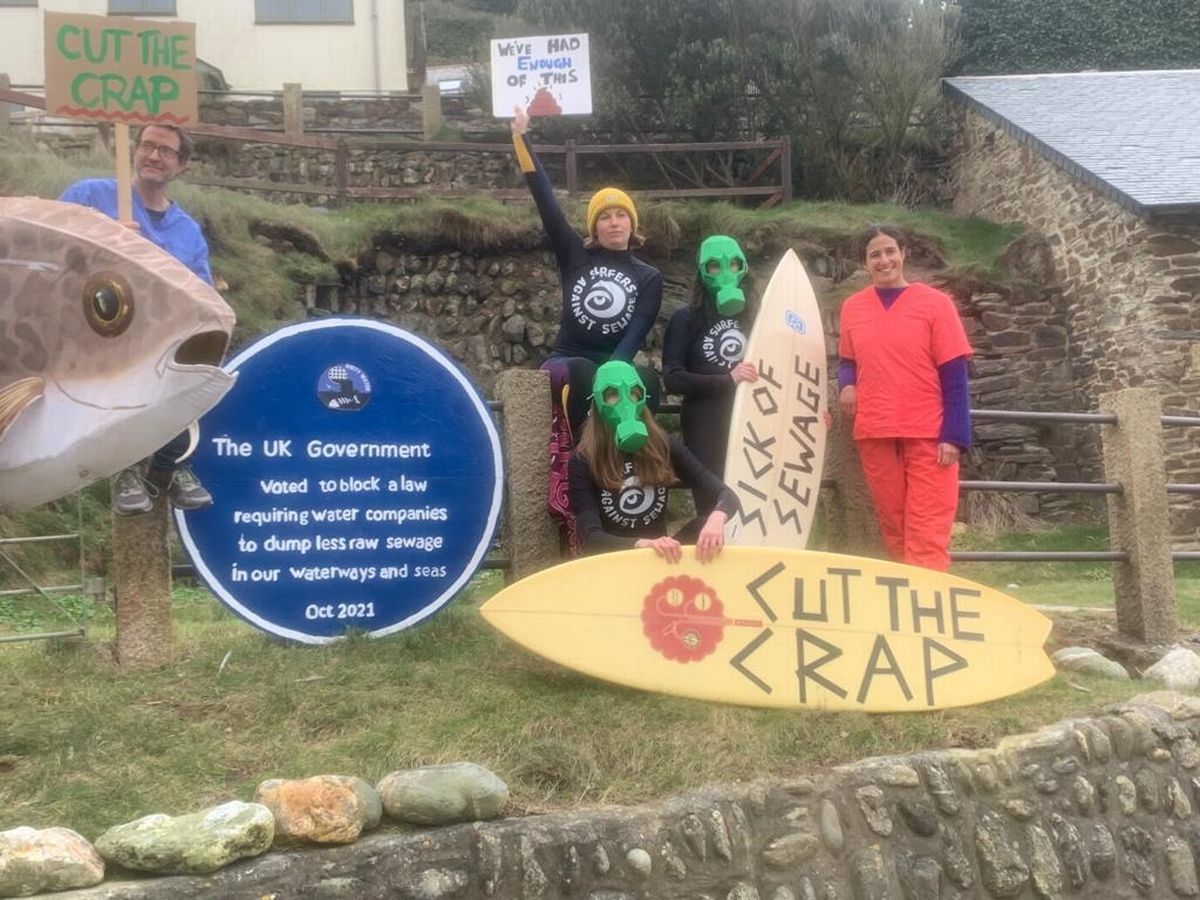
April 2023 Surfers Against Sewage and Extinction Rebellion protests in St Agnes, Perranporth, Truro and Charlestown which unveiled spoof Blue Plaques to the MPs and Conservative Government who allowed raw sewage to be dumped in the sea (Image: Surfers Against Sewage)
England’s privatised water industry may one day be considered a textbook case study of failed corporate responsibility, regulation and governance. The Cunliffe review, the recent report into England’s privatised water industry, concluded that the financial regulator, OfWat, needs to be disbanded and a new water regulator will be introduced.
For that to work effectively, better pollution monitoring and more clearly defined pollution incident criteria are essential. While politicians and water companies have claimed to be reducing pollution incidences, they might not strictly be tackling sources of pollution, so communications must be carefully scrutinised for disinformation.
The UK’s environment minister Steve Reed MP has described the water industry as “broken”. The public have rising water bills. Water companies owe over £60 billion in debts and have left the country with uncertain water security in the face of climate change.
The Environment Agency (EA) in England recently announced that serious pollution incidents in 2024 rose by 60% to 75 from 47 in the previous year. The EA classifies pollution incidents using a four-point scale called the common incident classification scheme. Trained EA officers consider the evidence reported via their incident hotline to assess its credibility and severity.
Get your news from actual experts, straight to your inbox.Sign up to our daily newsletter to receive all The Conversation UK’s latest coverage of news and research, from politics and business to the arts and sciences.
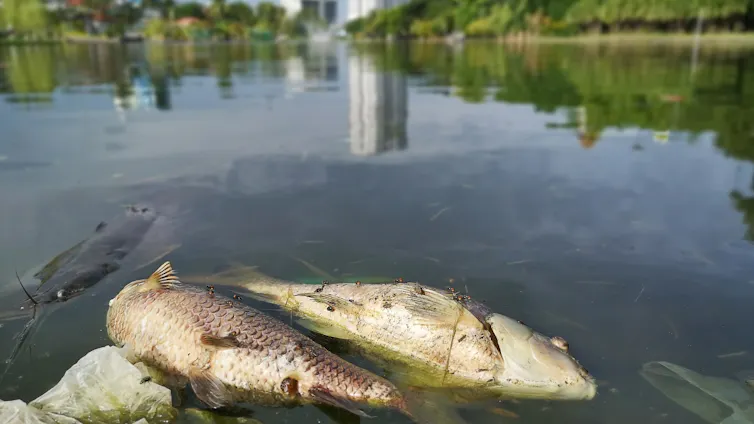
Category 1 is for major incidents, 2 for significant, 3 for minor incidents and 4 for no impact. Category 1 and 2 typically involve visible signs of dead fish floating. For salmon, if more than 10 adult or 100 young fish are dead, this is category 1. With fewer than ten adult and 100 young fish dead, it’s category 2.
No dead fish, no serious problem? The EA can also record damage on protected habitats as “pollution incidents” but these are harder to substantiate without investigative research that takes time and money.
Last year, more than 450,000 sewage discharges were recorded by event duration monitors. These are devices fitted to the end of overflow pipes that indicate when and for how long they have been discharging.
These discharges represent 3.6 million hours of untreated sewage going into our rivers and coasts. These contain chemical contaminants including pharmaceuticals, detergents and human pathogens. Only 75 incidents were recorded as serious or significant in 2024. Another 2,726 were classed as minor.
So lots of sewage discharges are not being classified as pollution incidents, despite containing pollutants. The EA advises its investigating officers to “record substantiated incidents that result in no environmental impact, or where the impact cannot be confirmed, as a category 4”.
The EA has been criticised for turning up late to 74% of category 1 and 2 pollution incidents and for being pressured to ignore low-level pollution – all claims that they have denied. However, they admit they are constrained by finances. Any new regulator must be adequately resourced and independent.
Pollution isn’t always classified as an official pollution incident. YueStock/Shutterstock
In their recent report into pollution incidences, the EA states that they respond to all category 1 and 2 (serious and significant) water industry incidents and will be increasing their attendance at category 3 (minor) incidents. They highlight that more inspections will identify more issues. This shows some acceptance that the more incidents they attend, the more would be substantiated or recorded appropriately.
Most sewage discharges would not have been reported to, or recorded by, the EA as pollution incidents because they were permitted discharges from combined stormwater overflows. Water companies are allowed to discharge untreated wastewater under exceptional rainfall or snowfall conditions to prevent sewage backing up through the pipes.
Extra water flow in rivers from rainfall is meant to dilute chemical contaminants in wastewater. However, some discharges can last days or weeks. The EA is currently investigating whether water companies have been breaching their permits and discharging untreated wastewater when there is low or even no rainfall.
What counts as pollution?
The UN classifies pollution as “presence of substances and energy (for example, light and heat) in environmental media (air, water, land) whose nature, location, or quantity produces undesirable environmental effects”. This definition differs markedly from the EA’s working definition of pollution incidents.
Many sewage discharges containing low concentrations of pollutants won’t kill fish but might still be harmful to fish larvae or small insects, for example.
However, the broad picture from EA data is that invertebrate communities at least are in a better state than they were three decades ago before wastewater treatment plants were upgraded following the EU’s Urban Wastewater Directive.
Some pollutants bioaccumulate through the food chain, so they become concentrated in top predators such as orcas. Some chemicals mimic reproductive hormones even in low concentrations and can feminise fish, for example. High levels of nutrients from agriculture and sewage in rivers can cause fungal diseases in seagrass meadows.
Other families of chemicals build up in wildlife and people, such as persistent “forever chemicals”, much of which comes from wastewater discharges. Continued discharges of antibiotics into waterways might not be classified as pollution incidents but still pose a substantial risk to human and ecosystem health through bacteria developing antibiotic resistance.
The government has just committed to cut sewage pollution by 50% by December 2029 based on 2024 data. But it’s not yet clear whether these involve cutting the frequency of discharges, the duration or both.
This data could also be manipulated so that a large number of small discharges can be consolidated into one official discharge event. Currently, the volume of discharges from stormwater overflows isn’t known. Without this vital data we can’t ascertain the risk posed by their contaminants.
Water companies are panicking they will be left unable to dispose of millions of tonnes of sewage sludge due to tougher pollution rules, and rising concern over the contaminants sludge contains.
Read the full investigation with supporting documents from Unearthed, here.
Sewage sludge is the human faeces and other solids left behind when wastewater is cleaned. Around 90% of the UK’s sludge is treated and spread on farmland as a source of nutrients to fertilise crops. However, concern is rising in the UK that this could be introducing damaging levels of contamination to agricultural land.
An analysis for trade association Water UK last year found that in a “worst-case” scenario the industry could be left with “3.4 million wet tonnes” of sludge with nowhere to go, documents obtained by Unearthed under freedom of information laws show.
The key documents not already in the public domain (available via the Unearthedwebsite) include:
National Plan B: water industry analysis of sludge disposal crisis
The National Landbank Assessment Report 2024: water industry capacity modelling
EA CEO internal briefing: prepared by the Environment Agency
Earlier this year, environmental regulators in the United States warned that toxic PFAS ‘forever chemicals’ in sewage sludge spread on American pastures were posing a cancer risk to people who regularly ate meat or dairy from those farms. This came after investigations by Unearthed and others found that sludge destined for British farmland also contained a range of harmful contaminants, including microplastics and forever chemicals.
The water companies fear increased scrutiny of sludge-spreading in the UK could trigger a ‘backlash’ akin to the public outrage they have faced over sewage released into rivers and seas, Unearthed has learned.
Reshima Sharma, political campaigner for Greenpeace UK, said:
“This investigation is yet more proof that we can’t trust the privatised water companies to deal with waste responsibly. So long as they can get away with it, they will just pass any problems on to our countryside and pocket the money they should be investing in solutions.
“In addition to the national scandal of river pollution, their negligence has led to a cocktail of toxic contaminants being spread on the soil that grows our food. The government must stop toxic sludge from being spread on farmland immediately and water companies must be made to pay for disposing of it safely, without passing the buck to bill payers.”
A worker from Thames Water delivering a temporary water supply from a tanker to the village of Northend in Oxfordshire
THAMES Water’s record fines for sewage spills and improper dividends only underline our inability to hold water companies to account.
Water regulator Ofwat is hardly blameless when it comes to the supplier’s crippling debts, amassed by unscrupulous transnational corporations to shower their shareholders in cash — safe in the knowledge that when an essential service goes bust, it’s the British public that foots the bill.
…
Ofwat is a captured regulator, and not just because chairman Iain Coucher (who made a fortune in another publicly subsidised privatised service, the railway, and who has named his extensive Sound of Jura estate Iainland) has been caught enjoying the hospitality of the water companies (as has Steve Reed).
Its negotiations with water firms on price hikes have allowed steep rises in household bills despite the rotten state of the network, which they say they have to pay to repair, being the direct result of their own mismanagement.
As Weston has himself made clear before parliamentary committees, making a privatised water firm pay for its crimes will simply see investors pull out, forcing the government to rescue it. Fines for bad behaviour are just one of the recognised business costs they weigh against the greater cost of water companies investing in infrastructure and repairs, or delivering a value-for-money service.
Designing elaborate regulatory regimes to stop capitalists behaving like capitalists hasn’t worked any better for water than it has for energy. It’s a con, and the only way to ensure our water supply is managed in the public interest is to take it into public hands.
This work by Middle East Monitor is licensed under a Creative Commons Attribution-NonCommercial-ShareAlike 4.0 International License.
Palestinians, including children gather around a water tanker to collect clean water amid ongoing Israeli attacks on Gaza and the continued closure of border crossings, which have severely limited access to basic necessities in Khan Yunis, Gaza on March 29, 2025. [Abed Rahim Khatib – Anadolu Agency]
Under the weight of war and a suffocating blockade, more than two million people in the Gaza Strip are facing an unprecedented water crisis that threatens their daily survival. What was already a dire situation before the escalation has now turned catastrophic due to the ongoing bombardment and the widespread destruction of water infrastructure. The UN report from 2022 unveils a grim reality: over 97 per cent of Gaza’s drinking water is unfit for drinking or human consumption as a result of contaminants infiltrating groundwater reserves, whether it was caused by the excessive pumping of polluted water by the Israeli Occupation into Wadi Gaza, leakage from deteriorating sewage networks into the aquifer or the intrusion of the polluted saltwater into the aquifer by 75 per cent to meet the water deficit of the increased demand caused by the increased population. Compared to that, natural rain that does not exceed 30 per cent of natural replenishment. The situation is further exacerbated by the leakage of residues from Israeli munitions into groundwater sources.
Gaza’s water crisis: Numbers dripping with pain
Gaza’s water reality reveals a prolonged and profound deficit. While the Israeli Occupation enjoys a near-universal coverage of clean water (more than 99 per cent), as well as a substantial control over the aquifer, Gaza languishes among the world’s lowest water access rates, with a coverage below 10 per cent, placing it in a state of constant water emergency.
Over the past years, Israel, through its national water company, Mekorot, supplied Gaza with around 18 million cubic meters of water annually through three pipelines, amounting to only 9 per cent of Gaza’s needs. Yet, the water sector in Gaza suffers from a severe deficit exceeding 120 million cubic meters per year (approximately 60 per cent of total demand). With the outbreak of the latest war, these limited supplies have been repeatedly disrupted and, today, they are completely cut off following the destruction of transmission networks. During the war, these pipelines provided up to 70 per cent of Gaza City’s water supply, after most local water sources were destroyed. More than 85 per cent of Gaza’s water and sewage networks have been bombarded, causing destruction and damage to 2,263 kilometres of pipelines and 47 pumping stations, as well as the cessation of all operations of wastewater treatment plants. Currently, only 30 per cent of Gaza’s wells remain operational. The capacity of desalination plants has plummeted to their lowest levels due to continuous bombardment and the shortages of electricity and fuel. Consequently, water supplies available to Gaza’s people have dropped by 95 per cent, with the average daily water consumption per capita reduced to just 3–5 litres, far below the 15-liter minimum emergency threshold set by the United Nations.
Gaza’s displaced: Long queues and arduous journeys for a few drops of water
Since the beginning of the escalation, thousands of Gaza’s residents have endured the tragedy of displacement, which has only deepened their daily suffering. Hundreds of families, forced to flee their homes under heavy bombardment, now face the exhausting challenge of searching for water in distant areas or in overcrowded shelters lacking even the most basic necessities of life. Long queues at water distribution points and wells have become a daily reality, fraught with the constant risks of air strikes, fear and loss of life.
“We wait for long hours just to access unsafe and contaminated water, and sometimes we only manage to get our share after complete exhaustion,” says Fatima, a 35-year-old mother of four, who was displaced with her children to a shelter in western Gaza. “The distance we have to walk every day just to collect water can stretch for several kilometres and, with each passing day, the journey becomes even more difficult.”
Contaminated water: An immediate and long-term health threatThe health situation in Gaza has become catastrophic due to the acute shortage of clean water and the forced reliance on contaminated sources for drinking and hygiene, if available, which has led tothe widespread outbreak of acute diseases such as diarrhoea, kidney infections, urinary tract infections and waterborne diseases, as well as skin infections due to poor hygiene conditions or the use of polluted water for personal care.
These health risks are even more severe for children under the age of five, who are particularly vulnerable to malnutrition, intestinal infections, and severe diarrhoea, which can lead to dehydration or death. Pregnant women also face higher risks of early miscarriage, premature delivery and reduced breast milk production due to dehydration and exposure to contaminated water. The elderly are not spared, either, as they face an increased risk of kidney diseases, kidney failure and challenges in managing chronic conditions in the absence of safe and sufficient water supplies.
Impact of the water crisis on food security and forced displacement
The water crisis in Gaza is not only a health emergency but also a growing threat to food security. The destruction of agricultural irrigation networks has further worsened the already fragile economic situation, increasing poverty and hunger across the Gaza Strip due to a sharp decline in agricultural and livestock production. Agricultural productivity in the limited available farmland has dropped by 60 per cent as a result of using contaminated water, not to mention that farmlands have become either unsuitable for cultivation or located in unsafe areas due to the ongoing conflict. Moreover, the scarcity of clean and safe water has intensified forced displacement, with many residents compelled to leave their homes in search of areas where drinking water is available.
A grave breach of International Law: Denying people their right to life
The targeting and destruction of water sources and infrastructure in Gaza constitute a grave breach of international humanitarian law.
According to the 1977 Additional Protocol I to the Geneva Conventions, it is prohibited to attack resources indispensable to the survival of civilians, such as water supplies. Denying water to civilians amounts to a war crime under the Fourth Geneva Convention and represents a blatant violation of Article 25 of the Universal Declaration of Human Rights.Such acts may also qualify as crimes against humanity under the Rome Statute of the International Criminal Court.
In the face of tragedy: An urgent call for action
In light of this tragic reality, there is an urgent need for immediate and coordinated action. Internationally, the United Nations must activate emergency protection mechanisms, while international organisations, including the Organisation of Islamic Cooperation and the Arab League, should play a key role in intensifying political pressure on the United States to compel Israel to stop the war, halt the supply of weapons to the Occupying forces and ensure the immediate entry of humanitarian aid into Gaza. The Human Rights Council is also expected to issue investigative reports on these violations, and the International Criminal Court should open immediate investigations into the crimes committed.
On the humanitarian level, aid organisations must intensify efforts to find emergency solutions for providing clean water to the population in Gaza by repairing damaged water networks, maintaining wells and desalination plants using locally available resources, operating mobile desalination units powered by solar energy, expanding water distribution through water trucks to shelters and displacement camps and providing households with simple tools for water purification and desalination.
On the relief level, it is essential to pre-position water-related equipment, including well supplies, fixed and mobile desalination units, generators, solar energy systems, spare parts for water networks and fuel in both Egypt and Jordan. These should be ready for immediate delivery as soon as border crossings are opened for humanitarian aid. It would be a grave mistake to wait until Crossings re-open before starting to procure these critical supplies, given the time required for sourcing and delivery.
For the recovery and development of Gaza’s water system, it is equally critical not to wait until the war ends to begin planning and preparation. Delaying the restoration and development of the water sector will only prolong the suffering of a population that has already endured unimaginable hardship for over 17 months. Efforts must begin now by developing a comprehensive recovery plan, securing supply chains, mobilising funding and preparing technical teams to respond without delay, ensuring the most vital resource for life, water, is restored for Gaza’s population.
Between a suffocating siege and relentless bombardment, the people of Gaza struggle for every drop of water, much like a drowning person gasping for their final breath. They call for water but receive none; they cry out for help but are left unheard. Has humanity truly turned its back on them? Is water not a right for every living soul, including those trapped and besieged in Gaza?


 A worker from Thames Water delivering a temporary water supply from a tanker to the village of Northend in Oxfordshire
